



ORCHARD PARK, NY — Spend two hours with Jordan Poyer in such tranquility and you’re overwhelmed with the urge to book a trip to Costa Rica to sip ayahuasca. Or give holotropic breathwork a try. Or meet the chief of the indigenous Yawanawá in Brazil. But be careful. We can’t wander deep into the forest because — out there? — extraterrestrial energies are far too heavy for mankind to handle.
Forget X’s and O’s and an organization’s push for its first-ever Super Bowl title. The 34-year-old seated here on a plush leather chair inside the Buffalo Bills’ fieldhouse has obviously found the meaning of life. When he speaks, Poyer closes his eyes to think, and think, and articulate a response straight from the heart. He’s exceptionally calm. He unlocked something the rest of us are chasing.
There’s the visible scars. Deformities may be the better word choice. This 191-pounder has been a crash-test dummy through a 191-game career. Honestly, it looks as if a doctor implanted golf balls into the two middle fingers on his right hand. They’re swollen to circus proportions. His AC joint looks ready to tear through his flesh. And, this day, there’s a fresh gash on his left index finger. It’s fair to wonder why in the hell Poyer wanted to keep playing football this season. He has a wife, a daughter, a mansion in Florida. Life on the beach sure sounds better than Western New York where bands of snow induce a state of panic any moment, any day on Route 219. This day, the doors to the fieldhouse are wide open. That cup of Tim Horton’s black coffee in his hand chills quickly.
But there’s also the scars you don’t see. All the moments that pushed Poyer to the brink of destruction.
Alcohol addiction.
Witnessing a friend’s heart stop on the field.
Hooked on pain pills.
Begging God for mercy the night before a playoff game.
Feeling “alone” on the field in Miami.
All of that explains why he’s here. All of that led to the psychedelics that changed his life. If his job was to serve as a pseudo coach on the Bills’ practice squad, he was content. If he was resigned to scout-team duty through the arctic months, fantastic. Instead? He’s back in the starting lineup on a team with title aspirations. This is more than a reunion — it’s a calling.
“I’m supposed to be here,” Poyer says. “Yeah, I could be done right now. My cleats could be hung up. I’d be good for a long time. But I want to go out my way. I want to go out the right way. I’m going to put my fucking best foot down. I’m going to keep swinging.”
When the Bills were roundly mocked for welcoming back relics from yesteryear, GM Brandon Beane knew exactly what he was doing. Right here is a player you want in your building, your life.
He can play. In Buffalo’s 23-20 win over the Cleveland Browns on Sunday, Poyer had a team-high 11 tackles with a half-sack and an interception. He was the glue. Like old times.
Young players know where to go for wisdom. Early this season, both cornerback Christian Benford and running back Ray Davis were in a funk. “Down in a hole,” Poyer recalls. His message: Be patient. Consciously respond the right way because negativity can spiral. He told Davis he didn’t find his flow as a pro until Year 5. By no means is he taking credit for their turnaround but, since those conversations, Davis morphed himself into the NFL’s best kick returner and it’s no stretch to suggest Benford helped save this season with back-to-back TDs vs. Pittsburgh and Cincinnati.
Poyer brings far more to this team than a tackle on second and 8.
“You can look at things in two different lights,” Poyer says. “The dark light or the positive light. Shifting someone’s perspective is all I came here to do: Be a light. Obviously, I didn’t think that the season was going to turn out the way that this is. I thought maybe I’d still be on the practice squad and just be a light for guys to ask questions about football. Ask questions about life. Ask questions about aliens. I don’t give a fuck. I love talking about aliens.”
Aliens?
Yes, we talk aliens. Poyer believes they’ll show themselves by 2027. By the end of our conversation, he’s deep in his beliefs. One to the next. Humans descend from different star systems. We would live until 200, if not for stress. We should be taught laws of energy, not what he labels “false history.” And damn right Poyer will fight the “system” that tries to control us all… even if that same system kills off anyone who speaks up.
Poyer views himself as a “star seed.”
“People,” he says, “who come here to help wake the planet up. We are all star seeds, but the light has to fucking flicker to be like, ‘Oh shit.’”
His light burns bright because of the worst moments of his life. Most people are terrified to stare down their demons. Poyer offers a simple challenge: Stare into a mirror for three minutes straight. Those first 30 seconds, odds are, you won’t like what bubbles up. And those thoughts, those most uncomfortable thoughts, are precisely the ones you must listen to most. Your brain’s telling you what’s right vs. what’s wrong.
This is the best way to explain ayahuasca. The Banisteriopsis caapi vine and a DMT plant crystallize such faults with jarring clarity.
“Everything bad in my life came out: my drinking problems, my sexual addiction, the things that I would do that were just bad,” Poyer says. “You must face them, sit with them, learn about ‘em. Once you understand them? Now you have the awareness to say, ‘OK, this is where I need to be different. This is where I need to change.”
Everyone pretends to be fine. Everyone wears a mask at some point. “We all go through shit,” Poyer adds. “Everybody struggles.”
Staring into that mirror, we can face our demons. Or not.
In that moment, we can make changes. Or not.
He’s on a mission to show everyone you have the power.
Years past, it’d piss him off if a random fan screamed, “You fucking suck!” His reaction now is nothing but love. Poyer knows that person is crippled by their own dark secrets. “Don’t let anybody else dictate your emotions, your feelings, your actions,” he says. “because you control all that.”
One word comes up the most both times we sit down. The Bills safety views positivity as a “web.” It spreads. If he can get my light to flicker, I’ll get yours to flicker. You’ll get someone else’s to flicker. And so on. The best way he knows how to wake everyone up is by tearing open those invisible scars for all to see.
Poyer declares that 2025 will be his final season.
He’ll make it count.
“This shit is hard, but I love it,” Poyer says. “I’m going out my way.”

Go Long is your home for raw storytelling in pro football.
Our aim is take you behind the curtain.
Thank you for supporting our work.
Alcohol
A trip to Super Bowl LX in Santa Clara sure would amplify his message. And yet, a football is shaped funny for a reason. One bounce the wrong way and your dreams are crushed. Your sanity, tested.
“How do you respond to that?” Poyer asks.
For years, his response was the same. The Bills lost and he’d get bombed.
In reality, it didn’t take a debilitating L on gameday. Poyer points toward Southwestern Boulevard. After a 9-to-5 weekday, he’d go to the same grocery store where the same cashier had the same six-pack waiting for him every single day: Southern Tier IPA. The ritual was as common as brushing his teeth or taking a shower. In the parking lot, he’d chug all six of those bottles over the course of 20 to 30 minutes. This was his mask. At 7 percent ABV, this beer completely numbed Poyer before he even said hello to family.
“This shit is hard, dude,” Poyer says. “And if you’re not mentally strong enough to handle it? My crutch was alcohol. I didn’t know how to handle it.”
Thinking back, he first got hooked in 2016. His fourth pro season. Poyer played for the hapless Cleveland Browns.
Covering a second-quarter punt, he absorbed a malicious blindside block from Antonio Andrews. The Titans running back drilled his left shoulder into Poyer’s sternum, sending him airborne. He writhed in pain. He collapsed to all fours. He, initially, thought Andrews simply knocked the wind out of him. When he got the sideline, however, Poyer started coughing up blood. He stayed back in Nashville and was hospitalized three days in all — the scans were mortifying. A doctor told the young pro his internal bleeding was akin to someone who got into a car crash without wearing a seatbelt. He suffered a lacerated kidney, a bruised liver and, frankly, was lucky to be alive. If Andrews struck Poyer a half inch lower or higher, the doctor said, his life could’ve been at risk.
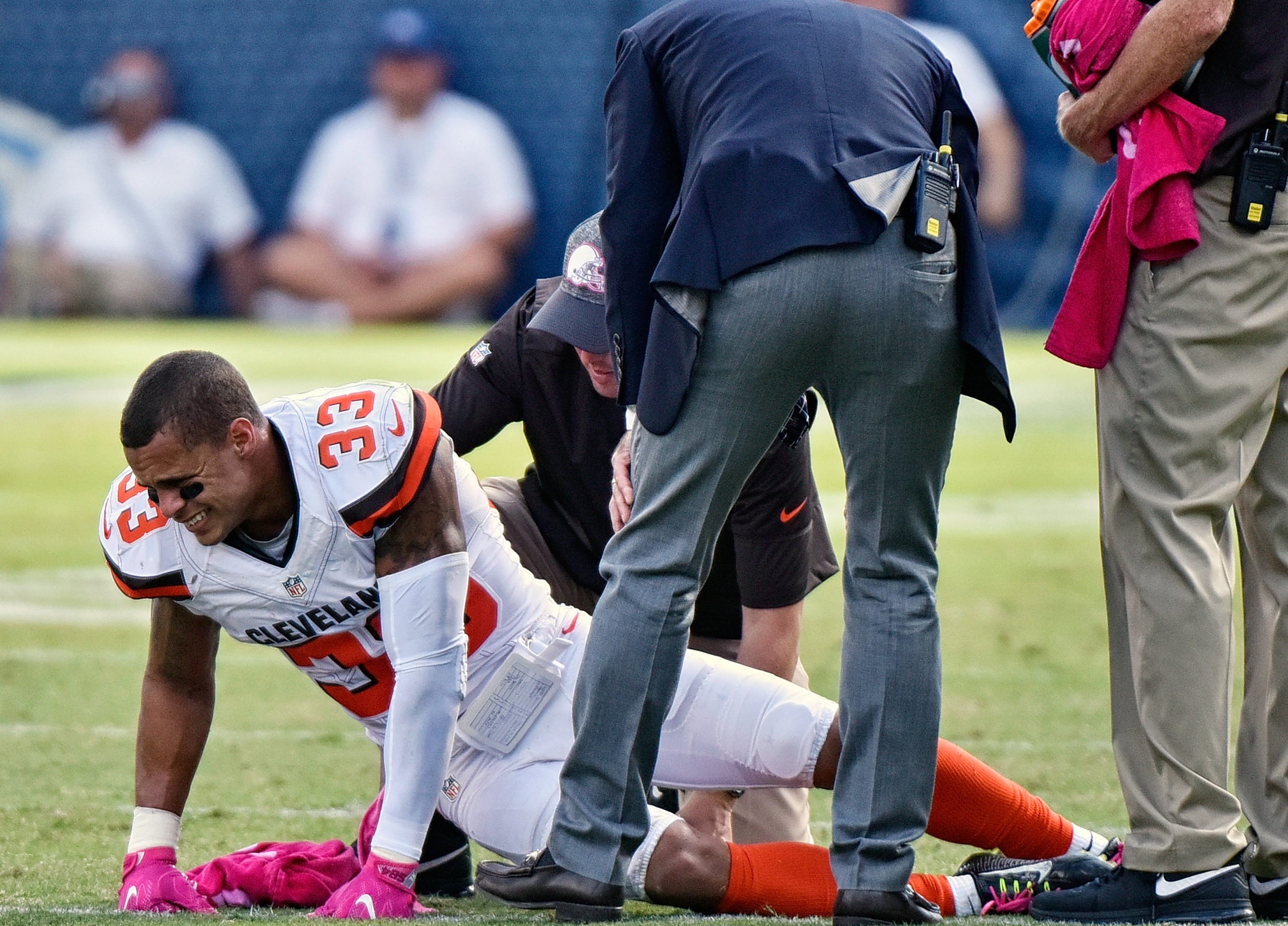
He was a nobody then. A back-up safety, for a tanking 1-15 organization, surviving on the NFL’s fringes. Andrews showed zero remorse, posting a clip of his hit on Instagram with the caption “relentless.”
All of which could’ve easily compelled Poyer to quit the sport cold turkey. His wife, Rachel Bush, was pregnant. A new life awaited.
Instead, he played on… with the help of that “crutch.”
“Alcohol was a way for me to numb all of that,” Poyer says. “Just run away from it and not feel anxiety or stress.”
The next spring, he signed a new deal with the Buffalo Bills and became one of the best safeties in the NFL with nine interceptions through the ’17 and ’18 seasons. In ’19, his Bills came within an overtime of beating the Houston Texans in the playoffs. The sudden jolt in expectations was a shock to Poyer’s system. He wasn’t prepared. So, he drank. And drank. And drank. Especially those three months after losing to Houston.
“When I was drinking, when I couldn’t separate the difference between football and home, I was walking around with a mask on,” Poyer says, “pretending to be this, when deep down inside my soul knows like, ‘Bro, you’re bullshitting.’”
Rachel grew fed up. She’d find his Southern Tiers and throw ‘em in the trash but, as a full-fledged alcoholic, her husband still found ways to feed his addiction. Back then, they lived in an old house that included a mysterious wine cellar that was never touched. So when Rachel went out of town one weekend, Poyer seized the opportunity. He explored these dusty doldrums, discovering a bottle of white wine from the 1970s.
He gulped it all down at once. Bad idea.
His head buzzed like never before. This was easily the worst hangover his life — quite a feat.
When his daughter wanted to play, Dad couldn’t move. Jordan needed to call his brother to come watch Aliyah. He crashed at 1 p.m., slept until 9 p.m., and when he awoke? Oh, shit. Rachel was livid. That was the final straw. He started attending Alcoholics Anonymous meetings.
The next three months, he was inundated with gut-wrenching stories. Others in AA were raped as children. Others were abused by their parents or grew up without any parents at all. Others lived in the streets.
“Me?” Poyer says. “I had a mansion in Florida. I had a beautiful wife, beautiful daughter. I was playing in the NFL and I’m drinking because you lose a game, bro? I’m drinking because you got into an argument with your wife? It really gave me perspective on my life. That really motivated me to not drink. I was like, ‘Bro, you’re fucking dumb.’”
He has not had one drink in five years since.
That first year of sobriety tested him. As time ticked 4… to 3… to 2… to 1 on Nov. 15, 2020 in Arizona, he raced across the end zone to swat a Hail Mary attempt and DeAndre Hopkins posterized him. He calls this play one of the lowest points of his career. Mainly because he was forced to sit on it. The Bills had a bye week, so Poyer had no choice but to think about that viral replay. Idle time that easily could’ve steered his car back toward a six-pack of IPAs.
“I could have gone one or two ways,” Poyer says. “I made a choice to step the fuck up.”

All negative thoughts were silenced. The Bills won eight straight. Poyer finished with a career-high 124 tackles, four turnovers, two sacks and should’ve been an All-Pro selection. Yet, he was not cured. Not by a long shot. Pro athletes are often pro athletes because of their addictive personality. They don’t merely lift weights, they go berserk in that weight room. Train like warriors. They don’t have a beer or two, they drink until they’re blackout drunk. It’s in their nature to go all out.
Poyer thought removing alcohol from his life would fix everything. It did not.
His crutch gone, he responded by getting angry at loved ones. He hated the person he was becoming.
He started to question everything: “Why am I feeling this way? Why is my brain all over the place?”
Those questions led to bigger questions: “What the fuck am I doing here? If I can’t stop drinking and be happy, why am I here?”
People told him to pray to God, but Poyer didn’t know what that meant. Didn’t know what to say. COVID-19 sent him to a dark place. He was no fan of the widespread vaccine mandates and started to question authority. Question everything. “They’re fucking lying to us,” he remembers thinking. “Everything that I’ve ever been taught was a lie.”
Thirteen fateful seconds rocked his world in 2021. A very real chance at a ring went up in smoke.
Then, 2022 happened.
2022
His head was pounding, pounding, pounding the night before one of the biggest games of his life. Jordan Poyer balls up a fist and smashes it into the palm of his other hand repeatedly — that’s what the right side of his head felt like. He played the Cincinnati Bengals in the postseason on zero minutes of sleep. The last place he wanted to be was a football field.
Twenty days after seeing one of his best friends nearly die on the field.
He was a zombie. Buffalo lost. He considered walking away.
To understand how Poyer got here, start in training camp of that 2022 season.
During an 11-on-11 drill, while stopping running back James Cook near the end zone, he hyperextended his elbow. Turning his arm at a gross angle, he re-enacts the scene. (“I bent back my whole elbow.”) His UCL was torn but thanks to a bulky elbow brace that resembled more of a crossbow, Poyer was back in time to play the Los Angeles Rams in Week 1. That game, he had an interception. The next game, vs. Tennessee, he had another pick. Two weeks later, he fueled a 23-20 win at rainy Baltimore with two more picks. On his fourth-and-goal swipe with 4 minutes to go, Poyer was harpooned in the midsection. (Again.) He thought this only knocked the wind out of him. (Again.)
This time, the diagnosis was cracked ribs and a collapsed lung. After missing one game, the team told Poyer he couldn’t fly to Kansas City due to the air pressure associated with flying.
But they did offer one alternative. He could make the 1,000-mile trek via automobile. They’d arrange a driver.
He was in. Right after Friday’s walkthrough, Poyer, Bush and their daughter loaded into a van and took off. They spent a night in Indianapolis, then hit the road again Saturday AM. On Sunday, he played 67 of 67 snaps in a 24-20 Bills win. He protected those vital organs with a massive rib cage — and wore rib protectors from that point on — but make no mistake. It was a painful evening.
Cornerback Cam Lewis remembers that night well.
“Insane,” Lewis says. “The things he’s willing to do to help the team? It was crazy. That tells you what type of guy he is. He puts his body on the line year-in, year-out. Week-in, week-out. I love everything about Po. … Everybody has little bumps and bruises, but his are a little crazy.”
After showering, Poyer met his family in the bowels of Arrowhead, loaded back into the van and made the same trip back.
He has no regrets. But Poyer admits he would not do the same thing at 34 and that he absolutely felt pressured to play. Not that he necessarily blames the Bills. It’s an NFL thing. This is the gladiator nature of his profession. If a team presents an opportunity to play, you play. Period. And that pain you feel? Nothing that a little Toradol can’t mask for a few hours.
The NFL’s dirty little secret is this potent anti-inflammatory. Toradol, more of a superpower, has been the league’s drug of choice for years. The days of players lining up for a shot in the ass are long gone, but the pill remains very legal and very prevalent. In 2021, the NFL sent a memo urging teams to limit Toradol use but, as we wrote then, such a request is laughable. The pain rate in football is 100 percent. Far more than any team sport in existence. Unless the NFL is interested in second- and third-stringers filling lineups each Sunday, the 32 owners need Toradol. And when there’s millions of dollars at stake, players aren’t going to bow out.
Poyer is naturally a quick healer, but not quick enough to play a violent sport seven days apart.
The choice was easy. He popped Toradol pills “like Skittles.”
By Tuesday, that superpower wore off.
“I could play pain-free,” Poyer says, “but after the game? My stomach? I couldn’t bear the pain. When the medicine wears off, you feel the effects of the actual soreness from the game. That bitch would last a whole 24 hours, so you don’t feel it until Tuesday. But when you do feel it? It hurts. It’s not fixing anything.”
He doesn’t think he ingested more doses than he needed. But on second thought, Poyer took 1 ½ pills before the game and then that other half inside the locker room during halftime when there was no need for a midgame boost. It was all mental. Poyer tricked himself into thinking he needed to fill his body with Toradol to dive into piles. In retrospect, he was engaging in an absurd race against his body’s natural healing.
His quality of life plummeted. In addition to all Tuesday pain, the drug triggered wild mood swings at home. More anger.
When I bring up Brett Favre’s Vicodin addiction in the mid-90s, Poyer nods. He dealt with the same internal struggle. You love football, you do anything to play football. But at what cost?
Then, something happened that clearly defined this breaking point.
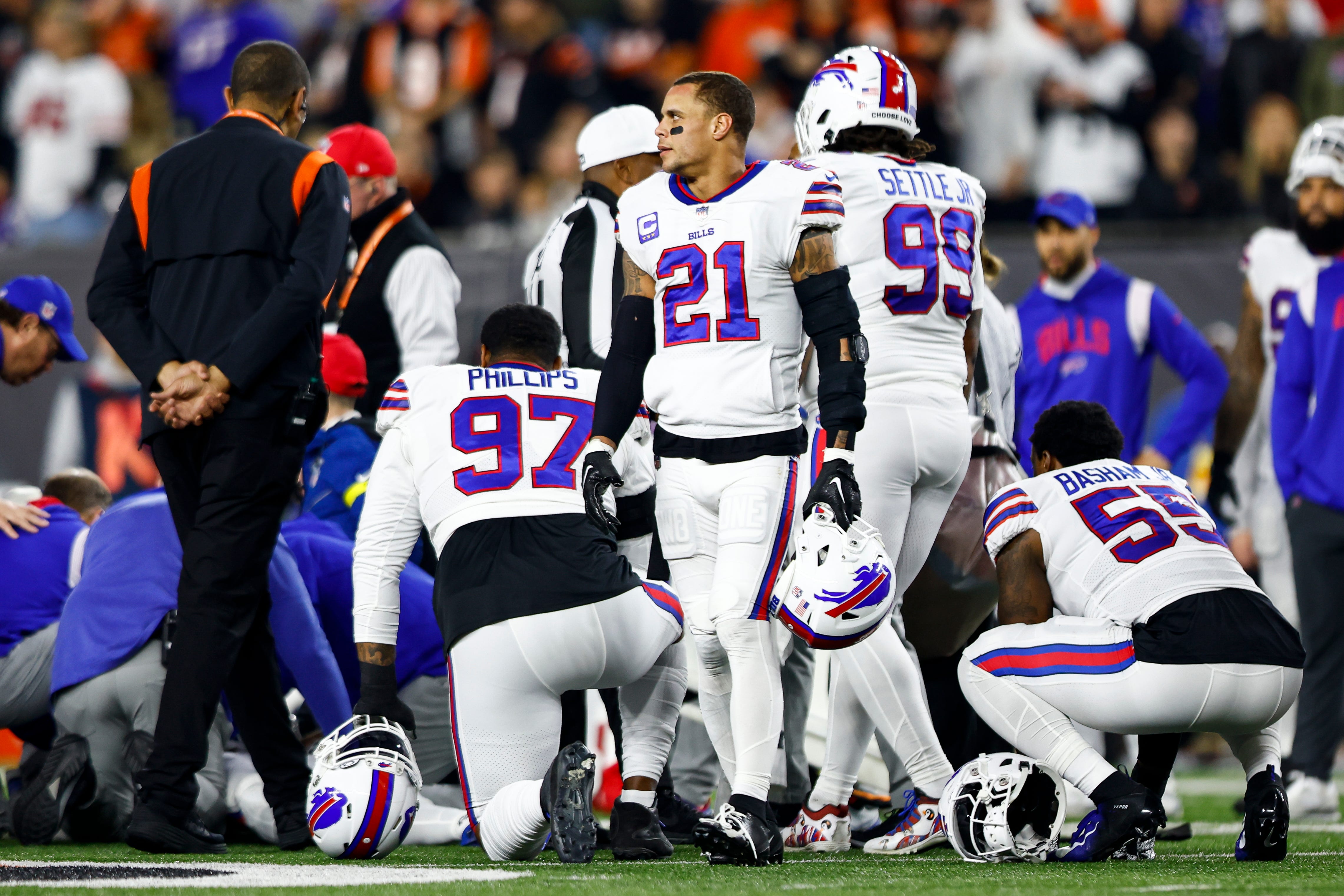
He doesn’t blink. He’s in a trance. His radiant blue eyes stare at the ground in front of him. Right there on the turf, Poyer replays the events of Jan. 2, 2023 in his mind. One second, Damar Hamlin makes a routine tackle on wideout Tee Higgins. The next, he’s motionless. His heart stops. He appears to be dead.
Poyer plays the same position.
When he leaned in for a closer look, he saw blood trickling out of Hamlin’s mouth.
“That fucked me up,” he says in a colder, quiet tone. “That fucked me up for a long time. I didn’t care after that.”
Hamlin recovered at UC Medical and business proceeded as usual for the Bills, for the entire NFL. Poyer was incensed. It was as if the sport itself high-stepped over Hamlin’s body and never looked back.
He stopped caring about the sport entirely.
“I just saw my friend almost die,” Poyer says. “Nothing in life is that serious. We play this game because we love it. But the world wants us to not have emotions and not have feelings and not have a life outside of the lines. That fucked me up for a long time because it’s real life. I was so angry. I’m not going to lie. After that happened? I couldn’t care less what happened that season.
“Like dude, ‘How are we in here still in meetings with my buddy in the hospital? What are we doing?’”
On cue, a few minutes later, a smiling Hamlin walks by. “You got a good story cooking?!” asks Hamlin, a man with a doc-worthy life before that near-fatal night. He recovered from that cardiac arrest and has been playing football since.
Life went on. Poyer played on. But as that ’22 postseason neared, he dealt with more serious side effects to those painkillers.
Cluster Headache No. 1 struck the second week of December. At first, it throbbed. Poyer figured this was a normal headache. But when this headache felt more like someone beating his skull with a hammer, he called the Bills. Trainer Denny Kellington advised Bush drive him to a hospital, ASAP. He hooked up to an IV, spent six hours in care and the pain subsided. One week later, it struck again. More hammers. This time, Poyer stayed home to wait it out.
The timing of the third cluster headache was a nightmare. Inside the team hotel — the night before a playoff game vs. Cincinnati — Cluster Headache No. 3 pounded the right side of his head. Bam! Bam! Bam! He felt the pain with each heartbeat. Since childhood, Poyer always had a ridiculously high pain tolerance, but this was different. This was unbearable. “Like my head,” he says, “was getting cracked open every time.”
Poyer dropped to his hands and knees. “God!” he pleaded. “Please help me!”
He paced. He prayed. He paced. The hammering never stopped.
No, he did not sleep the entire night. Not one minute.
When the sun came up, Poyer detailed the entire episode to trainers and the NFL’s powerful centrifugal forces kicked in again. They asked Poyer if he could play. He felt like shit, he was on “E” in body and spirit but no way Poyer could tap out of a playoff game. He popped pills, slid on his shoulder pads, sucked it up. Throughout warmups, it wasn’t snowing. Players herded into the locker room for one final word from head coach Sean McDermott, returned to the field and were greeted to a snow globe. Bar none, this was the weakest Poyer ever felt into a game.
“Because I hadn’t slept,” he says. “I didn’t feel confident in myself. I didn’t feel confident in how to think. I went out there anyway to play and try to help us win. We got mollywhopped.”

Cincy blasted Buffalo, 27-10. Poyer believes those headaches were the product of all pills he was putting into his body, Hamlin’s near death and the resulting stress. This was his 10th pro season. More than ever, he considered quitting.
Alcohol wasn’t rock bottom — this was.
Poyer still couldn’t separate what he labels “football life” from “human life.” If anything bad happened at work, he brought it home. Right when Bush thought she got her husband back — post-alcohol — she lost him again. Poyer can see now that “99.9 percent” of the battle is in the mind because back then? Football ate him up inside. He only heard the darker voice in his head.
“We don’t realize that it is a choice,” Poyer says. “We hear the voice and then we accept reality for that voice.”
There was one silver lining through this season from football hell.
One day, Poyer caught Aaron Rodgers on YouTube discussing something called ayahuasca. On the right side of the screen, in the comment section, viewers mocked the Green Bay Packers QB as a whack job. For years, that’s how Poyer himself viewed those who took psychedelics. (“Crazy motherfuckers.”) But for some reason — this day — he was mesmerized. He kept watching. Something about this conversation resonated with the Bills safety and he kept an eye on Rodgers all season. Unlike himself, the quarterback seemed at peace.
So when this season mercifully ended, Poyer took charge of his life.
In March 2023, he visited Costa Rica to try the medicine for himself.
“It opened my eyes to a whole different world,” Poyer says. “A bigger picture than what we can even fathom.”
Ayahuasca peeled back layers of his subconscious. He was forced to confront all demons in his life like never before.
He believes now that bad things don’t happen to you. They happen for you. Think this way and you inch closer to being your authentic self. This South America psychoactive decoction explicitly reveals how you can reach the “higher version” of yourself. Years past, Poyer made dumb decisions without realizing it. “Part of the awareness,” Poyer says, “is listening to the brain that’s telling you to do this and acting on it.” Not that you’re instantly fixed. Once Poyer returned, he made this a lifestyle. He embraced holotropic breathwork — the practice of rapid, controlled breathing to slip into an altered state of consciousness. Poyer has since partnered with Buffalo’s own, Christopher August, the man behind an app called “Beats and Breath.”
All breathwork helped “rewire” his brain before games. He tries to manifest the plays he’ll make on the field.
“To do it before a game?” Poyer says. “Oh my God! Half the battle’s in the mind.”
A sharp turn from Toradol. Poyer isn’t even taking ibuprofen now.
Psychedelics, above all, have shown Poyer we’re all one. If everyone realized life isn’t about “me vs. you,” Poyer says, there would be no race, no politics, no division. Believe in any God you’d like. Whoever created this all, he says, didn’t do so to pit people against each other.
More heartbreak waited for him in 2023. After Buffalo’s 27-24 divisional playoff loss to the Chiefs, cameras captured Poyer slouched on the bench next to veteran Josh Norman. Eye black and utter shock are both smeared across his face. His breath, visible with each exasperated word. “Season over? Like that, bro?” he asks. “Like that, bro? Unreal dog.” Norman shakes his head.
Poyer had a sinking feeling this would be his final game as a Bill.
That didn’t make it any easier when Brandon Beane’s name flashed across his cell phone. He was about to golf in Costa Rica with his mother and brother when the GM called to explain why the team was cutting him loose. This was the franchise that raised him. This was home. Poyer didn’t say a word. After a curt “thanks,” he hung up, called Drew Rosenhaus, and instructed his agent to get him to the Miami Dolphins.
Poyer is right.
One sip of ayahuasca doesn’t cure all.
The Great Unknown
The second time we sit down, we find ourselves chatting about a substance called “kambo” before anything football. It’s a simple procedure. Step One, take a hot stick to burn the inside of your forearm. Two, gently scrape off the blisters. Three, apply the kambo — secretion from a giant leaf frog — to the wound in small dots. Shamans use vacina-do-sapo to cleanse the body of toxins and strengthen natural defenses. It’s treasured as a spiritual reset.
Good luck finding anyone in the NFL on a mission to unlock the power of the mind quite like Jordan Poyer.
In my 15 years covering the league, only one player compares: Sammy Watkins. Shortly after the wide receiver won a ring with the Kansas City Chiefs, in 2020, we sat down for dinner in Orlando. It was a wild ride. He, too, struggled with alcohol when he played for the Buffalo Bills. He, too, traveled down a maze of psychedelic rabbit holes on a search for enlightenment. Astral realms. Etheric bodies. Dimensions. Every time I mention one of Watkins’ epiphanies, Poyer nods. He has studied all the above.
At one point, Watkins’ voice lowered. He predicted the world was in for a period of “darkness.” He could sense bad times ahead.
A novel virus hardly anyone was discussing ravaged everyday life two weeks later.
As I share this with Poyer, he’s all ears.
He has news for everyone, too.
The way we view life itself will change drastically very soon.
“My personal belief?” Poyer says. “By 2027, it’ll be known that we are not here alone. Whatever you want to call ‘em. Aliens. Angels. Extraterrestrials. It’ll be known that humans aren’t the only intelligent life on this planet.
“They are here. They’ve been here. And they are going to show themselves.”
Everyone wants tangible evidence. Experience enough psychedelics, however, and you’ll realize that’s the wrong way to think about aliens. One 40-minute holotropic session can sift you into that astral realm, a parallel universe to our material world. “Beyond what you can fathom,” Poyer adds, “and it’s real, it’s so real.” Don’t be scared. If aliens wanted us dead, he assures they would’ve annihilated us ages ago. Aliens have been chilling here for a long time.
I mention Watkins’ theory that he’s an alien. Poyer doesn’t flinch.
To him? We’re all technically aliens because we hail from various star systems.
“That’s why you have your color eyes. I have my color eyes, they have their color skin. I have my color skin,” Poyer says. “We’re all human, but we’re all from the stars. We have soul contracts with each other. People you meet in your life aren’t random. You and your wife aren’t random. You and your kids aren’t random. From the soul’s perspective, 100 years on earth is the blink of an eye. A soul has been and will forever be. So from a soul’s perspective? It’s like, ‘Let’s go down here on earth, learn these hard lessons that we’re going to have to learn.’ A soul can’t taste, can’t love, can’t feel heartbreak, can’t feel pain, can’t feel all of these human elements that you need to feel in order for your soul to evolve and grow and learn.
“That’s why everything that happens in your life doesn’t happen to you. It happens for you.”
OK, so back to those aliens.
He’s no flat-earther, but Poyer believes there’s life within the core of the earth. (“What’s up is down. What’s down is up. know that’s hard to grasp your mind around.”) He points out that only 3 percent of the ocean has been explored and that even National Geographic has chronicled ancient cities built underground. He cites nuclear shelters within the earth… technologies that governments hide… and, no, we should not picture “aliens” in the pop culture sense. Rather, there are “millions” of different extraterrestrial forms. They haven’t shown themselves yet, Poyer explains, because we humans have lacked the emotional capacity to handle their presence. People would go crazy. Everything we’ve learned would be exposed as a lie.
That’s the power of psychedelics. Poyer realized so much he learned in school was a giant lie designed to put humans in a box.
“They’re out there, bro,” says Poyer with a laugh. “I don’t even want to start to explain what they look like because I might lose you.”
I’m barely keeping up, but tell him to keep going.
When I ask Poyer if he has ever encountered one, he smiles. During one ceremony in Brazil, he most certainly felt the presence of a spirit. Perhaps it was the Arcturians (extraterrestrials from the red star Arcturus) or the Lemurians (from “Lemuria,” a continent that sunk to the bottom of the Indian Ocean, as theorized by zoologist Philip Sclater in 1864) or the Anunnaki (gods worshipped by people in ancient Mesopotamia). He’s not quite sure. Ahead of taking a new plant medicine, Poyer walked about 50 feet into the woods to purge.
He threw up, turned back toward the fire, the music, the ceremony where everyone was gathered, and the sensation was more gobsmacking than any collision on the field.
Something was watching him.
“I look into the trees,” Poyer says, “and saw formations of a presence letting you know, ‘You’re not by yourself. You’re not alone.’”
He thought back to what Chief Isku Kua, chief of the Yawanawá, said about not wandering too far off.
“In that moment, I knew exactly what he was talking about,” Poyer says. “Like, ‘Holy shit. We’re not by ourselves. There’s an energy, a presence around us watching us.’ Your spirit guides are watching you, guiding you your whole life. People that have passed in your life, they’re not dead forever. Their energy lives and exists within you and is guiding you. Things you can’t even fathom.”

He brings up Denzel Washington’s famous commencement speech at Dillard University. At one point, Denzel references an IQ test in which you had to draw five lines within nine dots without lifting the pencil. “The only way to do it,” Washington said, “was to go outside the box. Don’t be afraid to go outside the box.” That’s always been Poyer. He challenges convention. He always loved asking “Why?” and plans on continuing to ask “Why?” These retreats changed his life.
He was challenged again. Negative energy is inevitable. Fresh out of this awakening, in ’24, he fell out of love with football.
Last season in Miami was a disaster. Players never grasped this 3-4 scheme coordinated by Anthony Weaver. Each game, Poyer had no clue if the player next to him knew their job. Which meant he was lost himself. Poyer could not identify all “holes” within the defense. Miami would throw 100 calls at the wall, he says, and hope something stuck. Too often, Poyer was the one trapped in 1-on-1 tackling situations.
“It was the first time in my career,” he says, “I felt alone on the field. It’s one of the worst feelings. You’re out there having to guard everything. I didn’t understand our defense. Nobody understood our defense. I can understand concepts of how an offense is trying to attack us — but if I don’t know where the guy next to me knows where he’s supposed to go? It’s draining. It took a lot out of me. Mentally, physically, emotionally.”
All after essentially sharing the same football brain as Micah Hyde for seven straight seasons.
Miami basically spun a wheel before snap. There was no foundation to fall back on.
“And,” Poyer adds, “we’re getting our ass whupped.”

Losses mounted and Dolphins fans never forgot all the shit that Poyer talked as an opponent. Amid one 35-0 drubbing in 2021, he kindly let fans know how many points their team had scored. As this season deteriorated — as Miami lost to Buffalo twice — Poyer became an easy whipping boy.
He lost his passion for the game, told himself, “fuck all of this” and was fully prepared to retire. For good. Depression started to set in.
So, of course, he responded the only way he knew how.
He traveled south to the Brazilian rainforest.
Poyer spent time with the Yawanawá, an indigenous tribe, for more “deep inner work.” He needed to see himself as more than an athlete. He spoke at a psychedelic science convention in Denver. Some days, he liked the idea of not hitting anyone ever again. Other days, he needed it. Fifty-five percent of Poyer wanted to retire to the beach, latte in his hand. The more he thought about it, the more he could not allow one “trash” season in Miami to be everyone’s lasting impression. Poyer continued to train. And as the 2025 NFL season inched closer, he got the itch to play.
Eleven days before the season opener, Poyer signed onto the Bills practice squad. He credits his wife for the final nudge.
Initially, the vet was told he’d serve the same role as Hyde in 2024. Poyer figured he’d stay behind the scenes as another coach for young safeties Cole Bishop and Jordan Hancock. Last offseason, tight end Dalton Kincaid credited Hyde as the one in the locker room who helped him move on from that agonizing final fourth down at Arrowhead (“fucking own it”), but he never played a snap. Then, both Taylor Rapp (knee) and Hamlin (pec) landed on injured reserve and Poyer was vaulted right back into a starting role by mid-October. In each of the last seven games, he has played at least 76 percent of the snaps. Once again, No. 21 is prowling near the line of scrimmage for a Super Bowl contender.
Now, that same player helplessly asking “Like that, bro?” in ’23 can make plays in front of millions. A gift.
“Me being on the field right now? I just laugh,” he adds. “The divine creator has a plan. It’s bigger than me.”
No, he cannot move like he once moved. Only Harrison Smith is older at his position. He brings up the “naysayers” and promises he genuinely did not care that most viewed his return as an act of desperation. On the field, he steadied Buffalo’s defense. Off it, he has played a major role in Bishop’s ascension. The two are inseparable through the walls of One Bills Drive. A ton is on a safety’s plate in this scheme. One formation can change the call completely. Bishop met Poyer for the first time in late August. Back then, nobody had a clue where the 2024 second-round pick’s career was heading.
He couldn’t shake injuries. He was Twitter’s favorite Bills target.
He’s been picking Poyer’s brain ever since. Through 15 games, Bishop leads Buffalo in tackles (83) with seven pass breakups, two sacks and three interceptions. He loves watching Poyer’s process up close.
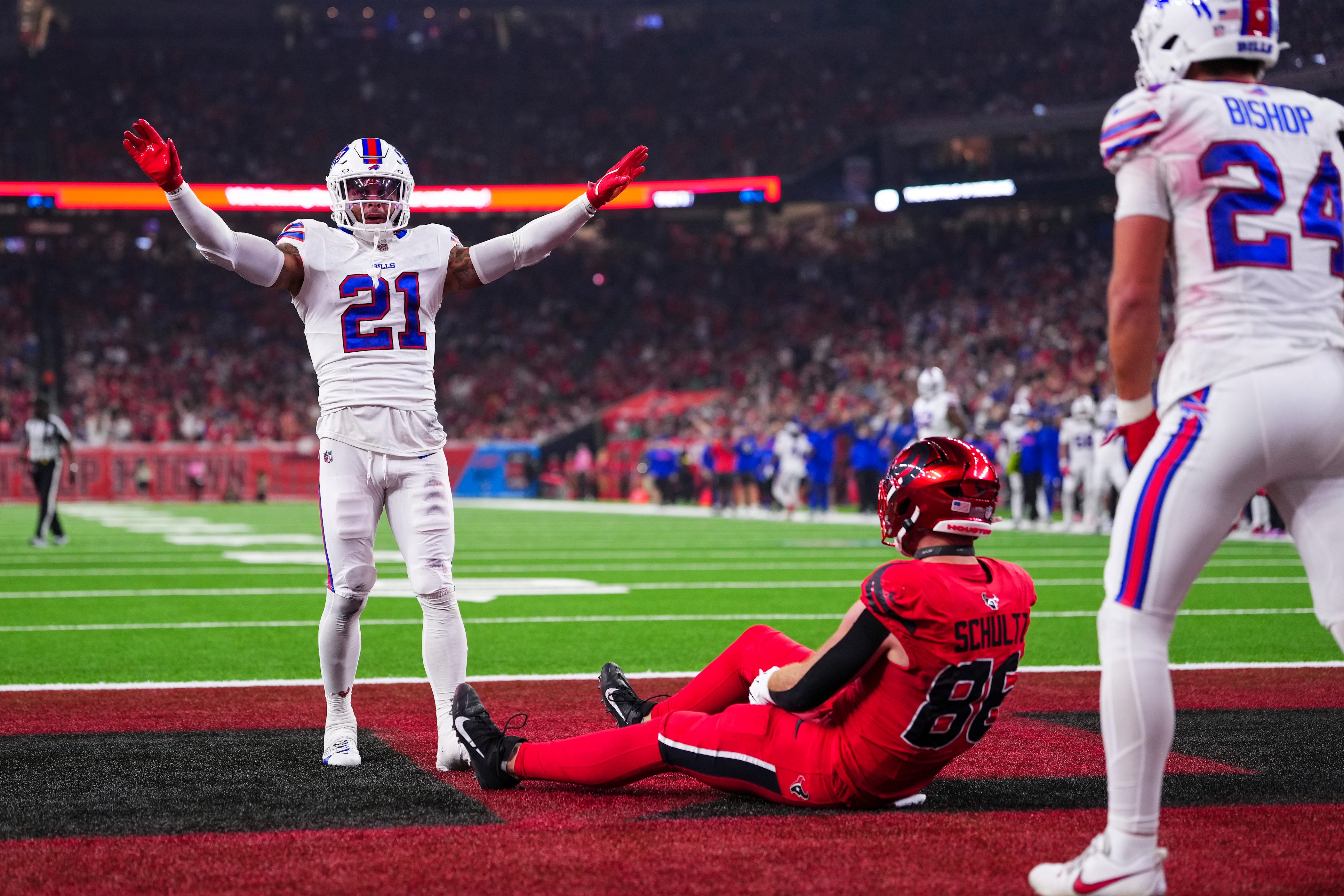
“He loves the game, No. 1,” Bishop says. “He was here for a long time, invested a lot in the program, so he’s able to come back and finish off his career and end it on a good note.”
Adds Lewis: “You know what type of person you’re going to get every time. You can talk to him about anything. It doesn’t have to be football-related. Anything. Life, in general. Kids. Wife. Anything. That’s what you’re looking for. An older guy, but also a friend.”
Miami left an awful taste in his mouth. No way was he going out like that.
Not with a message to spread inside this locker room, and beyond.
Change the world
He does not care if a Twitter mob assembles. He deleted the app long ago. “Fuck the mob,” he says. “It’s not even real.” Nor does he care if the New World Order — whoever is surveilling us 24/7/365 — hears what he has to say. He turns toward the cell phone resting on the armchair of his recliner. “I hope you’re listening. I’m not done talking. I’m not done fighting.”
Jordan Poyer has a lot to say.
He wants to deliver a Super Bowl to this trophy-starved city. But the reason he returned to One Bills Drive runs so much deeper than a game. The breathwork. The medicine. The meditation. All of it opened Poyer’s mind to an entirely new world. If one person sees No. 21 drill a ball carrier on Sundays and thinks, “Oh, shit. He might know something,” it’s all worth it.
Initially, he knows outsiders saw the ayahuasca headlines and figured this all was a fad.
No sir. This is what he believes to his core.
“And this,” Poyer adds, “is how I can help change the world. Realize you have the power. That’s what I’m trying to teach people. I’m not saying I know everything about everything, but I know enough to know it’s not Me vs. You. It’s us together. And you have the power within to do whatever the fuck you want to do in this world.”
He’s in-tune with all spirits, all energies every single day.
Take the other night. he went snowboarding 40 miles south at Holiday Valley in Ellicottville, NY. Beforehand, Poyer placed his car key inside a jacket pouch over his chest. On the slopes, he was nearly perfect. Poyer fell once. But upon returning to his car, he couldn’t find the key. It wasn’t in that zipped pouch. It wasn’t anywhere. Aghast, Poyer looked toward the mountain and wondered how he’d possibly find a needle in that haystack. It was pitch black.
He patted his coat and… voila. It trickled into his hand.
In his view? It’s no coincidence he saw Rodgers on YouTube, no coincidence the ’25 Bills need him to produce, no coincidence that key materialized.
“Coincidences are not coincidences,” he says. “Synchronicities are not just random. When shit happens, you catch 11:11, it is not random. It’s the energy that you’re flowing within this 3-D dimension.”

Poyer’s voice picks up. He leans forward. This is what he’s most passionate about. He cites time as a linear construct created by humans. Big picture: it doesn’t exist. All we have is the here and now. “Yesterday’s gone, tomorrow’s never going to get here,” he repeats multiple times. Important to understand because time, he adds, is the No. 1 source of stress in our lives. Humans are engaged in a constant race against, well, something that does not exist.
“That’s why we get old so quick,” Poyer says. “We’re supposed to live until we’re 150. Our bodies can live until we’re at least 200 years old. Stress is the No. 1 reason why people die before they’re supposed to. All stress that builds up and builds up as you get older. Now you have all these symptoms and diseases from the energy of stress.”
The key is shifting your perspective. Consciously acknowledging you’ve got to do “X, Y and Z” to avoid stress.
IPAs, to cluster headaches, to feeling alone in your profession. Everyone can relate to Poyer.
He agrees with Watkins’ take that we all transfer so much energy with our spouses — good or bad — that you practically share the exact same mood. Bush isn’t into psychedelics, no. But she enjoys holistic remedies and fully supports her husband on this quest. They agree, disagree, engage in vibrant conversations on all the above. Poyer is open to all debate because his point’s a simple one: Be a good person.
Behind us, Josh Allen appears bearing gifts for his offensive line. One by one, he’s rolling in everything himself. This year, the QB tells us, he’s giving the Bills O-Line grills and Snake River Farms steaks. “Good guy!” Poyer calls back.
He snaps his fingers. All it takes is for one light bulb to go off and you can think of life’s obstacles in a new way. That’s his goal inside the locker room and at his ceremonies.
“Shine a light. Shine it where it’s dark,” Poyer says. “I’m a light warrior. We all are light warriors. And when the light hits the darkness, it’s a web.”
There’s a lot of work to do. He sees a world full of far too much darkness.
Who are these people controlling the system? Poyer cites the vile cases of Jeffrey Epstein and P. Diddy and a nefarious “big club we’re not in.” Whoever’s in this club fully grasps the laws of the universe. We don’t. We should be taught laws of energy and karmic laws and the law of one, Poyer says. (“The energy that you put out is energy that we get back. That is what we should have been taught as a kid. When these specific emotions come up, how to harness that energy from that emotion and use it in a place that will help benefit you.”) Instead, he believes we’re taught separation to stoke rage. We’re taught gobbledygook to create a society full of worker ants who’ll blissfully play a role from Day 1.
That’s why he calls “Antz” the greatest movie of all-time.
That’s why he brings up the “lady in a red dress” scene from The Matrix.
“Everybody’s in a role,” he says. “A role that if they were to just wake up, they’d be like, ‘Why the fuck am I doing this?’”
Question the system, Poyer adds, and you’ll turn up missing.
He points to Isaac Kappy, an actor who spoke out against Hollywood. (“What happened to him? They said, ‘Oh, he jumped off a bridge.’ No, he didn’t.”) He points to Amy Winehouse as another public figure who got to the top, saw the truth, couldn’t fathom it and died under shady circumstances. And he singles out Michael Jackson as the ultimate example of a star seed sent to wake the planet up. A “vibrational being” sent to shift energy a positive direction. Listen to his lyrics, Poyer tells us. It was working. (“That’s why they killed him. He was the most influential person on the planet.”)
Poyer isn’t as politically inclined as you may think. Rather, he views the most popular podcast voices on both sides of the aisle as “compromised.” Whoever’s pulling the strings is playing chess, not checkers. Heated rhetoric feeds into the division we’re taught at such a young age and the temperature’s only rising. (“They’re going to put people in place on both sides so that the other side says, ‘She’s just fucking crazy.”) Poyer vows to do everything he can to wake the planet up, to bring people together.
Expect to hear his voice. A lot. He has two documentaries coming — one from Costa Rica, one from Brazil. His Luminate platform is live. His nonprofit, “Conscious Living Network,” is in the works. One day, Poyer will host his own ceremonies with plant medicine, mushrooms, ayahuasca and DMT. People can ease in with breathwork and microdoses. His 5-year plan: Create a full-fledged retreat center.
Whoever’s watching us cannot win as far as he’s concerned.
He wants anyone out there asking questions to reach him.
“We all want to exit the matrix that we’ve been put in,” Poyer says, “and find our own light.”
Until then, he’ll play football. This is the healthiest he has felt since 2022. What a sight it is to see Jordan Poyer, NFL vet, race down the field on a kickoff. He’ll do whatever the Bills ask. Nothing in life is perfect. It pains him to come off the field on third downs. He may injure a new body part this final month of the season. But Poyer knows he’s still effective, still can help the Bills win, still can improve the lives of everyone around him.
Later in the day, he texts me a reel from Instagram. It’s the voice of writer Alan Watts, detailing his view of addiction. Watts doesn’t see addiction as a moral failure. Instead, he describes it as divine communication. You’re not cursed, he says. You’re chosen. God wants you to awaken others.
Jordan Poyer knows this is where he’s supposed to be.
You can share Go Long with a loved one this Christmas.
Recent Bills Features:


2025 Features:
“Ultimate competitor:” Michael Pittman Jr. and the 2025 Indianapolis Colts are on a warpath
‘I’m a sick f--k:’ Why Al-Quadin Muhammad is the missing piece for the Detroit Lions
Power of the Mind: How Dan Campbell and the Detroit Lions play so fast, so free
PATRIOT REIGN? How Mike Vrabel and Drake Maye can restart a dynasty of their own
License to Kill: Jackson Hawes infusing Buffalo Bills (and the NFL) with a ‘Full Send Mindset’
House of Dysfunction, Part I: The Curious Case of Caleb Williams
House of Dysfunction, Part II: Inside the Chicago Bears’ “rigged trial” at No. 1 overall
Great article. Keep going. Love your work.
Outstanding job Tyler!