

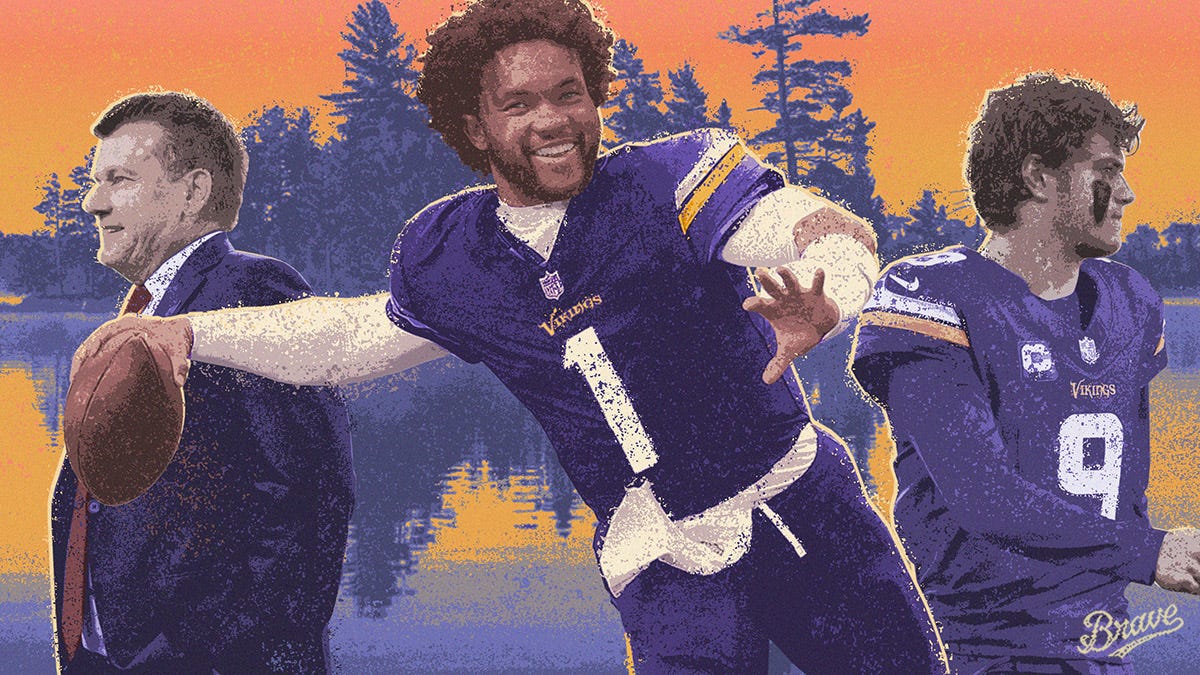
Our 2026 NFL Season Preview Features continue with a comprehensive, two-part series on Kyler Murray and the Minnesota Vikings. Part I is below.
EAGAN, Minn. — Failure was a foreign concept to Kyler Murray. Shame. Regret. Anguish. The stench of losing is an aroma he never experienced. No chip was implanted into his shoulder by a debilitating high school injury or a Division I coach who told him to buzz off. The football field was his personal arcade game with the difficulty level set on easy.
Ball in his hands, Murray mesmerized all witnesses.
The best way to understand the league’s most enigmatic quarterback is by first zooming out.
Ex-Arizona Cardinals running back Chase Edmonds, asks us to examine the case of “K1” through this context. When he declares Murray the greatest high school football player from the greatest football state in America, it’s no exaggeration. Murray went 42-0 with three state titles in Allen, Texas. Won the Heisman Trophy. Went No. 1 overall in the NFL Draft and No. 9 in the MLB Draft, Edmonds adds, “for shits and giggles.”
Adversity, Edmonds admits, is a word that’s never been part of Murray’s vocabulary.
Until now.
“He knows what it feels like to be on his ass for once,” Edmonds says. “And I think that’s the best thing for him. That’s my brother, that’s my friend. I say that from a true friend standpoint, as someone who cares about him and wants to see him be his absolute best. This is very necessary for what he is to become.”
Never before has this 5-foot-10 joystick of an athlete been humbled to this extreme. After seven seasons, the Arizona Cardinals ate $54.7 million in dead money to cut him loose. He signed the vet minimum to play in Minnesota and was then forced to fight for a starting job against one of the worst starting quarterbacks in the NFL last season. On Tuesday, the Vikings finally named Murray QB1.
Crawling inside his mind is no easy task. Murray shows zero emotion in front of the cameras, hasn’t conducted 1-on-1’s this offseason and keeps his inner circle microscopic. You hear Kyler Murray and, chances are, you think Homework Clause. You think, Video Games. It’s been 1,482 days since Murray signed a contract with the infamous “independent study” addendum mandating he study film on his own four hours a week. Backlash was so swift, so deafening that the Cardinals removed the clause which, of course, was akin to taking a watering can to a wildfire.
Those close to the QB believe the Real Kyler has been bastardized in the court of public opinion.
Not that he cares.
He took mental notes of everything said about him all offseason long.
“He’s the ultimate competitor,” Edmonds says. “This is going to be the hungriest version of Kyler that people have ever seen.”
Venture down this rabbit hole — hunt for the ultimate competitor — and one ex-Cardinals coach brings a vivid practice scene to life. How will Murray handle this unchartered terrain? Autry Denson points to what gets lost in the plot. Publicly, Murray appears apathetic. Privately, he’s more werewolf. Denson, a South Florida native, was a high school phenom who starred at Notre Dame in the 90s. He could relate to this hyper-competitiveness. One subtle, “I can lower the standard if you’d like” or “You can make that throw in your sleep” was all it’d take.
From ’23 to ‘25, the Cardinals running backs coach grew close to Murray and knew precisely which buttons to push.
Others on staff were more pointed.
Abrasive coaching is a must to tap into this quarterback’s wild side.
“When you challenge him, he’s going to bite,” Denson says. “He’s going to bark back because that’s what competitors do. That’s what alpha dogs do! They are alphas for a reason. It’s not going to be kumbaya. No, when I challenge him, he feels like his way is right. You have to intellectually duke it out until it’s like, ‘Alright, in this situation you win.’ That is how you become great. You need tension, conflict. People think that’s negative, but that’s how you grow. It’s not going to sound or look normal because what you’re trying to do is not normal.”
This spring, while coaching his daughter’s travel flag football team, other parents asked Denson where he thought Murray would sign. It hit him. He knows people in the building. He thought back to their joint practices. The Minnesota Vikings had the perfect blend of “structure” and “organizational competence” and “talent” to unleash Murray onto the NFL.
“Man, if K-1 went there,” Denson said aloud, “he would take off.”
Two days later, Murray became a Viking.
Take this clue. Talk to more people about this dichotomy and… oh my.
Walking through the TCO Performance Center for the first time likely felt something like landing on a new planet. That owner to this owner? Michael Bidwill is intent on triumphing over Woody Johnson for the sport’s Worst Owner crown. Marvin Harrison Jr. to Justin Jefferson? The Ohio State University Biletnikoff winner is more broken than anyone realizes. And as Murray soaks in all refreshing sights ‘n sounds, he’ll find a picture that perfectly encapsulates what’s expected of him this season. Through a main hallway, just outside the indoor field, the Vikings commemorate special moments in team history with a series of photographs. One stands out. Right there is Sam Darnold, in purple, being hoisted atop the shoulders of teammates after a victory over Green Bay in ‘24.
A year later, that same quarterback hoisted the Lombardi Trophy for the Seattle Seahawks. The Vikings had a 4,319-yard, 35-TD quarterback in their building and let him slip away. After decades of recycling veterans, the Vikings opted to draft and develop one of their own. It backfired. The Michigan Man known as “Nine,” J.J. McCarthy, was such an abject disaster that this franchise revved up the hamster wheel once more.
The Vikings are unable to travel back in time, but there’s hope in Kyler Murray. A high-voltage quarterback who warps the 160-foot-wide field into his personal playground on gameday while serving as an expletive-laced shock this organization needs the other six days of the week. A 29-year-old knows damn well his football life is on the line. A mystery.
No team in the NFL has the vertigo-inducing variance of these Vikings. One veteran starter on their roller-coaster ride of a 2025 season puts the imminent Kyler Experience best. “It could be really good,” he says, “or it could be really bad. There is no middle ground.” Minnesota strategically cleared the books to position themselves for either route. Vikings players on the record (and anonymously) supply unfiltered truth on both quarterbacks. Pack the hazmat suit, too. Players, coaches and front-office execs bring all Cardinals grime to life. And then, to objectively dissect Murray’s 1-of-1 play style, we check in with some Hall of Famers.
These Vikings could compete for a Super Bowl… or combust.
Murray could catapult into the upper echelon of quarterbacks and stick a middle finger to his doubters forever… or get banished to backup quarterback island.
This summer, our charge at Go Long was to figure out which direction Murray takes this team.
In Part I, we pan a magnifying glass over the forces that brought the Vikings and Murray together.
In Part II, we envision where this partnership goes.
This is the risk this team needs to take.
Go Long is your forever home for longform journalism.
Our mission is to bring you as close as possible to real, raw football.
Thank you for growing our community.
Murray has been politically correct in front of a microphone.
Away from the cameras? Those who’ve seen his bite up close know he’s fed up with the masses trashing his name and expect “K1” to shock the football world. The Murray that Jordan Hogan remembers from his days of coaching inside the Cardinals quarterback room wants to “shut up the people throwing mud on his name.”
“He’s very excited about this opportunity because he has seen these offenses — plural — have success,” Hogan adds. “It doesn’t matter who the quarterback is. Whether you’re very athletic. Whether you’re a first overall pick, Jared Goff, or you’re the last pick in the draft: Brock Purdy.”
The playcaller. KOC! The weaponry. Jefferson! Addison! Hockenson! Even the practice setting vs. Brian Flores each day. Edmonds describes Murray’s new life in Minnesota as quarterback heaven. Best of all, all parties involved are pissed off in the best possible ways.
“I know the mentality he’s going to carry into that situation,” Edmonds says, “and it’s the best situation that he’s been in his professional career.
“By far.”
Darnold, a portrait of resolve, is proof that situations matter in pro football. Murray now has a realistic chance to author the same resurrection.
The third overall pick in the 2018 draft needed to escape Jets Hell.
The first pick of the 2019 draft needed to escape the Arizona Cardinals.
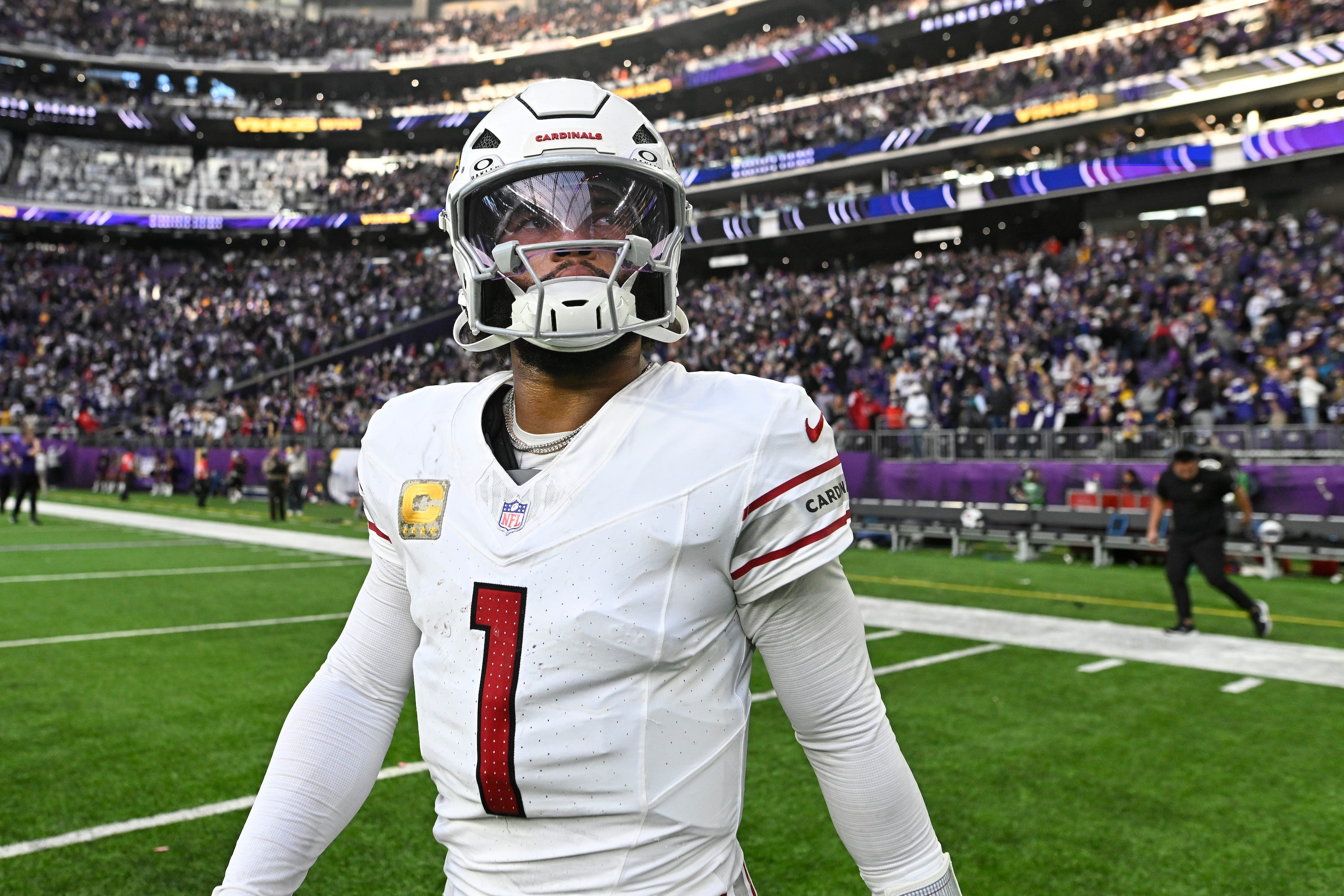
Arizona Absurdity
The Grand Canyon State should function as a football oasis. Warm weather, low taxes, beautiful scenery. Everything works in this team’s favor. One well-traveled veteran who began his career in Arizona believes there’s no reason this shouldn’t be a Top 3 destination for free agents. “Every. Single. Year,” he bellows. New York and Los Angeles are entertainment capitals, but some of the best players in the NFL are hesitant to hand a chunk of their paycheck back to the government.
Nor are players eager for a life of scraping windshields and driving through blinding whiteouts.
Instead, these Arizona Cardinals represent the greatest missed opportunity in the sport itself. Woody’s Jets are widely heralded as the NFL’s preeminent village idiots, but look out. He’s got company. An industry secret burst into the mainstream with the NFLPA’s Report Cards. Bidwill, scoring an F from the players, is equally incompetent. He doesn’t walk into his own locker room and berate players like the dunce in New Jersey, but life here may be worse.
“Bidwill’s not as arrogant as Woody,” one ex-Cardinal says. “Bidwill just doesn’t have a clue. Cheap. Cheap. Cheap. You’ve got no reason to be cheap, dog! If you do it right, people will flock to Arizona. People love it out there. But he’s got no clue.”
This player then takes our hand and guides us through the filth. The food. (“Terrible. Piss poor.”) In 2023, those report cards revealed players needed to pay for their own dinner to take home via payroll deduction. The facilities. (“Shit. God awful.”) Everything was outdated and truncated by NFL standards. The weight room and locker room are rough. Arizona will finally modernize with a new performance center in 2028. Treatment of families. Other NFL teams go to the extreme to help players from simple sideline passes before kickoff to daycare services. Bidwill does the bare minimum. When a free agent’s decision boils down to two teams, this is often the tipping point. (“That matters. It changes the way people think about your organization.”) Treatment of players. One coach thought it was strange that they received preferential treatment on flights over the players.
All it takes is one bad experience. One player tells another. And another. And another. To the point where this franchise’s poor reputation is established.
Those who’ve worked alongside Bidwill at the top of the organization have a treasure trove of horror stories. One former exec recalls a culture of intimidation, saying Bidwill’s default mode was to scream at everyone. He calls the owner “100% evil” and claims he denigrated women and minorities.
“He doesn’t have one good quality,” this source says. “Dan Snyder was a jerk, but he had a wife and kids, so he had the capacity to care about other people. Michael Bidwill doesn’t have the capacity to care about anyone but himself. You’re not going to find one human being alive that’s going to say anything nice about the guy.”
The Athletic published a damning account of life under Bidwill. To his credit, Bidwill acknowledged in a statement he “would have done some things differently over the years” and was “extremely excited about what we can be tomorrow.”
That’ll be difficult. Toxicity is embedded deep into the fibers of the franchise. Back to the 70s. When I reported on “Blood and Guts: How Tight Ends Save Football,” one of the greatest tight ends ever — ex-St. Louis Cardinals star Jackie Smith — choked back tears thinking back to his ugly divorce with the franchise. His ultra-kind, grandfatherly demeanor turned despondent because, to this day, Smith is ostracized. The Cardinals haven’t put the Hall of Famer into their Ring of Honor. Wounds are still fresh over his messy exit from the team. He’s not alone. Bring up the Cardinals to ex-players from any decade and there’s a good chance they’ll appear as if they just took a whiff of a baby’s diaper. It’s not a joyful topic.
All issues inevitably spill onto the field. The Cardinals have made the playoffs nine times since 1948. In the name of parity, of course, the league’s worst teams (and worst owners) are rewarded the best draft picks.
So, hey, come on down Kyler Murray. You are lucky No. 1.
The quarterback who doesn’t lose headed to the franchise that doesn’t win.
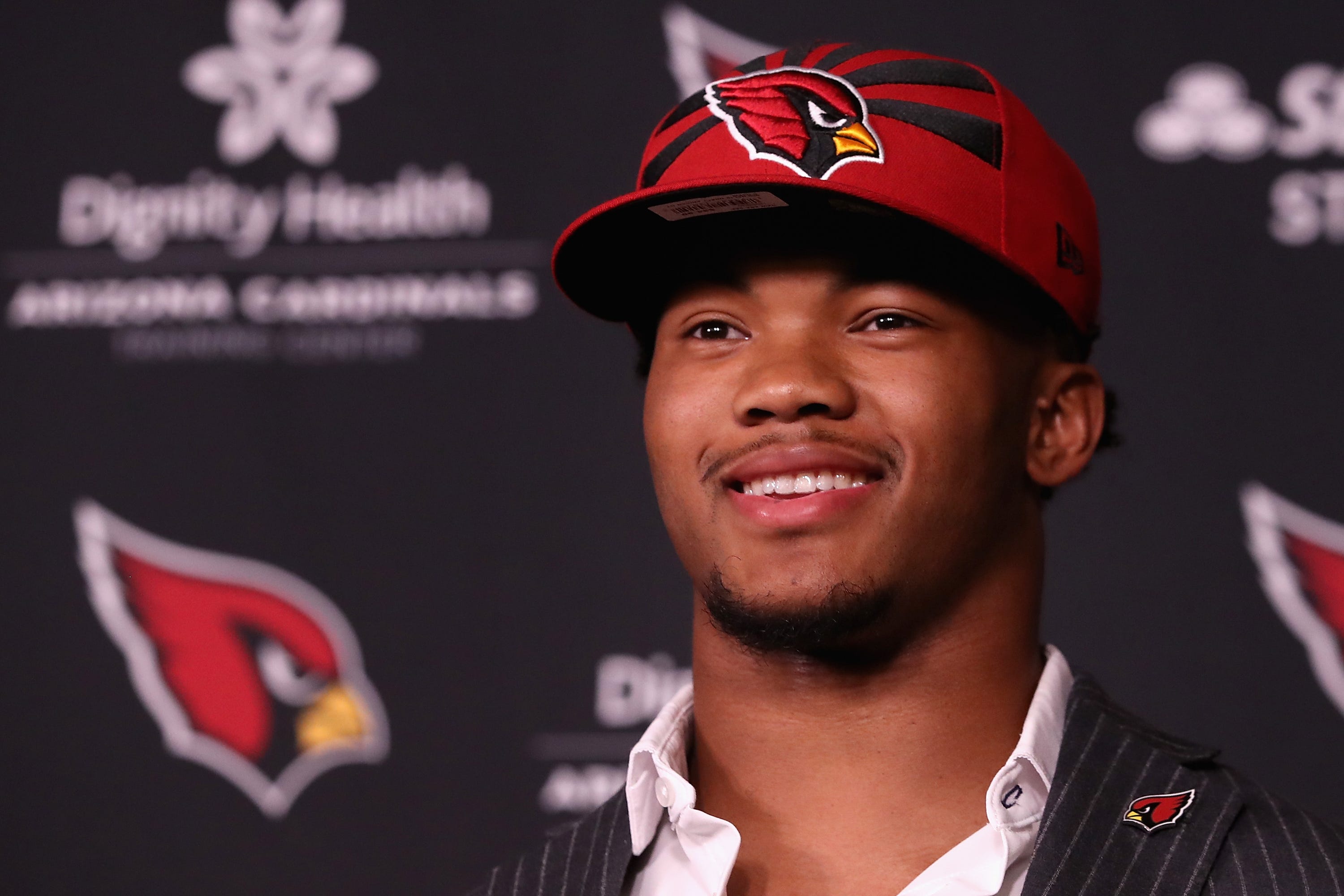
By Year 2, in 2020, Murray had these Cardinals looking like a contender when one insane “Hail Murray” vs. the Buffalo Bills upped their mark to 6-3. The next fall, in 2021, they started even hotter at 10-2. Both seasons petered out, the latter derailed by hamstring and knee injuries to DeAndre Hopkins. The roster cratered and Murray suffered through his own erratic play. One regime was fired. Another regime was hired. After a few promising moments in ’24, everything fell apart the first month of 2025. Arizona lost five games by a combined 13 points to fall to 2-5. Murray suffered a foot sprain in Week 5, the team said his injury did not heal and — into December — the quarterback was shelved for the season. On Instagram, he posted a photo of himself and teammates with the words “Weird year” and the caption “Never Again.”
This final year followed the same script we see from bad teams run by bad owners.
It’s hard to imagine head coach Jonathan Gannon was in favor of shutting down the superior quarterback with his own job at stake. Coaches are most concerned about the present, not the future. He had a strong relationship with the QB, too. They bonded off the field. Multiple sources believe Gannon was forced to follow orders and was then fired anyway.
Denson doesn’t go there, but calls Gannon a great human being who fights hard for his coaches, his players and will absolutely get another shot at being a head coach.
Another coach on staff cannot stop raving about Gannon as an “outstanding head coach” and “a monster” in all the best ways. He assures that people have no clue how rotten the Arizona Cardinals are to the core.
“You question what the intent is of the organization,” this coach says. “When you’re the head coach, you take the fall for a lot of shit that’s not on you. Nobody could have been as steady and stable and been able to be themselves the way JG was for the last three years there.”
There was no explicit edict from above. No master plan, no open line of communication with the front office at all as the season crumbled.
“To us,” says this assistant coach, “it’s like, ‘What the fuck are we doing?’”
Nonetheless, they took the blame for it all.
Gannon was fired. GM Monti Ossenfort stayed. This coach cannot help but shake his head at Ossenfort drafting Notre Dame running back Jeremiyah Love with so many other problems plaguing the roster. The decision is something like a family drowning in debt purchasing a Rolls-Royce.
Winning three games this season may be an odyssey.
One former Cardinals starter rips Bidwill’s cockamamie half-measure as a sure sign of organizational decay.
“Any time you know a team’s tanking and you fire the head coach — and you don’t fire the GM associated with a lot of those draft picks the last three years? — you’re setting yourself up for another recycle,” says this player. “To me, they should have cleaned complete house. Bidwill being Bidwill, he didn’t clean complete house because he doesn’t know how to run a whole operation by himself. So he stood by the GM in his ear who said, ‘X, Y, Z was the reason we didn’t do this.’”
All while the flames from A, B and C continue to burn in front of the owner’s face.
Ascending homegrown players that Ossenfort inherited slipped away — Zach Allen to Denver, Byron Murphy to Minnesota — and his drafts have been hideous. In 2023, Ossenfort traded out of the No. 3 overall slot that netted the Houston Texans defensive end Will Anderson Jr., a move praised to the high heavens by talking heads at the time. This offseason, Anderson, the “Terminator,” signed the richest non-QB contract in NFL history. Suggest to one Cardinals coach on staff that his front office passed on one of the best defensive players in the sport and he chuckles. (“We heard otherwise before the draft. This could go on and on and on.”)
As Anderson makes opposing offensive tackles piss themselves, the collection of players Arizona acquired in the deal haven’t done anything of note.
Somehow, it got worse in 2024 when Ossenfort chose Ohio State’s Harrison Jr. at No. 4 overall over LSU’s Malik Nabers.
The move was supposed to unlock greatness in Murray. Instead, it drove one final nail in his Cardinals coffin.
Even worse? It was all predictable, all avoidable. In NFL circles — one wide receivers coach explains — Nabers was widely deemed the superior prospect. “You talk to 99 percent of the league,” says this coach, “everyone knew that Nabers was a Hall of Fame player.” The variable was his supposed baggage. Nabers was obviously the more volatile personality. Harrison was the safer choice and Arizona opted for safe. (Our Wide Receiver Matrix debate most certainly applies here.)
“We knew coming out that Harrison doesn’t have that dog,” this coach explains. “He doesn’t have that fire.”
One Midwest scout whose livelihood is making sense of all prospects in Columbus, Ohio, told the team that Harrison struggled with the stress of being the son of Hall of Fame wideout Marvin Harrison Sr. — a major presence in his life.
Even after big games, Dad ripped him. Told him it wasn’t enough.
“His father is a very big influence on him,” the coach continued. “His father would text him and call him like, ‘Hey man, you need to do this, you need to do that,’ while he was at Ohio State. So he feels the pressure. Any time he comes off the field — practice, games — his Dad is always there. So, he’s not a very confident guy.”
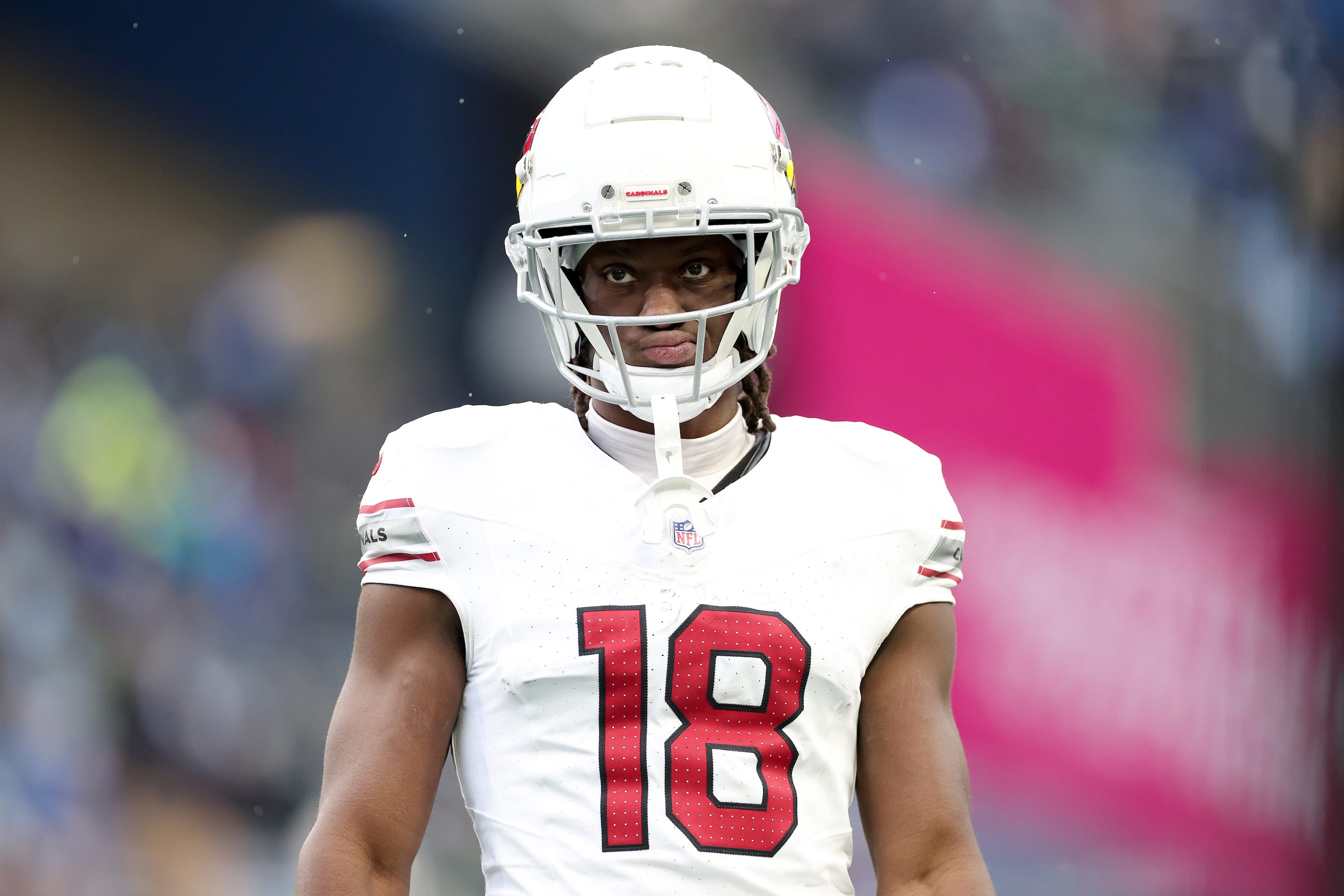
Coaches and scouts alike in the other three NFC West draft rooms were thrilled to see Arizona pass on Nabers. San Francisco’s Kyle Shanahan watched 10 or so clips of Harrison and said aloud that he thought the Buckeye would be better. Hard to blame him. At that point, the prospect was being compared to Julio Jones and AJ Green as the world’s next can’t-miss wideout. The closer NFL people looked, the more they didn’t understand the hype.
Especially when it was time to turn on the Nabers film.
Goodness.
This wideout was a dog in every sense of the term.
He caught slants in stride and toasted defenders. He dunked on cornerbacks in the end zone.
“It was clearly night and day,” one NFC coach recalls.
Perhaps Arizona didn’t believe it had the veteran infrastructure to take on a big personality. Gambles can backfire. But even this excuse is an indictment of Bidwill because, remember, vets should be dying to play in this market. However you slice it, the Cardinals missed on elite talents in back-to-back drafts.
Any GM petrified of selecting receivers with attitude should probably post their home on Zillow. There’s no guarantee the “safe” pick won’t give you a headache, either. One source labels Harrison one of the hardest players to coach on the entire roster and one of the hardest he’s experienced in his career. “And usually when somebody says that,” an ex-Cardinals coach adds, “it’s like, ‘Oh, that guy’s an asshole. You’ve got to get him going.’ That type of shit.” In Arizona, Harrison was difficult “for all the opposite reasons.” He lacked fire.
Production equals tolerance.
Nabers has already flashed that Canton potential.
One NFC wide receivers coach says he always prefers the WR1s with “some shit to them” like Nabers. He’ll handle baggage. He’ll tell guys to simply make sure they roast Patrick Surtain and Jalen Ramsey when the game’s on the line. “That’s why those guys get 30, 40 million dollars,” he adds. The goal is to land on the Ja’Marr Chase end of this spectrum and avoid Brandon Aiyuk-level disasters. To him, it’s obvious Harrison Jr. lacks the confidence required at this position. The 6-foot-3 wide receiver who refused to run a 40-yard dash at his pro day runs slow and plays small. In 42 percent of his games, he caught two or fewer passes.
This coach points out that the soft-spoken Harrison Jr. doesn’t seem very confident when he speaks. But it’s bigger than that. Some receivers bring a palpable presence to the field. They plant a feeling of play-to-play dread inside a cornerback across the line of scrimmage. Like Nabers. Like Chase.
Others, like Harrison, do not.
“His game’s not very powerful,” this coach says. “He’s a big guy, but he’s not. If you’re ever on the sideline while he’s playing, you don’t feel him out there. You can feel Malik Nabers. You can feel Justin Jefferson. The best players, you can feel the presence. You don’t feel him out there. He’s just kind of out there. You can easily take him out of the gameplan.”
Murray tried to fuel his young receiver with confidence. Pull up Arizona’s gut-wrenching 23-20 loss to the eventual Super Bowl champs in Week 3. Harrison quits on one route that leads to an interception. Later in the game, on a slant, he bobbles the ball right to linebacker Ernest Jones IV for another interception. Murray refuses to ice him out, as if knowing that would be the worst thing for a young player’s mental state. The QB gives Harrison a chance to high-point a touchdown and the two later connect on a crucial third and 5 that helped knot this game up at 20-20.
It took Seattle all of 28 seconds to move into field goal range. Seattle won.
Murray played all of one more game for Arizona.
Hey, on one hand, Ossenfort isn’t the man who preceded him. Bidwill’s previous GM for a full decade is embroiled in controversy this week. Pro Football Talk reported this week that Steve Keim has ties to Mohamed Coulibaly, the man a Barron’s investigation revealed ran a scam duping pro athletes into investing in fake Shopify stores. Keim is identified on the company’s pitch deck as “chief operation/growth officer.” He’s the only name on the deck with Coulibaly.
The alleged scammer was found dead in a pool last week. A New Jersey investigation is underway.
Bidwill has not hired the best of the best, no.
Off to Minnesota Murray goes. (Most likely at the speed of light.)
He’s now throwing the ball to a dominant receiver with an undeniable presence. Blinding diamonds around his neck, Justin “Jets” Jefferson feasts on corners.
He’s now employed by owners with an undeniable desire to spend, to win. The Vikings’ pristine headquarters in Eagan, Minn., a $120 million project, is the league’s crown jewel. At some point, the narrative completely got away from Murray in Arizona. Maybe because the Cardinals avoid the nationwide mockery typically reserved for the Cleveland Browns and New York Jets. The career arc of Darnold should’ve opened all eyes. Edmonds, the team’s former running back, repeats one word: Situation. Organizational structure, coaching, all factors around an individual talent matter more in football than all other pro leagues combined.
“You draft Victor Wembanyama in basketball and it doesn’t matter who’s coaching,” says Edmonds, who has played for five different teams himself. “You’re going to be fine. In football, those things matter — that influence, that structure, that situation, that can literally determine the success or failure of players’ careers.”
Which begs one question.
If everything’s so gorgeous here in Minnesota, how in the hell did someone drafted 11th overall play worse than any other quarterback in the NFL last season? Look closely and the math starts to add up.
The JJ Miscalculation
All coaches who fancy themselves quarterback sommeliers make their move. The decision to draft a quarterback and then start that quarterback after a redshirt season is not outlandish. It’s wise. It’s practical. Kevin O’Connell worked his magic with Kirk Cousins, Sam Darnold, hell, Joshua Dobbs. It was high time for a man who played the position himself to handpick, mold and unleash a creation of his own.
Lord knows he tried to trade up for Drake Maye ahead of the 2024 draft.
Inside St. Philip the Deacon Lutheran Church in Plymouth, Minn., during a “Faith & Leadership” speech, one fan asked the Vikings head coach if he’s working his old Patriots connections to trade up to No. 3 overall. O’Connell joked that he sent a bouquet of flowers to Robert Kraft. New England (wisely) did not budge and Maye nearly won NFL MVP in Year 2. Minnesota settled on the fifth quarterback in the class, McCarthy, at No. 10.
After Darnold’s riveting season ended with a thud, the Vikings ushered in the J.J. Era.
There was a lot to love. Winning? McCarthy went 27-1 with a national title at the University of Michigan, home of Tom Brady. Tangibles? The 6 foot 2 ½, 219-pounder recorded a throw of 61 miles per hour at the Combine, just shy of the 62 MPH set by an MVP (Josh Allen) and the NFL’s Happy Gilmore (Joe Milton). McCarthy said he once threw a football 78 yards with the wind. His three-cone time of 6.82 seconds was the best in five years. Intangibles? McCarthy’s been candid about his battle with depression as a high school senior and the power of meditation. His leadership and intensity in Ann Arbor were lauded so much by Jim Harbaugh that you couldn’t help but assume the kid was a long-lost son.
A damn impressive resume for any CEO of the position to consider.
After the pick, O’Connell made it clear it was his mission to find the team’s long-term answer at the position. A quarterback he can “pour into and develop.” Added O’Connell: “There’s nothing I love more than coaching that position and being around somebody hungry to get better every single day with a great skillset like JJ has.” Meanwhile, GM Kwesi Adofo-Mensah called McCarthy “as talented as anybody in the draft.” In their conversations ahead of the draft, McCarthy asked Adofo-Mensah a question: Is there any reason you wouldn’t draft me? To which, the GM admitted there’s some “guesswork” because of Michigan’s run-heavy offense. “But,” he told the QB, “we think you can do it.”
Even players on the roster who I’d consider very pro-Darnold understood O’Connell’s logic.
During that magic carpet ride of a ’24 season, one vet explains, it was fair to assume the coach was driving this ship. Those Jets and Panthers days were the last images everyone had of Darnold. Then came Game No. 272 for the NFC’s No. 1 seed. Then came a wild-card meltdown vs. the Los Angeles Rams. The gameplan stunk, the offensive line caved, Darnold was skittish. Ghosts of trauma past seemed to resurface amid a flurry of sacks (11) and incompletions (38) those two blowout losses.
So, the Vikings reverted to the original plan.
“It didn’t seem crazy at the time,” says one starter on the team. “I think KO does a really good job and I think obviously Sam does a great job and I think JJ’s young and talented. That’s about as simple as it is. It’s not super complex after that.”
He hears his words out loud, pauses and adds an important word.
“Well, it’s costly. Very costly.”
Darnold won a Super Bowl for someone else.
McCarthy was half EJ Manuel, half Chris Farley SNL skit.
Adofo-Mensah took the fall, though it’s naïve to think the head coach hired for his quarterback prowess was an innocent bystander.
The Vikings failed to properly measure two variables in this quarterback equation.
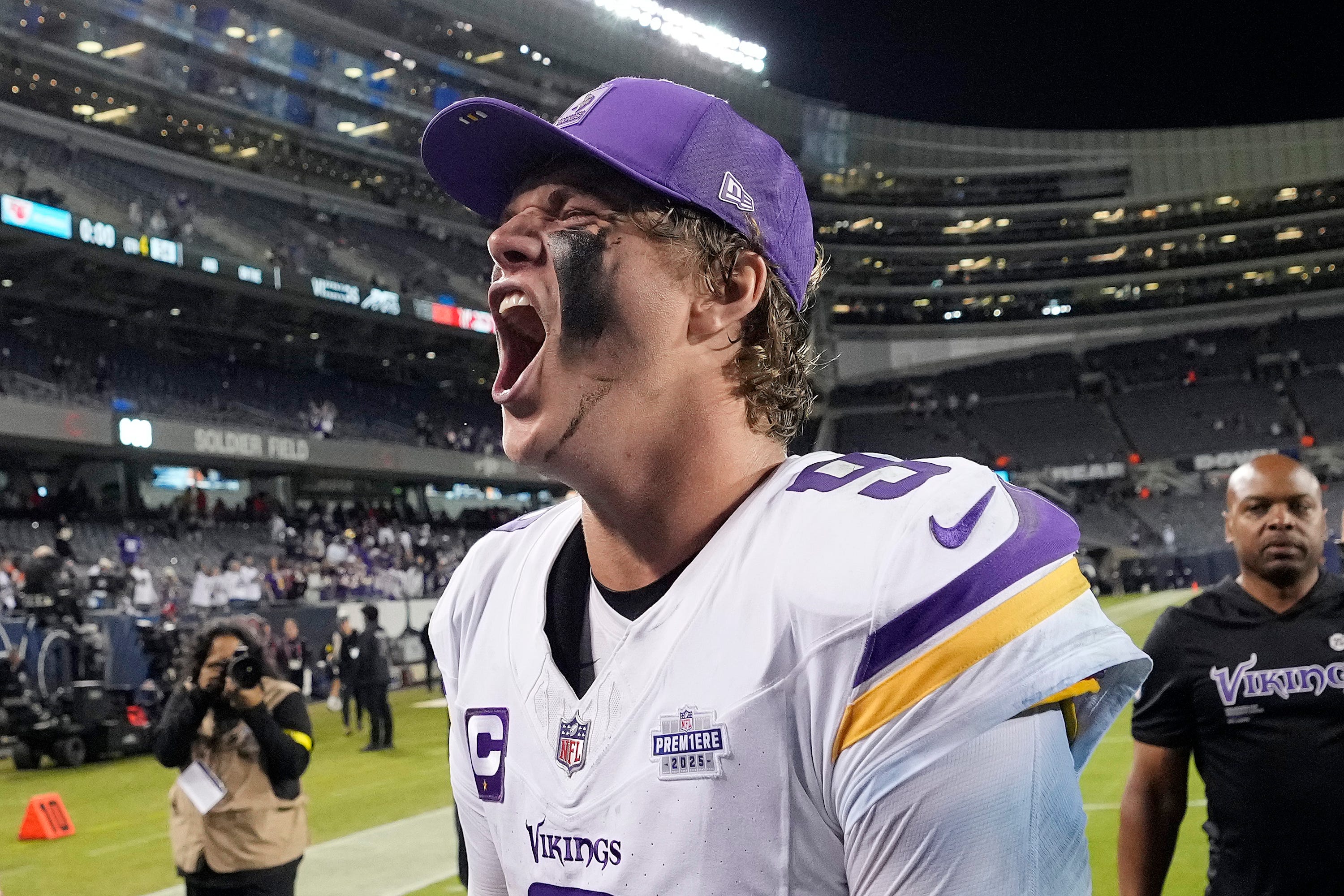
One, everything that post-Packers celebration symbolized. Players grew to genuinely love Darnold’s stoicism and how he never painted himself a victim. He had every plausible reason to bitch about those losers in the swamps of New Jersey, yet never did. We covered it in real time. Even during Super Bowl Week as a Seahawk — interview to interview to interview — Darnold never came remotely close to dunking on the Jets. When the entire football world declared him a bust, all Darnold did was work. And improve. And work some more. Former Vikings teammates pulled hard for him in Santa Clara. They loved his mentality. It was galvanizing. Linebacker Blake Cashman told us that everyone would’ve been thrilled if Darnold returned as the starter. (“The guys in our locker room, everyone’s thinking: ‘Why wouldn’t you run it back?’ … Of course you think about all the what-ifs.”)
In retrospect, all Darnold needed was coaching. It’s obvious he was already on his way back.
The Vikings’ other blunder was failing to grasp just how thick the bubble wrap was around McCarthy in college. Fatal flaws were concealed. This was a player who threw the ball all of eight times in a game at Penn State. In his team’s championship win over Washington, he was 10 of 18. A perfectly fine way of doing business if you’re Bart Starr in the 60s or Bob Griese in the 70s. Not so much in the 2020s. Code-Red sirens were blaring at full blast this entire time. Nonetheless, they went all-in. Off a 14-3 season, the Vikings chose McCarthy over Darnold, Aaron Rodgers, Daniel Jones, everyone who was available and signed a slew of free agents to capitalize on McCarthy’s rookie contract.
No team in the NFL spent more cash last year.
The plan was to compete for a championship.
It did not take long for players on the roster to realize those dreams were silly.
Early. As in OTAs early. On both sides of the ball, players noticed that McCarthy’s timing wasn’t close to NFL ready. During 7-on-7’s, a pop-a-shot drill for most QBs, one player recalls McCarthy waiting until his seventh read to throw the ball. He worked from 1 to 5, then all the way back to 2. Nor was the Vikings defense doing anything crazy. Flores wasn’t rushing anyone in this drill.
He was the antithesis of decisive. Wonky mechanics compounded the problem.
“And when training camp started,” one starter recalls, “I was like: ‘Oh. Yeah. This isn’t going to work this year.’”
McCarthy never revved up to NFL speeds with the worst completion (57.6) and interception (4.9) rates of any starter in the league. This pick rate was a full percentage worse than the next QB (Tua Tagovailoa). “If it takes you a little while to process,” said this player, “and then your mechanics are weird, it’s hard to play.” The QB’s best success came off extending plays — when timing doesn’t matter anymore. O’Connell’s passing game never found a rhythm.
Immaturity did not help. McCarthy’s approach was a stark departure from the stone-cold Darnold. Take the Nine meme. Even when the getting was good, McCarthy created needless issues for himself. At Detroit, he scored three touchdowns and hit Jalen Nailor on third and 5 late to ice a 27-24 win. Moments later, the quarterback was recorded in the locker room mean-mugging and swaying back ‘n forth with war paint splattered underneath his eyes. This peculiar visual was soon followed by a mid-week press conference in which McCarthy was asked if he mentally enters a different place on gameday.
The QB began by noting that, yes, he flips a switch.
“I call him ‘Nine,’” McCarthy said. “Nine comes out and I’ve got to understand, ‘OK, he can’t be at his peak performance throughout 3 ½ hours. So how do I find little ways on the sideline, get back to my breath, get back to my visualization to maintain that intense competitive stamina throughout the whole game? It’s just the pure will and determination to get the job done.”
For a young quarterback trying to find his way, the comment was strange.
One teammate understood McCarthy’s point. He, too, becomes someone else on the football field. Many players tap into a darkness, an alter ego to excel. It’s a violent profession.
“It doesn’t mean I’m, ‘Mr. Badass,” says this player. “It’s just: ‘This is how I’m going to operate within football.’ That’s what he was trying to get across, but it sounded more like there’s some hubris to it where it really doesn’t need to be hubris. It needs to just be like, ‘Here’s what I have to do in order to operate at a high level.’ … It was silly for him to create that issue. That’s the immaturity. You don’t say that after one nice win. I don’t think he realized how big the spotlight is on him.”
McCarthy’s performance tanked and the Internet did its thing photoshopping face after face into the cartoonish nine meme.
To his credit, McCarthy was a good sport. Teammates remember him laughing it off.
Still, he couldn’t help himself the next time he had a good game.
At Dallas, as he crossed the goal line for a TD on a bootleg, McCarthy held the ball low to the turf and did his version of Jefferson’s Griddy. Minnesota won, 34-26. This was the quarterback’s best game. Unprompted, O’Connell kindly noted he did not enjoy a celebration before the touchdown was scored. McCarthy admitted he did it in practice and was told not to do it. “Me being who I am,” he added, “it’s like, ‘Oh, now I’m more enticed to do it.”
Another eye-roll moment for vets in the locker room.
Another hard turn from everything they experienced the year prior.
“Like, why? You’re just inviting more,” says one starter on the team. “Some of the stuff where you’re like, ‘I know you’ve talked about this and thought about it.’ You can avoid unnecessary scrutiny.’”
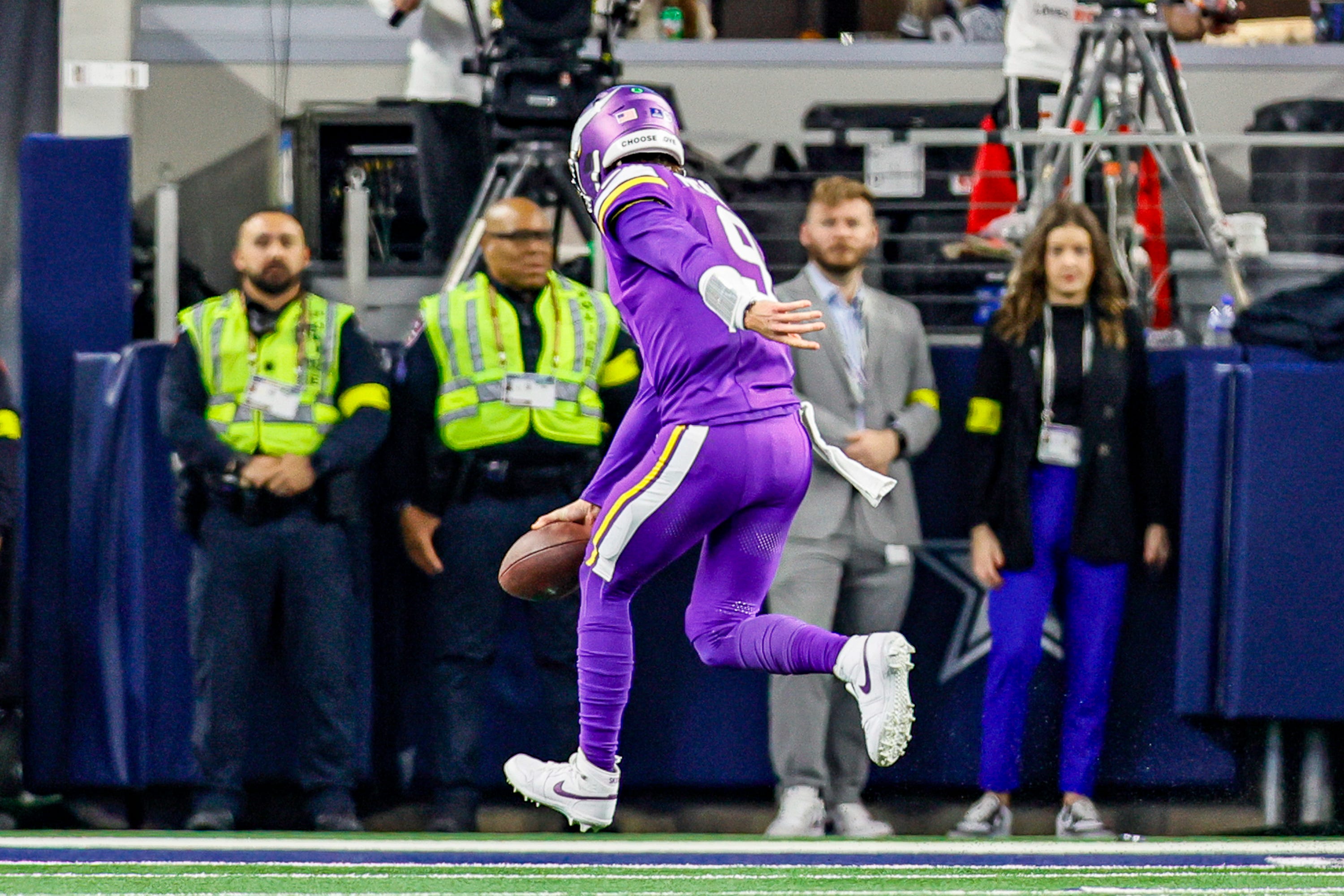
Right to the end of the season. This player brings up a third example. Against Green Bay in Week 18, McCarthy tried to grit through a hairline fracture in his right hand. Admirable. Especially after missing five games due to a high ankle sprain and one to a concussion. To polish off one run, McCarthy even lowered his shoulder and taunted a Packers DB with a flex that’d cost him $11,593. When the pain was too much in the second half, McCarthy took himself out of the game.
That wasn’t strange. But what some teammates did find odd was McCarthy’s decision to cover up his hand with a towel.
There wasn’t anything gruesome about the injury. No blood gushing from a wound.
“Why are you putting a towel over your hand?” one teammate recalls. “It’s just kind of weird.”
Perhaps McCarthy did it to prevent himself from fist-bumping teammates. Former Vikings linebacker Ben Leber, who’s part of the team broadcast, ripped the “theatrics” and “drama” of it all on K-Fan 100.3 the next day. “It’s not melting,” Leber said. “There’s not a bone sticking out. It’s not disfigured. It’s not harming anybody by looking at it. He’s got a lot to learn about just the body language, the behavior, the outward optics of how things look.”
One teammate gets a soccer player flopping to sell a foul. It looks ridiculous, but there’s gamesmanship. There’s an advantage to such theatrics. This made no sense.
Nine. The Griddy. The Towel. All of it would’ve been nothing but footnotes in 2-point font if McCarthy performed. He did not.
When O’Connell made coaching points, sources say, McCarthy too often pushed back: Why don’t we do it this way? An acceptable rebuttal for a veteran quarterback with a full library of game reps to his name. Not so much for a novice who barely threw the ball in college. The head coach doing all of the teaching has pelts on the wall, too. O’Connell can point to Matthew Stafford, Kirk Cousins and Darnold. “You don’t really have that latitude,” one teammate says. “Just execute as good as you can.” In 2024, sure, Darnold would occasionally ask for a different route on the backside of a play. Even then, he was more diplomatic about it. There was an understanding that O’Connell had a bigger-picture why to everything he was dialing up.
Think of Caleb Williams in Chicago. In Year 1, as we reported, the No. 1 pick in the ’24 draft pushed back and the staff was much obliged. The snap count. The scheme. Everything changed on the fly to the rookie’s preference. A horrible precedent was set and all the coaches were fired anyway. In Year 2, Ben Johnson arrived and made it clear the quarterback needed to get with his program or he’d simply find someone who would. Williams, to his credit, bought in. He realized Johnson was a rare coach and signed off on winning different types of games. Chicago leaned on a powerhouse rushing attack, was OK with punting, kept games close and Williams — 2 minutes to go, down one score, crunch time — was given a green light to improvise. It pays for a young quarterback to trust in coaching.
One press conference during minicamp hinted that immaturity may still be a problem for McCarthy. He stated that he sits on one side of the classroom and Murray sits on the other.
The good news? Some sources in the building believe McCarthy has taken a more realistic approach to his job this summer.
This NFL career does not need to end with memes and wounded ducks. McCarthy has time to rehabilitate and build a pro career.
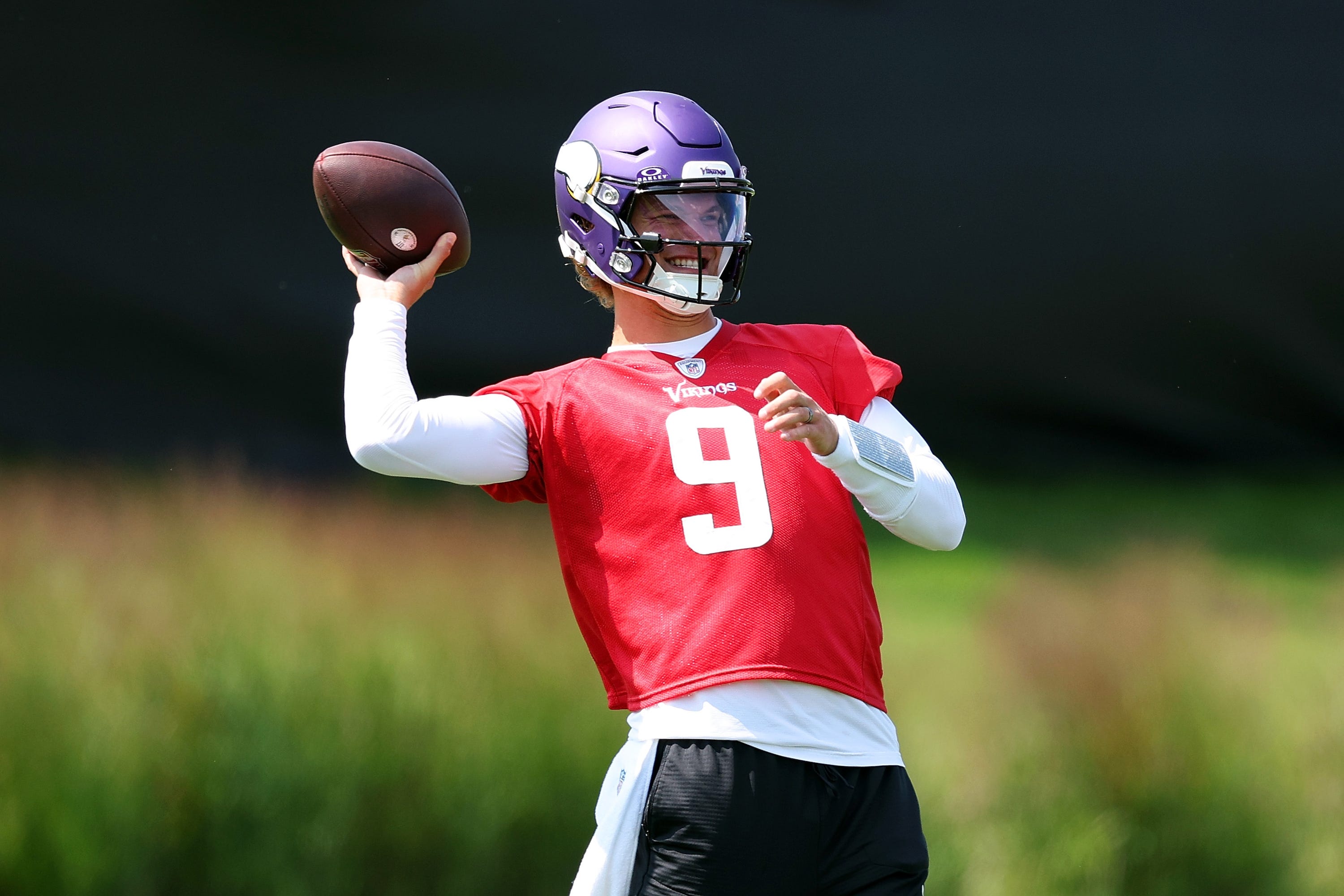
Take Matt Hasselbeck. He heard whispers of “preparation” and “professionalism” issues with McCarthy. But he also lived this same predicament as a player and managed to carve out a 17-year career.
After getting traded to the Seattle Seahawks to be the starter — handpicked by his own ex-coach in Green Bay — Hasselbeck fell flat on his face. Mike Holmgren benched him for veteran Trent Dilfer. It was humbling. It was humiliating. Dilfer received a four-year contract to be the new starter and told the younger Hasselbeck to watch how he prepares, competes, leads. “At the time,” Hasselbeck concedes, “I hated him for it.” Then, into late October, Dilfer tore his Achilles.
Hasselbeck took over and, this time, he was ready. “Way more ready,” he says. All he did next was throw for nearly 30K yards and 174 touchdowns as a Seahawk.
All along, Hasselbeck fully expected Murray to be the QB1. His hope is that McCarthy learns the same lessons he did. Some quarterbacks sulk when they’re demoted. Others learn how to read defenses, swallow their ego and savor their hearty slice of humble pie.
Right now, McCarthy is the lemon Minnesota chose over a Super Bowl champion.
This doesn’t need to be his legacy.
Hasselbeck’s advice? Stay ready.
“Hopefully, he’s ready the second time around,” Hasselbeck says. “I lived that. And I’m sure half of the locker room was not in on me — at all — but there was at least a handful of people in the building that saw something that I didn’t even see that really no one else saw. And I’m grateful for those guys: guys like Mike Holmgren and Jim Zorn.”
The crime of last season is that a maelstrom of a Vikings defense was wasted. Members of this unit believe they could’ve done real damage in the playoffs with even average quarterback play because, by December, they had total command of Flores’ defense. Confidence was skyrocketing. Opposing quarterbacks were spooked. It’s no stretch to suggest the Vikings could’ve been the team dancing atop the Super Bowl dais in Santa Clara if they simply chose Darnold.
But enough looking back. Free from Arizona, Kyler Murray now gets his chance to right all quarterback wrongs as the starter in Minnesota.
This whole quarterback competition charade may go down as nothing but a time-suck O’Connell regrets. Murray missed valuable reps in a complex scheme. By letting it drag into mid-August, though, O’Connell did cultivate more adversity for a quarterback who hasn’t experienced much of it in his football life. This is Murray’s moment of truth as a professional athlete. Outsiders have no clue how he’ll respond with his back against the wall.
Insiders know the key is to tap into Murray’s wild side.
Somehow unlock this version of the quarterback and the 2026 Vikings have a chance to shock the football world.
Read Part II here.

Related:
'Who’s going to take this yard?' The Arrival of Eric Wilson

EAGAN, Minn. — Nothing about his career makes sense. Eric Wilson spent most of a decade in special teams anonymity before announcing his arrival with the delicacy of an asteroid last season.
Canton is still the goal for Aaron Jones

Five years later, their final conversation stays on his mind. Loved ones were all able to say goodbye to Alvin Jones Sr. inside the comfort of his home.

Absolutely agree: “The Vikings’ other blunder was failing to grasp just how thick the bubble wrap was around McCarthy in college.”
Outstanding piece, Tyler.