

Read Part I here
Our entire two-part series on Green Bay Packers head coach Matt LaFleur is available to paid subscribers.
He saw red.
That’s all.
An intrinsic need to seek and destroy.
No, T.J. Lang did not carefully calculate the permutations of his predicament in real time. His 2014 Green Bay Packers were down, 14-10, to the Dallas Cowboys in the third quarter of an NFC divisional round showdown at Lambeau Field. The ball was at the Dallas 12-yard line. Second and 6. If there was ever a time to exemplify restraint, this was it. Instead, the team’s resident enforcer saw wide receiver Davante Adams fighting for extra yardage — eyed defenders vulture’ing around his teammate — and flew in to throw a vicious block.
Mayhem ensued. Suddenly, Lang was Jon Snow taking on a Cowboy militia.
The Lambeau faithful loved it. The officials, however, did not. Lang was flagged for unsportsmanlike conduct and Green Bay was forced to settle for a field goal. Green Bay gritted out a 26-21 victory to advance to the conference championship, but part of Lang still felt “like shit” inside the locker room. His split-second decision could’ve ended the season.
Naturally, he dreaded what came next.
The morning after games, head coach Mike McCarthy would replay about five good plays and five bad plays in front of everyone to drive home his final points. On the sideline, defensive players loved his hostility. They slapped him on the back and assured, “We got your back.” Adams appreciated it considering one of those defenders could’ve lit him up. Nor did the logic from officials make any sense. Lang wasn’t flagged for his block. Rather, officials told him he “instigated” the brawl. All minor details. Lang hadn’t spoken to any coaches, so he feared McCarthy would tear him apart.
Sure enough, McCarthy wasted no time plastering this play up on the video screen. Lang got nervous. Shit, he told himself. I’m going to get my ass ripped. McCarthy hit play and let the melee play in full.
“TJ,” McCarthy began, “if you get a chance to do this again…”
Lang’s blood pressure rose. The room went silent for 2.5 seconds that felt like 2.5 hours.
Then came the hammer.
“…do the same fucking thing! You protect your fucking guys. You play to the whistle!”
Relief. Joy. Acknowledgment that his God-given instincts in this sport were allowed.
Players told Lang this was the loudest they had ever heard Lambeau.
Green Bay lost four points on the drive, but gained something far greater.
“It was Cowboys-Packers,” Lang says. “Two very historic teams that don’t like each other. And even during that brawl, you black out because it’s like, ‘Holy shit.’ Adrenaline’s pumping. You don’t really hear anything, but you could tell it took everybody to the next level. It woke everybody up a little bit like, ‘Oh shit, fuck this. We ain’t letting them come in here and punk us.’”
One split-second decision that contrasts sharply with the indecision that nuked a Packers season 11 years later.
The 2025 Packers were riding high at 9-3-1 into a date with the Denver Broncos. On fourth and 1 in the first quarter, Jordan Love scrambled for the required yard and his head was promptly two-hand shoved into the grass by Broncos safety Talanoa Hufanga. Nobody rushed to Love’s defense. Instead, those in the vicinity simply pointed a finger at the bully as if on an elementary playground… and the teacher didn’t even see the cheap shot. Hufanga was later fined $11,533, but never drew a flag.
So, what is a Matt LaFleur Football Team? Last season, it was a group that refused to stand up when punked. Green Bay lost its final five games in agonizing fashion, and the same issues have trickled into this 2026 season.
LaFleur possesses many excellent qualities. His offensive acumen is considered elite. Those who witnessed the LaFleur-Rodgers-Love dynamic firsthand praise the Packers head coach. He helped mold an ultra-raw passer out of Utah State into one of the best in the game. Entire franchises wander aimlessly for years when a Hall of Famer exits the building. Green Bay contends in perpetuity. This ability to develop a quarterback and scheme receivers open gets waves of coaches hired each cycle.
X’s and O’s alone, however, do not constitute a team identity.
Into Year 8, LaFleur is a man still searching for his… and that’s a problem.
When bad turns to worse, something’s missing in the hearts and minds of these Packers… and that’s an indictment of coaching.
Collapses rage on into 2026: The Packers surrendered 29 unanswered points to Minnesota, barely escaped the New York Jets and were then humiliated by the Atlanta Falcons. Despite LaFleur’s efforts to ban all “Super Bowl” talk and despite his emphasis on finishing, it does not appear much has changed. Not yet. Angst could soon reach extremes president Ed Policy cannot ignore.
One team exec articulated last season’s demise perfectly.
“It’s organizationally being really prepared for those moments,” this source says. “Understanding the moments we’re in. Bad things are going to happen in games. You’re going to take some shots. That’s the NFL and you have to understand how to respond. I don’t like to use the word, ‘front-runner,’ but that was going on. We overwhelmed people with talent, speed and physicality and the game was over before it got started. But then when you get into December, January football, you’ve got to be polished as a team to handle all the moments.”
In Part II of our series, we examine the soul of this team, relive the wild-card disaster in Chicago and try to forecast where this all goes for LaFleur and the Packers. Go Long spoke to people in all corners of the building for answers concerning the NFL’s most perplexing team in September.
The personnel’s imperfect.
What’s lacking most is that ever-elusive intangible.
Adversity strikes and there’s panic. Not calm.
Teammates are punked and there’s restraint. Not pride.
Momentum shifts, opposing fans roar and the Packers collectively submerge into quick sand. All damning evidence of a front-running team.
There was one glimmer of hope. In Week 2, Love took a vicious shot to the head and, this time, players had his back. “That’s what it should look like,” LaFleur said. “Right there.” Music to the ears of everyone in Wisconsin. Then again, this comment comes after LaFleur spent his first seven years harping on the need to avoid personal fouls. One assistant on the Packers staff admits that Mile High paralysis in ‘25 was a case of players simply doing what they’re coached.
“You’ve got to flirt that line as a coach,” this assistant says. “You’ve got to be careful with what you’re saying to the team. You make a big deal about not getting penalties and then shit like that happens. You aren’t going to have a guy go fight the dude, but then you’re a ‘soft’ team. That’s the line we as coaches need to figure out. I don’t think the guys aren’t tough.”
Agreed. The roster’s full of badasses.
But coaching can be soft and perception can become reality in the NFL.
Much of the NFL likely view the Packers in a damning light. Throw a punch — literal or figurative — and, odds are, they’ll fold. Heading into Week 4 at Tampa Bay, the team’s reputation is at an all-time low under this head coach.
Those clocks at 1265 Lombardi are ticking.
Go Long is your forever home for longform.
Transitioning from Aaron Rodgers to Jordan Love, the spring of 2023, the vision of this head coach never wavered. Assistants were wildly impressed with Matt LaFleur’s leadership through one of the most turbulent offseasons in franchise history. Rodgers slipped into a darkness retreat. Go Long first reported that the Packers were finished with the Hall of Famer. Rodgers was traded to the Jets.
LaFleur never flinched.
Internally, he refused to dull expectations into the great unknown.
“Matt was the same as far as ‘We’re going to go win a fucking Super Bowl with Jordan, and it’s our job to do whatever we need to do,’” one coach on staff recalls. “There was no blink. It was, ‘Hey, this is what it is, let’s fucking go.’”
LaFleur, rejuvenated, was ecstatic to get back to what he cherishes most: teaching.
The games began and… yikes. Green Bay started 2-5, Love ranked dead-last in completion percentage (57.7), and the general manager who put his career on the line by selecting this quarterback offered a public challenge during his midseason press conference. Brian Gutekunst said the team would use these final 10 games to determine whether Love was their franchise quarterback.
A precarious juncture for the Green Bay Packers’ entire organization.
Externally, locals feared those dreaded pre-1992 Dark Ages.
Internally, sources recall LaFleur stressing out. He poured endless hours into trying to find the perfect plays for his young QB. Remember, he’s a perfectionist. But this was precisely when LaFleur made the conscious decision to quit holding Love’s hand and let him fail.
When the Packers lost to the Pittsburgh Steelers to fall to 3-6, LaFleur flew back to Wisconsin feeling very, very encouraged about Love’s future. Because that day, he took the reins off and loved what he saw. Resiliency in the pocket to deliver one clutch heave to Jayden Reed. Deep touch. Guts. No, Love was not perfect — he threw a pair of picks — but this was the first time the raw passer out of Utah State truly gunned the ball downfield with zero fear. Then, all Love did from Nov. 19, 2023 riiiight up to an ill-advised, cross-body interception vs. San Francisco in the playoffs on Jan. 20, 2024 was play better than any quarterback in the NFL. Legend Brett Favre gushed over the quarterback’s ability here and here at Go Long. “I think they hit a home run,” the gunslinger told us.
The Packers rewarded Love with a contract worth $55 million per year.
No relationship in sports matters more than the one between Head Coach and Quarterback.
Multiple sources insist the bond is strong.
“And I think they’ve obviously grown together through a lot of ups and downs,” one personnel man says. “So those guys are locked into each other. Jordan is such an unselfish team guy that’s probably the way he’d be with most coaches.”
Whereas LaFleur seemed frazzled talking to the offensive linemen, he was always remarkably relaxed around Love. He’d mirror the quarterback’s flat-line demeanor.
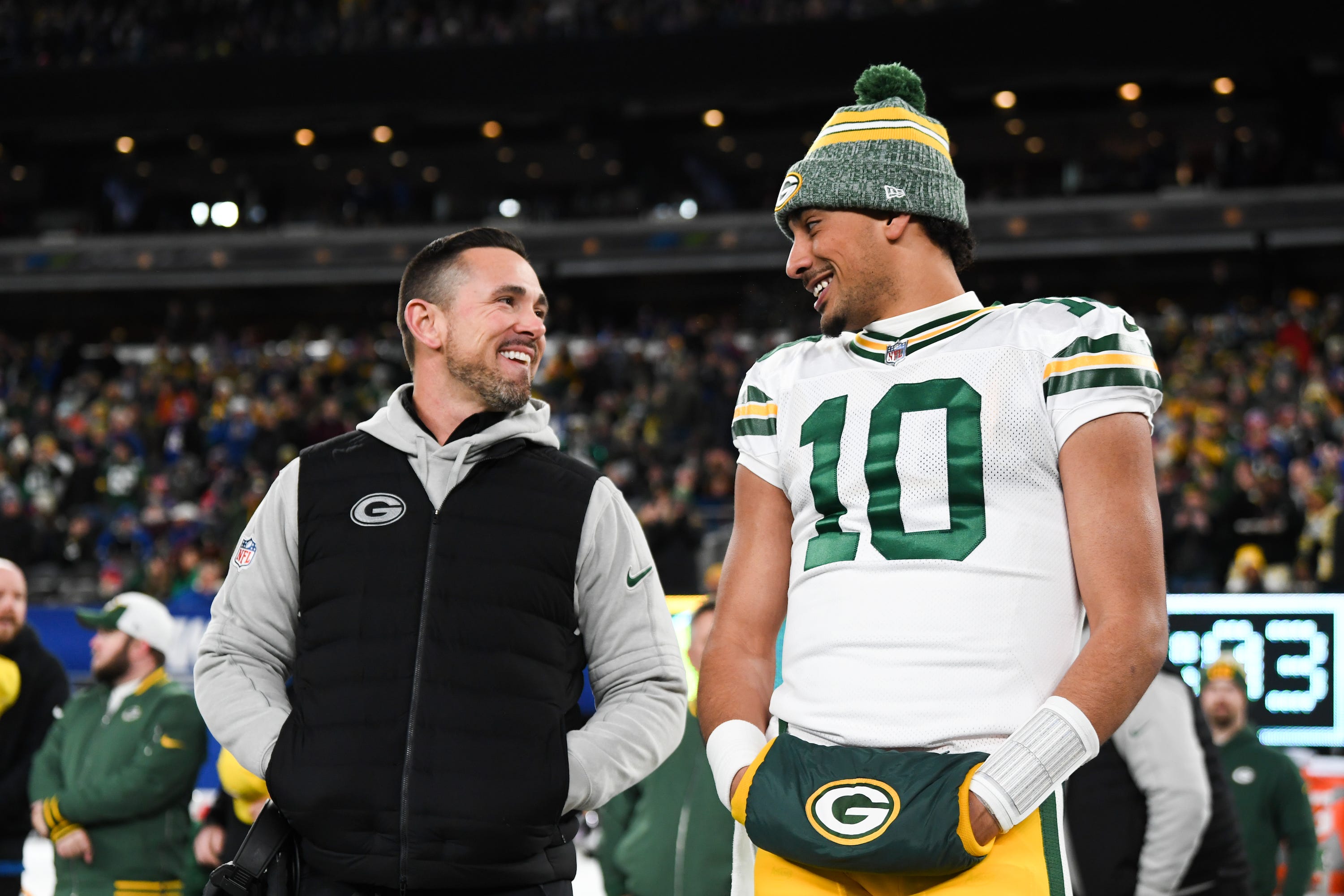
Those who believe LaFleur is the man to lead this team believe it’s important to make one distinction.
True, it’s Year 8 overall and coaches almost never win a Super Bowl beyond this point with a club. But it’s also only Year 4 with Love as QB1 and, each season, the coach has been putting more on his quarterback’s plate. There’s immense value in these two growing together within an intellectually demanding scheme. This was the central point made by retired quarterback Matt Hasselbeck in our offseason Q&A. The 18-year-vet cited the fact that 21 new playcallers were taking over units this season. He’s lived in the eye of the storm himself. He’s survived countless turnover. It is not fun. Year-to-year-to-year synergy is a gift.
Look around the NFL. What can seem hunky-dory on TV is often a completely different story.
In Buffalo, those ESPN snow angels were a red herring. Josh Allen and Sean McDermott were never fully aligned. The latter never understood that the franchise should funnel through the former. One high-ranking source told me that some members of the organization were frustrated McDermott fixated so much on his infamous 9-11 speech going public and not our reported issues with Allen in Part III of that series. McDermott, this source adds, viewed Allen as “a burden.” So, the Bills gave Allen a literal seat at the table through their nine head-coach interviews and hired a new head coach, Joe Brady, who gets it.
In Green Bay, no way is LaFleur bitching to other coaches about his quarterback building a house as McDermott did. No way is he ever going to hold him back. The keys to the offense have been handed to Love. Source in personnel and coaching laud LaFleur’s eye for “space” with how he attacks defenses. Going all the way to back to Mike McCarthy, Mike Sherman and Mike Holmgren, he adds, the Packers have treasured schematic stability on offense.
Yet, here’s another timeline worth considering.
It’s also been 15 years since this team’s last championship appearance. Everyone is starting to feel the pressure to win a title.
“All that matters here is winning championships, so Matt is going to feel that pressure,” this personnel source says. “That’s not a bad thing. We all do. There’s not a day goes by that you don’t think about it.”
Fresh off three straight wins over NFC North foes last season — at 9-3-1, into mid-December — it appeared LaFleur and Love were speeding toward the sport’s apex. One day after a stirring 28-21 win over the Chicago Bears, I caught up again with Steve Calhoun. A man who knows Love better than anyone on earth. The longtime mentor/private coach wasn’t pleased that Love threw an early ball off his back foot in an otherwise sterling performance. “Are we trying to be great or do we want to be average?” Calhoun asked. “We want to be the best that’s ever done it and we want to win a Super Bowl.”
Then, the Packers headed to Denver. Already down tight end Tucker Kraft, they lost edge rusher Micah Parsons to a torn ACL.
Worst of all was the non-reaction to Hufanga’s dirty play.
From afar, Lang could only grit his teeth. He did not like what he saw one bit.
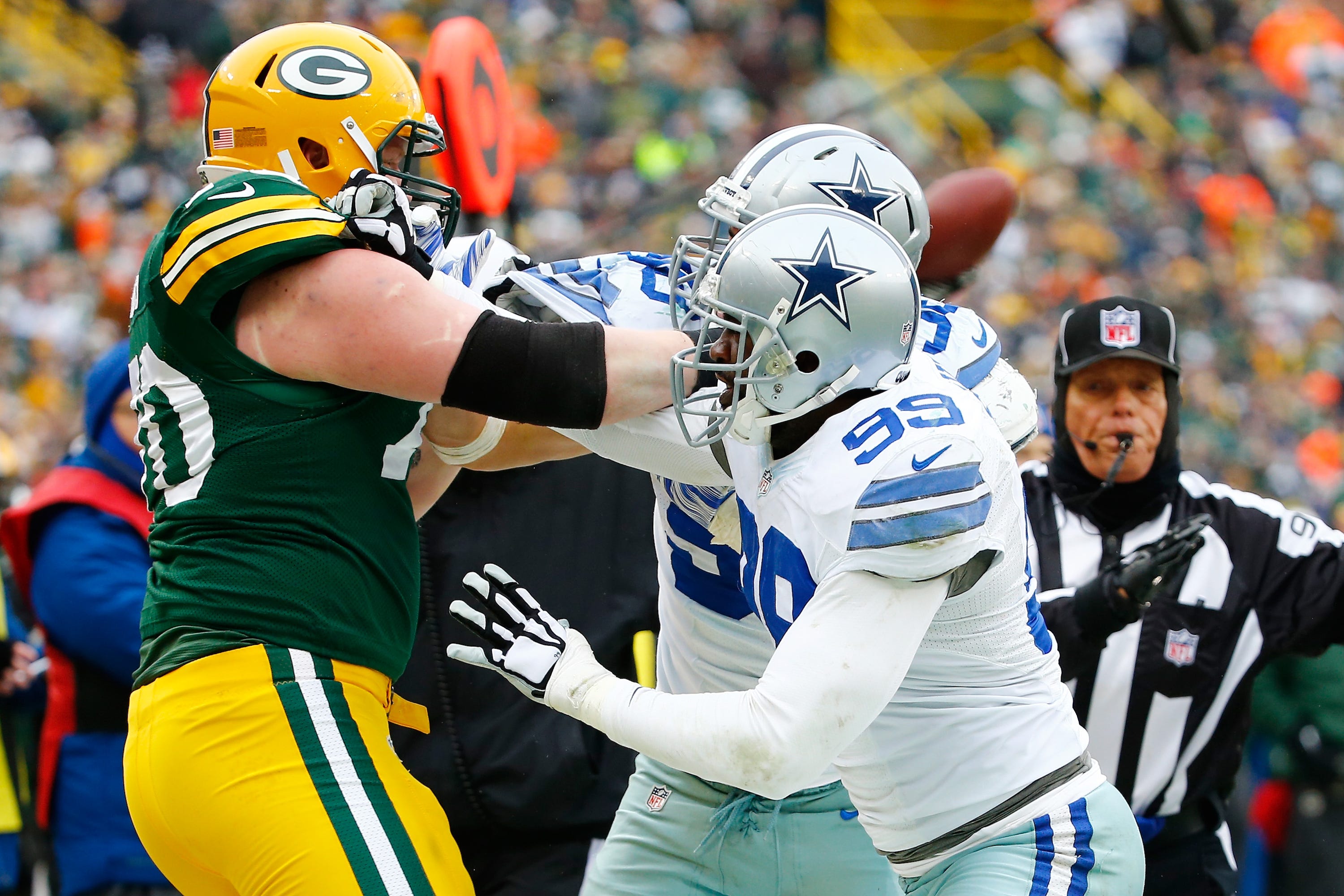
The Dallas game wasn’t the only time Lang transformed into a Spanish Fighting Bull. Into 2015, the very next season, he did the same thing to KJ Wright when the Seattle Seahawks linebacker slammed tight end Richard Rodgers’ head into the ground. “Fucking dove in there,” Lang adds, “and went ballistic. Started mauling guys.” And if anyone touched Aaron Rodgers, they knew there was hell to pay. A diehard Detroit Red Wings fan, Lang relished being this team’s Bob Probert/Darren McCarty/Joe Kocur rolled into one.
To him, today’s Packers appear to be a team that’d rather let the opposition throw a punch and do nothing in the name of 15 precious yards.
Logic that disgusts him.
Logic that fails to understand the big picture.
An NFL locker room is unlike any ecosystem in the country.
“I don’t want to be out there, get cheap-shotted and then watch all of my boys do nothing because it’s like, ‘Coach doesn’t want us to get a penalty,’” Lang says. “Fuck that shit. And that’s the thing I loved about McCarthy. He was no bullshit: ‘You don’t fucking let anybody fucking bend you over. You don’t let anybody take a shot at you. You don’t let anybody take a shot at your teammates. You stick up for yourself. You stick up for your teammates.’ That’s the most important thing — especially being an offensive lineman. You’re the big guys on the field, dude. You’ve got to stand up for your boys.
“And if you don’t do anything about it, other teams see that on film and they’re going to be like, ‘OK, they’re soft. They’re not going to do anything about it. Let’s give this guy a little extra shove after the play.’”
Watch any Packers game closely. Love has taken his share of love taps through the echo of the whistle.
OK, if the game is on the line with one minute left, Lang was not going to submarine through a man’s chest. There are rare exceptions. But he cannot stress it enough — football demands a “deeper connection.” LaFleur may dominate spreadsheets and whiteboards and forever serve as the apple of the All-22 Expert’s eyes.
Until the suits on Park Avenue ban tackling, this remains a primitive game.
Me vs. You.
Lang wanted his teammates to know that nobody in their right mind would screw with them as long as he was on the field. Josh Sitton, too. The Packers certainly felt the absence of both players in 2017. With this element of fear removed from the field, Bears linebacker Danny Trevathan knocked out Davante Adams with one dirty helmet-to-helmet hit. Nobody responded. Seventeen days later, Vikings linebacker Anthony Barr broke Rodgers’ collarbone. Again, nobody responded.
It didn’t matter if it was the all-galaxy quarterback or, as Lang eloquently puts, a “slapdick rookie.” He prided himself on an immediate response.
“Teams watch it on film,” Lang says. “Teams say: ‘Oh, look, they didn’t do anything about that. That’s embarrassing!’ Especially when it’s your quarterback. If that Denver play would’ve happened to Aaron Rodgers, all five of us offensive linemen would’ve beat the shit out of that guy and got kicked out of the game, Mike McCarthy would’ve been like, ‘Whatever. It sucks, but you don’t do that to our fucking guy.’”
Biting your tongue — “being the bigger man” — poisons a locker room. There are larger implications here. No different than hockey. If your captain takes an elbow to the head and linemates do nothing, those linemates lose credibility and never get it back.
“A perception of softness that comes with that,” Lang says. “It doesn’t really matter if you do something the next time. Because then it seems fake. There’s a brotherhood-teammate bond that you have in those moments. I’m not calling their players soft, but from what I’ve seen? It looks like it’s coached: ‘We’ll take 15 yards.’”
It’s not only a Packers thing. Lang gets pissed watching all linemen who refuse to retaliate. Granted, this comes with a cost to your bank account. Lang estimates he was fined about $100K in his career protecting teammates.
This offseason, LaFleur stressed the need to “finish.”
Well, settling scores on the field is a true act of finishing. Someone starts a fight — you end it. And on Monday morning, the play is applauded on the big screen. Not criticized.
“We ain’t going to let this shit happen,” Lang adds. “You ain’t fucking with us today. You ain’t taking liberties with any of our players. You let the other team feel you every single play.”
Instead, post-Denver, the book was out.
One debilitating loss bled to the next. You better believe Ben Johnson had a lot to say to his Chicago Bears players in those days that followed. First, Green Bay blew a 16-6 lead with two minutes left at Chicago, bungling an onside kick. Next, they surrendered 307 humiliating rushing yards to Baltimore. Derrick Henry’s total (216) was the most-ever for an individual opponent at Lambeau Field. LaFleur opted to rest starters in a Week 18 finale vs. Minnesota.
Then came the playoff game back in Chicago.
All of LaFleur’s finest qualities were on display through the first half.
All of Love’s talent, too. If a quarterback throws for 323 yards and four touchdowns with no turnovers in a road playoff game, you should win.
Alas, the Packers did not.
Thirteen Seconds ultimately doomed McDermott.
21-3 may ultimately doom LaFleur.
The best way to understand the ludicrous nature of this playoff loss at Soldier Field is by gauging how comfortable coaches felt about Matt LaFleur’s job status before this 31-27 defeat versus after.
Up to kickoff? This felt like a done deal. Of course president Ed Policy would stick with both his head coach and GM. Continuity reigns supreme in Wisconsin. Upheaval is for everyone else. On the team website, Policy offered both individuals a strong vote of confidence by stating how “proud” he was of this team for persevering “through a litany of injuries and a very challenging schedule.”
But then the Packers suffered a heartbreaker nobody will ever forget.
Playoff losses this grisly get people fired all the time.
“Doubt,” one assistant admits, “obviously crept in.”
What happened on the shores of Lake Michigan? Let’s dive deep.
There are essentially three prisms in which you can view this disaster.
Player Error.
The simplest fix.
If one of a dozen or so plays go their way, the Packers likely win.
So many forgotten moments will be lost in time.
21-3 with :25 left in the first half. At the Chicago 47-yard line, Love drops deep, glances left, resets and heaves a bomb up the right sideline to Christian Watson. It’s overthrown. Take a little heat off this ball, and the 6-foot-4 Watson has an enviable 1-on-1 opportunity vs. the 6-foot Tyrique Stevenson. On the broadcast, color commentator Kirk Herbstreit claims Jayden Reed was open over the middle — and he is — but one Packers coach directs our attention to rookie Matthew Golden up the left sideline. He doesn’t blame Love for choosing the proven Watson. “But MG,” he adds, “cooked his guy on the other side.” Perhaps a 28-3 halftime lead would’ve been insurmountable.
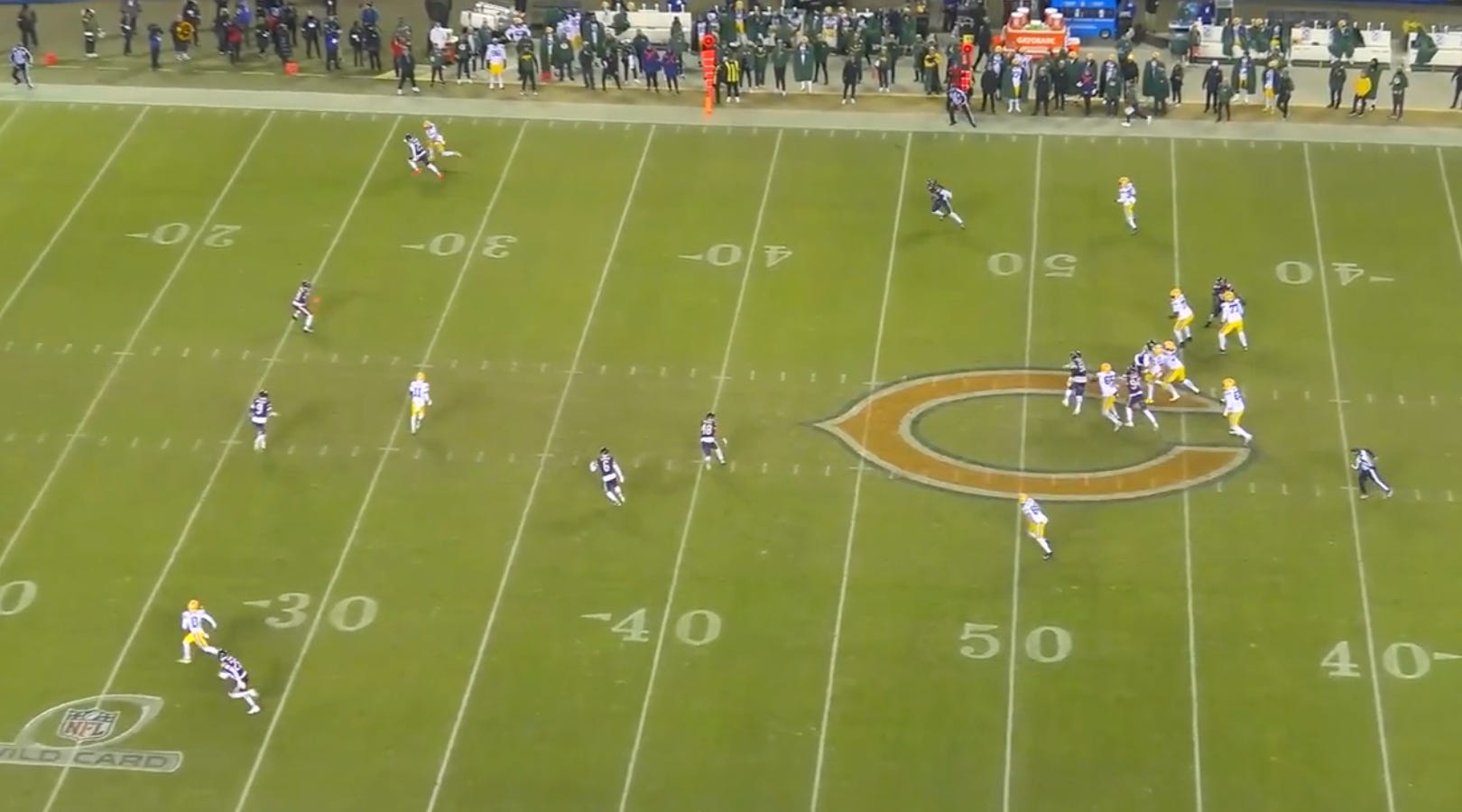
21-9, at the Packers 6, with 10:12 left in the game. D’Andre Swift, on third down, darts through the Green Bay defense to make this a one-score game. Chances are, the Bears running back scores anyways, but Keisean Nixon’s actions at the goal line symbolize this team’s late-season swoon — he completely leaps out of the way. Punch at the ball. Fight. Try. “I don’t think we were a soft team,” one coach says, “but there were examples where we weren’t physical enough.”
27-16, fourth and 8, with 5:37 left. If Rashan Gary simply holds the edge vs. left tackle Ozzy Trapilo to keep Caleb Williams inside the pocket, linebacker Isaiah McDuffie likely sacks the Bears QB. There’s no escape route. Gary, instead, washes himself into no man’s land and Williams scrambles left to twist-a-flex his body in mid-air for an improbable completion to Rome Odunze. The Bears QB later files trademarks for both the silhouette logo of this pass and the nickname, “Iceman.”
27-24 with 3:07 left. Tight end Luke Musgrave motions wide left to draw a juicy matchup vs. linebacker Tremaine Edmunds. Love knows where he’s going with this ball. If he doesn’t drift backward, if he stands firm in the pocket to loft this go ball, it’s a touchdown. At worst, a defensive pass interference to place the ball at the 1. But he gets sloppy with his mechanics, and his ball is both underthrown and uncatchable. Precisely what Calhoun pointed out a month prior. Brandon McManus misses the ensuing field-goal attempt. The Packers kicker left seven points on the board in all.
Funky bounces that went Green Bay’s way in the first half flipped Chicago’s way in the second. One snap before Williams’ fourth-and-8 heroics, center Drew Dalman sailed a snap over the quarterback’s head… but saved himself with a false start. “I don’t think the first half was as good as it seemed and the second half probably wasn’t as bad as it seemed,” one coach on staff says, before pausing. “But it was a shit show. That’s for sure.” Particularly on the O-Line. Into the second half, Bears defensive coordinator Dennis Allen lived like there was no tomorrow and the Packers couldn’t handle his blitzkrieg. Each play, a lineman either missed an assignment or got his ass kicked. The Packers generated zero movement up front in the run game.
“Then, when we were dropping back,” a coach continues, “someone had a catastrophic fuck-up on each play. It was the same plays we were calling. It was just someone freaking out in the moment and making a mistake and it started snowballing. I don’t think we overcame that. We just needed to put together a drive. As soon as we did (to go up 27-16), the defense gave up a drive.”
Despite it all, the Packers had a chance to win on the final drive and came so, so close to their own trademark-worthy moment.
First, Jayden Reed dropped a high-cross that would’ve placed the ball around Chicago’s 20-yard line with :50 left. “J-Reed catches that 90 out of 100 times,” one coach says. “It was a perfect call in that situation for that coverage.” Reed atoned with a 20-yard reception. An injury to center Sean Rhyan triggered a costly 10-second runoff.
Then came the throw that could’ve lived forever in Packers lore.
Down 31-27, ball at the Bears 23, with :19 left. As time ticks, Love feverishly smacks his palms together to get the attention of new center Lecitus Smith. Upon corralling the shotgun snap, Love hangs… hangs… and hangs in the pocket — knowing damn well that 6-foot-6, 326-pound defensive tackle Gervon Dexter will devour him — to deliver a hole shot at the goal line to Watson. In a sea of four Bears bodies, the ball is essentially dropped from the heavens by Lombardi himself.
It’s not an easy catch. All receivers from all eras get smacked in this situation.
But Watson extends with one arm, gets drilled and the pass falls incomplete.
“If he extended — he would’ve gotten fucked up — but he would’ve caught that and gotten hit into the end zone,” says one coach. “It was close. You’re probably talking a foot, maybe, on a 30-yard throw over the middle. Less than a foot. It was such an unbelievable throw.”
On this particular concept — vs. Cover 2 — it helps to have more space in the secondary.
Call this play from the 50-yard line and Reed is bookin’ it. Reed smokes linebacker D’Marco Jackson (No. 48) out of the action and Watson may not feel the need to pull up in front of those two safeties. From the 23, the design of play is condensed. That being said, Reed could’ve angled his route higher, over the top, and cleared Jackson. Instead, Reed crossed his face and crowded the space. Watson’s brief hesitation was costly.


This play was eerily similar to “The Catch II,” Steve Young’s 25-yard TD strike to Terrell Owens in the ’98 wild card game, one of the most famous plays in NFL playoff history.
If Love and Watson connect, one coach contests, the narrative around this entire team changes. He’s not wrong.
“No one’s saying ‘Fire Matt!’ Matt and Jordan are clutch and they came through with an unbelievable fourth quarter, two-minute drive to knock out the Bears,” he adds. “But it’s this business. That’s your guys’ job is to write what happened, not what could have happened.”
I point out that his Packers have suffered several loses of the same ilk.
In five of their nine losses, they led by 9+ points.
“All very fair,” he continues. “We’ve got to figure out how to not be in that position. But it is funny how it’s so close to being completely flipped.”
Coaching Malpractice
Surf through other areas of the building and you’ll find a different interpretation of this collapse. One source in personnel points to the third quarter. Every time the Packers had a chance to choke teams out last season, they’d instead offer a little breathing room. “Those are the moments,” this source adds, “where you can’t let teams feel like they actually have an opportunity to come at you.”
The best teams play at different tempos.
At times, they speed it up. At times, they slow it down.
Up 21-3, the Packers missed an opportunity to throttle down and bleed the Bears dry.
“Depress them that way,” this source continues. “You have to execute in all those moments. You could talk about it, but if you go three-and-out, it doesn’t fucking matter.”
The best way to inflict a slow death is to run the ball. Sprinkle in play-action. Drain the clock through marathon drives that end in points. Green Bay’s rushing attack, however, deteriorated down the stretch. Bell-cow RB1 Josh Jacobs mustered six yards on seven carries in the second half. It’s not wise to repeatedly bash your head against the wall if something’s not working. LaFleur didn’t want to waste downs in the name of the clock. And by now, Love had Rodgers-like freedom to change a run to a pass if the defense loaded the box. When he tried to exploit such 1-on-1’s outside, protection caved.
One coach on staff — one who’s unafraid to critique his boss — strongly defends LaFleur’s playcalling.
“To me, there was so much time left,” this coach says. “The game was crazy enough where I think we would’ve been killing ourselves if we handed the ball off to Josh and said, ‘Hey, let’s go.’ I wouldn’t have wanted to go out like that. But what we did didn’t work, so fuck it. Doesn’t matter.”
Fair enough. LaFleur’s offense also can be too all-or-nothing. There weren’t easy chunks available in the run or pass game. A more efficient short-to-intermediate air attack could’ve helped Green Bay bury the Bears late. This is where the absence of Kraft stung most.
Part of this is on Love. Headset communication shuts off at :15 on the play clock.
“He’s mentally as good as we’ve had,” says one longtime personnel man. “So it’s just a matter of getting all 11 on the same page, getting into the right stuff and executing.”
Part of this is on LaFleur. A very large part. In retrospect, the 2025 Packers were destined for such a tragic conclusion because LaFleur never set forth a vision for how this team wins games. We’re the first to mock all coachspeak as useless, insipid gobbledegook but one Packers coach on staff argues that complementary football — or, the lack thereof — was a massive problem last season. The way LaFleur calls offense (“explosive”) clashed directly with how coordinator Jeff Hafley calls defense (“bend, don’t break”). At its best, Green Bay was a quick-strike operation. Five plays, 80 yards, TD in a blink. So when those three-and-outs start piling up, a defense designed to force opponents to go 12-plus plays per drive gets gassed.
Everything snowballs.
Finding a rhythm felt impossible down the stretch.
Some games, it would’ve been smart for LaFleur and Hafley to agree they’ve got to win a “13-10” slugfest. Control the ball. Limit shot plays. Grind it out. Some games, it would’ve been smart for LaFleur to tell Hafley to blitz. Take chances. Embrace a shootout. If they’re going to score, let ‘em score quickly.
When LaFleur scripted gameplans, there was no overarching thesis that accounted for both units.
“It doesn’t necessarily need to be told to the players,” one coach adds, “but as a staff, we’re on the same page with how we want to win a game. And I don’t think that was talked about enough. Their philosophies were different. Which is tough. It was two separate units trying to play their ball. And that’s not the best answer.”
Per Sharp Football, the Packers averaged only 8.9 possessions per game in 2025, the lowest rate for any team in any season since at least 1999. This made life hard on a defense giving up 10-minute drives. (“You’re going to be dead by the end of the season.”)
There was zero animosity. LaFleur and Hafley, this coach adds, were “super tight.” Simply, the two were trying to win two different types of games.
Rare is the offensive wiz who relinquishes playcalling duties. It takes a suppression of ego. Many times, this is Step 1 toward firing yourself. Nonetheless, taking a more CEO-like approach could’ve opened up LaFleur’s eyes to this discrepancy. With his face buried in a tablet between offensive series — talking to Love, plotting his next sequence of plays — he never saw the forest from the trees. Perhaps a step back helps him realize if a game is trending toward 13-10 or 38-35, and he can offer real-time input to the DC.
Suggest this as an option and multiple assistants cite playcalling as one of LaFleur’s strengths.
The No. 1 problem with the Packers in this wild card defeat is even more holistic.
No killer instinct
Back in the gritty town that made him — Milledgeville, Ga. — Javon Bullard unloaded.
Zero words were minced over dinner with Go Long. The Packers’ headhunter was still fuming over his loss to the Bears because “Bull” could still picture the look of pale dread in the eyes of those Bears players when Green Bay was dominating.
Earmuffs, kids.
“We’re on y’all ass and you’re acting like you motherfuckers don’t even want to play no more,” Bullard told us. “But we need that instinct to kill motherfuckers’ hope. Like, ‘No. Not today. Not tomorrow. Y’all through. We finna beat y’all ass.’ I don’t think we’ve got that as a team yet. But we’ve got another year to prove it.”
This intangible — which is more difficult to put a finger on — is where Matt LaFleur has failed most.
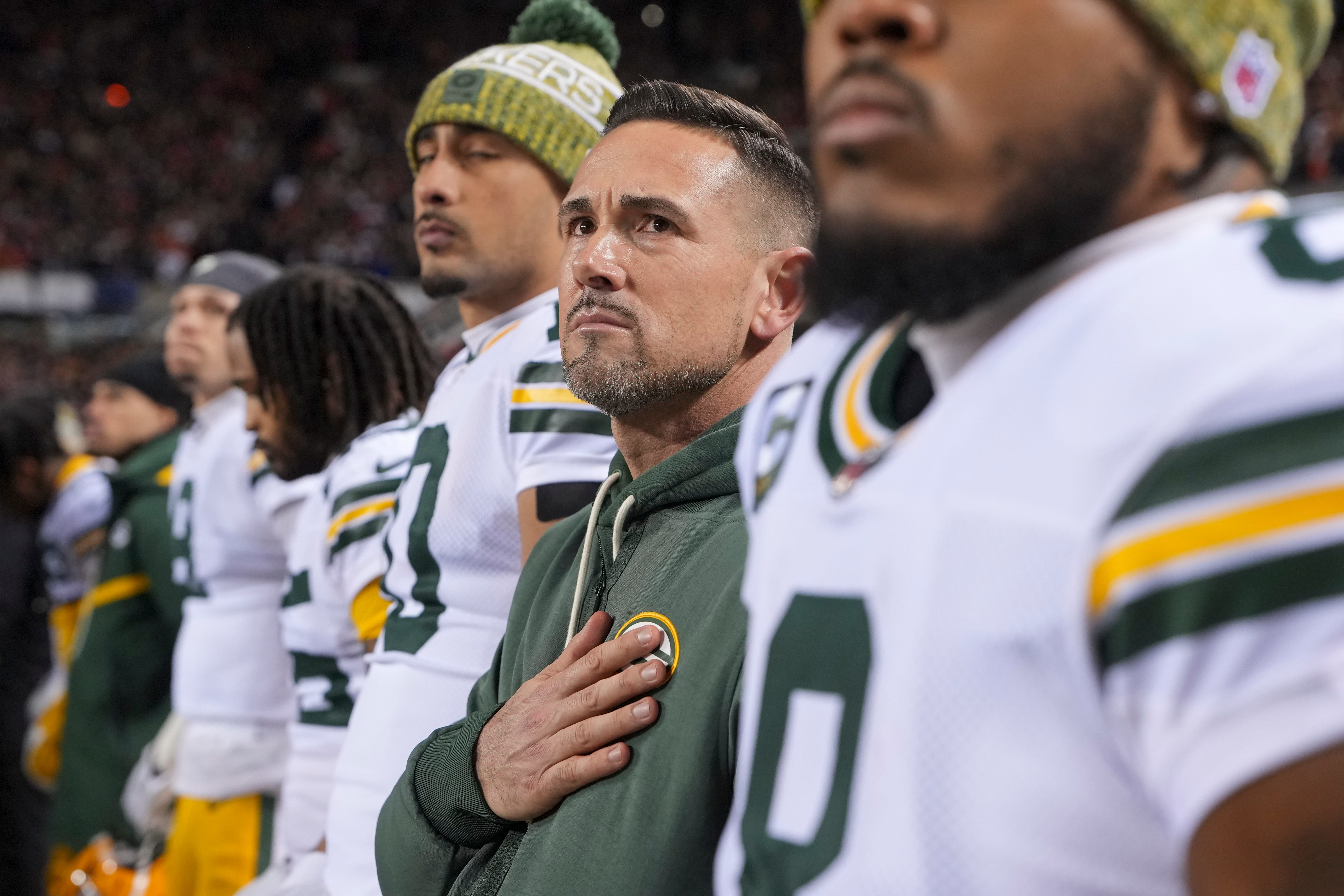
With a chance to stick a dagger directly into the chest of a hated rival and storm into a divisional round game at Seattle, his Packers puckered up. Here in Western New York, countless Buffalo Bills players felt the same exact effect in their playoff losses under McDermott. As one veteran on those teams explained, “You make a good batch, but then he just adds a drop of poison in there and it makes the whole thing bad.”
The same defect is evident in LaFleur’s teams.
One silver lining? Through all interviews for this story, injuries were never used as an excuse. Those in both coaching and personnel maintain the team should’ve adapted and evolved the way they play after losing Micah Parsons, Zach Tom, Tucker Kraft, Devonte Wyatt and Elgton Jenkins. One high-ranking source insists injuries did not kill the Packers’ season. Rather, “situational football.” Third down. Red zone. Controlling the game with short passes when the run’s shut down.
All of which leads us to an age-old, chicken-or-egg debate.
This 1-2 start to the 2026 NFL season is a bad look for Gutekunst’s build on the offensive line. Less than one month after expressing full confidence in the young linemen on the roster, the Packers GM was scrambling for three vets to save the season: Laken Tomlinson, Mekhi Becton and Kevin Zeitler. He’s hoping a player like Zeitler proves to be what Bruce Wilkerson was for ex-GM Ron Wolf’s Packers in 1996. With Jacobs suspended, the team’s also been S.O.L. at running back. Criticism is warranted.
Still, most head coaches in this league would kill for this quarterback, this Canton-tier edge rusher, this collection of weapons and, as examined in our piece on Bullard, the GM has infused the roster with malice. Gutekunst has taken risks his predecessor would not in nasty temperaments like Rhyan, linebacker Edgerrin Cooper, “Bull.”
Bullard is a man who hates everything about Chicago (except their food) and doesn’t care who hears him. Multiple times in our conversation, the nickel back implored his head coach to stand up. He didn’t like Ben Johnson’s antics. “Don’t let him try to shit on you like that,” Bullard said.
Asked publicly about this feud, LaFleur has been coy. Downplays it. One person close to the coach assures bad blood is now mutual.
Green Bay and Chicago will meet again on Oct. 11.
Bullard promised revenge.
“They got two little wins last year,” Bullard said. “But don’t forget who the big brother is. We’re still big brother. They got a long way to go before they can try to shit on us. But we got to show them, too. We can’t just talk that shit. We’ve got to be about it. So it’s going to be hell next year, man. It’s going to be hell.”
Unfortunately, it’s been a different kind of hell thus far.
The boss man’s reaction to the Atlanta Falcons desecrating Lambeau Field was actually quite encouraging. In the wake of his team’s blowout loss, Matt LaFleur didn’t seek the nearest chair and go full Bobby Knight behind the scenes. Hardly. Less than 24 hours later, sources inside 1265 Lombardi Ave. describe the Packers coach as steady.
LaFleur acknowledged that Green Bay got its ass thoroughly kicked, but those around him didn’t sense any panic.
Calm that was appreciated by those who’ve absorbed so many tongue-lashings over the years. LaFleur made it clear the Packers would not be blowing anything up. There was no need to sleep at the office until they solve X for Y. He held an informal open forum with coaches on Friday and then gave everyone the weekend off to clear their minds.
“But yeah,” admits one person who works daily with LaFleur, “it was a fucking ass-whooping.”
It’s a new season. Allegedly. The same haunting scene is set on repeat. These Packers are something like those three college kids in the Blair Witch Project hiking all day through the wilderness only to discover they’re right back where they started. Infuriating for all parties involved.
Bad breaks are a guarantee in pro football. It’s how you respond.
Far too often, LaFleur’s team spirals.
In Week 1, a fourth-and-1 sneak from the Vikings’ 17-yard line failed in the fourth quarter and the U.S. Bank Stadium roof caved in. A flurry of blitzes ate this line alive. Instead of taking a double-digit lead, Green Bay lost, 39-22. In Week 3, a fourth-and-1 pass from the Falcons’ 8-yard-line failed. Instead of cutting the deficit to a field goal, the Falcons pieced together a demoralizing 92-yard drive. One coach also points to an early third-and-11 roughing the passer penalty that kept Atlanta’s first TD drive alive.
Coaches emphasize strike zone… repeatedly. It’s not LaFleur’s fault that end Brenton Cox Jr. went high. Plus, he let up. It’s a ticky-tack call.
Point is, the Packers could not mentally recover.
Here-we-go-again dread is often written across faces.
“You’re going to get penalties,” one coach says, “but why can’t you overcome that? I don’t know.”
LaFleur is still trying to figure out why his team’s spirit breaks every time a play goes awry. He’s dangerously close to becoming comedian Tim Robinson in the hot dog suit, muttering “We’re all trying to find the guy who did this.” His answer may be in the mirror.
Policy must weigh all pros, all cons as this Packers season diverts left or right.
There are virtues worth repeating. Assistants know exactly where they stand with LaFleur. He’s completely devoid of passive-aggressiveness that can linger in other buildings. Nor will LaFleur publicly throw anyone under the bus. At the mic, he points the finger at himself and it’s no act. He’s not afraid to tell the entire team that he F’d up a play call.
He demands a ton out of you, but also himself. He’s no hypocrite.
One by one, sources praise his intellect. His tirades are rooted in wanting you at his level.
He made adjustments to his messaging. He tried to foster camaraderie with coaches last offseason with more golf outings.
But nobody’s kidding themselves. What you see in Matt LaFleur is, indeed, what you get.
He’s not changing. He’ll go out this way.
There’s plenty of time for Green Bay to right the ship. Parsons is one of the best players in the sport, period. Love’s ceiling remains extremely high. The division, hell, the conference is wide open. Mastering this intangible is the hardest part of coaching. Ask Kyle Shanahan. The 49ers head coach who laid the blueprint for LaFleur in Houston, Washington and Atlanta — and changed football as we all know it — has no rings to show for it.
Something’s amiss in the subconscious of these Packers. A belief.
Nobody’s discussing titles in “Titletown” this season. LaFleur’s calculation was that players let that Super Bowl pressure mount, but what if all external pressure was always a great thing for this team? A daily reminder of why the Green Bay Packers are forever different? With each loss, the organization inches closer to a danger zone of being like any other franchise.
Those legendary names perched on the Lambeau façade — Wolf, Holmgren, Favre, Butler and, soon, Harlan — changed the psychology of everyone associated with the team. The Super Bowl unapologetically became the end-all, be-all. Zoom out and you’ll see that Favre’s epic “Super Bowl or Bust” press conference in 1996 was an extension of what Vince Lombardi told his team in his first meeting as Packers head coach in 1959. Back when Lombardi famously said these Packers would “relentlessly chase perfection knowing full well we will not catch it because nothing is perfect.” He added: “In the process we will catch excellence.”
A standard’s been engrained into every fiber of Lambeau. Favre won one title, Rodgers won one and these Packers have made the playoffs 75 percent of the time since ’92. This team is almost never an abject embarrassment. Those boos through a 35-14 loss to Atlanta hinted at a chilling alternate universe that may be closer than anyone realizes.
Details of the extensions handed out to the men who lead these Packers have been kept under wraps. Other coaches on staff have no clue how many years LaFleur signed up for.
At this point, all anyone can care about is the here and now.
Because if they keep losing, if the same grotesque symptoms linger on, millions of dollars will prove inconsequential.
The people — the owners — will speak. Loudly.
At which point, Ed Policy will have no choice but to listen.


Interesting read. One thing you have done, Ty, is undone the perception that MLF doesn't hold his coaches accountable, which has been something other writers were putting out there.
Yes, he is a wound-tight perfectionist, and that was known when he came from the Titans years ago. They also needed a guy who could get them from Rodgers to Love successfully; again, it worked.
I think there has been, even going back to MM, a disconnect in the players MLF needs and the ones Gute brings in...if guys don't like getting chewed out when they screw up and being held accountable, then I am sorry thats not on MLF.
Gute's buying the groceries... MLF cooking. If the guy buying those groceries isn't getting the correct ingredients, don't blame the cook when it tastes bad. Dig deeper on Gute Ty.
There’s nothing in these articles that make me think Matt LaFleur is a bad coach, much less the reason the Packers have struggled. He’s highly intelligent, detail-oreinted, chasing perfection, holds his players, staff, and himself accountable. That’s what people expect from an NFL head coach. Dunn keeps trying to draw parallels between LaFleur and McDermott, but the only thing I see is that they’ve had a few awkward moments in front of the team and Matt has reportedly really grown here. Really this article sounds like it’s the players’ messing it up, especially looking at what Dunn writes about the Bears layoffs loss. I gotta say, I see a demanding, hard-working, earnest head coach that really wants to win and is willing to endure the painful parts of growth to get there.