

ORCHARD PARK, NY — Staring down, he taps his foot on the hard carpet underneath his soles. There’s no cushion, no give at all. The sight of something so dull transports Joe Brady back in time. All the way back to Jan. 6, 2013. He was a college senior with exactly zero coaching prospects at the national coaching convention in Nashville.
He was also exceptionally naïve.
Brady knew that his buddy, DJ Mangas, had a hotel room at the convention’s Gaylord Opryland resort and figured he was good to go. The two were college teammates at William & Mary and Mangas, now coaching at D-III Hampden-Sydney, assured Brady he could tag along. Surely, this meant two beds for two guests. Yet when he showed up, Brady realized there were three Hampden-Sydney coaches bunking in this room.
He was the outsider.
There were no blankets to spare. Mangas threw him a pillow.
Brady taps his foot again.
“I was literally on this,” he says.
Somehow, Brady was more distressed during the day than at night. In his mind? Landing a full-time job was a slam dunk at this monstrous convention. Brady had two boxes of business cards printed up and Brady was already emailing his cover letter and resume to coaches coast to coast. He was the overzealous job seeker initiating conversation with everyone. In his mind? It’d only take one. Just one coach amongst the hundreds of D-I, D-II and D-III coaches in attendance to believe.
“Basically doing what the high school kid does with his highlight tape,” Brady says. “Will anybody give me an opp?”
Uh, no.
All cards, all resumes were treated with the tender love and care of junk mail and those annoying fliers pinned underneath a windshield.
He left town thinking he may never coach.
“It was depressing,” Brady says.
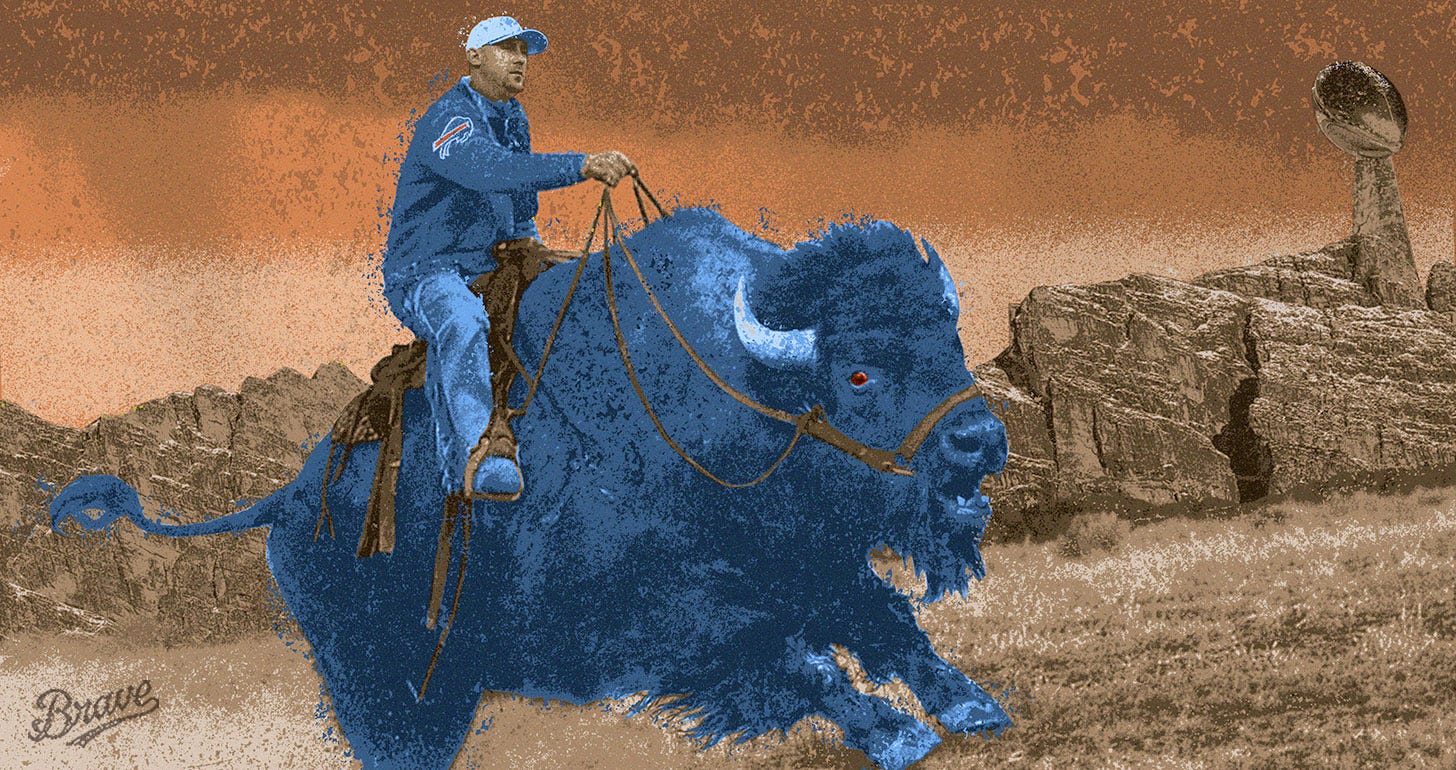
Thirteen years later, he landed the most prestigious sports job on the market. The college kid who just might’ve sold his soul to work 100 hours a week as a graduate assistant for Timbuktu Tech is the new head coach of the Buffalo Bills. Nine coaches in all interviewed for the position — Terry Pegula, Brandon Beane and the Bills brass chose the man in their building with zero head-coaching experience on that updated resume. Brady inherits a perennial title contender piloted by an MVP quarterback. A future Hall of Fame quarterback. He was hired to accomplish exactly what his predecessor could not.
Get to a Super Bowl. Win a Super Bowl.
How does he handle this pressure? He points to those three nights in Tennessee.
“By remembering,” he says, “that I slept on a floor in a hotel room.”
He thinks back to defying his coaches as the sixth wide receiver on the high school depth chart. It got him to college. He thinks back to teaching himself how to write scouting reports in ‘13. It got him his first job. He thinks back to how his relationship with quarterback Josh Allen first bloomed. A partnership was born.
“Don’t change who you are just because you got another opportunity,” he continues. “I work with the same mindset.”
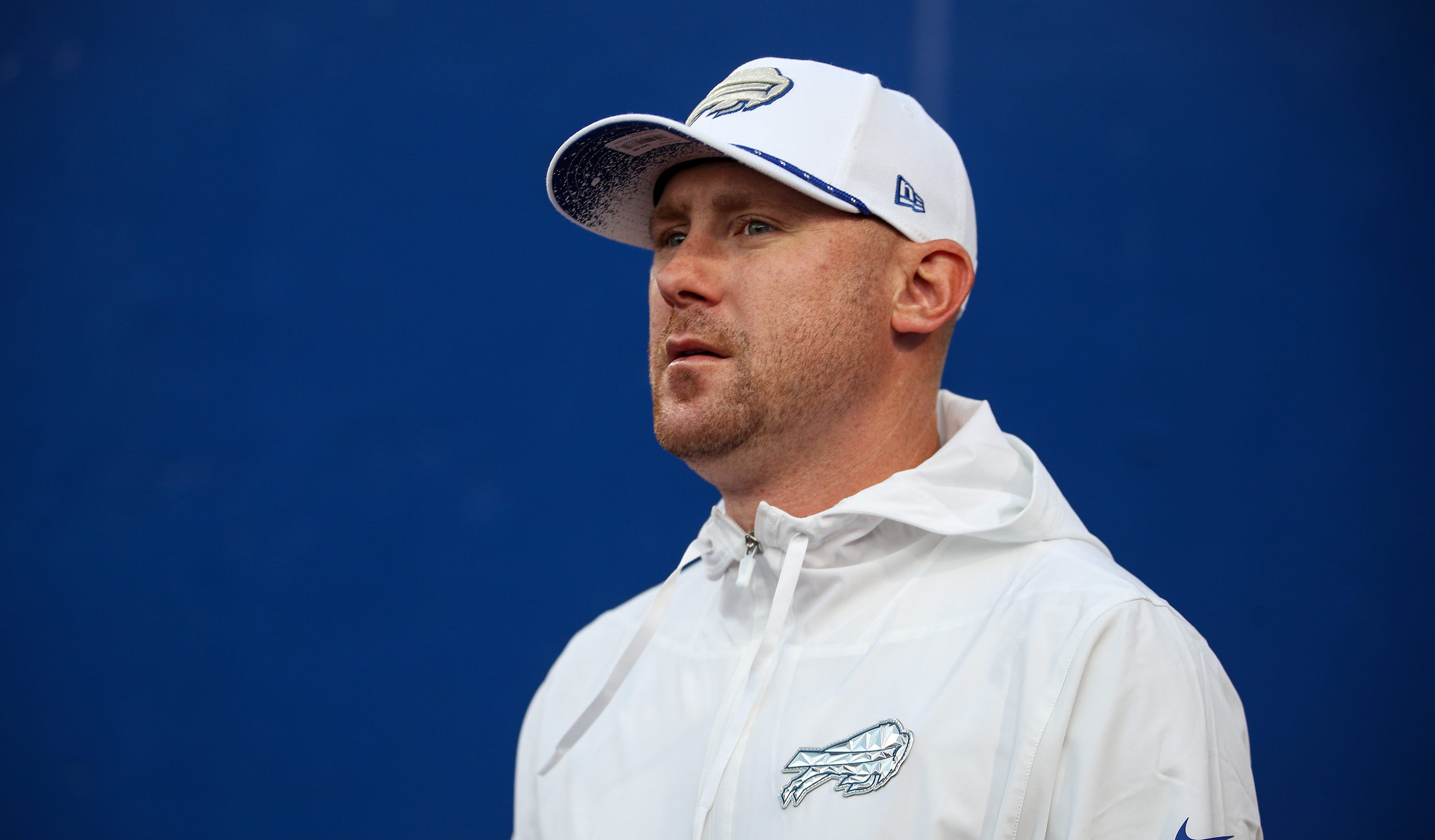
That’s a man who walked into the building this morning wearing shorts. It was 15 degrees and snowing. Tall ‘n pale ‘n perpetually bounding room to room on the strength of far too many energy drinks, it doesn’t appear as if his eyebrows have ever tilted in 45-degree rage. Don’t let kindness fool you. In the cutthroat terrain of pro football, Joe Brady has always been a carnivore who seizes the moment. Everyone may think they know the man who’s been calling plays for 2 ½ seasons. Fans love nothing more than the mysterious unknown and Brady — by a landslide — was the most known candidate interviewing to replace Sean McDermott. News of his hiring was initially treated by locals like receiving a new pair of socks on Christmas morning. Well, if those socks were first soaked in the old stadium’s urinal trough on a hot summer day.
There’s always been more to this coach than the wide receiver screen you hate or hook and ladder you love.
Who is Joe Brady?
He’s hesitant to answer, describing himself as a “close-to-the-vest guy.” An introvert. Until one story flows to the next, and the next, and the next, and two hours pass. A portrait sharpens this conversation with Go Long. He’d go even longer if not for his assistant texting that he’s due for a meeting. Time will tell if a total reset was needed. One fact is indisputable. This 36-year-old from South Florida is a striking contrast from the man he’ll replace precisely where it matters for this team at this time. Presented with an opportunity, he does not vacillate and overanalyze until that opportunity passes him by.
Brady attacks.
Go Long is your forever home for longform journalism in pro football.
We are powered — 100 percent — by you.
His press conferences will likely meander. Brady jokingly crowns himself the worst person to ever speak at a podium because his only goal in that setting is to protect his players.
“I’ll take the blame. I’ll eat it. I’ll praise when it’s good and, when it’s bad, I’ll take it,” Brady says. “But with my guys, I curse a lot. I’m passionate. There is an edge to me that I choose not to show to the outside world.”
That edge is the real story.
An intense confidence rooted in what nobody sees.
“I know how hard I work, how hard the coaching staff works, how hard the players work,” Brady says. “You need an edge going into that game. I’ll set my jaw. I want everybody to know that we’re going to try to make it a game they don’t want to play. I need that persona, that mindset. It’s not fake. It’s who I am.”
Hesitate for one second in high school, in college, in the pros and Brady knows for damn sure he isn’t sitting right here.
He starts the only place he can. The good ‘ol days of youth sports when Dad coached him in everything.
“Man,” Brady begins, “he was hard as hell on me.”
Joe Brady III routinely threw Joe Brady IV out of games, benched him, punished him and… yeah. It was warranted. Son was a ticking time bomb. Son admits his temper ran boiling hot because, plainly, he despised losing. Thinking back, he’s not sure parents even deploy this form of discipline anymore. But if he threw his bat in a baseball game, Brady was told to sit down and write six words repeatedly. I will not throw my bat. I will not throw my bat. I will not throw my bat. A real-life Bart Simpson in detention.
Drives home from practices and games were always contentious.
One baseball season, Brady vividly remembers hoping someone other than his own father drafted him.
Switching back ‘n forth between different sports got tiresome, so he admits his mindset “probably sucked.”
He gives Dad a hard time but relives all of this with immense reverence. Today, Brady hopes he’s home in time for his son’s bedtime routine when he knows his own father was back to throw a ball around every single day. All Joe III wanted for Joe IV is the father-son relationship he never had — and the football future he let slip way. Dad was a star running back in high school, briefly enrolled at Clemson and it didn’t last long. He planned on transferring to Florida State, to walk onto Bobby Bowden’s team, but those plans fizzled. Son only says that Dad “was a knucklehead idiot.” In sum, he didn’t have parents instructing him to suck it up through hard times.
He quit. A lifelong regret.
Eventually, Dad ran his own company but he made a point to tell Joe that if he ended up working for him at Brady Fire Equipment, then he failed as a parent. He pushed him.
Adds Brady: “He wanted me to do more.”
Day-to-day pressure that presented a young Joe Brady with a choice. He could repel, rebel, refuse such a life.
Instead, the two became exceptionally close. Brady knew his father’s heart was in the right place.
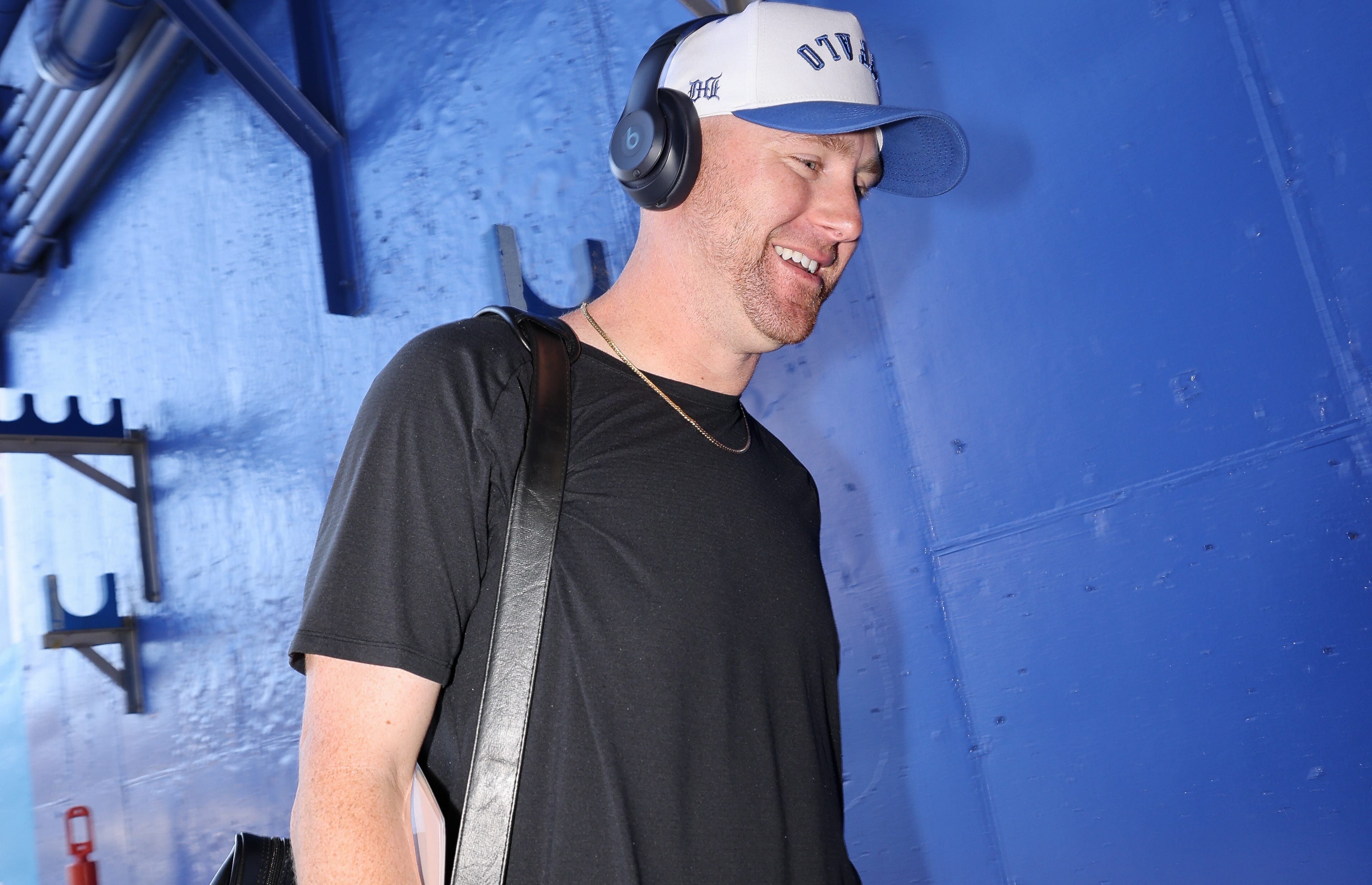
South Florida was the perfect sports breeding ground, too. This is where dreams become reality. Thinking back, one reason Brady believes he relates to players and coaches from all backgrounds today is geography. Outside of baseball tournaments in Cooperstown and North Carolina, he never left the state. All while sports constituted his entire life. His grandfather was an original season ticketholder for the Miami Dolphins. The Joes must’ve talked about something other than sports at some point in life, but nothing comes to mind.
To this day, Dad is his most trusted consigliere.
Never matters what time it is. Brady calls him after every practice. If the Bills face the New York Jets that week, they dissect the defense. Joe II isn’t afraid to offer a suggestion or two. Back when Brady was the offensive coordinator at LSU, Dad drew up a triple-option play on the board he thought his son should implement. The ball is handed off to a running back and that running back reads the defensive end. He can either keep it or pitch it back to the quarterback.
Son politely informed his father that LSU’s quarterback was Joe Burrow. Two simple words then had him fuming.
Son dismissed such a design as… “old school.”
“Man,” says Brady, shaking his head, “that pissed him off.”
That fall, naturally, Oklahoma’s Lincoln Riley ran this exact play with quarterback Kyler Murray and Dad texted the video to his son quickly as his thumbs permitted. Old school, huh? Joe IV reminded him that Burrow and Murray are quite different. But later, as the Buffalo Bills’ playcaller this past season, you guessed it, Brady had running back Ty Johnson leading quarterback Josh Allen through the hole in a game vs. the Pittsburgh Steelers. Dad brought it up again.
“He’ll be wrong,” Brady says, “but I don’t know if he’ll admit when he’s wrong.”
The same day the Bills smashed those Steelers, 220 miles away, Brady’s wife gave birth to a baby girl.
He missed it all.
He wants to be a present father to his two kids. It won’t be easy as the new head coach of the Buffalo Bills.
Quarterback was the position he played his entire life. Quarterback was his destiny. In another lifetime, Joe Brady and Geno Smith engage in 48-45 shootouts galore in South Florida. The two attended rival high schools. Those dreams, however, were swiftly dashed ahead of Brady’s freshman year.
Don’t pan your pregame binoculars toward Brady expecting to see whistling fastballs delivered between the numbers of receivers. To this day, he struggles to throw a football. That’s because during a camp at St. Thomas Aquinas, Brady threw out his shoulder. “Dead arm,” he calls it. He paid the price for throwing with all arm — no lower body torque at all — in both football and baseball.
This injury also served as the first major tipping point in his football life.
Brady switched to wide receiver. (“My Dad was just so pissed. You know, here’s this tall, goofy kid: ‘You’re not going to be a wideout.’”) On the JV team, Brady scored touchdowns on his first eight receptions. (Dad was now all-in.) Moving up to the varsity team, there was only one problem. Into his junior year, during a camp in Orlando, a coach called for five wides and didn’t mention his name. The coaches at Everglades High School did not view Brady as one of the five best receivers on his own team. “This is not good,” Brady told himself.
He didn’t transfer, instead choosing to stay ready.
The first drive of the first game that 2006 season — against local power Chaminade–Madonna — one receiver suffered an injury. And before a coach on the sideline even called the name for a replacement, Joe Brady rushed onto the field. Didn’t think twice. Didn’t care. All animalistic instinct told him to go. First play, the quarterback threw him a hitch for eight yards. Brady stayed in the game. Brady caught another pass, then another, and led his team in receiving this 34-13 defeat.
Yes, on the sideline, he was chastised for insubordination.
Yes, he was sent right back to the bottom of the depth chart into Week 2.
He proved a point, too.
That week, Brady was eating a bowl of pasta and meatballs when a coach informed him he’d be starting because a handful of his teammates got in trouble. He scored a touchdown in a 14-7 win over Nova, again led Everglades in receiving and — suddenly — the name Joe Brady ranked near the top of receiving stats in talent-rich Broward County.
Division I football became a realistic destination. He was even asked to do an interview on Miami television.
After fielding questions from a local station, walking back, Brady’s hamstring and glute felt tight. He didn’t think it was a big deal. Brady tried to practice and informed his coach he couldn’t even move. He underwent testing at the hospital, was sent home and nobody was too concerned. The next morning, he tried to get out of bed and fell. He couldn’t even stand on that leg. More testing revealed that Brady needed to be transported to the children’s hospital. ASAP. He had a staph infection, MRSA, and it had gotten into his bloodstream.
On the drive, he asked a paramedic if this was bad. The gentleman did exactly nothing to quell his fears. “There’s a chance you can lose your leg,” he deadpanned.
Brady freaked out, understandably.
“Wait, what?!” he replied. Don’t tell me that!’”
Here at Bills HQ, he points through the window toward a nearby car. Walking that short distance, about 20 feet, would take him 15 agonizing minutes. Nobody knows what caused the infection.
From the hospital that Friday night, he watched his own interview on TV.
Then, the game.
It was heartbreaking.
“For me, I had football,” Brady says. “I was so proud of staying with it, staying locked with it, finally getting an opportunity to go, staying ready when my time came. I was ready. And then finally when I was able to get the opportunity, it was taken away.”
He spent two full weeks in the hospital and lost close to 15 pounds. But with loss, came a totally new perspective on life: Appreciation. One sprint onto the field led to one ball thrown his direction and a sliver of success. Brady realized right then just how much he loved football. Needed football. So he quit baseball altogether to pour all focus, all attention into excelling on the gridiron at Everglades.
“A huge moment in my career,” Brady says, “that is so small.”
One school took notice: the Air Force Academy in Colorado Springs. On his visit, Brady watched highlights of future NFL assistant coach Chad Hall tearing up Notre Dame for 142 yards on 32 carries. Head coach Troy Calhoun had just taken over after coordinating the Houston Texans offense and made it seem as if the Falcons were modernizing into a pro-style offense that’d allow him to flourish out wide.
Brady chose the Air Force and, soon enough, was doing running back drills himself.
He also had broken his wrist in a high school all-star game before stepping foot on campus. Brady didn’t tell anybody because he figured he could tough this out. His first scrimmage with the Falcons, he broke it again and needed surgery.
Football — again — was snatched from him. Only, this time, there was no kicking his feet up on a hospital bed. Brady continued to push his body through hell as a cadet in basic training. He admits he didn’t exactly do his research on day-to-day life at the Air Force. Brady didn’t even eat the first three days of basic training because he didn’t know how to properly ask for food.
Fun was limited. Military life is not the normal freshman college experience.
“But I wish everybody would have to go through a basic training,” Brady says. “When you go from being an 18-year-old to being on your own, and you can’t think for the next eight weeks, it breaks you a little bit. So much of who I am was a product of my upbringing and then the rebranding once I went to the academy.”
If football was going to stay central to his life, though, another aggressive move on the chess board was required. ASAP. One member of Brady’s squadron had the same football aspirations as him, suffered an injury, then never sniffed the field again. A cadet who now attended the Air Force for military purposes only. It spooked Brady. He was here for one reason — football — and feared future recruiting waves would wash him away, too. So, he decided to transfer.
Dad was livid. Dad saw his own life repeating in his son. “Like, ‘Oh my God, this is my life. I can’t F up my son’s life in the same moment,’” Brady recalls. But if there’s a theme to his rise, it’s the melodic blend of hardship and instinctual conviction.
With Dad’s assistance — perhaps too much assistance, he jokes — Brady transitioned to William & Mary.
Leaning back, Brady cannot help but crack a smile and laugh. He did not suddenly live happily ever after.
One week into spring ball under Jimmye Laycock at this FCS school, he broke his foot running a route… against air. Because of course he did. Brady knows how this all sounds and agrees he was an injury-riddled mess. Initially, he thought this was only a sprained ankle. As the new guy going full Rudy Ruettiger to make an impression on the staff, no way was Brady reporting this injury to the training staff. Fresh off that broken wrist, he didn’t want anyone thinking he was brittle. He played doctor. He treated himself. Inside his dorm room, Brady Googled various remedies and learned all about RICE (rest, ice, compress, elevate) in a slapdash attempt to fix himself.
Soon, Brady had no choice but to seek help.
He spent all of spring ball in a walking boot.
The good news? Brady never suffered another injury. Bad news? Brady barely sniffed the field. His name was never invoked by coaches for dynamite plays to be deployed on Saturdays. Rather, a hint of disdain on the scout team. When William & Mary prepared to face the ACC’s North Carolina Tar Heels, Brady snatched an in-breaking route and defensive coordinator Bob Shoop lost his mind. Brady imitates Shoop’s scratchy voice here to a T. “Repeat the play!” the coach shouted. “If Joe Braaaaa-deee is catching balls on us, what do you think North Carolina’s going to do?!”
Says Brady: “I was like, ‘Damn, Shoop!’”
NFL ball was not an option. Sorry, pops.
In four seasons with the Tribe, he caught all of three passes for 34 yards.
“Balling,” he says. “I can name all those catches.”
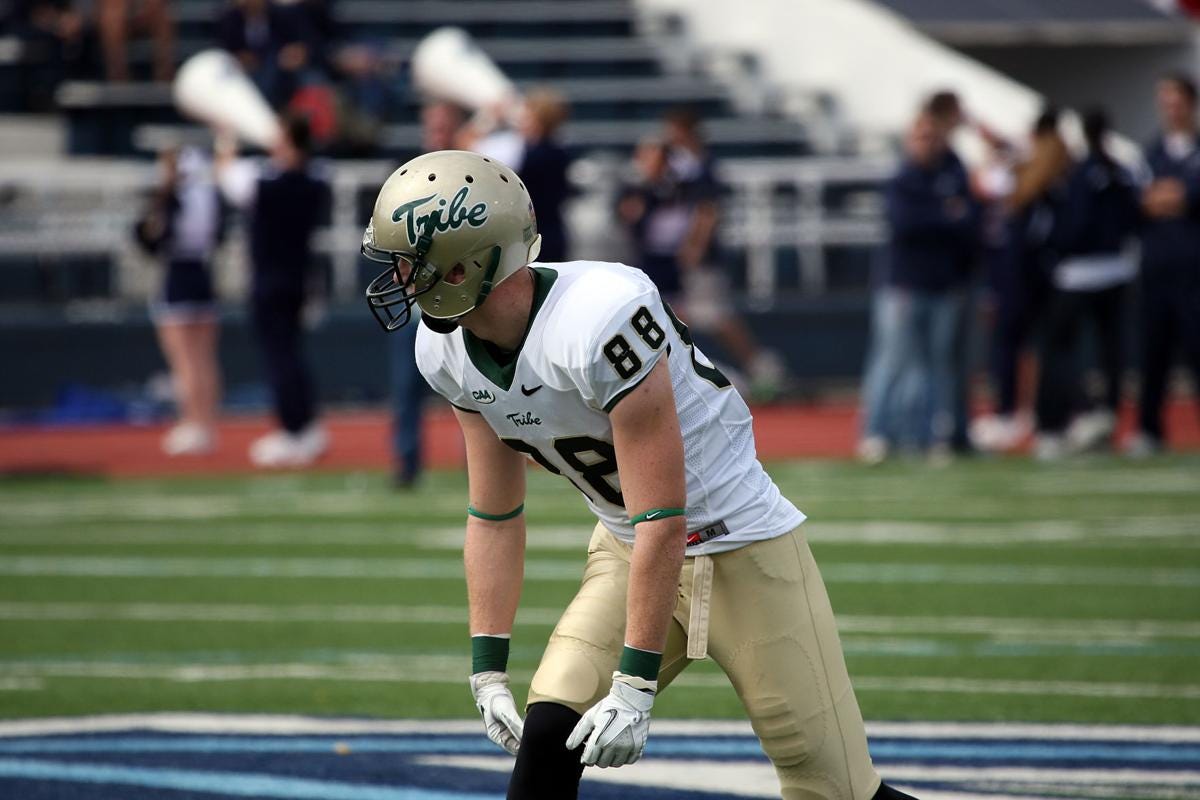
When Brady thought he’d finally get a shot at substantive offensive snaps, into his junior year, William & Mary brought in a wide receiver who was clearly more talented: Tre McBride. Rather than treat McBride as a dragon to slay or toil in self-pity, Brady (again) manufactured an opportunity. He genuinely tried to coach up a kid out to render him obsolete. McBride was skeptical. At first, he couldn’t trust a teammate who was this helpful, this generous. But for Brady, the relationship was an awakening. He understood exactly how to run routes — releases off the line, stems at the top of routes, etc. — but physically could not do it.
Now, in a way, he could play vicariously through a 6-foot, 210-pound weapon from McDonough, Ga. McBride heeded every morsel of advice, took Brady’s spot, and blossomed into one of the school’s best offensive players ever. After catching 64 passes for 809 yards with four scores, he was drafted by the Tennessee Titans and kicked around the league for five teams.
Too often, Brady would get knocked off a route, ask “What should I do differently?” and simply hear a coach tell him to do something different.
He embraced life teaching the why. This was a calling.
“The moment,” Brady says, “I was like, ‘Alright, I need to coach.’”
Of course, Brady was also a double major at William & Mary, the second-oldest institution of higher education in the United States next to Harvard. This school’s been around since 1693. Undergrads don’t kill themselves over midterms and dissertations here to become a coach. They’re seeking six- and seven-figure jobs at Fortune 500 companies, not shameless QC gigs demanding 100 hours a week for humiliating pay. Sane third parties on campus — professors, classmates, etc. — considered this a harebrained master plan.
“Like, what a waste of education,” Brady says. “And I don’t mean that in a negative way. But you don’t go to William & Mary to be like, ‘Hey, I’m going to go be a coach now.’ I could have just done that anywhere.”
Yet, he craved the sport’s entry-level serfdom and all insomnia, all microwavable dinners that came with it.
Which brings us back to that concrete-soft carpet.
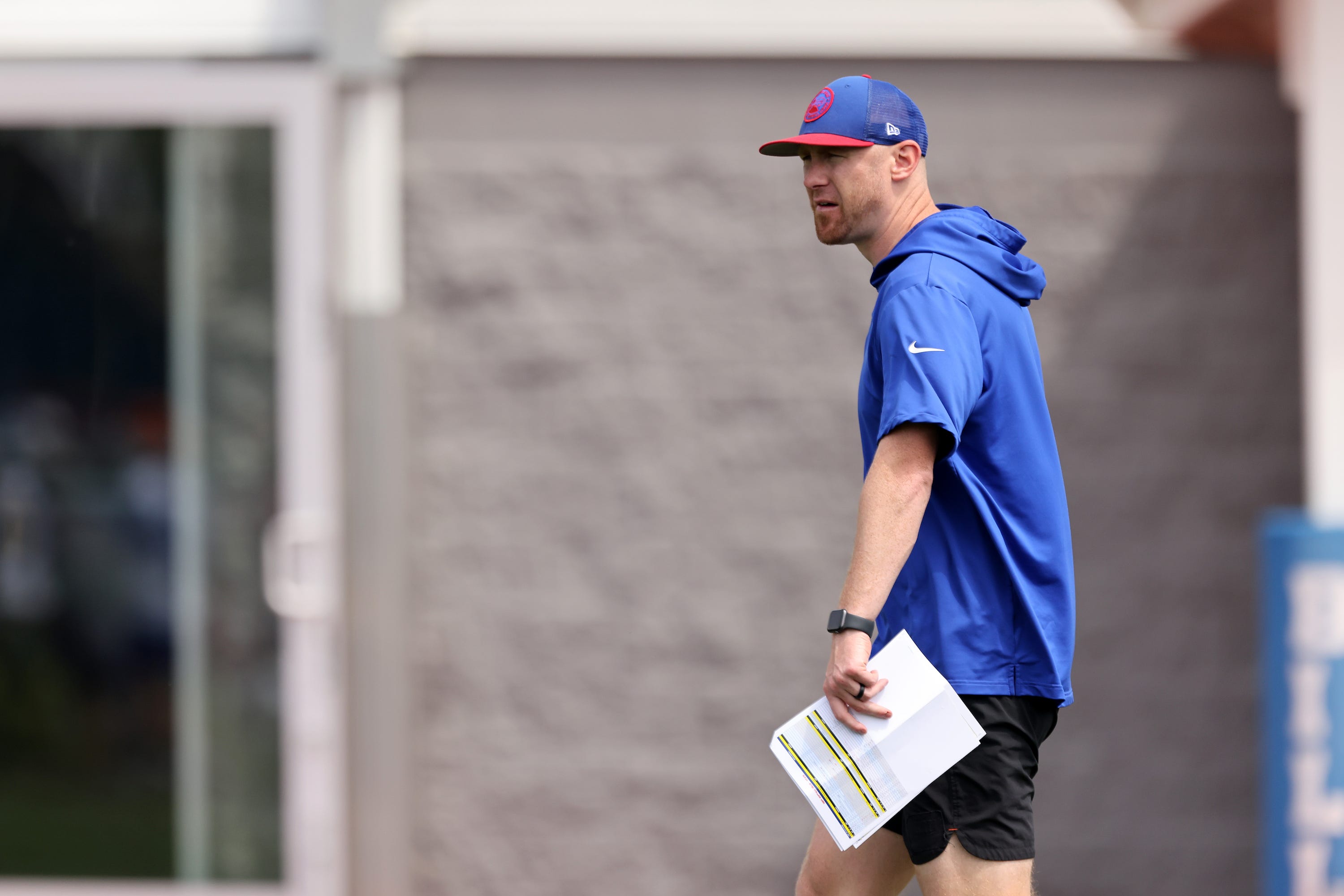
He’s one of 32 head coaches. Elite company. The face of an organization. But if this was Joe the Janitor or Joey Ticket Sales, there’s a good chance a member of the Buffalo Bills’ security staff would stop this employee in his tracks on the walkway to ask a.) why he’s up at 3:20 a.m.; and b.) why he’s wearing shorts in freezing temps.
This is no performance for social media. It’s who Joe Brady’s always been. Ask any player inside this Buffalo Bills locker room about Brady and they’ll inevitably cite his magnetic energy. How he’s a relentless tidal wave of positivity.
For a team led by the same man the last nine years, it’s severely needed. And natural.
I ask Brady where this all comes from, and he points to this all being an innate passion.
“When people are around me,” he says, “I think they can feel that. I’m not trying to be energetic. I’m not trying to be a hoo-rah guy. I’m trying to be myself. But people can feel that. I’m getting to live my dreams and do exactly what I want to do and, honestly, where I want to do it. That makes it easy. You get to come to work and it’s not like I have to be like, ‘Ugh. Here we go. I’m going to have to put on a show today.’ Yeah, I drink a lot of caffeine, but there’s no fake…”
A lot of caffeine, as in… how much today exactly? Well, Brady needed to get his blood drawn so it’s been a mild morning. An espresso, caffeine gum and, finally, Gatorade Fast Twitch No. 1 are powering him through. The caffeine element of this energy drink beverage is real — each bottle contains 200 mg of caffeine. He’ll typically drink three or four per day. And two Espresso’s. And two MEG Caffeine Gum pieces.
That’s the offseason.
During the season, those numbers all go up.
Brady does replenish his system with ample H2O, and the team nutritionist assures he’s got nothing to worry about. The same probably cannot be said for the coach calling himself “C12” in Foxborough.
Moments later, he’s still thinking about that “energy” question and pinpoints a day he’ll never forget — Jan. 6, 2013 — because it was the same day rookie Robert Griffin Jr. tore up his knee in the NFC wild card. His buddy, DJ Mangas, grew up a diehard Washington Redskins fan and they watched this game on at TV at the Gaylord Opryland Resort in Nashville on Day 1 of that American Football Coach Association (AFCA) convention.
Those fruitless three days were the turning point of his entire life.
Mangas, a year older, was already coaching quarterbacks at D-III Hampden-Sydney. Brady toted a bag of nice clothes, business cards and a notebook with the expectation, teetering on a full-fledged guarantee, that he’d land a job of his own in this psychotic world of coaching. Upon arrival, he realized he wouldn’t even have his own bed. Two of Mangas’ fellow coaches packed in the room, too.
Hampden-Sydney DC Wes Dodson had booked the room for himself, Mangas and fellow assistant Ahmaad Smith.
The convention rotates to a new city each year. Many speeches are given. Notepad in hand, Brady took copious amounts of notes. (Still has those notes, too.) He remembers Shannon Dawson, West Virginia’s offensive coordinator, discussing wide receiver technique. The previous year, Tavon Austin and Stedman Bailey tore up the Big 12. A coach from North Dakota State, Craig Bohl, was honored as the FCS Coach of the Year. At one point, the ex-William & Mary DC Shoop took a crew to a nice breakfast spot. He now coached at nearby Vanderbilt.
Wisdom was shared by all. Brady was a sponge.
Brady was also here with one goal in mind: Get a damn job.
He received a tinge of interest from FCS Marist and D-II Findlay (Ohio) before both admitted they couldn’t seriously consider him because he was still in school.
Room to room, Brady encountered mobs of young coaches gunning for jobs and promotions — a humbling reminder that he was not alone. Any 23-year-old seeking a job can feel like a guppy lost in a sea of candidates. Schools and schools of coaches swim into the same speeches… engage in the same small talk… take the same notes. An intimidating scene. Those pre-NIL days, stacks of cash weren’t piled in the coffers. “Analyst” positions weren’t concocted out of thin air. Colleges had a finite number of positions available.
“Oh my goodness,” says Dodson, now the head coach at D-III LaGrange. “There’s just so many people. That’s what people don’t understand. The coaching profession is not easy to get into because there’s more coaches than there are jobs.”
Dodson remembers booking the room. Details are hazy. He, too, had slept on his share of floors and chairs over the years. But even though he had coached at William & Mary himself in the past and his stepson played at the school, Dodson never met Brady before. Never even spoke to him before the kid showed up.
Brady’s energy stood out. He was “on the run” nonstop.
To this day, with pride, Dodson tells colleagues: “Joe Brady slept on my floor.”
“You can tell people that are always willing to just go and talk to people — they’re going to make something of themselves,” Dodson says. “They’re not afraid to go get something if they want it. That’s what you do as a young coach. Any way you can find a room to sleep in, you find a way. And that’s what he’s done. He found a way.”
Still, in the moment, the trip felt like one gigantic swing and miss. Nobody at this de facto job fair understood the Real Joe Brady. Upon landing back to Williamsburg, Va., he could’ve pivoted and put his education to use. Coaches across America most certainly threw his business cards into the trash. He only received a handful of automatic replies on email. Three collegiate receptions at a small school don’t exactly send a bat signal. Everyone in life must come to grips with football passing them by. It’s sad.
Yet, Brady did not bail. Brady refused to stay discouraged for long. Much like a 17-year-old quarterback on the other side of the country, in Firebaugh, Calif., reaching out to every Division I football coach he possibly could and hearing nothing back this same year.
He took a deep breath and looked around. The Tribe hired a new OC in Kevin Rogers this spring. Brady viewed this as another chance to learn. The longtime coach had Donovan McNabb at Syracuse and Brett Favre with the Minnesota Vikings. Brady loitered around Rogers’ office as much possible, soaking up as much knowledge as he could. Right around then, one of the Tribe’s assistant coaches on defense, John Bowes, took a new job at Fordham.
Brady walked into Laycock’s office to say he wanted a job. “He laughed at me,” Brady recalls, “and told me to get the hell out of his office. ‘Beat it geek,’ in so many words.” It wasn’t personal. Laycock explained to his backup wide receiver that this isn’t something he does. Never before had Laycock hired one of his players directly to the staff.
“Well,” Brady told him, “I’d be a great first.’”
Brady kept hanging around… hanging around… and chipped in with spring ball.
The reason Laycock shunned his own players fresh off the graduation stage is that he didn’t want assistants coaching their buddies. He believed in a healthy separation between church and state. There’s a first for everything. Both DC Scott Boone and D-Line coach Trevor Andrews thought Brady had potential. Put him on defense, they told Laycock, and he would be with a totally different crew. Boone saw a promising “football junkie.” The head coach started warming up to the idea and, as graduation loomed, informed Brady that he was bringing in three coaches to essentially audition for a linebackers position. He’d be one of the candidates.
At some point, Laycock would then decide who gets the job.
He told Brady to get the heck out of dodge after graduating. Relax. Recharge his batteries.
Yeah, right. No chance was Brady going to decelerate now.
All coaches on staff hit the recruiting trail and Brady stayed right inside the football offices preparing for his one shot. He studied the Tribe’s playbook to biblical proportions, teaching himself defensive football. He looked ahead, too. Brady authored detailed scouting reports on every single one of William & Mary’s 2013 opponents. He knew diddly poo about playing linebacker, but Brady applied what he did know — offense — to each report. The Tribe’s first opponent was West Virginia. The year prior, his old high school foe in Miramar, Fla. (Geno Smith) lit up defenses. He explained how the Mountaineers incinerated defenses.
Brady knows himself, too. He would’ve gone insane back home in waiting mode.
All instinct told him to stay right there inside those offices and teach himself how to break down tape.
“So when those coaches came back, everything was ready for them,” Brady says. “Just go. Just go. Why am I going to go away and let two other guys have an opportunity at the job?’ And I didn’t sit there and think like, ‘Oh, if I’m sticking around, it’s going to be my job.’ But, one, where am I going to go? I get to be in the office and learn the defense. I looked at it as, ‘Here I am as an offensive coach. I can bring value. I might not bring any value as a defense. I probably didn’t know anything like looking back. But I thought I could bring value as an offensive-minded guy on defense.”
Nobody told Brady to sprint onto the field for that eight-yard hitch at Everglades.
Nobody advised he sleep on a hotel floor.
Nobody made him stay at school and prepare scouting reports.
He sees an opportunity, smells blood, leaves zero doubt.
“I got the job, basically, by not leaving,” Brady says. “I was the grinder. You figure out what everybody needs and do that. Your job is to try to make everybody’s life easier.”
When coaches returned to campus, the reports were done. They were stunned. Brady remembers Boone putting it bluntly to the head boss. “Shit,” he said, “we might as well hire him.”
Brady watched clinic tape of Penn State’s Tom Bradley to learn this funky new position. He had talent in his room. Luke Rhodes has been the Indianapolis Colts’ long-snapper for 10 years and counting. It also helped that the DC, Boone, coached linebackers.
Cite the harsh reality of this industry to Boone — how those clinics are flooded with candidates — and he interjects.
“There’s a bunch of guys that want to coach, but there’s not that many guys who want to be a coach,” says Boone, now a special teams coach at Duke. “We talk about it all the time. There’s guys who are fans with whistles and guys who are coaches. And guys who are coaches don’t get caught up in all the things: the gear, the trips, the travel, the hotel. They get caught up in the ball.
“You can’t dip your toe in it. You’ve got to jump in with your full body. And Joe — early — was one of those guys.”
Endorsing Brady was a no-brainer — because of this work ethic — but then his offensive acumen popped. Defensive coaches thought they knew what offenses were trying to accomplish on certain plays. Inside meetings, Boone says, the young Brady often corrected them. “That’s not really what is happening,” he’d say. “They’re doing this to create this matchup.” He was right. That season, William & Mary’s defense held opponents to 10 points or less in six games.
Boone saw a young coach dying to learn and evolve. Every day.
“That’s probably why his track has been as fast as it has,” he says.
No kidding. When Boone headed to Nevada into 2014, Brady assumed autonomy over those linebackers for a full season and his career then took off like a rocket ship.
To Penn State as a grad assistant. Shoop, the coach needling him as a player, was the DC who helped bring him to Happy Valley.
To the New Orleans Saints as an offensive assistant. He treasured access to an all-time great coach (Sean Payton) and quarterback (Drew Brees).
To LSU as the pass game coordinator. Pressure was high. Heading into that 2019 season, Brady knew that his boss, head coach Ed Orgeron, was squarely on the hot seat with an 11-11 record through two seasons. If his offense stunk it up? Coach O was getting fired. Brady had never called one play before in his life. “Just like that guy running out on the field,” Brady recalls. “Don’t change who you are just because you got another opportunity.” LSU humiliated defenses weekly en route to a national title. Burrow enjoyed one of the finest seasons in college football history. Just like that, he was the new boy wonder in this profession.
To the Carolina Panthers as an OC. The same season his greatest weapon (Christian McCaffrey) barely played and his quarterback play was bottom tier, Brady squeezed 1,000-yard seasons out of four players: D.J. Moore, Robbie Anderson, Curtis Samuel and Mike Davis. But this 1 ½-year run was a crash-landing to that proverbial carpet. A nightmare. Brady’s tone changes from biographical to introspective thinking back to his time as the youngest active offensive coordinator in the league. Ego entered the equation.
The 30-year-old Brady thought he needed to act a certain way and admits he did not make his job about the players. Scheme dictated all in his mind.
“If I try to be someone that I’m not, if I try to act like someone that I’m not, if I try to think I have all the answers, I’ll fail,” Brady says. “And in elements of myself, I did that in Carolina. I told myself if I ever get that opportunity again, I’m not going to do that.
“That’s not who I am. Don’t get me wrong, I love going into the office and drawing stuff up. But when I’m with my guys, I need them to know that it’s not about the scheme. We’re going to win because of you guys.”
Coaches can go through their 30s, their 40s, their 50s and never accept that players should take precedence over plays. This concept is a central theme in Michael Silver’s excellent “The Why is Everything.” Kyle Shanahan quickly gained notoriety as the sport’s most inventive play designer, but it took years for the San Francisco 49ers brainiac to value the gifts of individual players ahead of those X’s and O’s devised in the middle of the night. Bring up Shanahan’s name and Brady points out a key distinction.
Shanahan was winning and winning before finally evolving.
“I had to fail for that to happen,” Brady says. “How many times did Shanahan fail? The best thing that ever happened to me was getting fired.”
Brady did not want to chase another OC gig. Not yet.
He needed a total reset and coaching quarterbacks for the Buffalo Bills made perfect sense. Everyone else in town — OC Ken Dorsey, QB Josh Allen, etc. — knew the offense better than him, which forced Brady to open his eyes and reexamine offensive football. One thing went right in Carolina. Sam Darnold, one of his rotating Panthers QBs, must’ve enjoyed something about his coaching. Because if Darnold trashed his name to Allen, a close buddy, no way he gets this job.
Heading into Orchard Park, Brady knew all about Allen, the player.
He didn’t know Allen, the person.
That changed immediately.
Read Part II here.

Related:
'He wants to win the whole damn thing:' Inside the Buffalo Bills' decision to hire Joe Brady as HC

ORCHARD PARK, NY — Before the news lit up your cell phone, Brandon Beane knew for damn sure many of you would not be happy. He was briefed on public perception. Many outsiders would inevitably view the announcement of Joe Brady as the next Buffalo Bills head coach as status quo. Safe. Brady was the familiar name, the author …
Great profile! I’m looking forward to part II.
So, so good.