


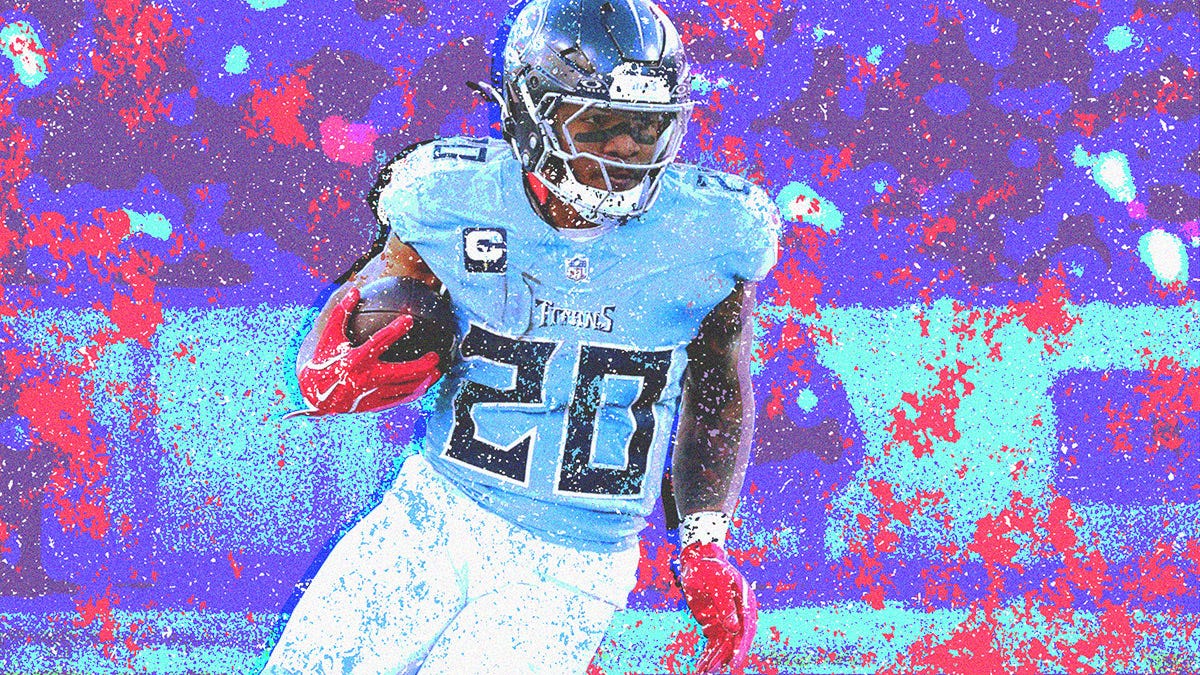
NASHVILLE, Tenn. — Madness awaits Tony Pollard. Whenever he wraps up work here as the starting running back for the Tennessee Titans, he returns home to his wife and kids.
Four children to be exact.
Four, that is, under the age of four: 4, 3, 1 and 2 ½ months.
“Chaos,” Pollard assures. “A lot of diapers, a lot of bottles.”
No nannies, no in-laws, no close friends at all assist with a single changing or feeding. Mom and Dad handle 100 percent of the parenting. And as Baby No. 4 closed in this offseason, so did the No. 4 overall pick. Pollard had a feeling who his employer coveted, too. Jeremiyah Love, a thoroughbred from Notre Dame, was mocked to Tennessee so relentlessly it’s a shock he didn’t open up a honky tonk on Broadway between Garth Brooks’ “Friends in Low Places” and Blake Shelton’s “Ole Red.”
Pollard isn’t naive.
He acknowledges all the telltale signs of an expiration date nearing.
He turned 29 in April. He has 1,568 total touches on the odometer. This is the final year of his contract. Nothing about the man’s physical stature — 6-foot-nothing, 209 pounds — suggests Pollard is an anomaly who’ll ward off the sharp regression we see from all 30-something backs. He’s a former 128th overall pick, a hybrid weapon out of Memphis who needed to prove himself on special teams before he ever received meaningful carries on offense.
Everyone’s on notice. This organization is also run by a new head coach with a new direction.
Oh, he fully immerses himself into Dad Life. The second Pollard steps through the front door, it’s on. They ask him to make pancakes on a stick. Or SpaghettiOs. His oldest loves gymnastics. She’s flipping nonstop. He’s a very, very busy father.
Even then… yeah. Pollard cannot lie.
“I heard the noise,” he admits.
A flame was relit. He found himself back in the role he prefers.
“It all put me back into the prime spot to feel like I’m the underdog,” Pollard says. “I’m easily overlooked. So it’s easy for me to get up and get going. It’s easy for me to grind and give my all every day because I know they might not be expecting that from me or they may be surprised by the things that I’m doing. I look at it as motivation.”
Right around 8 p.m. the night of April 23, diapers were put on hold. Pollard nestled into a seat and watched those first few draft picks: Fernando Mendoza to the Raiders, David Bailey to the Jets and then, at No. 3, the Arizona Cardinals selected Love. Tennessee drafted Ohio State pass catcher Carnell Tate. Good news, true, but he didn’t deeply exhale and throw himself a party. Even if the Titans did land Love, he insists the same thoughts would’ve been running through his mind: Earn your spot every day. Earn your respect every day. Earn your position.
An offseason that could’ve re-routed his career was instead reinvigorating.
One bonkers statistic served as the impetus for this trip. Look up the current running backs who’ve strung together four consecutive 1,000-yard seasons and No. 1 is obvious. Derrick Henry is a bionic man who should be studied by our nation’s top health experts ASAP. Then, there’s Pollard. That’s it. That’s the end of the list. Mainly because no athlete in sports is battered quite like the NFL Running Back. Injuries are a guarantee, you’re always deemed replaceable, nor is this Grandpa’s three-yards-cloud-of-dirt NFL.
So… how?
Go Long is completely independent. Thank you for growing our community.
From afar, No. 20 in powder blue appears remarkably unremarkable. Up close, he’s soft-spoken. The Memphis native who hails from a family of barbecuing extraordinaries speaks in a slow southern drawl. When he repeats the word “consistency,” however, it’s no platitude. It’s a lifestyle. Dive into a four-year streak he fully plans on extending to five and Pollard’s edge crystallizes.
Quickly, it’s clear to see Pollard is part of the solution in Tennessee.
He enjoys being overlooked. He labels himself an underdog multiple times.
Pollard is also a believer that “the cream will always rise.”
“Being confident in yourself,” Pollard adds, “knowing that you’re the best at what you do and even if you may be overlooked, your time will come. Keep chipping wood.”
A state of mind that sure seemed impossible to adopt when his leg literally snapped in half.
This is the best place to start. Back when the streak stood at one 1,000-yard season.
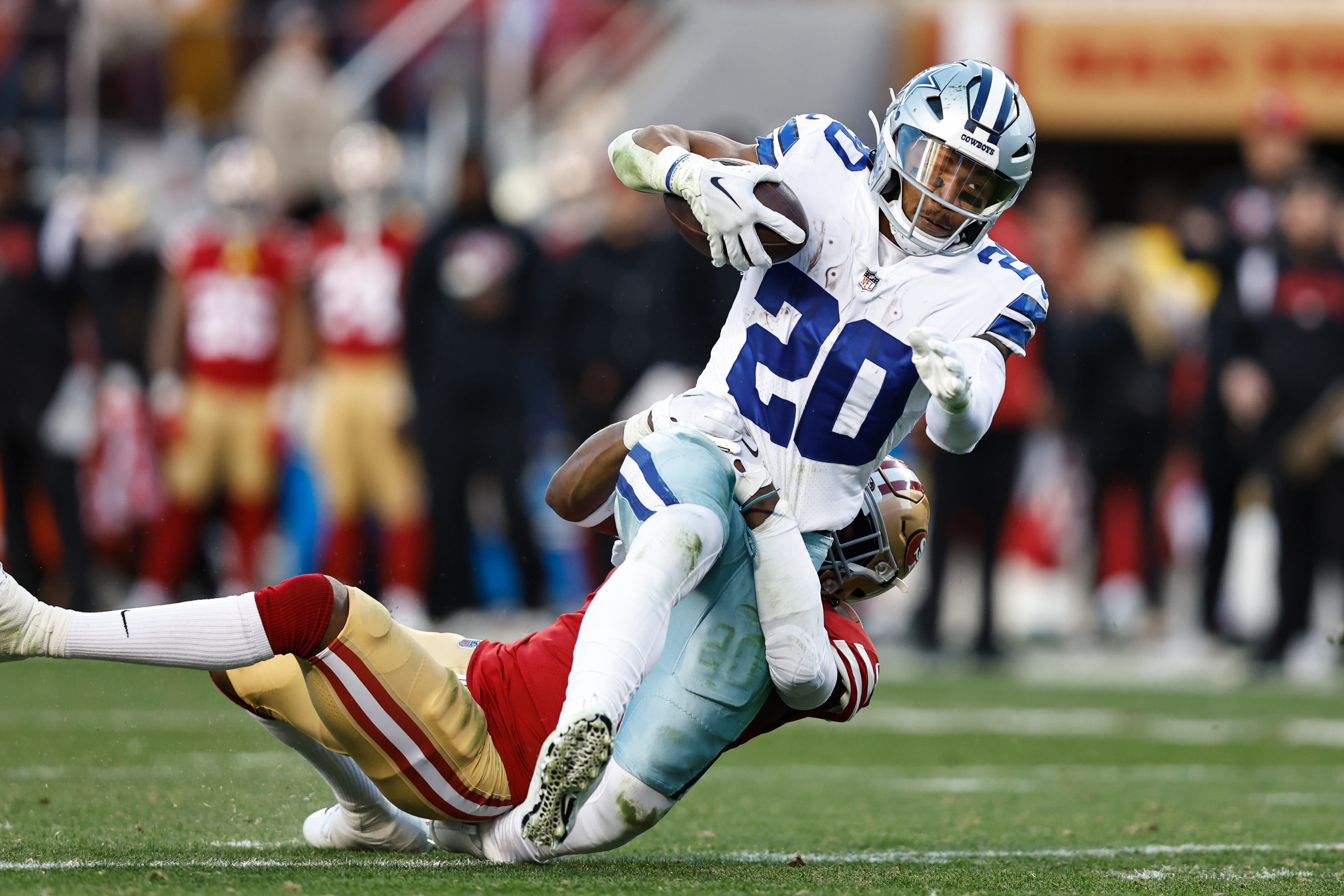
Four years later, he puts himself right back into the Dallas Cowboys huddle.
2022 NFC divisional playoffs. Tied game. First down from the Niners’ 26-yard line with 1 minute and 36 seconds left in the first half. As the crowd roared, Pollard leaned toward Dak Prescott and told his quarterback that if the first and second reads are covered, he’ll be wide open on a checkdown. On cue, Prescott dumped the ball off to Pollard, the back turned upfield and that’s when safety Jimmie Ward grabbed him around the waist and pulled him down.
All of Ward’s weight crashed on top of his left leg.
“I felt my ankle get collapsed underneath him,” Pollard says, “and then I felt something pop.”
He balled up his fists, army-crawled across the Bermuda grass for seven paces and tried to get up. He could not. Utter “shock” overwhelmed all pain. Hell, he barely felt anything. A drop of bad blood still lingers. When I ask Pollard if Ward really needed to drop his weight on top of him that, he’s quick to say “no.” The NFL itself would later cite this play as justification for banning hip-drop tackles. Still, Pollard admits the defender is in a lose-lose predicament because they’ve got to do everything in their power to get backs to the ground. There’s a reason officials rarely enforce Rule 12, Section 2, Article 18.
Either way, the damage was done.
Pollard broke his fibula and tore ligaments in his ankle.
Even as he hobbled into the blue tent and eventually the locker room, the only pain he felt was helplessness. That season, he usurped Ezekiel Elliott as the team’s best running back and made the Pro Bowl. That previous week, his Cowboys sent Tom Brady into retirement. He believes his presence could’ve gotten Dallas to the NFC Championship, then the Super Bowl.
Instead, Dallas lost 19-12. Pollard was a spectator.
“I felt like I let the team down,” he says. “That’s what ate me up the most.”
One moment, Pollard’s dreaming of a playoff run for America’s Team. The next, his leg literally snaps in half and he faces a grueling, monotonous rehab to an audience of one. Such is the shadow war you’ll never see plastered across NFL Network and ESPN. When all hopes and dreams abruptly die, a pro football player’s mental health can suffer. Sometimes, to catastrophic extremes. AJ Green helped drive this conversation into the mainstream after Rondale Moore committed suicide this offseason.
Moore is an extreme, tragic case of a darkness all players fear.
Into the ‘23 offseason, Pollard attacked each day, embraced small wins in treatment and rushed for 1,005 yards. Physically, he was cleared. He told himself, “This shouldn’t be bothering me.” But he was not the same player — not even close — because he couldn’t cleanse his mind and trust that leg. He hesitated. He didn’t fight through tackles like before.
“Once you get injured,” Pollard says, “it can be very mentally, physically, spiritually tough in all aspects of life.
“Some days, I would go out there and run and I’m like, ‘I can’t do it.’ And that’s scary. Because people don’t realize injuries in this league? They can really mess with you mentally. When you know what you can do and what you’re capable of — and then to get on the field and have to tell yourself, ‘I can’t do this right now. I can’t run. I can’t sprint. I can’t cut.’ It hurts to even digest it and accept that.”
The key, he adds, is to maintain a tight circle. Listen to your body.
Not until he got to Nashville, in ’24, did Tony Pollard feel like Tony Pollard again.
A rare threshold for pain fuels his career. He refuses to tap out.
In 2024, Pollard suffered a high-ankle sprain against the Detroit Lions in late October and this hurt far, far more than his leg splitting in half.
“One of the worst pains ever,” Pollard says. “A constant pain that you learn to tolerate.”
Players often think they can simply numb up an ankle, but quickly realize it doesn’t help much at all. Toradol doesn’t do a damn thing, he explains. Not for this. He describes more of a vicious cycle. On gameday, adrenaline powered him through. The morning after? The rehab clock set. It was back to ground zero. He couldn’t put any pressure on his foot at all. Monday to Tuesday to (eventually) kickoff, Pollard lived in the training room to rehab.
Each week, he felt good enough to play. If his ankle was on fire, Pollard headed to the sideline to focus on his breathing, let the pain subside and then sprinted right back into action. His first game off the injury, Pollard plowed ahead for 128 yards on 28 carries in an overtime win over New England.
He finished with 1,079 yards on a career-high 260 carries with five touchdowns.
All for a Titans team on a 150 MPH path toward irrelevancy. They finished 3-14.
“That’s just me,” Pollard says. “I felt like I was good enough to play. I wanted to be there for the team and I wanted to finish the year off strong.”
When he looks around the NFL, he sees peers making very different business decisions.
Pollard never thinks twice and cites DNA as the reason why.
He watched his father, Tarrance, bust his ass 24/7 to grow Pollard’s Bar-B-Q on Elvis Presley Boulevard in Memphis. To this day, it’s hard to get Dad to travel 212 miles east to visit because he genuinely loves working.
Growing up, Tarrance told Tony that if you don’t believe in yourself, nobody will. That wasn’t easy when he broke an ankle into his crucial 11th grade year and missed four games. He was forced to play a manic game of catch-up. As all of Pollard’s friends raked in SEC offers, he generated minimal interest from small schools.
“Always having that mindset,” Pollard adds, “feeling like I’m the underdog and feeling like I always have a chip on my shoulder. I’ve got something to prove.”
His best offer came from the hometown Memphis Tigers and Pollard did everything. Ran the ball, played receiver, returned kicks. Onto Dallas, backing up a player fresh off inking a six-year, $90 million deal, Pollard hit rewind on Dad’s childhood message. He knew a few dynamic kick returns was all it’d take for the Cowboys to realize he needs the ball on offense. Life always felt a bit odd in Jerry’s World with stadium tours passing by and the owner holding his own press conferences after each game. “It’s definitely different,” he says. Yet, Pollard forced his way into an NFL backfield with a slew of jaw-dropping plays — “put the league on notice” — and hasn’t looked back.
We see what makes Henry special. With these Titans, he’d stiff-arm defenders into Wednesday.
We see Saquon Barkley backward-hurdle fools.
We see Jahmyr Gibbs, dust DBs who seemingly have perfect 45-degree tackling angles.
Pollard’s gifts aren’t so visible to the naked eye. He’s no Adonis. Pollard could blend into any crowd around Nashville. Suggest that he also isn’t a track star with blazing 4.2 speed and he’s compelled to interrupt. Even this self-described “mild-mannered” gentleman must set the record straight.
“I’ve run a 4.2 before,” he says. “I have.”
Fair enough. He’s got better afterburners than we’d think.
The skill that separates Pollard, however, is more nuanced.
We’ve got to look deeper.
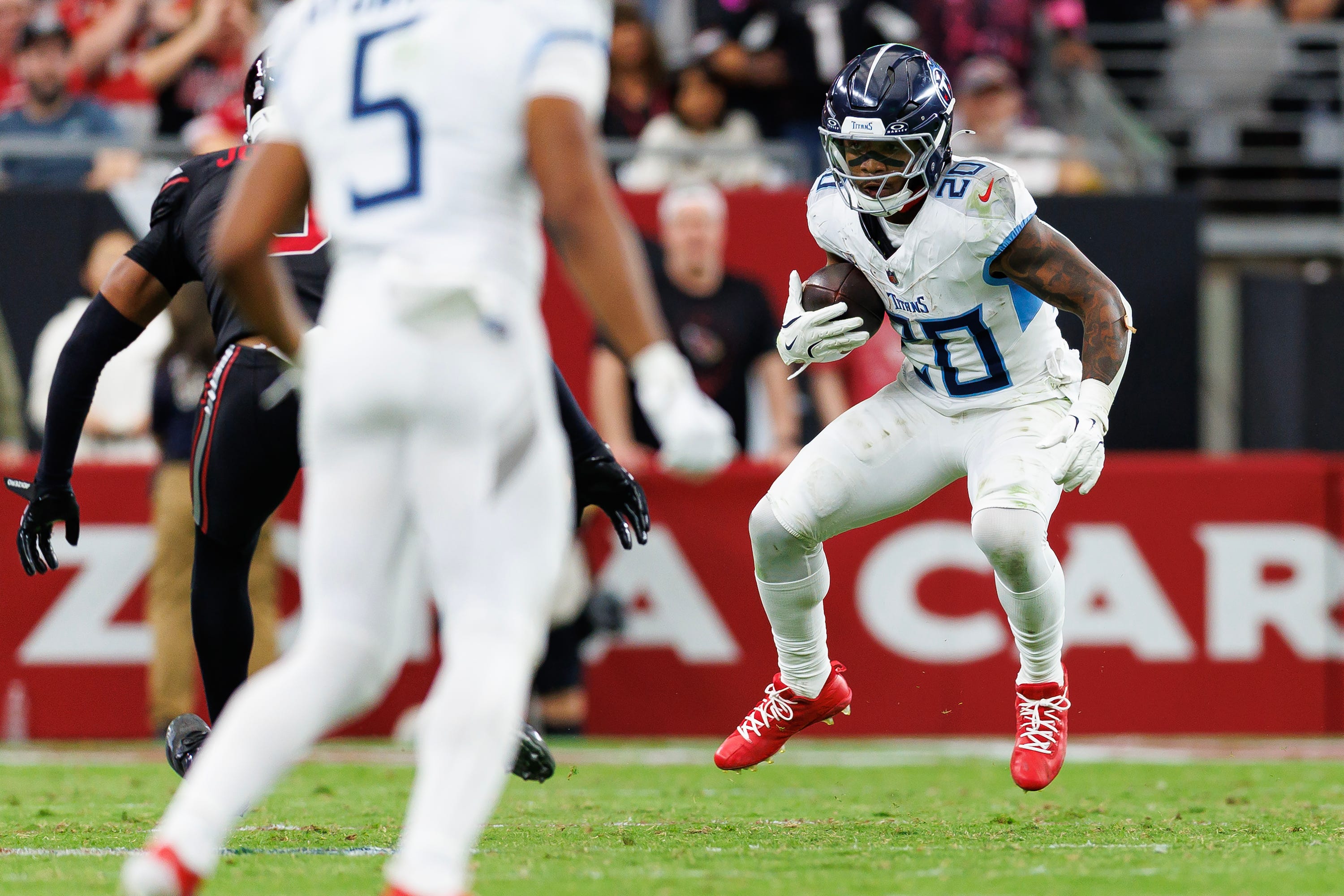
Longtime NFL running backs coach Randy Jordan has been with Pollard all three seasons in Nashville. Look up the word “pro” in a dictionary, he begins, and we’ll find a picture of this player. Attitude, effort, intelligence, leadership, how he treats his body. Jordan rattles off all the reasons and then knocks on wood because he doesn’t believe Pollard is close to finished.
In meetings, he asks for the “why” behind every play. Pollard doesn’t want to operate as some sort of robot moving from Point A to Point B. He must zoom out and study the greater picture to see, for example, how the Titans are leveraging defenders out of a 3-by-1 formation.
The more he knows, the more he subconsciously filters that intel into his rushing style.
“He’s seen it all, he’s done it all,” Jordan says. “So he can operate efficiently. And that’s what I think makes him so good. He’s a guy that you watch him run — he runs fucking hard — but you don’t usually get a big shot on him. He knows how to get skinny where he takes his body and torques and squeezes and then he just leaves about this much body surface. Whereas a rookie comes in and he’s fucking running in there and gets blasted.”
Pollard masters the full intent of a play, throttling down to Le’Veon Bell-level patience behind the line of scrimmage when required.
On trap plays, Jordan loves to tell his guys: “Hit it and get it so you say you did it.” It’s fast.
On tight zone plays, the goal is set up defenders on the first level to cut back. One or two extra seconds can feel like an eternity. It’s more of a feel.
“He knows there’s different speeds and tempos when you’re running the ball,” Jordan says. “He can put all that together. And when you look at his body of work, it goes unappreciated because he’s not 6-3, 230 pounds. He’s a guy that just goes about his business.”
The Titans’ No. 2 back, Tyjae Spears, views this ability to shift gears as a superpower because it allows Pollard to strategically place defenders on blocks. He can stay on a track and make everything look the same on a specific play through the course of a game to bait defensive linemen and linebackers into blockers.
One crevice of daylight and he slams his foot into the ground. Gets vertical.
“He attacks it,” Spears continues. “And what’s special about him, he gets skinny. He jumps through holes, he sheds tackles. One of the hardest things to do with Tony is tackle him. The first guy rarely tackles him. So he’s going to squeeze through at least two, three after contact each and every time.”
Take one handoff vs. Cleveland. Pollard stretches a run wide — waits for those dark-brown jerseys to wash down — and turns upfield 65 yards to the house. Defenders are in a bind. You’ve got to respect his speed to the corner, but how much respect is too much? Try to beat him to the sideline and he’s liable to crank the steering wheel.
Pollard never dances, either. His decisions are quick and he can easily rip right through the massive 34-inch arm of a 6-foot-5, 261-pounder like Carl Granderson.
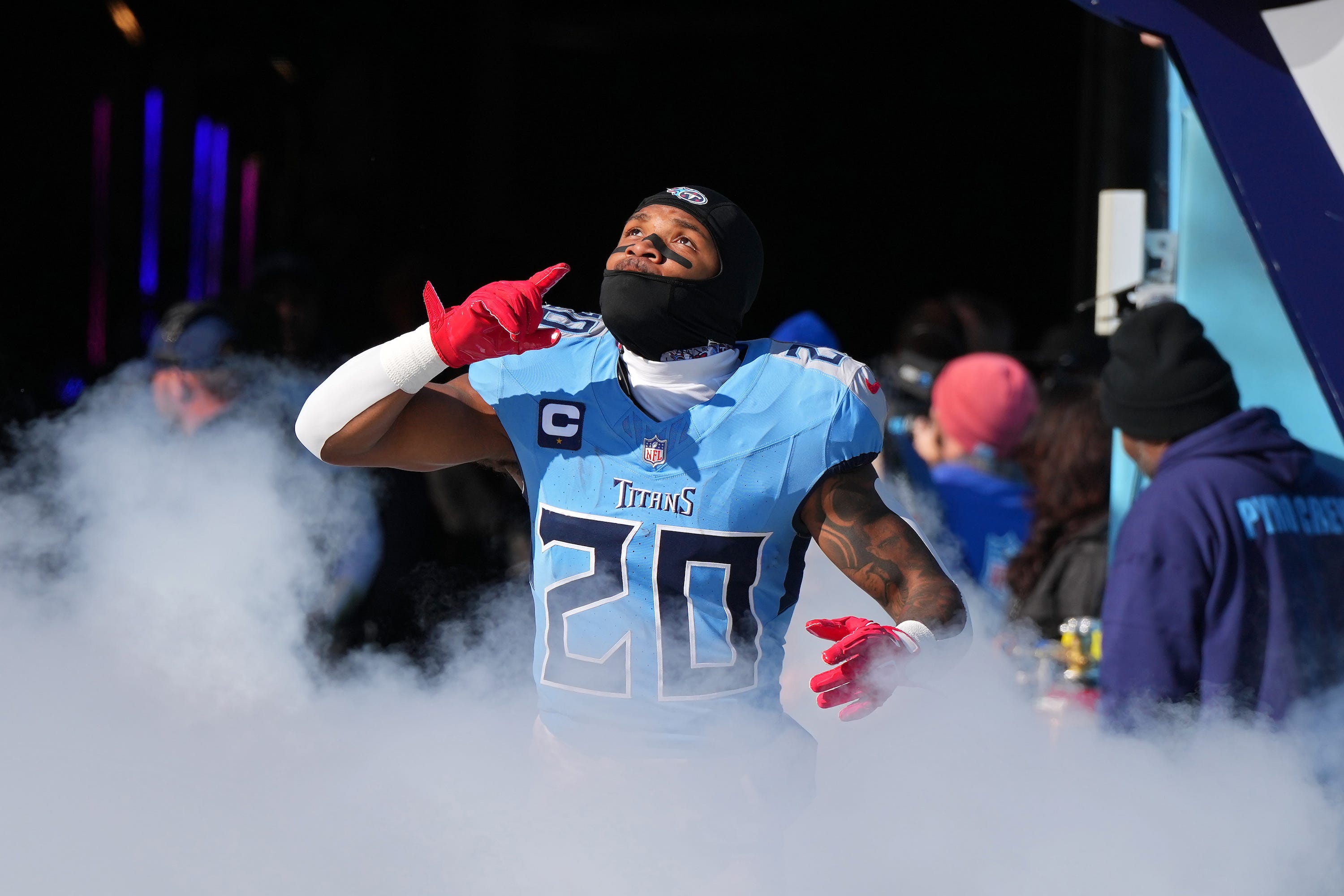
Nobody in team history — perhaps NFL history — accelerated 0-to-60 in such fashion like the player Pollard grew up watching. Chris Johnson is forever immortalized in Titans lore for his ability to effortlessly glide past defenders as if moving at 2x speed. In his second season, “CJ2K” set an NFL record with 2,509 scrimmage yards.
So, Pollard’s reaction to the news that rocked the football world this offseason was the same as your reaction.
On the morning of June 29, he was scrolling on YouTube, saw Johnson’s name, clicked the video and outright refused to believe his eyes. Right there, on Good Morning America, was an athlete with superhero strengths now completely immobile and reduced to communicating through an eye-tracking device. Johnson, of course, is now battling amyotrophic lateral sclerosis (ALS).
“It’s hard to even grasp what’s happening in such a short amount of time,” Pollard says. “I know it’s hard on him and his family. But all we can do now is just pray for them, send our condolences and just try to spread awareness for it.”
At halftime of Tennessee’s Week 1 game vs. the New York Jets at Nissan Stadium, Johnson will be inducted into the team’s Ring of Honor. The man who once treated this same field as his personal NASCAR track will be in wheelchair surrounded by loved ones.
There will be tears. Many tears. Everyone will again see how life can change to the most cruel extremes imaginable in an instant.
Perspective Pollard keeps at the forefront of his mind. Earlier this day, he and Spears were lamenting the dog days of training camp. Some mornings, they’re not exactly in the mood for 90+ degree practices. Some people work at a desk in a climate-controlled office. They crash into other humans.
But then, Pollard took a step back. He remembered it’s a blessing to feel so exhausted. Johnson’s ALS isn’t his only dose of reality. His wife’s brother was born with a deformity that renders his arms and legs useless. To this day, this brother-in-law relies on help to function on a day-to-day basis. And he’s smiling. Always. His spirits never waver.
“A lot of people would die to even be able to work out ‘til they get tired,” Pollard says. “So it helps keep things in perspective and not take things for granted. I’m really blessed that I’m able to walk. I’m able to get up on my own, move around, all of this.”
No way could the draft selection of any player any spring throw him for a loop.
Ahead of April’s draft, Pollard told his coach he was ready to compete if Love joined their backfield.
To Jordan, this player gunning for a fifth consecutive 1,000-yard season works like he’s still on special teams. “He had to fight for everything,” Jordan adds. “He knows the value of, ‘Hey, listen, every day I’ve got to fucking fight to keep my job.’”
A day in his life? If meetings start at 8:30 a.m., Pollard gets into the building by 7 to eat and slip into both the cold and hot tubs to get his mind right. He’ll review all play installs for the day, then head into Meeting No. 1 ready to ask questions. Next, it’s time for a full team meeting. Next, he makes time for Red Light Therapy. The red wavelengths of light help repair skin cells and tissue. Then, it’s time for practice… a lift… more meetings… more walkthroughs… and a return to the chaos at home.
Baby No. 4 needs a bottle ‘round the clock. Babies No. 1 through 3 want to play ‘round the clock.
A difficult combination.
“It’s, ‘Daddy, daddy, daddy, can we do this?! Can we do that? Can we do this? I want this. Can you make me this? Can you make me that?’ So, it’s nonstop.”
Not that he’s complaining. Pollard makes a conscious effort to prioritize his family.
Jordan notices. He sees a young father who doesn’t make football out to be any bigger than it should. (“If the mind’s right and the heart’s right,” the coach adds, “football will follow.”) That’s certainly been the case. With each child, Pollard felt himself leveling up at his day job. It’s no coincidence he’s getting better age 26… to 27… to 28… to 29. A large family demands optimal “efficiency,” Pollard says. Be it those 2’ish hours before bedtime at home or those 2’ish seconds in the middle of wide-zone play, he wastes zero time.
Expectations are low outside of this Titans building and Pollard’s name still generates minimal national buzz. Even locally, he’s overlooked. Fans no doubt miss the days of King Henry stampeding through defenders. Tennessee bid adieu too soon. These cleats would’ve been impossible for anyone to fill.
Pollard doesn’t care. He promises to prove people wrong this 2026 season and, yes, he’s got very detailed statistical goals.
Not that he’ll be disclosing them. He won’t go full Aaron Jones with talk of Canton. Nor will Pollard hint that a three-year rebuild can be three months like Jordyn Brooks with those Miami Dolphins.
We’ll need to see for ourselves, starting next Sunday.
“I’m going to hold it in,” says Pollard, with a brief pause.
“I’m just going to do it.”
Download the Substack app and turn notifications on to make sure you don’t miss a story or podcast:

2026 NFL Season Preview Features to date…
Thanks for making Tony Pollard story a headline! Love reading about guys like this.
Tony Pollard has my undying respect for that 2024 season. The man does not quit. Thanks for the great article!