

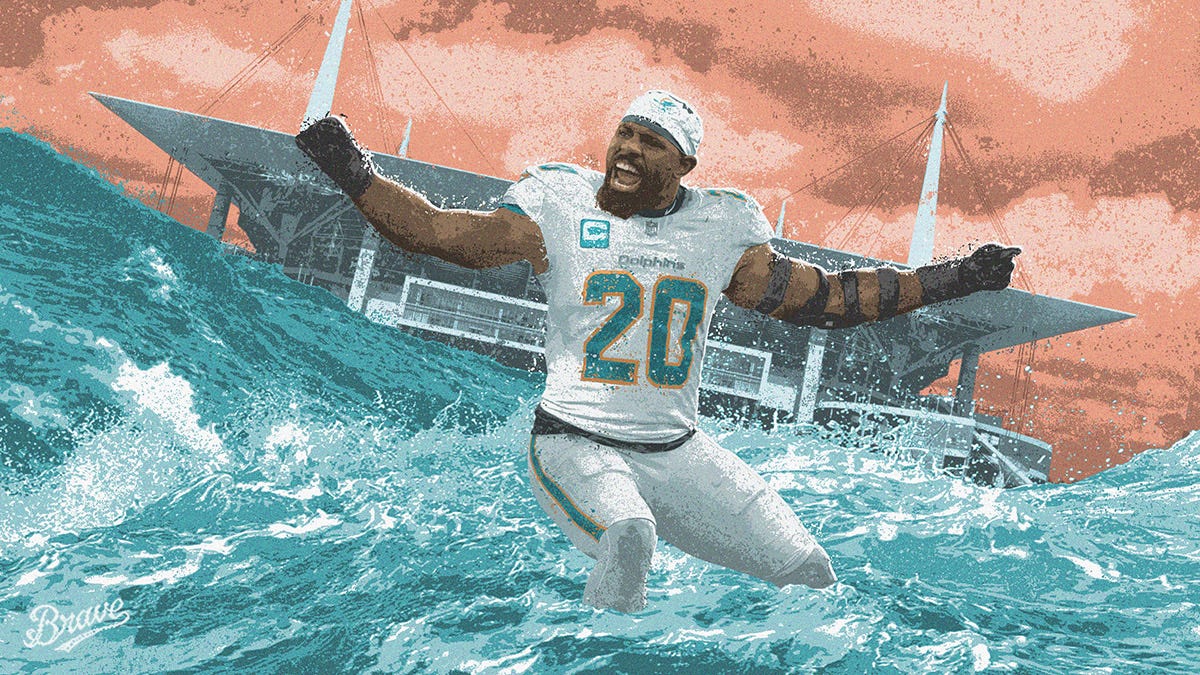
MIAMI GARDENS, Fla. — He can still picture immortals from the 1960s clashing in slow motion, still hear the crescendo of trumpets, cymbals and clarinets blend into John Facenda’s dramatic narration and still remember the visceral feeling it gave him deep inside. It was art. It was addicting. He didn’t have cable. Following modern pro football was not an option. But his father did own a box of NFL Films tapes and Jordyn Brooks could not get enough.
Whenever he stayed at a friend’s house, he’d ask to watch NFL Network in hopes of catching flashbacks to yesteryear. Jim Brown, Walter Payton, Barry Sanders. His eyes were glued to the running backs most. YouTube went mainstream around the time he was 8 years old. Any access to the Internet meant chasing down every rabbit hole imaginable to learn everything he could about the NFL’s roots in the 60s. Then, the 70s. Then, the 80s. He learned about the sport in chronological order. His appreciation for the sport was pure.
At home, he’d steal all pillows from all bedrooms to set up an imaginary offense and run plays. Siblings were pissed he was blocking the TV. He’d bash into furniture. Something inevitably broke. He only knew one speed because — in his mind — these weren’t pillows. These were players. “And sometimes,” Brooks adds, “you’ve got to have an imagination if you really have a vision of where you want to go in life.” Into youth football, as a running back for the Pleasant Grove Falcons in Dallas, scintillating NFL Films tracks like “Round Up” and “Ramblin’ Man from Gramblin’” played in his head TD to TD to TD. Into high school, his coach believed the best players should play defense. Brooks was moved to linebacker. Brooks loathed the decision. And out of sheer anger, he teed off on everything that moved. Pop to pop to pulverizing pop, he grew to realize this was a calling.
He was always more Butkus and Nitschke and Lambert on those tapes.
Far back as he remembers, nothing mattered more to him.
“God put the desire in me,” Brooks says. “The love was implanted into me with how obsessed I was with football.”
So, imagine his anger. Imagine what’s running through his mind when he’s witnessing the exact opposite as a starting linebacker for the underachieving Miami Dolphins. He gets it. Anything you want, you can get in Miami. Beaches, nightclubs, girls. Temptation is ubiquitous. All who play football do not necessarily love football. Loss to loss, many peers appeared wholly unfazed.
Here inside an office at Dolphins HQ, his dark eyebrows scowl. Brooks is wearing a cutoff Jordan Brand hoodie with a hat that reads Greatness is a Process. He swivels in his chair as he speaks.
“Look, we play football,” Brooks says. “We are not going to be able to run and hit forever. You’ve got a short window and then your body’s going to fade out. It happens to everybody. Nobody’s supposed to be running full speed into each other. But we do that. So you can only do that for a number of years, and then you can’t. So the urgency should be: ‘I’ve got to maximize this while I can.’”
Go Long is fueled 100 percent by our readers. Subscribers can access today’s longform on Jordyn Brooks and the Miami Dolphins, a rare look into how an NFL team strives to replace a broken culture with a winning one.
Football is the ultimate team sport. The player next to you quite literally must do his job for you to do yours. Tom Brady isn’t Tom Brady, he explains, if linemen don’t block and receivers can’t catch. All 11 players are intertwined. One imbecile, any given play, can lose a game. Apathy — in this profession — costs co-workers their jobs, their knee ligaments, their pride. Quit like so many of his teammates were quitting and you’re directly screwing with livelihoods. That’s where it became “personal” to Brooks the last two seasons. He confronted teammates. First, nicely. You’ve got it in you. I’ve seen you do it at this level. Sometimes, that’s all a player needs. Other times, sure, he’d get mean because he wants others to do the same to him.
Urgency. Accountability. Hunger. All of this must become contagious in a locker room.
“We haven’t been able to do that,” Brooks says, “because people don’t care.”
What’s old must be burnt to soot. A franchise that’s now gone 25 seasons without a playoff win cleaned house to historic proportions this offseason. The GM (Chris Grier), head coach (Mike McDaniel) and quarterback (Tua Tagovailoa) were all canned. Miami’s new regime will eat $179,214,254 in dead money this season. In other words, 60 percent of this team’s salary cap is allotted to players who won’t play a down. All of which is healthy addition by subtraction. Sources inside the mickey mouse operation tell Go Long exactly what this looked like, right down to highly-paid vets thumbing through their cell phone during walkthroughs. Reset button? The 2026 Dolphins, under new GM Jon-Eric Sullivan, are correctly spiking the nuclear football.
What’s new runs deeper than a flashy free agent signing, a jaw-dropping trade.
This organization needs a soul. It needs a 29-year-old with the wisdom, scars, talent and, above all, maniacal urgency sorely lacking at 347 Don Shula Drive: Jordyn Brooks.
His life is a guide. Long before asserting himself as one of the NFL’s best linebackers, he was lost. In college, drowning in alcohol, one wake-up call changed the trajectory of his life. In the pros, consumed with the self-pity, another awakening saved him. He’s a realist. Miami has the youngest roster in the NFL at an average age of 25 years old. There are no big names on the marquee.
Unsolicited, Brooks brings up exactly what readers are thinking.
“A lot of people on the outside are going to look at our team and be like, ‘Yeah, 0-17,’” Brooks says. “But me? When you’re in it, it’s different. You never have that mindset. I understand why people would say the things they say. ‘How many stars do they have? Proven guys?’ We ain’t got a lot of them. But we tried that and it didn’t work. To me, this is exactly what we need. Whatever the vision is, I’m all-in. The best teams win. Not the best players.”
He brings up Sullivan’s old team. The 2023 Green Bay Packers had the youngest team in the NFL and came within one drive of reaching the NFC Championship Game. There’s a fire in his eyes.
“Why couldn’t that be the same situation here?” Brooks asks.
He believes the combination of young and hungry is dangerous. He lived the other side of it all. He’s seen teammates adopt the laziness of older players — “that poisons the team” — and is all for Sullivan and new coach Jeff Hafley starting fresh with players who actually want to play football. Only then can a team create something new. A convoy of 21- and 22-year-olds dying to prove themselves aren’t going to skip meetings and rack up $200K in fines by Week 6. (A real thing.)
When Brooks sat down with the Dolphins brass early this offseason to discuss the new vision, he left convinced this group will mold into a true team. One that won’t beat itself, one that does everything right like those dynastic Patriots. It’s extremely early. But so far, he’s seen a general willingness to work. “That’s Step 1,” he says, with a chuckle. “You’re willing to do what it takes? That’s Step 1.”
Nobody’s expecting the Miami Dolphins to accomplish anything. Hype of years past has dwindled to a whimper.
Make way for the new voice to follow. On cue, Brooks inked a three-year, $51.3 million contract after this conversation.
None of this is bluster.
“We become a team? The sky’s the limit,” Brooks says. “We can do anything we want to do. I don’t care if we have no superstars.”
Brooks speaks in such terms because he can relate. He, too, fell victim to temptation. A decade ago, he nearly drank his career away.
Awakening
First, a geography lesson. Jordyn Brooks paints the scene. At 268,596 square miles, the state of Texas is larger than 150+ countries worldwide, including all in Europe. Yet all the action’s on the east side of the state. That’s where you’ll find Dallas, Houston, San Antonio, Austin.
West Texas, conversely, is “all desert.” (That’s no exaggeration.)
Locals, to cope, follow the same three-step protocol.
Drink. Root for the Texas Tech Red Raiders. Drink some more.
“So when you’re a football player out there, whether you won two games or 11, you’re a superstar,” Brooks says. “You feed into that. Shoot, the culture there was, ‘go to the bars and drink. We don’t have nothing else to do out here.’”
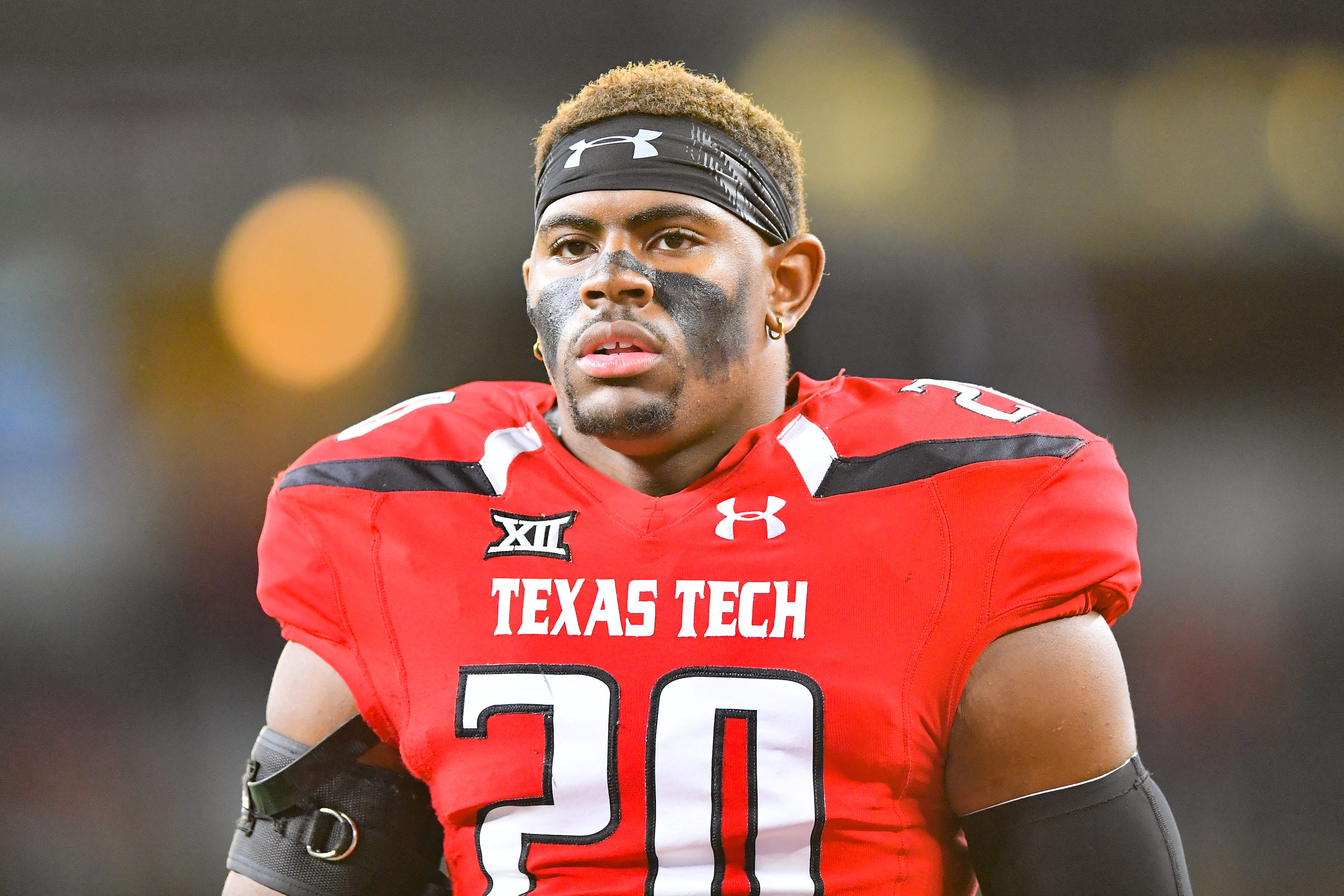
Freed from the nest, he was much obliged to assimilate right into that culture. Obviously, it did not matter if football players like himself were only 18 or 19 years old. Step into any bar and you are the guest of honor. Brooks loved hard liquor — never beer — and Brooks is also convinced those Lubbock bartenders were extra generous with their pours to keep their saloons packed. He drank, smoked, partied. And honestly it might not have been such a big deal if the freshman was a benchwarmer. He was not. He started on Texas Tech’s defense. Statistically, Brooks led his defense in tackles but he doesn’t kid himself. He was not ready to play — at all — because it’s “impossible” to process Big 12 playbook when your head’s pounding with a vicious hangover. Idle time was never spent studying his opponent.
Thinking back, Brooks is grateful he siphoned this YOLO phase out of his system in college. Go this hard in the pros and his ass would’ve been sent packing.
He played worse as a sophomore, recalls being on “thin ice” with Kliff Kingsbury’s staff, then played well enough as a junior to consider going pro. That was always the goal: get three years in and get out. Brooks received a fifth-round grade from the draft advisory board. Further, he loved Kingsbury and Kingsbury was fired. These pre-NIL days, he couldn’t enter a transfer portal and sign with another school. Either he’d stay in Lubbock or bolt. He was itching to bolt.
That January, as the Red Raiders’ new defensive coordinator addressed players for the first time, Brooks scowled. And sneered. And refused to buy one word Keith Patterson was selling.
Patterson kept his eyes on Brooks. Afterward, he asked the linebacker to come into his office.
“What he told me,” Brooks says, “changed me.”
Patterson explained that if he stayed and if he was coachable, he’d make All-Big 12, All-American, win the Butkus Award and go Round 1 in the 2020 NFL Draft. At first, Brooks assumed this coach was spewing BS to persuade him to stay. After taking a night to digest — to ask aloud, “Why can’t I be that?” — Brooks decided to stay. The choice was binary. He could continue to live at the bars, hook up with chicks, live a self-described “fake rockstar life.”
Or he could demand more from himself. Or he could embrace a new world.
The rush of urgency to do something with his life, now, was far more intoxicating.
“There was no more time,” he recalls thinking. “You had your fun. It’s now or never.”
Brooks elevated in three specific areas.
Morning Film. Each AM, he’d sit down 1 on 1 with Patterson to study tape and decode all tendencies in that Saturday’s opponent. Favorite runs, favorite passes, which angle a lineman pointed his toes before the snap. Patterson fed him intel in real time — as the DC learned it himself — so the two developed a telepathic connection. Hard coaching. If Brooks botched anything in practice, Patterson ripped him in front of the entire team. The coach knew his best player could take it. A tone was set. Rover role. Dual-threat quarterbacks populated the conference and Texas Tech’s personnel was rough. To find any success, Patterson cooked up an unorthodox scheme unleashing Brooks as an all-time spy. The kid who felt free at the bars was now fully liberated on the field. “I didn’t have any responsibility,” he quips. Against mobile QBs like Jalen Hurts, Khalil Tate and Sam Ehlinger, he was gifted a play-to-play-to-play green light to trust what he saw on film and roam. That fall, Brooks finished with 108 tackles with a Big 12-high twenty behind the line of scrimmage.
He made all-conference, All-American, was a finalist for the Butkus and, as promised, the Seattle Seahawks took Brooks 27th overall in the first round. At the end of GM John Schneider’s call to Brooks, you hear family scream in the background.
Most importantly, that fall is when Brooks learned exactly what a linebacker means to a team.
“They mirror quarterbacks to me,” he says. “The importance of leadership and how you set the tone for your team? To me, it’s equal. Ray Lewis and Mike Singletary were great linebackers. But they were great leaders. I’ve got to be a great leader for the dudes around me, which is ultimately going to help me become a better man and a better football player. That urgency was there. Having Coach Patterson come in at that time, the alliance was perfect.
“Real recognize real. He was a real guy. A real man and I see myself as that way, too.”
The NFL is destined to humble all rookies in ways they never foresee. This was 2020. Back when COVID-19 restrictions locked everyone inside their homes.
There were no OTAs, no minicamp practices. After going full kamikaze mode in college, Brooks struggled to learn a structured defense in training camp. “Mentally,” he admits, “I wasn’t ready to play.” Consequently, he played only 31.86 percent of the snaps with zero combined sacks, picks, forced fumbles, recovered fumbles and QB hits. Year 2? He moves his hand up and down. His numbers improved, but Brooks felt inferior to the vets in his room. He lists names off one by one: Bobby Wagner, Russell Wilson, DK Metcalf, KJ Wright, Jamal Adams. “I’m in here playing with future Hall of Famers,” he says. “I want to do my part. It wasn’t clicking.” At this level? Coaches don’t wrap an arm around you. At this level? Tendencies are camouflaged. No linemen are giving obvious clues away. This game of chess made college feel like Uno.
And into Year 3, his play was erratic right up to a rock-bottom moment that feels like yesterday. The play looks innocent enough on film. On New Year’s Day, against the New York Jets, he wraps up tight end C.J. Uzomah near the sideline, and his right foot awkwardly bounces off the turf. Brooks writhes in pain, reaches for his leg, and eventually hobbles away with two arms around two trainers. He tore his ACL.
The timing was atrocious. Not only was Brooks forced to watch his team lose a wild-card playoff game in San Francisco as a helpless bystander. He assumed next season was a wash given that this injury typically requires nine to 10 months of recovery. Next season also happened to be the fourth year of his rookie contract. Seattle understandably declined his fifth-year option and signed multiple linebackers. One injury, it appeared, cost him millions of dollars.
His football world was caving in.
He traveled back to Dallas for surgery.
He desperately needed another sign.
Urgency
That apartment Jordyn Brooks transformed into his own personal football stadium, pillows everywhere, was one of five different homes he occupied as a kid. Money was tight. His family moved liked nomads through Dallas. Mom and Dad divorced. And when Mom lost her job, homeless, they were all saved by Interfaith Family Services. At that point, Brooks and his twin sister were 7. Two other sisters were 13 and 17. Two brothers lived with Dad.
This safety net saved the family from living on the street. He slept in a bunk bed, relied on food stamps and wore the same pair of K-Swiss shoes for an eternity. But to Brooks, this never felt like poverty. He loved Interfaith’s pizza parties and field trips. They even helped his mother get a vehicle for transportation.
When he was in fourth grade, they moved to Houston. And once Brooks linked up with that high school coach who moved him to defense, Elliot Allen, he improved his sagging grades. Pillows transformed into reality. Brooks has no clue where his life would’ve detoured without Allen — he needed such fatherly guidance. His own Dad, West Brooks, was a truck driver who lived 240 miles away in Dallas. The two rarely saw each other. Drifted apart.
He got to Texas Tech, to Patterson, to the NFL, to that surgery room.
In the past, Brooks has vaguely referenced friends who’ve died. Prod for more and Brooks replays a tragedy he has not spoken about publicly.
“One of my brothers,” he says, “was killed my freshman year of college.”
He continues.
“A man walked up on him, shot him in the face while he was sitting in his truck. Point blank. Killed him.”
On Jan. 5, 2017, shortly before 2 p.m., an unknown assailant gunned down Jaquan Brooks, 25, in the parking lot of Spring Ridge Apartments at 3619 Folklore Trail in Dallas. Jordyn’s other brother called him with the news — those two were living together. Reliving that call, he gets choked up. Pauses. “It still doesn’t feel real,” he says. “It’s kind of like a shock.” News circulated. The Dallas Police Department asked the public to come forward with any information. Crime Stoppers offered up to $5,000 as a reward for intel. This was a bad part of town and, as Brooks details, neighborhood silence is par for the course. Witnesses went mute. No intel ever trickled in. Nobody talks because nobody wants to fear for their own life. “So,” Brooks adds, “he gets to walk around free.”
Jaquan was described as an old soul who carried a Bible in his pocket. But even Jordyn admits his brother chose a “different path” in life that likely precipitated the shooting.
Once the shock wore off, he zoomed out. He realized he needed to stay on his own path.
“Something positive, something that’s meaningful, something that can make true impact,” Brooks says. “Not trying to take a shortcut in life. It helped me to understand. The path that I’m on? Stay on it. What you’re doing, you’re supposed to be doing.”
Lubbock to Seattle, he’d continue to receive similar phone calls from two of his best friends in high school. Each year, they inevitably call to fill him in on their latest childhood friend who’s been shot and killed. At first, he was shocked to hear so-and-so died. Brooks was strapped with survivor’s guilt. Over time, those deaths became “expected” because, the way Brooks describes it, half his friends went one way and half went the other. At the age of 13 and 14, everyone made a choice.
“Those guys who went that way,” Brooks says, “almost all of them are either dead or in prison. Literally. Those are the only two options. But it was good to see that because it lets you know where you are going in life? This is the right path.”
College, in his bloodline, is more of a farcical fantasy. Briefly, he imagines where his life would’ve gone if he didn’t improve those grades, didn’t earn a respectable ACT score, didn’t use football to get to Lubbock. Similar to Dolphins teammate Aaron Brewer reliving his own close call, Brooks knows his name could’ve been uttered on such a phone call.
Thus, Brooks refuses to assume he has an inalienable right to be in the NFL.
Each call revealing each homicide only feeds his own sense of urgency.
“I’ve seen it — with my own eyes — people’s paths and life go totally left,” Brooks says. “And I played with plenty of guys who had great talent that should have been in the league. That humbles you if you look at it the right way and realize like, ‘Man, you know what? This is why I never take one day that I’m here for granted.’ I’ll never have the mindset like, ‘Oh no, I belong here. I deserve to be here.’ No, I’m lucky to be here. I’m lucky to be here and one day I’ll be gone. I’m going to appreciate every day that I am here because I’ve seen it for myself. Some people didn’t make it to the next day in life — literally.”
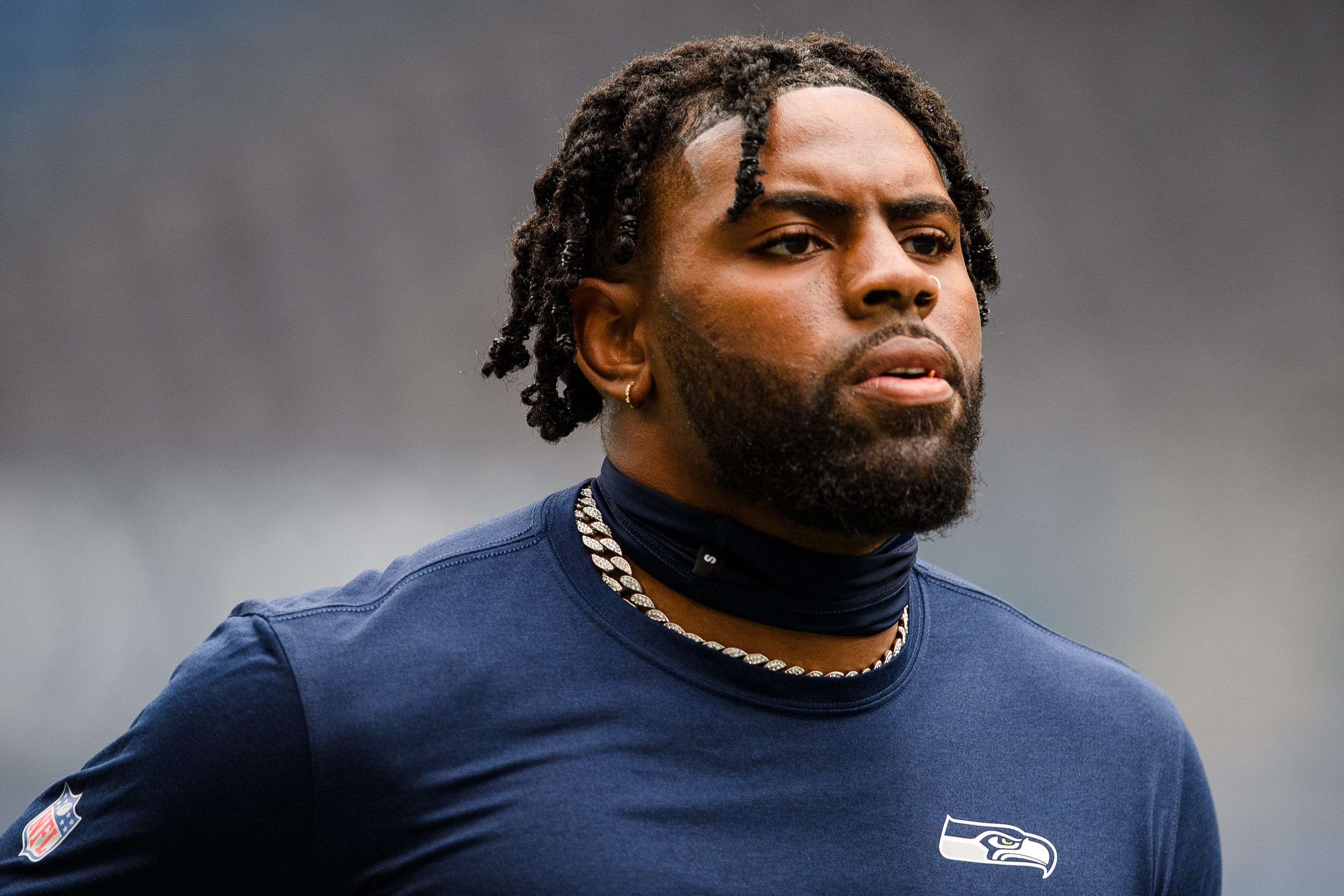
Sprawled on that artificial FieldTurf slop at Lumen Field, he was sad and mad and asking why me, why now. Those emotions, however, did not linger. No chance in hell would Brooks allow a torn ACL to ruin him. He chose to “let go,” completely, and accept whatever came next. Eighteen days later, Dr. Daniel Cooper performed surgery and he needed to stay in the Dallas area to rehab.
A twist of fate that opened a new door for Brooks. He reconnected with his father.
A relationship lost long ago rekindled. He always knew the genes were strong. Dad played college ball at Texas Christian University. One other childhood image sticks with him: a picture of Dad in his purple Horned Frogs uniform pinned on the wall. He told himself: “I want to do that” as the NFL Films looped. Suddenly, they were speaking daily again.
His living brother was in town, too.
All grew closer than ever.
“Man, it was perfect timing,” Brooks says. “You need somebody to talk to during that time. Here I was, 23, 24 years old and I still needed my father. We’ve been close ever since. Shit, we talk every day. All three of us bonded during that time.”
Nothing else mattered. Seattle signed former 10th overall pick Devin Bush and inked Wagner to a one-year, $7 million deal in anticipation of Brooks missing time. But this father-son reconciliation became such a priority that the stress of a murky NFL future dissipated to nothing. Brooks wasn’t even thinking about football.
He didn’t even realize his knee was rehabbing at an absurd rate.
Once training camp commenced and he started running around, his knee felt good as new. He started Week 1 and enjoyed his finest season in Seattle.
“A horrible moment,” he says, “turned into a great moment.”
The ensuing spring, Brooks signed with the Miami Dolphins, a team that fully planned on competing for a championship in 2024.
By Thanksgiving Night, his team was a national embarrassment.
Humiliated on a national stage, Brooks couldn’t hide his feelings. Fed up. Disgusted. Repulsed by what this team was putting on display, the linebacker used a slur far worse than those seven words George Carlin says you can never say on TV.
Brooks called the Dolphins the s-word.
“Soft.”
He was right, of course.
Old Miami
On Day No. 1 as a Dolphin, Jordyn Brooks stepped on a scale and the number climbed higher, and higher, and higher, inching awfully close to the 260s. He could not wait to step off that scale. Here a pro football team handed him a new contract worth millions and he repaid his new boss by showing up 20 pounds overweight.
Embarrassment overwhelmed him in March 2024.
This was not good weight. Rather, “bad, fat, vacation, cheeseburger weight,” he admits.
Miami’s team nutritionist, John Parenti, stared at the number. Then at Brooks.
“He gave me this look,” Brooks says. “It was shame. It was shame 100 percent. He couldn’t hide it.”
The glare was warranted because the scale supplied one blunt answer to a question still on Brooks’ mind. Why wasn’t I who I knew I could be? It was right there. He was not treating his body like a war machine, no. His diet primarily consisted of honey buns and hot chips.
Brooks sat down with Parenti to devise a plan to get to 235. Diet. Cardio. Sauna. Stretching. There are two types of players who take the field at Hard Rock Stadium. Those built to handle a surface-of-the-sun climate and those who cramp up and need an IV. Breathing should not be a problem for the man in the middle of the defense. His mind was sharp by ’24, but now his body needed to catch up. “Because,” Brooks adds, “we play a barbaric sport.”
To this day, he meets with Parenti weekly to seek a new 10 percent edge. Somewhere.
If Patterson’s prophecy served as a tipping point in college, that day on the scale served as one in the pros. That number was another reflection of the man. Nowadays, Brooks tells teammates that in order to be the best version of themselves as a player, they’ve got to start with the man. Gaffes on Sunday, he believes, are an extension of how you operate in life.
“Something gets hard and you give up,” he says. “Like: ‘Ah, the heck with it. I’m not going to try to do nothing about it.’ That’s probably who you are as a football player, too.”
As the 2024 season spiraled, this is what he saw.
Everywhere.
At 5-6, their season still very much alive, the Dolphins traveled north to face the Packers at arctic Lambeau Field in front of America and were thoroughly beaten with an ugly stick. Up close, Brooks saw how his teammates reacted to the cold. Many were disinterested. Others were scared. Miami fell into an insurmountable 27-3 deficit and missed 20 tackles in all. Brooks could not pretend everything was fine, instead saying the quiet part out loud: “I thought we were soft. Simple as that, I thought we were soft today.”
That word pissed off a few teammates.
He didn’t care then. He doesn’t care now.
“If the team is playing soft, we’re playing soft,” Brooks says. “We’re not playing the way that we should be playing. Let’s call it what it is. We’re getting killed out here in the cold. We’re fitting right into the narrative. As a leader, that’s what you’re supposed to do.”
Autopsies of all teams that suffer fatal hypothermia reveal a lack of candor. Shit hits the fan and both players and coaches refuse to face the facts. They’re worried about feelings, about ruffling feathers internally and/or facing backlash externally. Silly paranoia that only delays the inevitable.
Brooks could see the Dolphins were heading nowhere — it drove him insane — and opted to be the adult in the room.
“Be honest. Be honest,” he repeats. “Call it for what it is, in hopes that we’ll change it. Not to stir up anger in people but to create a sense of urgency to get it better. That’s my leadership style. That’s how I try to lead. Whenever I need to speak, I’ll speak. But the main thing is live it out first. So whenever I do speak, nobody’s looking at me crazy for speaking. Live and embody whatever you’re preaching. Live that part out first. That’s the biggest thing I learned. Playing with other guys in my career is like, ‘Man, some dudes say they’re leaders, but they’re not really doing what they talk about.’ So it’s hard for me to listen to them. It’s hard for me to respect it. I never, ever want to be that guy.
“And it’s hard. Being a leader of anything — a leader of your family, a father, any space that you’re in — it’s not easy because you’re the one out front.
“So it’s pressure on you day-in, day-out to do the thing right. To be the standard. The blueprint of what we’re trying to get done. That’s not easy to do.”
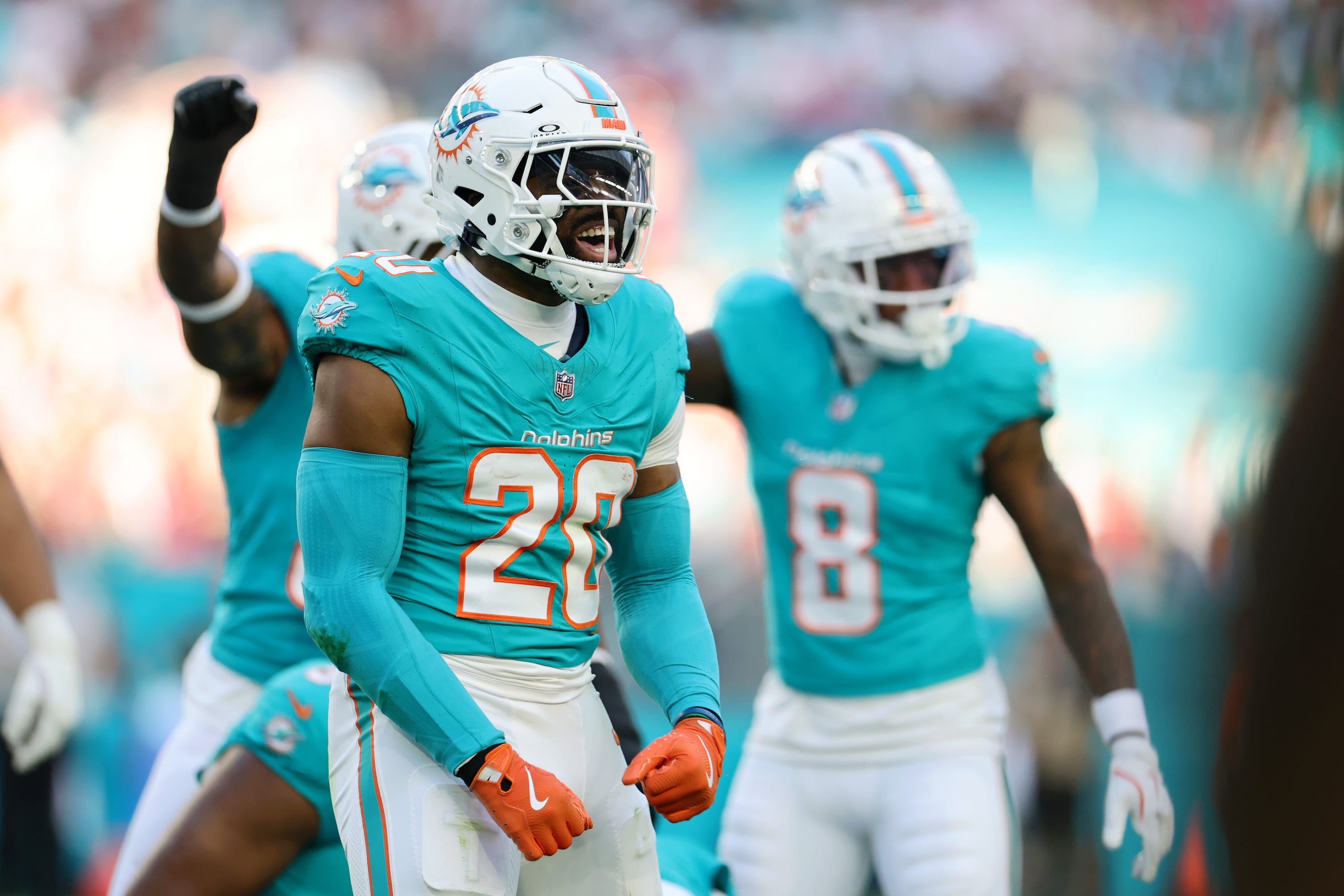
The blueprint of old ingrained in Miami was the worst in professional football.
This last half-decade is a cautionary tale for all coaches, all GMs, all owners who believe it’s possible to write a bunch of fat checks, cobble talent together, and win. It might work for a while. The Cheetah feasted. Tua Time was fun. They scored seventy freakin’ points in a game. But if the leadership’s wretched, implosion is a guarantee. Go Long reached out to multiple sources from those Dolphins teams to study this contamination.
Thanksgiving Night was a boiling point, but red flags dated all the way back to OTAs.
It was impossible to tell this Miami team was fresh off another December collapse.
One veteran knew this 2024 edition would be “trash” in May. When position groups of 10 to 15 players organized dinners, only four or so showed up. If a meeting started at 8 a.m., players moseyed into the building at 7:59. When the final meeting ended at 4 p.m., the same employees all but left screeching tire marks at 4:05. Nobody hung out. Nobody voluntarily ate together. Hence, the hidden advantage of smaller-market teams in the NFL. When there’s less to do in a city, players tend to bond off the field. Relationships matter.
“We didn’t fight for each other on the field,” says this ex-Dolphin. “We just didn’t give a fuck. Offense didn’t care about the defense. Defense didn’t care about the offense. That’s how it went. I stopped giving a fuck.”
Because there’s a real “psychology” to this sport, he explains. One that all cocksure calculator bros overpopulating the airwaves miss.
Pro football is destined to steer all participants into a dark, dark place. You’ll either fight through this darkness for a teammate you love… or coast. These Dolphins defined coasting. “When the game gets hard,” this player posits. “what decision are you going to make? Guys were selfish and looked after themselves.” Loss to loss, it became easier to coast. By Week 6 of the 2024 season, per sources, players had racked up $200,000 worth of fines. In a hopeless attempt to get guys to show up on time, head coach Mike McDaniel announced that sum to the team and compared it to previous seasons. The 200K was more than double the average, one source recalls.
Nobody took him serious and nothing changed.
Meetings were a joke. Some players didn’t show up, others strolled in late, others up ‘n left halfway through to receive treatment for an injury as if this was a drab, pointless History 101 lecture hall. Newcomers couldn’t believe the sight of players walking out. In functional NFL buildings, players receive treatment on their own time or in-between meetings. Never during. Wide receiver Tyreek Hill and cornerback Jalen Ramsey, two of the team’s stars, seemed to come and go as they pleased. One player recalls seeing Hill walk into a meeting 5 minutes late with McDaniel simply saying, “Hey, what’s up, Reek?” with zero acknowledgement of his tardiness.
The day after games, half the captains would miss captain meetings.
Curfew was treated as a suggestion.
What bothered guys most is that players with a “C” on their chest didn’t act like a captain. The letter was the product of past production — nothing earned. “Nobody respected the guys with the Cs on their chest,” says one player, “because they didn’t give a fuck. They made some crazy plays. Jalen is one of the most talented, gifted athletes I’ve ever seen. Obviously, Tyreek is. But other young players follow them. And watch them. And see how they do things.”
A few vets donning that “C” even brought their cell phones to walkthroughs, right in the pocket of their sweatpants.
Naturally, the 22- and 23-year-olds new to the pros started toting their phones, too. They assumed this was normal.
“Like this is a high school team and we’re just hanging out,” says one vet on that roster, still incredulous. “It’s like, okay, well if he doesn’t care, why the fuck do I care? That trickles all the way down.”
Surprise, surprise. Players were often confused on gameday.
Walkthroughs are treated differently on winning teams. All 11 players on all plays rehearse all Plan A, Plan B, Plan C contingencies. When you know exactly what you’ve got to do, God-given talent reigns. In Miami, lax Fridays and Saturdays led to hesitancy on Sunday because, as one player details, it’s difficult to trust a teammate who was texting the day prior. McDaniel failed to nip this bad habit in the bud. One starter on offense says he “was just too much of a bro” and lost control of the locker room. A delicate balance considering he was replacing a drill sergeant who lost the team.
Many players liked McDaniel, but being a head coach is much like being a father. It’s not smart to be players’ best pal. You lose authority.
Adversity inherent to the job was also foreign to him.
“When you get hit in the mouth or you get thrown under the bus a couple times or just ran over, what are you going to do? In those moments?” one player says. “If he’s ever in those moments again, I think he’ll learn from a lot of that shit because I do think he could have stepped up in a lot of different areas and a lot of different times to shut shit down.”
Once the 2024 season ended with a disgraceful 32-20 loss to the New York Jets, McDaniel admitted fining players didn’t move the needle. Ramsey and a wave of others were jettisoned through the offense. One reserve tight end noted Miami got rid of players who weren’t respectful.
Little changed about this team. Especially at quarterback.
Some quarterbacks ink a $212M contract extension and do everything in their power to justify the money. Others grab a microphone at training camp and shout “Show me the money!” as Tagovailoa did. “That video,” one player says, “really set the tone and put a lot of pressure on him.” Tagovailoa, shielded much of his football life, never came close to living up to that contract. On the field, his record dropped to 0-6 when the temperature was 40 degrees or lower and 2-9 at 50 or lower. Off it, he qualified as one leader who failed to back up words with action. At one point, in ‘25, Tagovailoa pointed the finger at players showing up to players-only meetings late or not showing up at all. His comments were widely skewered considering Tagovailoa was a.) the quarterback and b.) treating the ball like a hot potato. By December, he was benched.
All while players pointed fingers at each other. Nobody took ownership. Players would see what they screwed up on film but there wasn’t application through the week. So, problems lingered. Opponents hammered the same weaknesses. “Madness,” says one vet on the team. “We didn’t ever learn from our losses.” This isn’t Green Bay, where the nighttime options are scarce. Life’s different in Miami. Upon hearing the word “distraction,” however, one player with a front-row seat to the dilapidation loses it. There are no excuses.
“Grow the fuck up,” he snipes. “Focus on what you got to focus on.”
Which brings us back to Jordyn Brooks.
He, too, could not believe what he was seeing.
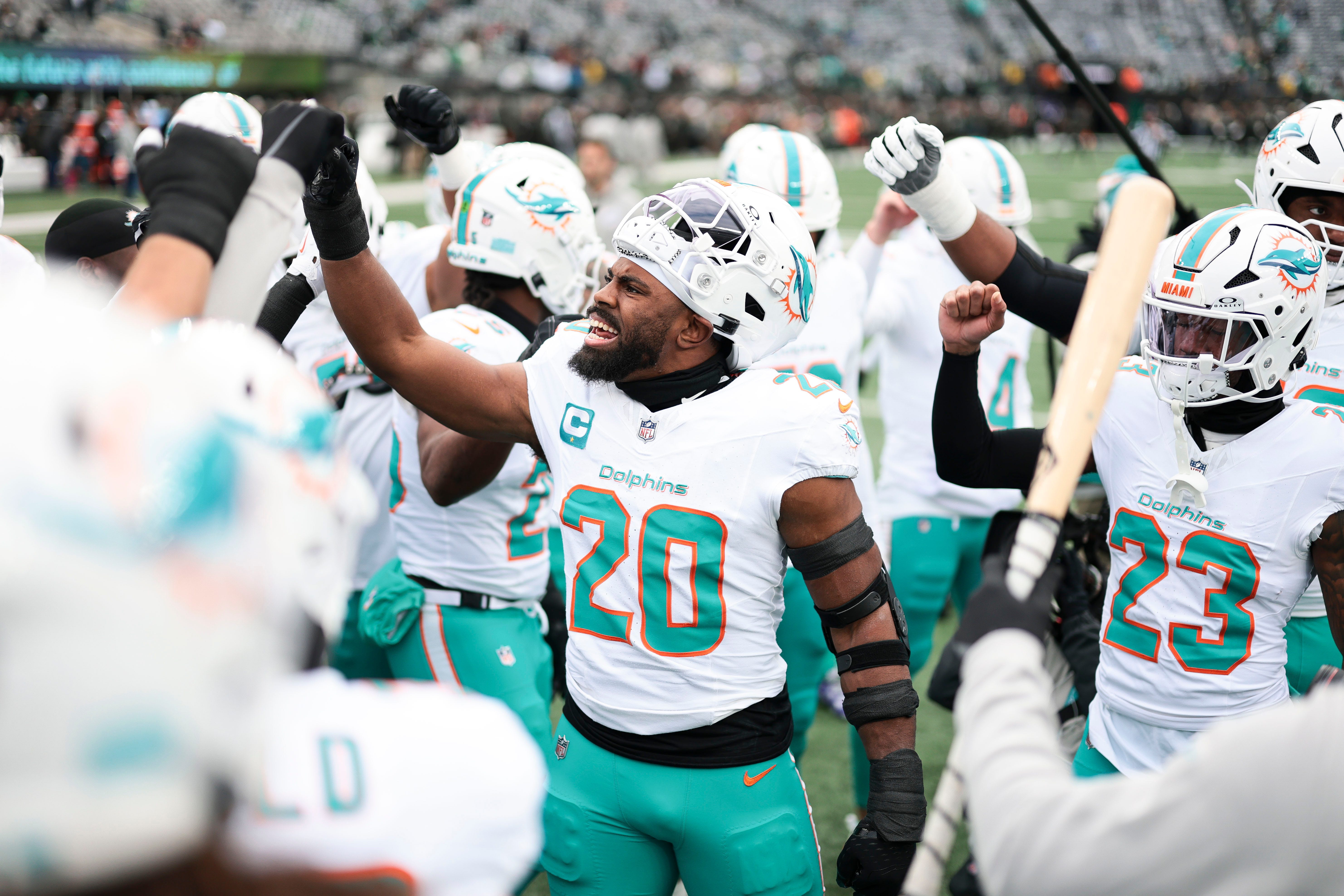
When I ask Brooks if he looked around the Dolphins locker room and saw leaders failing to back up words with action, he accurately states that any team that doesn’t win the Super Bowl suffers from this disease to some degree. He won’t throw ex-teammates under the bus by name, but, yeah. It was foul.
Leadership pills are not available at the local pharmacy. It’s either in you, or not.
“I don’t think you can be a leader because somebody says you are one,” Brooks says. “It’s a natural instinct — and people go about it in different ways — but it’s a natural instinct to get something done: No, we’ve got to get it done.”
When he was the new guy, Brooks tried not to step on toes. He let others do the talking and fell in line.
“It came to a point where I realized, ‘OK, some of these guys aren’t serious about this, and we are suffering behind it. I can’t just sit here and just let it go by,’” Brooks says. “Showing up late to meetings. Not buying into what we’re trying to do. We play football. If enough guys are not all the way locked in, we’re going to suffer. Basketball team, 15 guys, it’s a lot easier to get everybody to buy in. Whoever isn’t bought in is going to stick out like a sore thumb. But it’s easier to hide when it’s 50, 60 guys.”
One by one, Brooks witnessed teammates quit as Miami started 1-6 last season. And, hey, it’s a hell of a lot harder to wake up each morning in this profession when your team is irrelevant. Football becomes strictly a job — not fun — and football is no ordinary 9-to-5. There’s no retreating to a cubicle to screw around on Instagram when you’re contractually obligated to smash into other human beings for a living. Brooks empathizes with the impulse to throttle down, but only to a point. Only for a millisecond. Because, again, quitting in the NFL is blatantly selfish. Quitting directly affects the man next to you.
At this exact point, at 1-6, Brooks took charge. He saw an opportunity to speak up.
The linebacker discovered a new gear he didn’t know existed and announced himself to the football world as one of the best defensive players in the sport with 183 tackles (13 for loss), 3.5 sacks, a forced fumble and first-team All Pro honors.
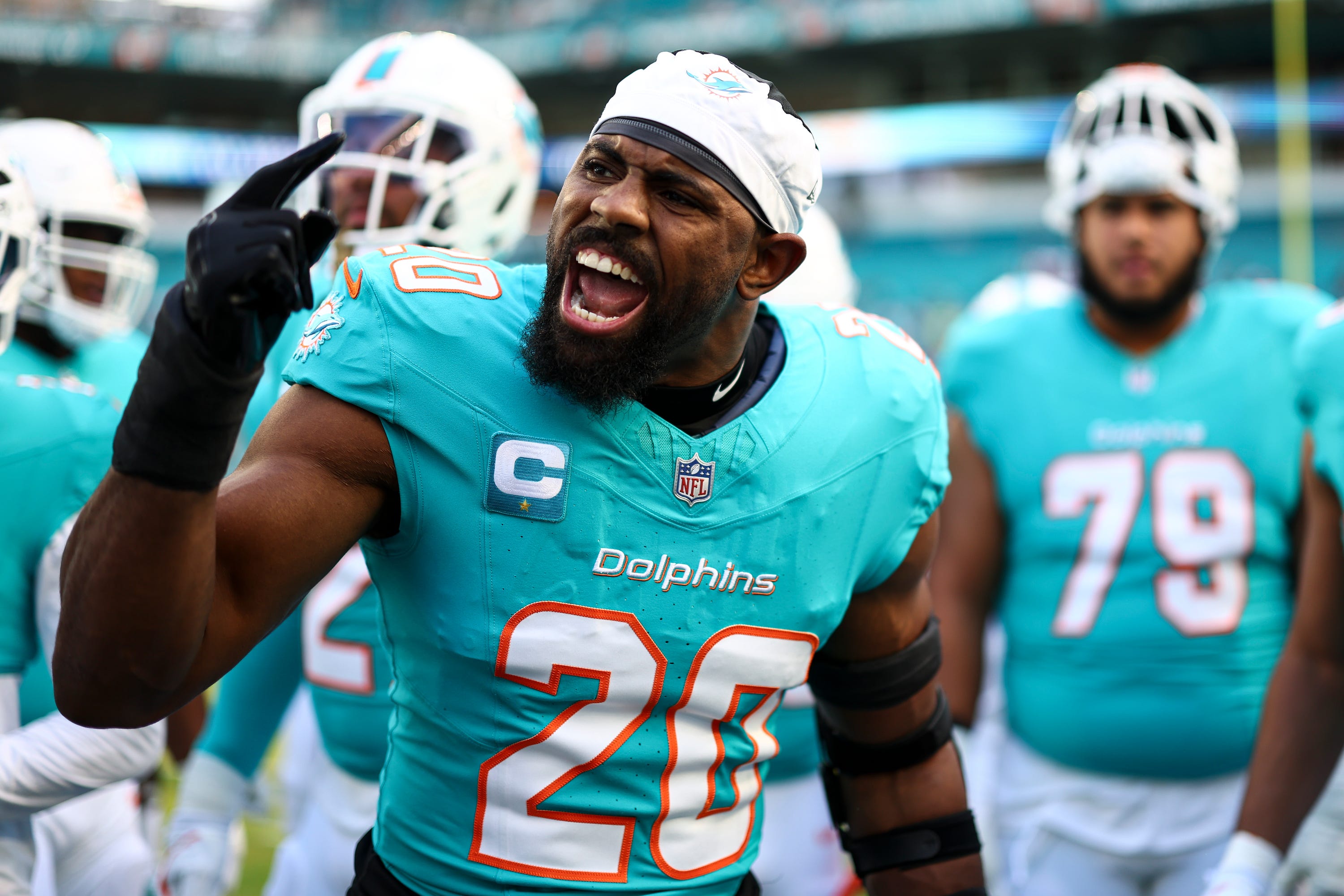
Trimmed down, he won those split seconds that eluded him seasons past. Shoestringin’ Jonathan Taylor on third and 2. Blitzing, then blasting through a running back to sack Drake Maye. Knifing through the line to stone Bijan Robinson for a loss. Stripping the ball out of Josh Allen’s grasp. Bullying Jaylen Warren to lasso Aaron Rodgers. Firing out of a virtual cannon to wallop Bucky Irving. The sight of No. 20 detonating plays and letting out a rebel yell with a finger pointed to the sky became a ray of light through Miami’s lost season. He was exceptional.
“The preparation, the work that goes into it,” Brooks says, “God honored it. He honored how I go about the work. Doesn’t mean it guarantees anything. But I was praying for things like this. Praying to take it up another level. We didn’t do what we wanted to do as a team, but that motivated me to play better.”
Owner Stephen Ross wisely fired everyone. In came Sullivan, in came Hafley. The two lit a match and threw more than $179 million into a bonfire. Once those embers burnt out, Brooks was essentially Will Smith at the end of Fresh Prince of Bel-Air, staring around an empty room.
Meanwhile, his old team hoisted the Lombardi Trophy without him. Brooks insists he was genuinely happy for his ex-teammates in Seattle. Still, that postgame sight pinched a nerve.
“Damn! That looks like fun. I wish. I wish.”
Brooks exhales. He was drafted by Schneider. He could’ve been on that Super Bowl dais, extolled as the chieftain of the “Dark Side.” Most 29-year-olds who witness such a celebration would sell their soul to join a contender and feel exactly what their friends did in that moment. Especially as these Dolphins embark on the most audacious rebuild in modern league history. John Facenda never waxed poetic about teams widely expected to win three games. Yet, Brooks refused to hatch an escape plan of his own. Miami’s mass exodus gave him clarity.
His Lubbock awakening. Losing Jaquan. The torn ACL. Those honey buns.
All of it steered Jordyn Brooks to the present.
“My true value is to be a leader of men,” he says. “We’ve got a bunch of rookies. I’ve got a lot of knowledge that I can give them through my own experience that can help them be more successful. That’s my true value.
“I went through all those lows for these moments.”
New Miami
Leading is hard, not difficult. There’s a difference. His blueprint for the Miami Dolphins consists of the most basic habits. Here, he rattles off three.
Show up on time.
Keep your locker clean.
Practice with effort, intent.
There’s no need to pull all-nighters reading books on leadership — the task isn’t complex. But wearing that “C” means living a 24/7/365 standard for everyone else to emulate. He views this as a divine calling.
“It’s a challenge. It’s exhausting at times,” Brooks says. “But I always tell God I embrace the role because as men, period, that’s what God has called us to be. We all have different jobs and different roles. But every man is called to be a leader in some shape or form. If you have kids, your job, whatever role it is — you’re meant to lead something. That’s how God knitted us.”
He brings up Genesis 3 in the Bible. Eve technically made the mistake of biting a forbidden fruit at the center of the Garden of Eden. But the first person God addresses, Brooks explains, is Adam, “the leader,” whom he instructed not to eat the apple. “That’s what God assigned men to do,” he adds. “That’s our role. We’re to lead our wives and our children. So that’s what I try to take to work.”
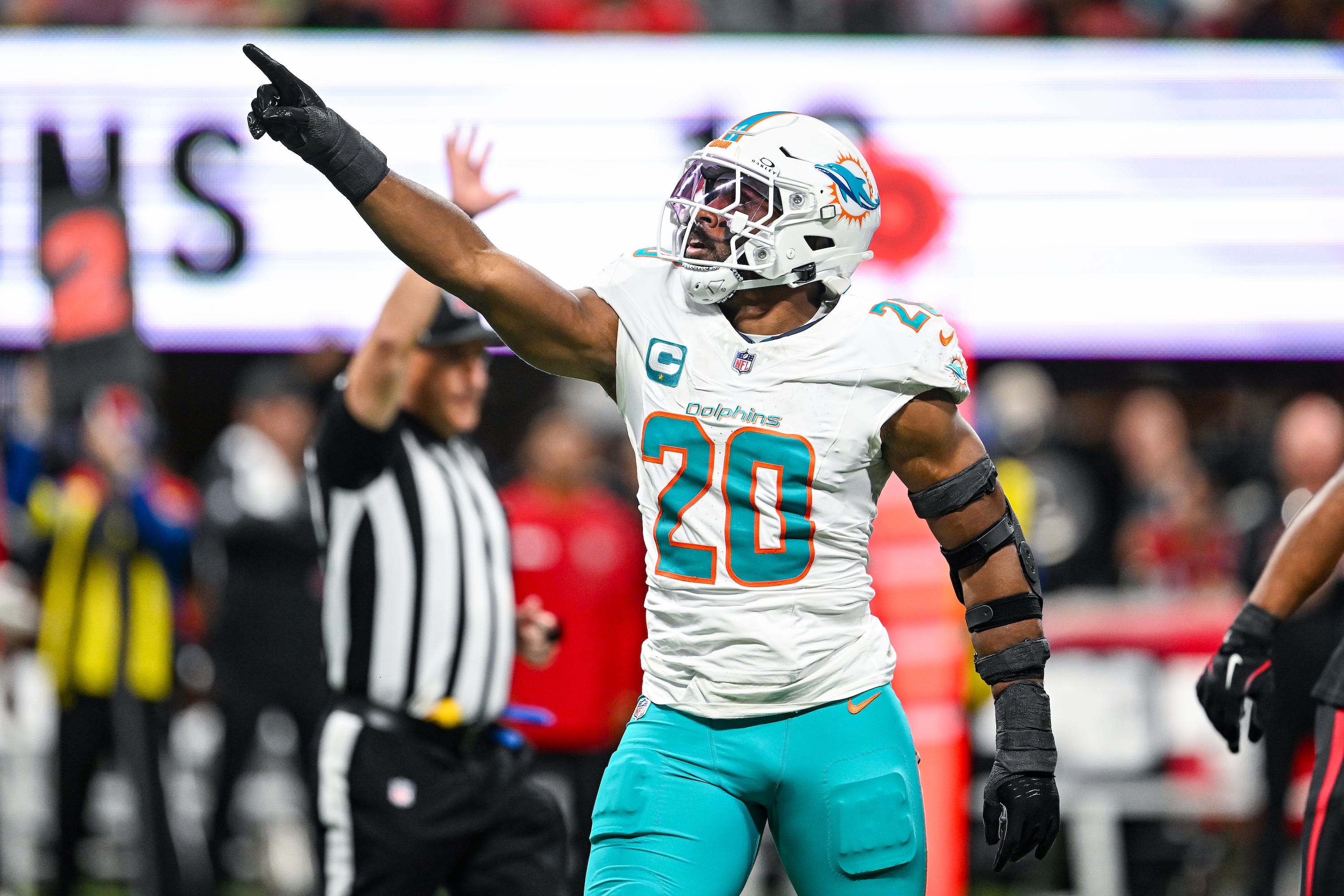
Expectations beyond South Florida are nonexistent. This is the youngest team in the league and, to repeat, 60 percent of the 2026 payroll is allotted to players who aren’t even on the team. Asking a bunch of rookies to play a grown man’s game can backfire. The Cleveland DePodestas would’ve employed kids from the nearest Berea, Ohio playground a decade ago if the Sabermetrics added up.
This isn’t a case of tanking. The Dolphins needed to cut dead weight. A lot of dead weight.
Brooks knows Miami will be deploying more rookies than any team in the NFL.
“I want to help them so that they can help us right away,” he says. “They might be rookies, but they don’t have to play like it. That’s my goal. How can I really have an impact on helping these young guys be successful as they can be?”
Brooks has already identified one future superstar on the team: Texas Tech rookie linebacker Jacob Rodriguez. He raved about Rodriguez’s game so much last fall that teammates told him to kindly shut the hell up. After seeing every snap every weekend, Brooks dubs Rodriguez’s 2025 campaign the greatest linebacker season in college football history — ahead of The Boz, Manti Te’o, Luke Kuechly. “All time,” he repeats. The mustached missile created 11 turnovers to take home that Butkus hardware.
Most vets quietly seethe if their employer drafts a player at their position. Brooks, on the contrary, was over the moon when Miami selected Rodriguez 43rd overall. He likened the sensation to being drafted all over again and cannot wait to attack offenses with a Red Raider bash brother.
“He’s got a different mentality on how he gets the ball,” Brooks says. “That’s something you can’t coach. It’s an instinct. He’s going to be an immediate success. Anything he needs, any questions he’s got, I want him to feel as comfortable as he can so that he can be as successful as he wants to be. He’s going to be great from Day 1.”
Of course, the success of the Dolphins ultimately rests on the shoulders of the team’s new quarterback: Malik Willis. His rise, as documented, is a sharp contrast to the man he’ll replace. From being overlooked at Auburn to dismissed by the Titans, Willis has been forced to wait, improve, wait, and wait a little more before parlaying a dynamite 1 ½-game cameo into a QB1 contract. Brooks gushes about this quarterback’s work ethic, describing Willis as a crystal-clear reflection of this team’s new direction.
“He’s being that leader he knows he has to be,” Brooks says. “And to me? Shoot, the sky can be the limit. Super talented. I like his play style. I love a quarterback that can extend a play.”
The organization as a whole desperately needed to take its medicine. The solution was never an individual talent at any position. Culture is real and the culture — inside this building — was toxic. McDaniel’s quirks were refreshing and fun… until they weren’t. His greatest strength, seeing the very best in people, became his demise. Tua was a hurricane vanquishing defenses… until softening into a gentle breeze. Vets on defense celebrated the departure of the sport’s best defensive coordinator because he was too mean. Hill became a pain. Ramsey, washed. GM Chris Grier stuck around far too long.
Substance, not style, is needed. Heart.
These Dolphins have been missing a Jordyn Brooks for ages.
His tone is emphatic, yet devoid of the inflated hyperbole that got the Dolphins into this mess. Brooks sounds like a mountaineer prepping for an 8,600-meter climb up K2, fully aware that the next 5+ months will be the most strenuous of his football life. But that’s precisely what he craves. He’s not married. He has no kids. Brooks is obsessed with the sport by choice. When I lob a softball — What do you do off the field? — Brooks is stumped. He’s got nothing. He’s neither on the liquor or diaper end of the young adulthood spectrum. All free time is spent taking care of his body or watching film.
When I suggest the blissful ignorance of a bunch of kids can be a good thing for this team, he interrupts.
Calls it a “great thing.”
Declares they can be the ones who flip everything upside down.
“And did it the right way. Did it the hard way,” Brooks says. “I know a lot of people look at it like, ‘Man, I’m not trying to be part of no rebuild.’ But look at it the right way. Nobody said a rebuild has to be three years. It can be three months. They drafted a lot of great dudes that are going to be stars in the league.
“Who knows man? The Miami Dolphins might surprise a lot of people this year.”
At some point this fall, Jordyn Brooks will receive news of another childhood friend’s death and his mind will again wander back to all pivot points. How the right people were put in his life at the right time to keep ascending. Then, he’ll snap back to the present. He’ll look around his Miami Dolphins locker room and realize his life’s come full circle.
He was put into all of their lives for the same reason.
Related:
Dregs to Domination: The Aaron Brewer Blueprint

MIAMI GARDENS, Fla. — Fear cannot enter the equation. Anyone at any weight can execute a flawless back flip. But you’ve got to trust that you won’t land on your head, break your neck and spend the rest of your life in a wheelchair. That’s why 99 percent of people attempting a back flip, he explains, stick their arms out at the last s…
The Patience & Persistence of Malik Willis

The NFL career of Malik Willis appeared finished almost immediately.
Wow! Fins folk been spoilt this past week or so. So much to digest. Thank you Mr. Dunne x
Total Banger Ty! I wish you’d send out emails for all of your posts. I miss like a lot of your work because I never just check your Substack. You’re one of my favs here!