


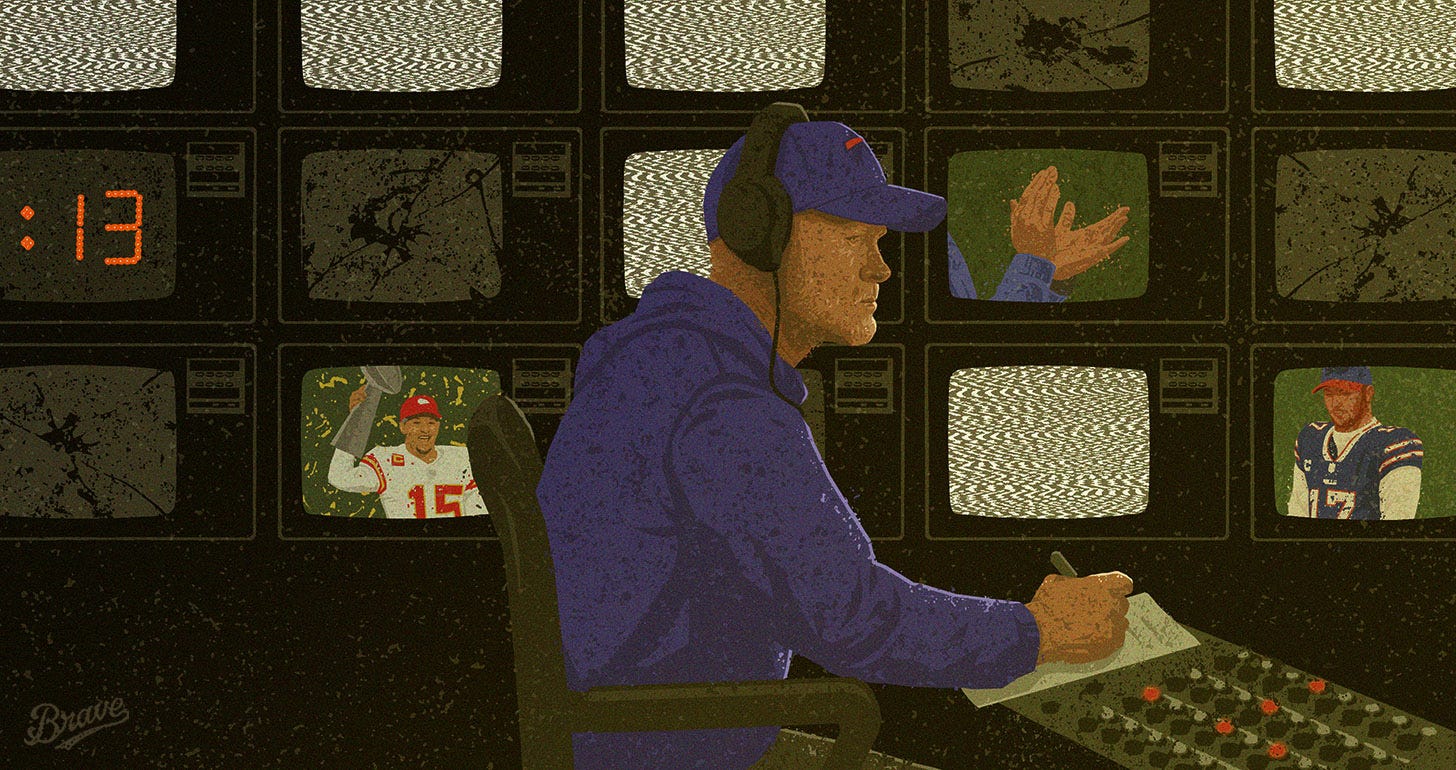
When the clock ticks closer… and closer… and closer to triple zeroes, all viewers of the Buffalo Bills have been conditioned to expect calamity. Seven years of torture will do that. The sight of Sean McDermott whispering into a headset has become synonymous with impending doom.
The 2023 season is caving.
The Super Bowl window is closing.
Those who’ve worked with the head coach on a day-to-day basis predicted all of this — months in advance — because they’ve seen how McDermott operates on a day-to-day basis. How tangibly nervous he gets in close games. How he has never truly appreciated his gift from the football gods: Josh Allen. How he’s quick to blame everyone but himself in defeat. That’s why one coach — in June — began by asking a simple question: “If they fail again this year? What does ownership do with Sean?”
Three seconds later, he answered his own hypothetical.
“Next year if they fail, you know who’ll be the first person he serves up? Ken Dorsey.”
The coach wasn’t quite sure how McDermott would manage to put Dorsey’s head on a stick. After all, it’s the head coach’s beloved defense that has melted in four straight postseason losses. The honeymoon period with fans ended a long time ago — pointing a finger at his breadwinning quarterback, again, surely wouldn’t work. Yet even back in June, this assistant knew his old boss would find a way to deflect blame.
“Watch,” he said, “if they sputter at all during this year, the narrative’s going to be the offense.”
On cue, seeds of blame were planted loss, to loss, to an agonizing 24-22 loss to the Denver Broncos on Nov. 13. McDermott didn’t lament the jailbreak blitz that teed up a game-winning field goal. Nor did he take ownership for 12 men being on the field, a penalty that gifted the Broncos another field-goal attempt. He gushed over the defense, trashed the offense and canned Dorsey the next day. A card he probably didn’t expect to throw on the table so soon. All the ensuing 37-point offensive outburst in Philadelphia did two weeks later was further brighten the blinding spotlight on the real problem in Buffalo.
A problem that began long before the Bills devolved into a 6-6 team loitering In The Hunt.
The great mystery of the 2023 NFL season — What happened to the Buffalo Bills? — is no mystery at all.
It’s McDermott. It’s always been McDermott.
He’s a coaching relic routinely paralyzed by fear late in games. He never imagines what could go right with 20 seconds left in regulation, instead forever horrified of what could go wrong. Oblivious to the reality that he employs one of the sport’s most talented quarterbacks. The word you’ll hear constantly from those who’ve been around McDermott is “tight.” He’s so incomprehensibly tight, they say, players cannot help but stiffen up themselves. As if the head coach uses the 2-minute warning to administer mass lobotomies on his team.
He’s an unnatural communicator, a “robot.”
He’s described repeatedly as a “blamer.” Coaches see a boss who preaches accountability while taking none himself. As the Titanic inches toward an iceberg, this captain shoves passengers aside to secure his own lifeboat.
He has never managed to truly connect with the most important player on the team: Josh Allen.
This is the man who ended the team’s 17-year playoff drought, who restored order and discipline to the moldy frat house Rex Ryan left behind. McDermott also guided the Bills through the near-death of a player. Damar Hamlin’s heart stopped, a football game was cancelled, a nation was forced to reconcile with its love of football. He deserved every rose of praise for navigating a team through such a surreal moment in time.
But if the goal is to win a Super Bowl, the Bills have one option: Fire the head coach before its too late.
This three-part series is the culmination of extended interviews with 25 coaches, players, personnel men and other team sources who’ve passed through One Bills Drive. Many were granted anonymity to speak freely without the fear of retribution.
Most know exactly when the McDermott Era broke: Jan. 22, 2022 at Arrowhead Stadium.
Adversity reveals character in any field. Not only did McDermott insult the public by writing off 13 Seconds as an “execution” error. He never owned the defeat privately. He allowed it to linger, and that’s the danger with any trauma. There’s no way for anyone involved to move on unless it’s dealt with head-on. Unless the guilty party takes accountability. McDermott, as Go Long detailed, was the culprit. Yet when his decision to kick a touchback and his defense doomed Buffalo against the Kansas City Chiefs in the divisional round of the playoffs, there was zero accountability. To delusional proportions. One assistant coach remembers McDermott saying in the locker room that the offense scored too fast and left the Chiefs too much time.
“It was such a ludicrous statement,” the coach said, “that it didn’t move the needle.”
The next day, McDermott continued to point the finger. “You guys need to get away,” the assistant recalled the boss saying. “Recharge, reflect, and figure out what you can do better to avoid that happening again.” With that, he walked out of the room.
“It’s narcissism,” said this coach. “Because narcissists are a unique conundrum. They want the attention, but they’re so insecure at the same time. And that’s him. The issue with the team is the guy at the top. It’s really nothing else. There are so many examples of his insecurity — and his bizarre leadership — that you could talk for days.
“He never takes accountability. For anything.”
One quick reporting note because I always want to be upfront with our readers. While Go Long is based in Western New York, the Bills are one of the few teams that have chosen to deny us credentials and, hey, that’s fine. That’s their prerogative. We were told a while back to grab quotes from press conferences online for stories. Of course, that’s a disservice to you. So, in the interest of covering this team to the best of our ability, we’ve brought you the “Isaiah McKenzie Show,” connected with many Bills players independently for longform profiles and, now, it’s time to sift through the rubble to figure out why everything’s going south.
The shame of it all is that this should have been the Buffalo Bills’ golden age. The hierarchy of most important employees should’ve been obvious that fateful night in KC: 1) Allen, the human buffalo of a QB; 2) Brandon Beane, the driving force behind drafting that QB; 3) McDermott, the man who ended the drought.
Rings are missing. But it’s not too late. Owner Terry Pegula can either operate in fear of the playoff-less wilderness or act now while there’s still time, while Allen is still a 27-year-old in his prime.
Complacency will only lead to more torment for all involved.
And that is what’s most telling about these 25 conversations. People who aren’t even working in Buffalo anymore empathize with the torment. Thrilled as they are to move onto greener pastures — as players, as coaches — they’re universally exasperated and saddened for those still in Western New York.
“This job’s too hard to fight from within and that’s what you do there,” one ex-Bills assistant explained. “You’re fighting against the head coach. You’ve got to overcome the head coach. This job is already hard enough. You’ve got to overcome all your opponents, all the dynamics. You’ve got to overcome so much shit. But then you’ve got to overcome the guy who’s supposedly steering the boat.”
Hold on tight.
The iceberg nears.
This entire three-part, 20,000+ word series:
Part I: Blame Game
Part II: Lost in translation
Part III: Let Josh be Josh
Drive around Western New York all day and you’ll find one, maybe two front lawns hanging on. Locals en masse are now demanding the dismissal of this head coach, so the sight of this yard sign has become more artifact, than political campaign. Trust it. Believe in it. Respect it. The Process attracted cultish allegiance when Sean McDermott first took over. The Buffalo Bills motioned to trademark “Respect the Process,” fans ate it all up, and why not? This was a franchise in dire need of a pendulum swing far away from anything that remotely resembled Rex Ryan.
One of McDermott’s first acts as boss was to emblazon the hallways with those three words in all caps throughout the facility.
So, for seven years, the same notes are struck at press conferences. The public is ensured that McDermott’s “process” is trusted. The “culture,” strong.
Yet, there’s a much different scene playing out behind the scenes. Away from the mic.
One ex-Bills assistant said he’s been hearing from players and coaches alike who want out.
“It’s all a persona,” this coach said. “You wouldn’t have players and coaches asking — begging — to get out of there if the culture was so great. That’s a good team that’s won a lot of football games. It’s hard to win games in this league. It’s not easy. Players and coaches would rather go somewhere else than be there and be miserable.”
To understand why McDermott has officially run his course, it’s best to start inside the building with those other six days of the week.
Those who’ve left the team separate fact from the fiction.
One assistant coach first points to a clip that went viral locally. During the Q&A segment of a speaking engagement, a woman asked McDermott about his work-life balance. His answer, she relayed, was emotional. The coach apparently said that he often sleeps in the office and wants to show his three kids how important it is to go all-out to win a championship. This assistant was flabbergasted by what he labels “a flat-out lie.” If the Bills lost, sure, the head man might burn that midnight oil until 3 a.m., but he claims McDermott never stayed the night. He couldn’t remember McDermott ever being in the building when he left. “Not once,” he added. “and I never speak in absolutes.” Plenty of times, coaches tried to find McDermott to ask a question but he had already left.
His point is not that coaches should be sleeping at the office. Smart coaches realize over time how counterproductive it is to physically sleep at the office and operate on fumes.
Rather, it’s the fact that McDermott felt the need to project such an aura.
“For somebody to say they did it because they think it’s cool?” this coach said. “Because they think it gives them a tough-guy image? That makes me sick to my stomach. For a guy to sit there and fly that up the flagpole, like, ‘Hey, this is how committed I am and this is how tough I am,’ one, if you’re really doing it, you’re fooling yourself. But if you’re lying about it? You’re a fraud. And that’s the biggest issue the Bills have. He’s a fraud and he’s a finger pointer.”
During the offseason, most teams take Friday off. A small way to help a staff of coaches recharge their batteries for the marathon ahead.
Not in Buffalo. With a week of vacation approaching, one coach remembers the boss refusing to let anyone book flights home for 3 p.m., because office hours were 8 to 4. He didn’t want his coaches getting an extra three days out of their vacation. Yet, there was a decent chance McDermott himself wouldn’t be in the building that Friday. (“He was a ‘Do as I say, not as I do’ guy.”) Nonetheless, he’d have his personal assistant do a lap around the office to see which assistant coaches were present. A tattle-telling mission the coaches could tell he did not enjoy.
Hypocrisy like this obviously chipped away at morale.
“He wants to keep his thumb on everybody,” one coach said. “But it’s hard to micromanage and do that when you’re not willing to do what you’re asking the guys to do.”
Another one of McDermott’s former assistants had a slightly different take.
This coach indicated that McDermott did pour himself into the profession, adding: “That’s the problem. He doesn’t ever turn it off.”
Either way, image is everything. Needless wars are waged.
One ex-player recalls McDermott getting upset that the offensive linemen wore Jordans on Saturday walkthroughs because Jordans didn’t seem very lineman to him. Didn’t seem tough. He preferred the big men on his offensive line walk around the facility in work boots and Carhartt jackets. When players were upset about this edict, center Mitch Morse actually drew a Jordan logo on one of his shark cowboy boots. One source cited an assistant coach with kids who’d typically arrive for offseason hours about five minutes early (7:55 a.m.) and leave no more than five minutes late (4:05 p.m.) simply to help out as much as he could back home as a father. McDermott, quite perturbed, decided to add an hour to the workday. In his mind, if his coaches weren’t going to give him the “extra,” he was going to get the “extra” out of them. He started requiring coaches to stay from 7:30 a.m. to 4:30 p.m., instead of 8 to 4. Even if there was a chance he wasn’t so punctual himself.
“Sean’s a different cat,” one former assistant said. “He’s hard to talk to. He can’t really relate. But he wants to have a certain image that’s not him. He wants to have this tough guy: ‘I’m a former tough guy, wrestler’ thing. I think if you’ve got to claim to be a tough guy, you’re probably the opposite. Don’t talk about being tough. Just be tough.”
He obsessives over minutiae. Micromanaging is a virtue.
Players recall McDermott sitting in on positional meetings simply to make sure everything was coached exactly as he demands. He’d cast a lurching presence over his lieutenants. If fundamentals weren’t taught to the “sliver” of what he prefers, one player said, McDermott intervened. Which made assistants visibly uncomfortable. This was your beloved fourth-grade teacher acting like someone completely different because the big-bad principal was sitting in the back corner. Only 100 times worse. They felt like their jobs were on the line. “He has to have his hand in everything,” said one former Bills captain. “A lot of the coaches felt like they were having to defend their jobs.” One newcomer to this year’s team in training camp found it silly that assistant coaches would yell out a “safe word” whenever McDermott neared during walkthroughs. A word that signaled for all to stand 15 yards behind the play. “Not 12 yards. Not 13 yards,” the player said. “None of y’all agree with this. You’re just doing it so you don't get bitched at.”
When he’s most on edge, McDermott can be “emotionally volatile,” one coach said. That’s when he just may threaten to fire you. Often over harmless infractions, too, such as how you spoke to him in conversation.
It bears repeating. This brand of coaching was understandable at first.
The Rex Ryan stories are legendary for all the wrong reasons. As one goes, coaches hollered for a player to enter a game on the sideline… only there was one problem. The player was up in a suite because the coaches forgot to tell him to dress. “The f--ker had to run down and put his shit on and go play,” said one ex-Bill, dying in laughter. “Rex was retired on the job. Those guys were drinking beer by 4 p.m. every day during training camp and just partying. It was a shit show.” The moment that broke that Bills team was when Rex and a batch of his assistants rented a bus to attend a World Series game in Cleveland three hours away during a game week.
This isn’t a culture of fear to Mike Zimmer proportions. Players actually do have complimentary things to say about McDermott and even the coaches who felt his wrath weren’t necessarily afraid of him.
Rather, it’s a dreary work environment.
Positivity does not rein in Buffalo like it does with Kevin O’Connell in Minnesota or Doug Pederson in Jacksonville or Dan Campbell in Detroit or Mike McDaniel in Miami, where genuine belief in players manifests to the field. These coaches don’t fear the worst on fourth down. Football is deeply psychological. The best coaches understand players need to be overwhelmed with positivity in those clutch situations, must instinctually believe Hell yeah, we’re converting this fourth and 4. And no coach conjures such confidence with the wave of a magic wand on gameday.
The belief must be engrained. Like any boss of any business, the head coach sets the tone.
When that alarm blares, are employees eager to fill up that travel mug of coffee and drive to work? Or dreading it? The coaches who’ve experienced life outside of Buffalo, cannot help but laugh at such a hypothetical. Because even as the Bills went 10-6, 13-3, 11-6 and 13-3 the last four seasons, it never felt that way around the building. As wins accumulate, the head man only gets tighter. And tighter. One coach remembers another walking into his office, completely drained, to ask if they had just lost five games in a row instead of winning five.
“You’re 12-3, but you feel like you’re 3-12,” the assistant continued. “He’s not a positive person. He never says, ‘Hey, we did a good job.’ Even when you win, he’ll find something to make it miserable.”
The Monday after a loss — “Blame Game Monday,” one coach called it — is liable to go off the rails. McDermott makes a habit of pinning the loss on one singular moment. In advance, while grading their own tape, assistants will see one of their players screw up and know right then who’ll catch the blame. This isn’t particularly different than other NFL film sessions but, one former staffer said, the extent in which McDermott would go is “very, very bizarre.”
Examples abound.
In the 2019 Wild Card round, the Houston Texans erased a 16-0 deficit to win 22-19 in overtime with a flurry of memorable plays. But, no, it wasn’t Deshaun Watson’s total takeover that had the head coach fuming. Not the quarterback’s preposterous Houdini escape from a sack sandwich that set up the game-winning kick. No, McDermott made it clear that the reason Buffalo lost was tight end Dawson Knox missing a block on a designed, first-and-10 quarterback sweep that gained one yard on Buffalo’s lone OT possession. Never mind that there was essentially a full quarter of football still to go.
The next year, 2020, McDermott faced the man who hired and fired him in a primetime spot. The Kansas City Chiefs, the defending champs, came to town and one veteran player remembers McDermott swiping defensive playcalling from Leslie Frazier for this showdown. His master plan? Invite the run with light boxes in a concerted effort to eliminate big plays. Andy Reid was much obliged as the Chiefs rushed for 245 yards in a breezy 26-17 win. Patrick Mahomes went a cool 21 of 26 with two scores. KC converted 10 of 15 third and fourth downs.
“Sean took over the coaching on defense that week,” this player said, “and then f--king blamed Leslie Frazier.”
Trent Murphy, a healthy scratch that night, ripped into McDermott a week or two later and one player believes that’s what got the defensive end into the coach’s doghouse. Permanently. Murphy played in four games, but was then inactive five of the final six contests. His contract was not renewed. He hasn’t played a snap since.
“Kicked off the f--king team,” this player said, “because he called Sean out to his face. … Everything’s run through Sean. He’s a tyrant. If you’re his boy, you’re fine.”
A similar theme has played out for others who’ve spoken out, like Quinton Spain. His fate was likely sealed during a Friday walkthrough, typically a breezy affair for teams. “Fast Friday” is a chance to dot I’s, cross T’s, have fun. Even here, players often fine-tune their touchdown celebrations. So, one day, Spain busted out a wad of cash, threw it on the ground and pretended to play dice. To McDermott, this was a step too far. “He was f--king furious,” one teammate said.
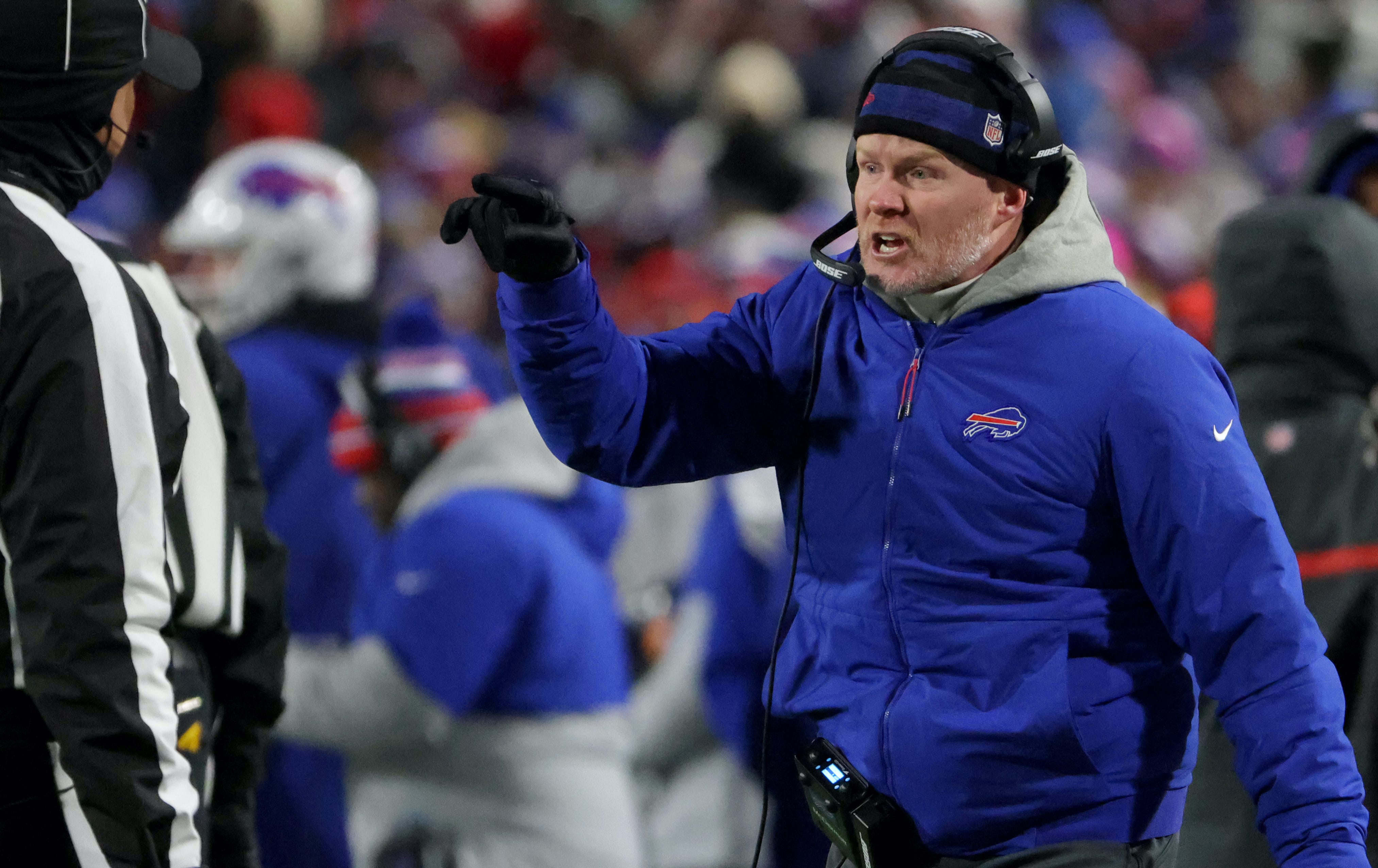
In 2021, the head coach took his blame game to the Monday Night Football spotlight. That night, the New England Patriots won a modern football game while attempting all of three passes in 40 MPH winds. Everyone in the stadium knew exactly what was coming play… to play… to numbing play, and the Patriots’ running backs still rushed for 217 yards on 38 attempts in a 14-10 win. He began that postgame presser by stating the 64-yard touchdown skewed the numbers, then quickly spun blame to the offense. He said the Bills should’ve scored points to stop the Patriots from running the ball so much and — multiple times — reminded everyone that the Bills finished 1 of 4 in the red zone and that their average starting field position was the 40, compared to the 23 for New England.
Answer to answer, he became increasingly disgusted by the Bills’ offensive identity.
“We’ve got to be able to run the football and we’ve got to be able to stop the run,” McDermott said then. “The message hasn’t changed in terms of the necessity for physicality and what we do. That’s why we start training camp the way we do with running the football. You’ve got to win at the line of scrimmage.”
And: “You’ve got to score more points. That’s the name of the game: Score more points.”
And: “If you were in the team meetings in training camp, you would know what style of offense I want and what style of defense I want. What style of football team I want. That identity is shaped in training camp and that identity needs to embody toughness.”
And then one question on the psychology of facing Bill Belichick visibly disturbed McDermott.
He answered as if trying defend his personal honor — one defensive coach vs. another.
“Let’s not give more credit than we need to give credit to Bill Belichick in this one,” McDermott said. “Whether it was Bill or anybody else, they beat us. But you sit here and you tell me when we start with an average starting field position of the 40-yard line and he starts with the 23-yard line and we were 1 for 4 in the red zone and they were 0 for 1 in the red zone? You give me that ahead of time, I’d say I like my chances. I like my chances.
“What are you doing with the opportunities you got?”
This was a revealing break from character, hinting at life on his staff.
We’re now all seeing this “bizarre” blame game play out in real time.
As pressure mounts this season — as fans correctly deduce that the head coach is the problem — it should come as no surprise that McDermott has tried to pin this disappointing season on the offense. After Mac Jones, one of the worst QBs in the NFL, drove 75 yards in 1:46 to win, plenty of shrapnel was reserved for the Bills offense. After losing in Cincinnati, he pointed to the line of scrimmage and the lack of run-pass balance. After the Bills squandered a lead with 1:56 left to Denver, McDermott ripped Allen for an interception and said he was “proud” of his defense all in the same answer. Losing Matt Milano (broken leg) was a major blow but step outside the Bills Bubble and you’ll see injuries ravaging contending rosters across the NFL. That didn’t stop McDermott from cushioning his critique of the D with multiple references to the injuries.
And when his unit allowed 30 points after halftime to Philly, he lamented the plays his offense left on the field.
The next day, he defended a defense that’s surrendered three game-winning drives with less than 2 minutes left.
“The defense has played, for the majority of our season, well enough to win,” he said.
This survival tactic is as transparent as it is weak. McDermott is oddly determined to create arbitrary distance between himself and the offense with an empty “it starts with me” qualifier. If anyone should realize he’s the head coach of the entire team, it’s him. It’s the man who surely views his meticulous process as a machine for good.
Midway through this season, Patrick DiMarco was back in town. The fullback played for McDermott his first three seasons — ’17, ’18, ’19. More specifically, he was a leader the head coach relied on behind the scenes to zap the culture. Tossing the football around with his son about 2 ½ hours before the Bills’ night game vs. the Tampa Bay Buccaneers, DiMarco couldn’t believe it when McDermott shouted his name from behind. They hugged. They chatted for 15 minutes. The head coach was genuinely interested in how DiMarco was adjusting to life post-football, how his body was feeling, how is wife’s doing and even knew all four of the fullback’s kids by name.
A moment like this only happens if there were redeeming qualities to that culture.
True, there are players who say we all must take a deep breath to see why this tendency to be so controlling, so anal was required.
DiMarco can remember mini breakthrough moments, too.
During OTAs, teammate LeSean McCoy once busted loose for a 70-yard run and the fullback chugged alongside “Shady” all the way to the end zone to celebrate. McDermott stopped practice, right then, to make an announcement to everyone: “This is winning.” DiMarco was fresh off a Super Bowl appearance in Atlanta, so the first-time head coach made a point to pick his brain. He’d ask the team captain for his true feel of this roster. To which, DiMarco said players didn’t know how to win. McDermott agreed 100 percent and asked how to change that. “Time,” DiMarco told him. “Asserting them on what they’re doing right and wrong in the wins and losses.” The head coach never forgot that lesson. He’d drill into everyone’s heads that the first key to winning is to “keep yourself from losing.”
DiMarco liked the fact that McDermott was never shy about expressing his Christian faith, openly preaching the gospel in team meetings. The head coach was family-oriented. When players saw McDermott interact with his kids, it resonated.
“I have a lot of respect for Sean,” DiMarco said. “He was going to build it his way and he was going to wear it. It’s still that way. That’s the one thing I respect about him — he’s not going to be circumstantial and change. He’s going to be himself. Genuinely himself at all times. Which is a characteristic that some people love, some people don’t.”
Tight end Lee Smith spent four drought years in Buffalo (2011- ’14) before heading to the Oakland Raiders and returning to Buffalo for the ‘19 and ‘20 seasons. As one of the most respected voices in the locker room — if not the most respected — Smith wants to be crystal clear in stating that McDermott, No. 1, was the person who transformed the franchise. He saw how much of a “dumpster fire” the Bills franchise was up close and shared many, many deep conversations with the coach on culture.
They agreed. They disagreed. Dialogue was open.
The longtime tight end, a gripping story himself, is convinced nobody is working more hours to fix the Buffalo Bills than Sean McDermott.
“Me and Sean got along great,” Smith said. “No one wants the Buffalo Bills to be better. No one wants to do it right more than Sean McDermott. He’s not that guy that’s going to be meeting a player for a beer after practice or after the game. He’s a worker, man. He’s a worker. He’s the boss. He’s obsessed with growing and being great at the boulders and not the pebbles.
“The only thing that matters is being consistent, being genuine, and having a damn good locker room.”
Added DiMarco: “He didn’t serve in the military, but he has that wrestler’s mindset of just: ‘You’re part of a team, look like the rest of everybody, go out, play your ass off and celebrate and do whatever you want after the game, after we get the job done. But until the job’s done, enough with the cute shit. Go succeed.’ Which you can’t argue with.”
Connecting with older vets is not an issue. Add Lorenzo Alexander and Kyle Williams to the mix. But it’s too often a polar-opposite situation with the younger generation. Multiple sources use the word “bizarre” in recalling how McDermott viewed the relationship between assistant coaches and their players. He appeared jealous.
One story comes to mind. Take a position traditionally teeming with eccentric personalities. Chad Hall played wide receiver, was much closer in age and — clearly — has a gift for managing egos in his room. The Bills receivers loved Hall so much that they bought him a truck for Christmas in 2020. An objectively touching moment that Isaiah McKenzie shared via Instagram. In the dark, in the rain, you see Stefon Diggs and Andre Roberts lead Hall out to the driveway with a beanie over the coach’s eyes. On the audio, Cole Beasley says that this was originally Gabe Davis’ idea and that they all chipped in.
It's impossible for any sane person to watch this heartwarming video and not feel happy for Hall.
Obviously, this coach had made a profound impact on those receivers’ lives — why anyone gets into coaching in the first place.
But Sean McDermott? Oh boy. Sean McDermott was not pleased. One source described this as “a dark day at One Bills Drive.” Not only was the head coach pissed that players were gathering as a group during Covid, McDermott told his staff he pays them to be a coach. Not a friend. Other coaches could not believe his cold response. They had never seen anything like this in their careers.
Not only were the Bills’ wide receivers shattering franchise records. Right here was the ultimate sign of respect.
Said one assistant: “I thought it was cool as shit. And he made it into the biggest negative ever. That’s him. He couldn’t take that. He couldn’t handle that. He couldn’t let that be. He couldn’t let that stand. And there’s cases of that more so on the offensive side of the ball than the defensive side. He has zero relationship with the offensive players. Zero. None. Absolutely zero. He’s insecure. He wants the relationship that he can’t have with the players. Because he’s not physically, mentally, or socially able to.”
And another: “Sean was pissed. He was super pissed. One of Sean’s biggest things is, coaches that related to the players, it was almost like he resented it. He’d always say, ‘I have to be the bad cop. You guys are always the good cop.’ He always hated the fact that players liked a couple of coaches. It was frowned upon.”
This coach cannot help but laugh at the absurdity of such a statement.
Multiple sources indicate that McDermott was especially harsh toward Hall and paid him a salary so low it was insulting.
Hall declined to comment for this story.
Molehills become mountains. Each day. One coach shared a wild story in which McDermott instructed him to reprimand one of his starters over something minor and then — behind his back — contradicted his own instructions in an attempt to ingratiate himself with that player. It was obvious to players and coaches alike that McDermott didn’t like the fact that his offensive coordinator, Brian Daboll, was close to his quarterback.
The bigger the game, the tighter McDermott gets. When Tom Brady was still in the AFC East, he’d appear exceptionally tense ahead of matchups with the New England Patriots. Ever since the Bills morphed into a Super Bowl contender, he’s been on edge ahead of dates with Reid and the Chiefs.
Anxiousness that becomes infectious.
“The players feel him being so uptight,” one coach said. “You go, ‘Uh oh. Sean’s doing it again.’ It shows during the week. It shows in his playcalling. That’s his downfall — he’s just so uptight. It takes a toll on him. … He’s a nervous wreck. The players can sense it just in his voice, his demeanor.”
All of which is reflected when it’s nut-cutting time. The sight of defensive backs lined wayyy off the ball in crucial late-game situations is as common as the ridiculous number of Tim Horton’s coffeeshops in WNY.
No wonder the team’s general manager, Brandon Beane, is cited as a force of good behind the scenes. Everyone who criticizes the head coach makes a point to paint Beane as the ultimate contrast and says the GM puts out more fires than anyone knows. Beane, conversely, is described as extremely personable. Coaches and players alike feel comfortable going to Beane with issues, which is rare considering general managers, by nature, should be cold and calculated. After all, GMs are the ones literally releasing players in their office.
If there’s something Beane cannot tell a player, he’ll flatly say so. But he’s authentic. People sing his praises throughout the organization.
“Beane is my favorite person on Planet Earth,” said one employee on the business side. “He is truly the best person in sports I’ve ever met in my whole life.”
The best way one higher-up who has worked with both put it is that Beane is someone you actively want to hang out with when work’s done. Whereas McDermott? “You’re not going to go have beers with him. He’s definitely not the most fun guy.” This person never hung out with the coach outside of work. “Nor would I want to,” he added.
Nor is McDermott always as cool, as collected as he appears publicly. Perhaps the surest sign that Bills Culture is the opposite of how it’s broadcast to the world is what cameras do not capture. One team source said McDermott treats his support staff — those who are not coaches — like “grains of sand underneath his feet.” He added that McDermott “brutalizes” the head trainer in that he’s constantly in his ear saying the trainer must get an injured player ready to play. If a player was unable to suit up, McDermott could blow a gasket: “What the f--k! You said he could play!” Further, McDermott views tenured employees as employees who get complacent. Those working on the first floor of the building get visibly nervous toward the end of each year, knowing someone could get fired.
Again, there probably was fat that needed trimmed when McDermott first took over. Cleaning house was understandable for an organization so desensitized by losing. However, over time, the unknown of “Who’s next?” only feeds tension. Feeds that tightness throughout the building. All while those on the support staff realize they can’t speak up. If a head coach fires you, potential employers are bound to call McDermott and ask why. The league is small.
“When Sean leaves a building, it’s like ‘Hakuna Matata,’” one team source said. “People are celebrating and they all bash him. They joke about it. They’re like, ‘He doesn’t know who the f--k I am.”
Language that surprised one source on the business side of the operation who viewed McDermott as more mysterious than malignant. This person said the head coach is clearly obsessed with “PR appropriate” tact whenever conversing with folks on their wing of the building. A football team is its own ecosystem. The jokes made here would never fly in a bank, a school, a retail store, essentially every other world and that’s precisely how people bond. Yet, when McDermott was around? Jokes were off-limits. If a conversation started meandering into dicey territory, he’d simply walk away. Whereas Daboll, the OC, would often take a seat and shoot the bull — with anybody — conversations with the head man felt like robotic dialogue pulled straight from a book “on how leaders should act.”
“That’s why I never trusted him,” the source said, “because nobody’s like that. Nobody’s like that all the time. Any time someone acts like that, I’m like, ‘I’m not getting the real you.’”
Open up the Buffalo Bills media guide from the year McDermott took over, turn to the bio on the new coach in charge and you’ll find a Q&A breakout box. A fun way for people to get to know the coach. McDermott is asked for his favorite TV show (“Monday Night Football”), the person who has influenced him the most (“Jesus Christ”), favorite movie (“Vision Quest”), favorite vacation spot (“Kiawah Island”) and his favorite musical artist (“Michael Jackson”) amongst other inquiries.
The final question is the most interesting.
Right next to a picture of a young McDermott pinning down a competitor on the wrestling mat, he’s asked for his pet peeve.
His answer: “Fake people.”
No wonder the coaches who’ve had the opportunity to leave don’t merely walk to the door. They sprint. The mass exodus of coaches doesn’t make any sense to outsiders. Typically, those attached to a Super Bowl contender — in any capacity — want to stay with that Super Bowl contender until a juicy promotion presents itself.
Not here.
“Everybody,” one ex-coach states, “wants out of that place.”
Some coaches were denied the opportunity to interview for promotions elsewhere. That’s not uncommon. What is peculiar is for coaches to not sign their “rollover.” Let’s say you have one year left on your contract. A team will offer a new contract to basically give you two more years. That way, you’re not feeling like a lame duck. An extension both keeps the peace and ensures job stability. With quarterback Allen ascending into superstardom, it makes all the sense in the world for coaches to stay put. He’s the Midas touch. He’s the one sure to make many people millions of dollars — certainly has for the head man. Plus, there’s no guarantee another coaching gig is waiting once your contract expires.
Yet, coaches leave in droves. Since Allen’s rookie year, 2018, by my count, at least 22 coaches have departed. Motive is always a personal decision: some took promotions, others took lateral moves to get out.
Jim Salgado was fired. Bob Babich retired. Aaron Whitecotton went to the 49ers, then the Jets. Daboll was hired to be the New York Giants’ head coach, and took the likes of Shea Tierney, John Egorugwu and Bobby Johnson with him. Bill Teerlinck and Terry Heffernan headed to the college ranks. Hall and special teams coordinator Heath Farwell left for the same jobs in Jacksonville. Ryan Wendell is now the Los Angeles Rams’ offensive line coach. He was previously denied the chance to interview for a promotion.
Dorsey was fired.
Round ‘n round we go.
Players notice the exodus.
“How many winning organizations that have a chance to win a ring, you see coaches leaving for lateral moves around the league?” said one longtime ex-Bill. “At this point, it’s laughable.”
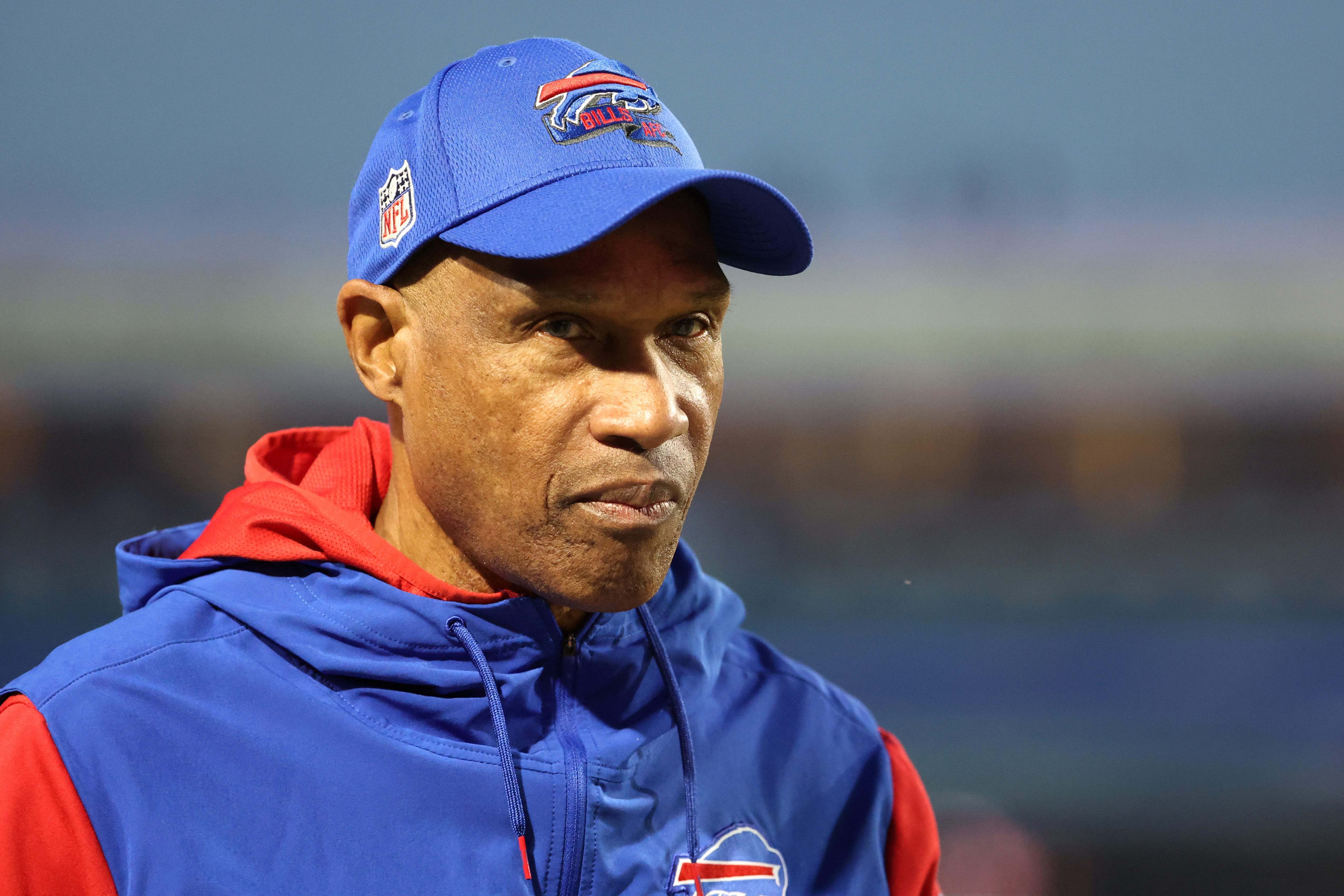
And, of course, there’s Leslie Frazier. The team’s assistant head coach and defensive coordinator departed under shadowy circumstances. At the NFL Combine, McDermott said that Frazier informed him the week prior that he was going to take the 2023 season off. Beane added during his presser that Frazier wasn’t ready to retire and wanted to take “a step back.” No further details were given. All this did was create more questions than answers.
Sources close to Frazier indicated that your suspicions are true: McDermott wanted Frazier out.
Removing the defensive coordinator conveniently pins recent playoff failures on the coordinator.
Outright firing the coach, the team realized, would’ve been horrible optics. Frazier’s defenses have statistically ranked amongst the NFL’s best and you’d be hard-pressed to find coaches more beloved across the entire league. His reputation as a coach, as a man is sterling. One source noted that it also could’ve jeopardized the team’s opportunity at draft capital. In 2020, the NFL approved a new provision that rewards teams third-round compensatory picks in each of the next two drafts if one of their minority coaches become a head coach. By title, Frazier was the highest-ranking assistant. (“Sean wanted to blame,” one of Frazier’s fellow coaches in Buffalo said. “The blame game: ‘You’re going to take the blame on this one.’ And Leslie’s like, ‘Oh, no, I’m not.’”) Thus, both sides came to this kumbaya agreement for all to save face.
There is truth to Frazier wanting to decompress. I’ve been told he still has the desire to compete and still loves coaching players today. He’ll be coveted. Those who’ve spoken to Frazier, 64, sense a strikingly rejuvenated coach. One ex-colleague described him as “glowing” and “as energetic as I’ve seen him,” adding that Frazier realized it was the atmosphere in Buffalo — not the profession — that was taking a toll.
“And that place is dictated by one person,” the former Bills assistant said. “The head coach.”
The rebuttal to everything written above is obvious. Arguably the greatest coach in football history, Bill Belichick, was famously ruthless on his assistants. Everyone should read Seth Wickersham’s exceptional, “It’s Better To Be Feared,” the definitive guide to the New England Patriots’ reign. Yet, there is one distinction between these two worlds. Six Super Bowls for starters. And when coaches leave Belichick — for promotions, not lateral moves — most come crawling back to their old boss. They find true purpose in working for Belichick.
Do not hold our breath for those who’ve left McDermott to return to Orchard Park.
A few say they’re grateful for their opportunity in Buffalo but mostly learned what not to do if they ever became a head coach.
Now, the Bills are a hodgepodge staff. McDermott lacks the deep network of allies typical of a coach who’s been in the NFL for two decades. Some current assistants want out; others are loyal.
Once you’re able to stop fearing for your job, those who’ve left insist Buffalo is a phenomenal place to work. They loved the fans. The city. The players. “Once you eliminate that one little piece — it happens to be the head coach — it’s awesome,” said one ex-coach. As we write often here at Go Long, this is a player-driven league. Always remember: Coaches lose games, players win games. And when it comes to the players, the exposure to asbestos in this building has been more indirect. This isn’t quite Urban Meyer kicking one of his players or Matt Patricia mother-bleeping players all practice through a combined 15 wins and 40 losses. These buildings needed to be burnt to the ground before being rebuilt.
Yet, that’s what’s most maddening in Buffalo. Super Bowl glory has been in-sight this entire time. Everyone can picture players atop that dais accepting the Vince Lombardi Trophy because the Bills’ talent actually has found a way to overcome its head-coaching.
Well, to a point. To the final seconds of a playoff game.
Thirteen seconds to be precise.
Read Part II right here

I'm not a Bills fan, but this is top notch reporting, subscribed just to read this. Had I a media empire, you'd be hired. Keep it up.
Stunning work Tyler, been following your writing for a while.
We'd love to have you on the Mafia Talk podcast to talk about the trove of research and conclusions in the three-part series. Please get in touch- Adam
apruem@gmail.com