

This is the 42nd year, and the fifth at Go Long, in which Bob McGinn has written a position-by-position series previewing the NFL draft. Previously, it appeared in the Green Bay Press-Gazette (1985-’91), the Milwaukee Journal Sentinel (1992-‘2017), BobMcGinnFootball.com (2018-’19) and The Athletic (2020-’21). Until 2014, many personnel people were quoted by name. The series reluctantly adopted an all-anonymous format in 2015 at the request of many scouts. Listed times in the 40-yard dash reflect the average of hand-held clockings from the combine and pro days. Electronic times from the combine aren’t compatible with most pro days and therefore weren’t utilized.
Seventh of 12 parts: defensive line.
By Bob McGinn
The defensive tackle with disruptive ability as a pass rusher will always be worth his weight in gold. Now there’s ample reason to pay more respect to the run-stuffing segment of the position.
Last year, 33 defensive linemen were drafted. Granted, it was a strong year at the position, but that was eight more than the 25 that had their name called the year before.
In 2018, this series eliminated the positions of defensive end and outside linebacker, combining them into a new position categorized as edge rusher. Meanwhile, the position of defensive line became the province of those weighing 285 pounds or more, and the linebacker position was designated for off-the-ball players. Specifically, for middle and weak-side linebackers.
What’s interesting to note are the numbers of defensive linemen that have been drafted in the years since the change was enacted: 2018, 28; 2019, 28; 2020, 21; 2021, 23; 2022, 24; 2023, 27; 2024, 25, and the aforementioned 33 in 2025.
Now, one executive in personnel says he has assigned draftable grades to 29 defensive linemen come April 23-25. His norm has been 22 to 23.
Defensive line, especially the 3-technique, always has been a premium position. But is something afoot that would account for the uptick in defensive-line attractiveness?
“When the running back is back in vogue so is the nose tackle,” said the scout. “Remember a few years ago it was, ‘Well, we can get a running back in this (late) round?’ Right? Well, let me tell you something, stopping the run has become a sense of urgency for me. Nose tackle is becoming a necessity.
“You can’t stop the run unless you have a nose tackle. You play light boxes, you need somebody that can clog up two offensive linemen. If you don’t, that’s why you see so many big runs.”
So teams drafted 33 defensive linemen a year ago. Georgia’s 327-pound Nazir Stackhouse, who wasn’t drafted, signed with Green Bay as a free agent and wound up logging 159 snaps as the Packers cycled through big bodies trying to plug the interior run — in base personnel or sub.
“The game’s changed,” continued the personnel man. “It’s more ‘11’ personnel. Sean McVay’s principle is three wide receivers. He’s got those big slot receivers so it’s light boxes. When you have light boxes because everybody’s covering down, you need bigger bodies inside because they’re getting double-teamed.
“If I got a little 6-1 guy that’s 280, now you run it. This is not hard. Because of the light boxes, these guys have to play the run. The average per run given up in the NFL is skyrocketing. It’s up 25%, 30% over the last six years.”
The executive referred to this year’s group of defensive linemen as a “smorgasbord.”
“There’s really no No. 1 guy,” he said. “There’s not a guy that’s a consensus first-round pick. This is a year where nobody is standing out as a 3-technique. Last year was a record DT draft. This year, I think there’s fits for people. I don’t see (impact) players, but I see guys that can fit a team and perform at a high level.”
Clemson’s Peter Woods, the No. 1 player on some boards, is a 3-technique but the next six in the rankings are nose tackles, or 1-techniques and 0-techniques.
“The group doesn’t have a lot of high guys,” said another scout. “There actually are more nose tackles than we’re used to, but not very many 3-techniques.
“Woods can (rush the passer). After that, I don’t see it. There are so few of these (rush) tackles, I wonder if they’ll get drafted higher.”
Links:
Part 2, TE: Kenyon Sadiq and the hunt for matchup nightmares
Part 3, T: Why Francis Mauigoa ‘n co. may define the 2026 NFL Draft
Part 6, RB: Notre Dame’s Jeremiyah Love? ‘The best NFL prospect in this draft
Paid subscribers can access the full, unvarnished analysis from NFL scouts around the country below.
Go Long is fueled — 100 percent — by our readers.
We appreciate you growing our community.
DEFENSIVE LINE
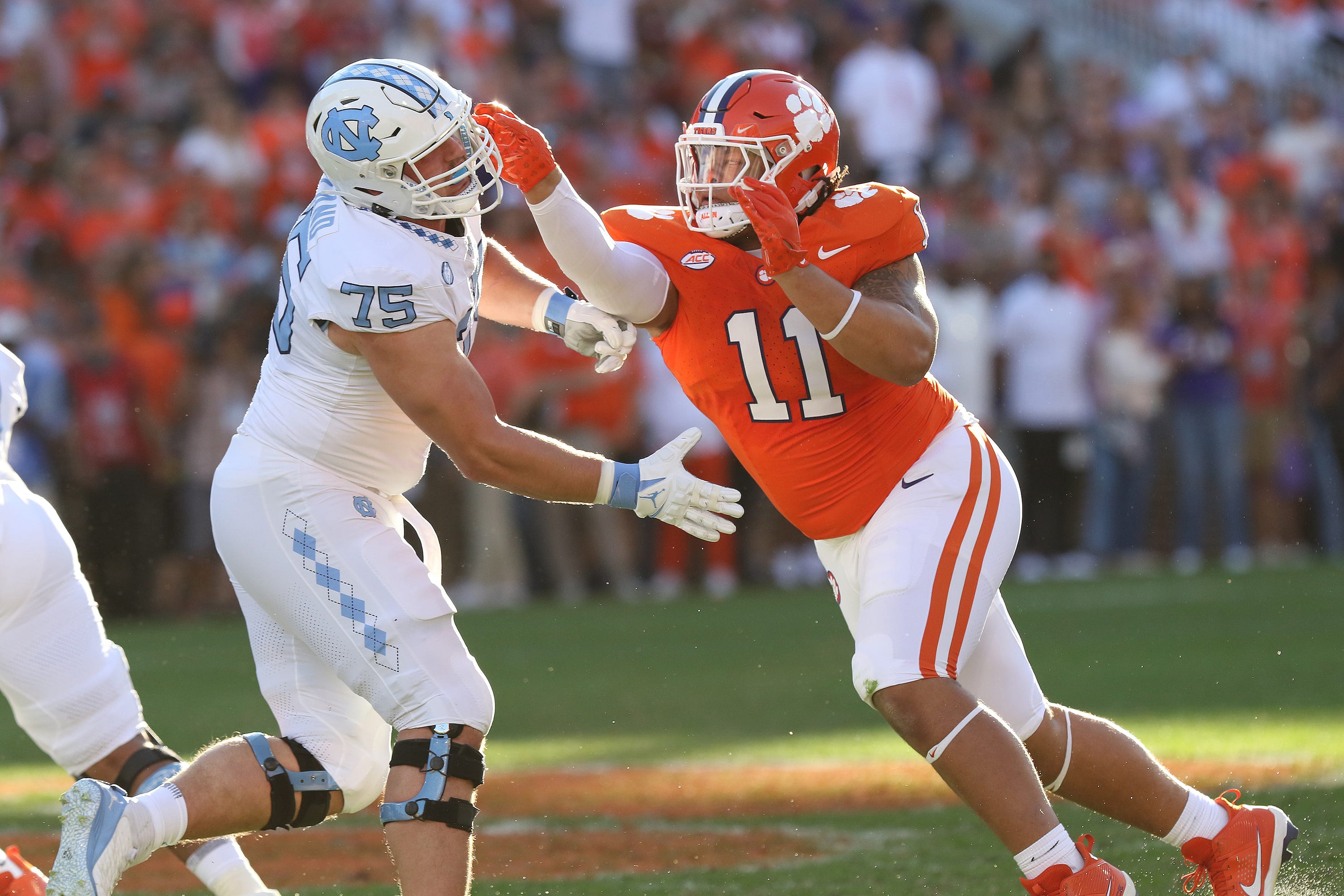
1. PETER WOODS, Clemson (6-2 ½, 300, no 40, 1): Third-year junior. Turned 21 in March. “He’s so damn quick for a guy that big,” one scout said. “He throws guys around. He can take an edge and, boom, get up the field. He takes on blocks at the point of attack. Quinnen Williams was like that. There’s just not too many of those guys.” Started two games as a freshman, then 22 games in 2024-’25. “He’s either an athletic nose tackle or a 3-technique,” said a second scout. “He can do either. The tape’s really good. The only issue is his size and length are not wonderful and his production this year actually wasn’t great. He’s got power and quickness, and some explosive movement.” Short arms (31 ¼ inches), small hands (9 1/8 inches). “I like Peter Woods,” said a third scout. “I just know he isn’t a Mason Graham or Walter Nolen, that type of player. Nothing in his numbers compare with them. You’re looking at a high-energy guy. He’s a fighter. He can play all three downs. He can play the edge. He can stack the point. He gets off blocks. He’s shone that he can run to the sideline. He has change of direction in space. But one of the reasons why Clemson didn’t have the big year was there were no impact plays. I don’t consider Woods a disruptor. His numbers are journeyman numbers. He’s more of a solid defensive tackle, a rotating-type guy. Is he a first-rounder for somebody? He could be but I wouldn’t pick him in the first. There’s nothing to support that.” Finished with 84 tackles (14 ½ for loss), five sacks, two forced fumbles and one batted ball. “He’s a better run defender right now than a pass rusher,” said a fourth scout. “He is steady and does a good job with his hands, but he isn’t a disruptive type. Doesn’t stand out in any specific area. He could start in the league for many years but never approach All-Pro.” Five-star recruit from Alabaster, Ala. Led his high school to four straight Class 7A state championships. “You wouldn’t even know he was on the field unless you were looking for him,” a fifth scout said. “Gets bounced around at the point of attack and gives you absolutely nothing in pass rush. He was a big-time recruit and some people still try to hold onto that. He just doesn’t do anything. He’s just out there. I didn’t think he played particularly hard. Some of these guys, at least they play their ass off.” His short shuttle time of 4.54 led the position.
2. KAYDEN McDONALD, Ohio State (6-2, 327, no 40, 1): Last season, he lined up alongside Tyleik Williams (6-3, 329), who was drafted No. 28 by Detroit last year and played 446 snaps as a rookie. “They’re similar,” said one scout. “Just a tough ass, rugged dude. He shows snatch and power. The run game, he just crushes it. He’s not your true (pass rusher). Not going to give you a lot of sacks but he’s good enough there. He can make a mess in there and push the pocket. He’s bottom of the first and will start.”