

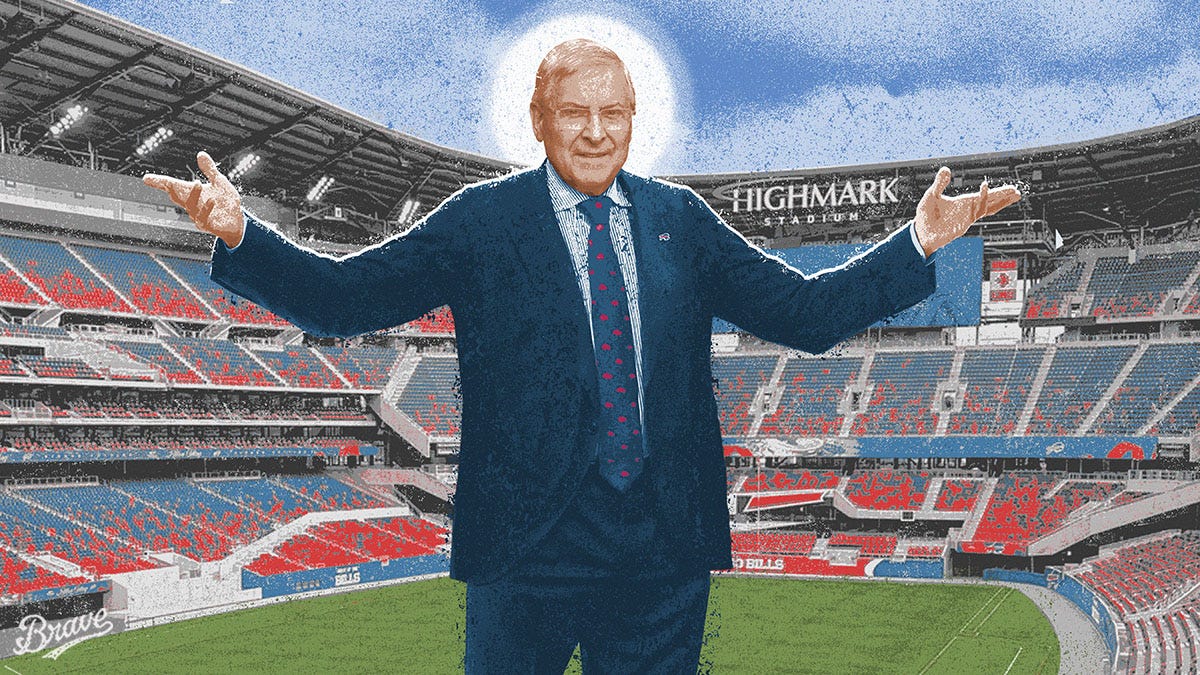
Tonight, the Buffalo Bills host the Detroit Lions in the first-ever game at new Highmark Stadium. Go Long sat down with owner Terry Pegula for more than an hour to reflect on his vision for the stadium and these Buffalo Bills.
Subscribers can read our story in full.
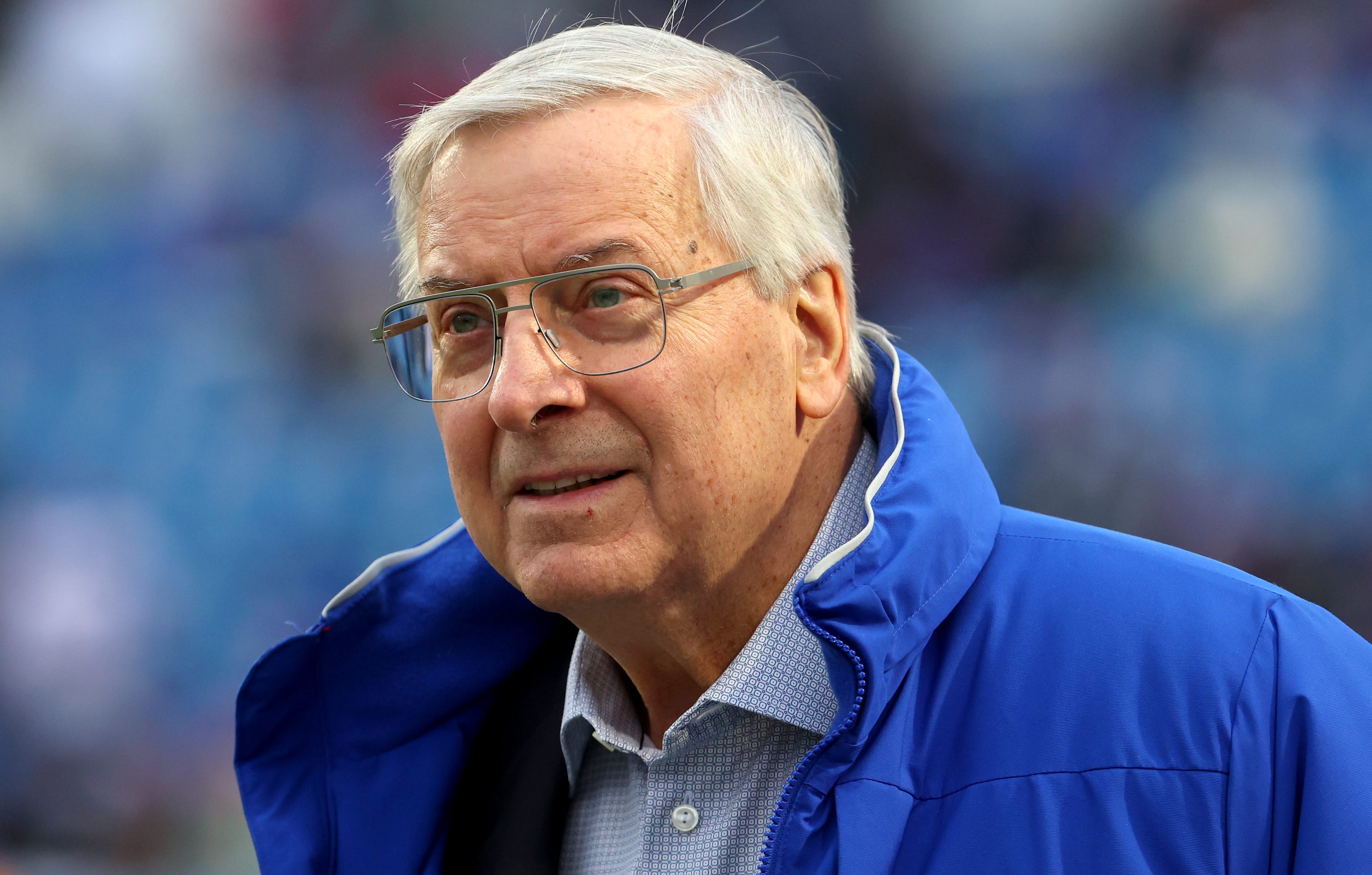
ORCHARD PARK, NY — Enter the office of Terry Pegula and a football-sized dog named Lucy barks and leaps and barks and spins in a choreographed swoop of hyperactivity. She’s clearly his official bouncer vetting all visitors. One firm “Lucille!” is all it takes for the Buffalo Bills owner to calm her down and he takes a seat at his desk. Behind him, there’s a picture of his daughter, Jessica, on the cover of US Open Daily and five Bills game balls amongst other mementos.
Outside, the stadium he inherited as this team’s owner is reduced to rubble. All open air and old memories.
Across Abbott Road is where his team will play for the next 30+ years.
What a night it’ll be inside new Highmark Stadium against the Detroit Lions for Home Game No. 1. There will be goosebumps, damaged vocal chords, ceaseless rounds of Labatt Blue Lights as 60,108 attendees create something new. Together. And sitting here, I cannot help but remember when such a scene was accepted by those in the crowd as an impossibility.
The team’s original founder aged. There wasn’t an estate plan in place. Frustration with Ralph Wilson turned into anger. Then, anger worsened into something much darker: doom. Ask any diehard in your life. They likely remember exactly where they were when a rumor circulated that Wilson had passed away because — at that exact moment? — a nightmare became a reality. The Bills would be sold off to the highest bidder and Buffalo, NY would be discarded like small markets past.
Driving down Abbott, you’d see empty lots to your left, a dilapidated stadium to the right and this entire area would slip into an unimaginable depression.
Of course, this rumor proved to be false. A temporary sigh of relief.
Three years later, in 2011, a petroleum engineer named Terry Pegula bought the Buffalo Sabres with his wife, Kim.
Wilson’s health — for real this time — started to deteriorate late in 2013 and the Pegulas were well aware of this great unknown, this cloud, hovering over the football team.
“It was: ‘Where are the Bills going? Where are they going?’” Pegula recalls. “That’s all we heard.”
He was no distant suit. A lifelong Buffalo Sabres fan, Pegula could relate to the anxieties, the fears of locals.
When he looked around Western New York, he didn’t see others with pockets deep enough to bid on an NFL team.
So it was right around then that Terry asked his wife a blunt question: “Do we want to own the only sports team in Buffalo? Or do we want to own two sports teams in Buffalo?”
They decided to go for it.
Wilson passed away from natural causes on March 25, 2014 at the age of 95. The Pegulas sold off some oil and gas assets and positioned themselves financially to make a competitive offer. Here, Pegula recalls the night they submitted a bid. Steve Greenberg of Allen & Company told him there was a 95 percent chance he’d get the Bills at $1.3 billion, but a 98 percent chance if he upped the bid to $1.4 billion. “I like 98 percent better than 95,” Pegula told him.
Done.
The Bills were his.
Now, this franchise comes full circle. New Highmark Stadium’s grand opening serves as 1.35 million square foot proof that the Buffalo Bills are here to stay. If anyone else would’ve purchased the team, odds are, they would’ve eventually transported them to Los Angeles. Or Toronto. Or Austin. Or San Antonio. So on the cusp of the Bills’ monumental 2026 home opener, Go Long sat down with Pegula to get his thoughts on the stadium.
Until now, nobody’s heard much from the person who saved football in this city.
The only team in a smaller market than the Bills, of course, is the one that’s been a publicly held, nonprofit corporation since 1923: the outlier Green Bay Packers. Football staying in Buffalo is a minor miracle as the NFL inches closer and closer to becoming a trillion-dollar enterprise. History is littered with tales of rich businessmen buying sports teams and moving them in the interest of the bottom line. Building a new stadium, arena, rink elsewhere is more lucrative and, hey, they don’t necessarily mind leaving tears and scars and sadness in their dust.
“Do you remember when Cleveland left? Are you kidding me?” Pegula says. “And they were like fifth in the league in attendance with a great fan base. I’m thinking the same thing here. Why should these people be suffering thinking they’re going to lose their team year-in and year-out for years? I don’t hear that talk anymore.”
Stripping away this team from this market is akin to cutting off their oxygen supply. Pegula understood this. He nods in the direction of the stadium.
“There’s the anchor right there.”
If this owner’s No. 1 objective was to make more money, the Bills would be elsewhere.
“I’m not all about money,” Pegula says. “I’m about what legacy you leave in your life. So I never looked at it that way. It was always: ‘What’s the best thing we can do?’ I’ve been coming to hockey games up here for years. So it was all about doing what we thought was the best thing for the area.”
So, I ask, what does Terry Pegula want his legacy to be?
“The Bills are here. The Sabres are here. And they’re going to stay here.”
Football first
On Oct. 8, 2014, NFL owners unanimously approved Terry Pegula’s purchase of the Buffalo Bills.
On March 28, 2022, the Bills reached an agreement with the New York State and Erie County on a 30-year lease for a new $1.4 billion stadium in Orchard Park. It was declared a “private-public” partnership. (More number-crunching on this later.)
On June 5, 2023, shovels pierced the ground.
On June 23, 2026, ribbon was cut to declare Highmark Stadium open.
Tonight — Sept. 17, 2026 — the Bills will host their first regular season game in this stadium.
Of course, the road from Point A to Point B was not so neat and tidy. Never is. Ask the Chicago Bears, a team with it sights now set on Hammond, Indiana. Ask any franchise for that matter. Pegula was a novice when it came to this whole stadium thing, so inquiring how in the hell he first launched into this world seems like the best place to start our conversation. Planning began in 2018. After having studies done on Ralph Wilson Stadium, he quickly realized this abode would soon be unsafe. The premium seating was outdated, too. Pegula himself always thought the viewing experience was far better in the bowl than the actual clubs. Inside of his own suite, from the first row, Pegula would need to bend down simply to view the scoreboard.
Around since 1973, this building was on its last legs.
Pegula began by selecting an architecture firm and touring the world. Tottenham Hotspur Stadium in London was particularly mesmerizing. Pegula asked the guide to take him to the three worst seats in the house and then nestled into each one. “These aren’t bad,” he told them aloud. With that, Pegula instructed the architects of his new stadium — Scott Radecic and Jonathan Mallie — to use this one as inspiration.
Of course, there was one not-so-minor difference.
“In England,” says Pegula, “you can’t have alcohol exposed to the stadium while they’re playing.”
Due to a history of hooliganism, UK football law prohibits drinking alcohol while in view of the field. You’ve got to stay in the concourse.
This is not a problem in the states, no.
And, as noted, Pegula was motivated to keep the team here.
He would’ve had suitors elsewhere. To the north, Toronto has always been a looming threat. To the south, Austin and San Antonio have a voracious appetite for an NFL team. The politicians in the state of Texas are very eager to play ball with prospective sports owners.
“We wanted to stay in Buffalo,” Pegula adds. “We’ve got a great fan base. Why not treat them to something they deserve?”
Building a stadium downtown wasn’t realistic given how much it’d cost to build up the necessary roadway in and out. It’s hard enough traveling to Buffalo Sabres games — inviting 20,000 more people would create gridlock the city’s never seen. Further complicating matters? A lack of communication from the office of Gov. Andrew Cuomo. That’s why Pegula is always quick to praise his replacement. When Kathy Hochul took over on August 24, 2021, everything changed.
Perspective matters.
Imagine being Hochul, a Hamburg native. If the Bills herded to Austin under her watch, it’d be impossible for her to buy groceries in her hometown again. Clearly, she felt an emotional attachment to the area and the team. Hochul valued the brand, the market and was motivated to sit down with Pegula.
Now, imagine being Cuomo. His approach was more politically driven. In-person, he was friendly with Pegula, with everyone associated with the Bills. Then, he’d return to Albany and go dark. He was not interested in anything that would require public funding. There’s a good chance he was worried that political opponents downstate would use a new Bills stadium against him. His chief loyalties veered toward NYC. Not Buffalo. To him, this all seemed like a nuisance.
One other question on the minds of those constituents filling up a prospective stadium was much simpler: Dome or no dome? When I bring this up to Pegula, he shares a funny story from the aftermath of his team’s 47-17 “perfect game” obliteration of the New England Patriots in the 2021 postseason. Quarterback Josh Allen and the Bills offense scored touchdowns on all seven of their possessions… all in 7-degree arctic conditions. Amid the elation inside the locker room, Allen quipped to offensive coordinator Brian Daboll that they probably just F’d up getting a dome. To which, Daboll smiled and said: “Look behind you.”
It was Pegula. “Yep,” the owner joked back. “You’re right.”
In constructing a new home, Pegula wanted the Bills to follow one north star: Make this stadium authentically Buffalo. And the team’s inherent advantage, of course, is location. Winters are a merciless blend of whiteouts and freezing temps on the shores of Lake Erie. Everyone has a white-knuckle war story from driving on Route 219. Players forced to live in these conditions, daily, naturally handle gamedays better than any visitor ever could.
A dome in Buffalo defies the laws of nature. Does not compute.
“I can tell you this for a fact,” Pegula says. “When I listen to other teams bitch about, ‘I’ve got to go to Buffalo to play in December, even November,’ I love it. Because that’s an advantage. So that’s Buffalo. The outdoor part of it. And we’ve done a pretty good job with extra heating and — even if you get cold in your seat — you can go up in the concourse and it’s heated.”
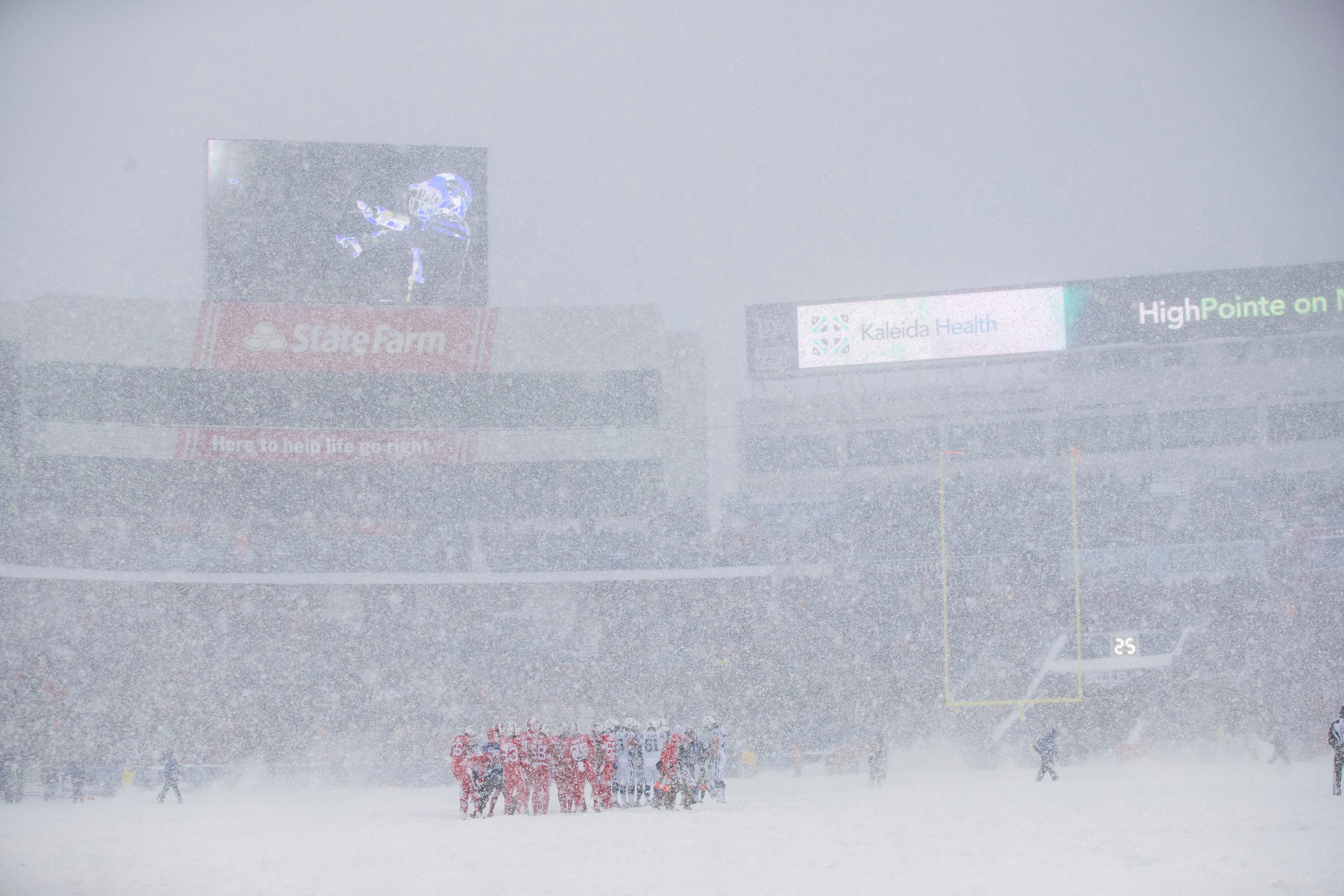
Seats are colored in a sleek red-and-blue pattern. And structurally, these seats shoot vertically to ensure this stadium’s even louder than the last one. Snow and cold are a distinct advantage, yes, but it’s also true that 50 to 55 MPH winds are fun for no one this side of Bill Belichick. (Remember this 2021 mess vs. the Patriots?) The perpendicular positioning of the Bills’ old home led to ungodly winds off the lake. The open western end zone directly faced Lake Erie, creating a wind tunnel. Conversely, the team’s new “wind confusion system” consists of a perforated exterior design to break up and slow down gusts. When the Bills tracked wind speeds at Old Highmark vs. New Highmark last season, speeds were cut in half.
The stadium’s 360-degree canopy will also cover 64 percent of fans from precipitation.
Pegula’s mission was to make the experience comfortable for fans without losing what makes Buffalo Buffalo. Too many new stadiums and arenas around the country are insipid, lifeless.
“I’ve been in sporting venues,” Pegula says, “where I look around and I don’t know whose stadium or whose arena it is. You walk in that stadium and just look at it and you’ll go: ‘This is where the Bills play.’ You look at the seats, it’s all Buffalo Bills. It shouts at you: ‘This is the Bills’ Stadium.’”
On his tour of arenas and stadiums, Pegula visited one that completely lacked any character whatsoever. When he asked why this team’s home was so bland, he was told it was built with music concerts in mind.
Here, Pegula wanted football to stay at the forefront of everyone’s mind.
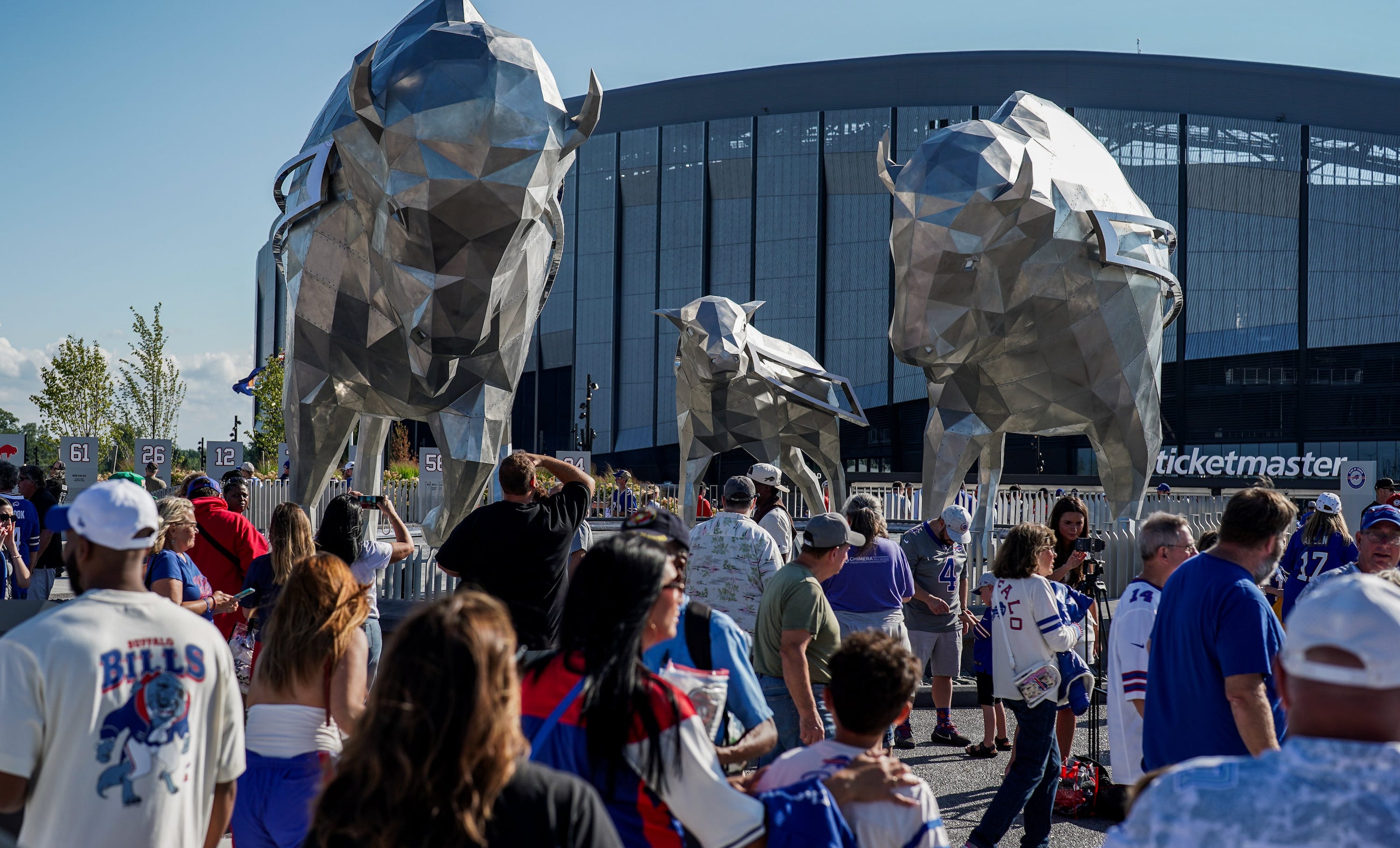
By popular demand, a family of three stainless-steel bison greet fans on their way into the game. The bull stands 27 feet tall, stretches 29 feet long and weighs 23,000 pounds. The cow is 22 feet tall and 23 feet long, while the calf is 12 feet by 13 feet. Inside, there’s a large-scale model of the Peace Bridge, the world’s largest broken folding table on the 100 level and a full-size camper bus in the 300s. Throughout the stadium you’ll find artwork from 45+ creators to further give the stadium a WNY flair.
As for complaints over obstructive viewing, all stadiums require some sort of safety requirement. The team has been meeting with any fans who believe their in-game experience is not reflective of what they saw virtually upon purchase.
Open concourses. Infrastructure to bring fans closer to the action. A clear view of downtown Buffalo from the sky deck. Pegula’s aim was to create a stadium that fans would proudly call home.
Equally important was making this all player-friendly.
President of football operations Pete Guelli describes the amenities for the players as “best in class.” The locker room, training room, hot tubs, cold tubs, everything players need is on this side of Abbott Road as well. There’s also an indoor practice field adjacent to the game field.
Obviously, players in the NFL prefer playing on grass over turf. That was an easy call.
With a string of three straight home games on tap, the Bills decided to re-sod this Kentucky bluegrass from Tuckahoe Turf Farms. Two games and two practices created enough divots for the team to take this preventative measure. The life cycle of the grass is between six and nine events so, rather than roll the dice, the Bills swapped in new grass. Of course, there’s no guarantee it’ll perform until the ball is kicked. Time will tell. They’re hopeful this edition knits together better than the first installment.
Overall, chief administrative officer Josh Dziurlikowski meets with the assistant to head coach Joe Brady frequently to discuss anything that’d help the team on gameday. “This goes back to what Terry said,” Guelli adds. “It’s football first. This has to work for the football team.” Everything is discussed: communications, technology, the scoreboard, the locker room.
Peering through the window, Pegula points toward the remains of the old stadium. At their old home, coaches hitched a golf cart at halftime to motor around the stadium — through snow, rain, sleet — toward the locker room. They’d meet with players and then need to hustle back out to those golf carts to trek back to the booth. Now, they’ll simply push a button and take an elevator down to the locker room.
“A little thing like that, who knows?” Pegula says. “In the past, that might have cost us a game for all I know.”
Pegula exited the stadium in a golf cart, too.
Driving past the fans, he’d hear a little bit of everything.
All passion was welcomed.
After all, he probably relates to those emotions more than they know.
Legacy
When I ask what he’s most proud of about this stadium, Terry Pegula first goes back in time.
His father was a truck driver. And when Myron “Rip” Pegula drove young Terry around, he’d point to a dam. “See that dam? I hauled a lot of that concrete in there.” They’d drive some more, and he’d point to something else. “I hauled that gravel.” Then again. “I hauled the steel in there.” So when he started the largest construction project in Western New York history himself, Son thought about Dad and the fact that nobody else had a clue what he did.
Underneath the words “We Built This House,” per Pegula’s instruction, the names of every single worker who had a hand in building Highmark Stadium are listed — 5,369 and counting.
“I don’t care if they drove from Georgia delivering steel, their name is on the wall when you go into the stadium,” Pegula says. “Twenty years from now, some man or woman’s grandchild can walk up to that wall and say, ‘That’s my grandfather. He worked here.’ We think about our football team and ownership and coaches and whatnot. But if it wasn’t for all those people, it doesn’t happen.”
There were stressful moments. It was a new world out of COVID and winters lingered. Pegula admits there were a few times he told himself there’s no way this stadium will be finished by 2026.
“And I’ll be darned if we didn’t,” he says. “It goes back to those names on the wall. The people. Our staff. We got it done and it wasn’t easy.”
Guelli, nearby, cites the fact that the Bills are now tethered to this market for decades — “basically forever.” All of which is a direct result of Terry and Kim’s vision to keep an NFL team in this market, he adds. When Pegula hears his wife’s name, he jumps in to note that Kim’s fingerprints are all over the stadium. Stuff people might not even notice. All detail in the suites — “freakin’ five-star hotel” quality, Terry says — were her idea.
For a moment, he’s quiet and emotional. Kim suffered a cardiac arrest in June 2022 and has been recovering ever since.
Guelli wants this point known, too.
“The more you go through that building,” the president says, “you realize that stadium’s not there without Kim. She was a catalyst behind the whole thing initially.”
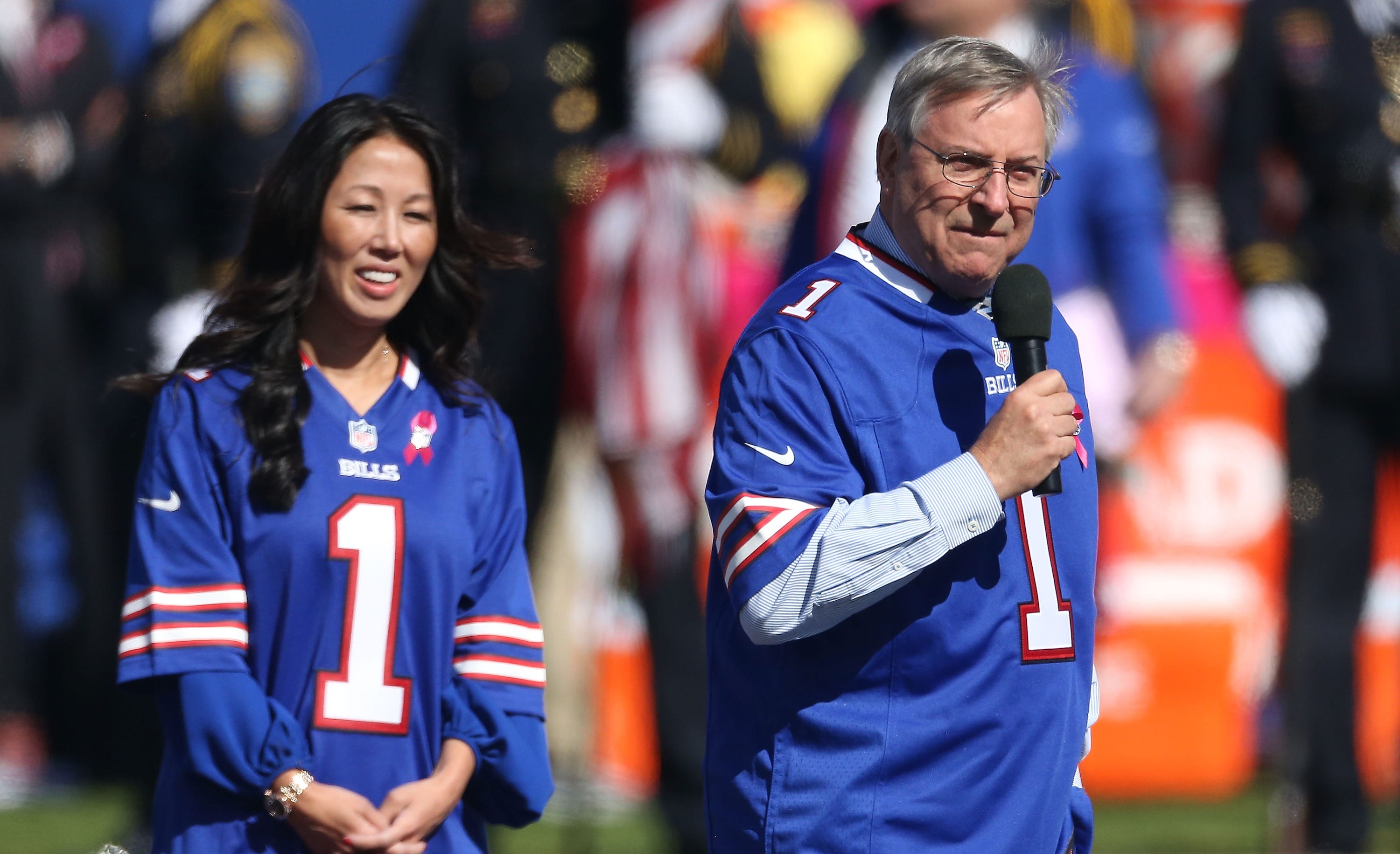
Timing was difficult post-pandemic. Inflation rose. Overages added up. One governor replaced another. Oddly enough, timing on the field was perfect. The Bills have been Super Bowl contenders for the entire 2020s and are armed with arguably the best player in the sport. The presence of Josh Allen surely burgeoned public fervor. “He helps,” Pegula says. “He helps.” The owner rattles off several names of people who made Highmark possible, including the VP of stadium development who had his eyes on everything: John Polka. “I hate to tell you that,” he says, “because somebody will try to steal him. He was really the all-star in this.”
A drive through Buffalo isn’t the same as the other metropolitan cities in the big business of pro football. M&T Bank is the only Fortune 500 company in the city. It’s more difficult to bankroll luxury boxes here than, say, those rival Patriots. There are seven such companies in Boston. The only city smaller than Buffalo (pop: 275,000) that hosts two pro teams is the one that just got a second in hockey: Salt Lake City (pop: 218,000).
Yet, it’s impossible to imagine what’d become of Buffalo if the Bills ever departed.
This fact stayed at the forefront of Pegula’s mind.
“Professional sports is so important in society,” he says. “Sometimes, some people think too important. But just look at the NFL’s ratings. I think one year of the top 100 shows, 96 were football games. It’s the pulse of America.
“This started with being a fan of the Sabres and buying the Sabres. Now, we’re anchored.”
He continues.
He pinpoints what makes this fan base unlike any other.
“The Buffalo fan base is sort of like… have you heard the saying ‘death by a thousand bee stings?’ That’s how we compete with the L.A.s and the New Yorks of the world. There’s a lot of us and we’re passionate.’”
Not that it’s easy keeping up with the modern NFL. New stadiums mean new PSLs (personal seat licenses), a concept widely (and correctly) skewered as evil genius. Fans today must purchase the right to purchase season tickets. New builds for Washington, Cleveland, Chicago and Kansas City will undoubtedly soar PSLs into a new galaxy. One source that attended the recent NFL owners meetings heard grumblings that one of these teams was hoping to earn $1 billion in PSL sales.
In a dream world, yes, all owners for all teams fund their stadiums without asking locals for a penny and when somebody says “PSL” the only image that comes to mind is a $7 Pumpkin Spice Latte at Starbucks. Alas, the Bills raised $263 million in PSL money. And in exchange for the 30-year commitment to Orchard Park, NY, the Bills received a record $850 million in total public money ($600M from the state, $250M from the county). What many Bills fans probably don’t realize is how much of Pegula’s own money was poured into the new stadium after overage costs.
That initial $1.4 billion ticket price for a new stadium finished at a tick less than 2.2 billion.
The stadium deal was also negotiated in a way that made the Bills fully responsible for any overages.
Thus, Pegula ended up paying more than a billion dollars.
New York State and Erie County are responsible for 38.6 percent of the final bill. After settling a dispute with the Seneca Nation, Hochul directed $418 million to fund the stadium. That leaves $182 million in state taxes and $250 million in county taxes. So while it’s true the individual price of season tickets, game tickets, parking, burgers, beer, etc. will soar with the rest of the NFL — and price out some locals — the burden on taxpayers isn’t as excessive here as other markets. Especially if you napkin-math’d the taxable households in NYS (4M+) and Erie County (350K+) over the 30-year commitment. Highmark Stadium essentially accounts for 0.0657% of the $277 billion state budget.
Talk to anyone at any bar, any cafe. Public support has been strong.
Buffalonians remember that haunting fear from the early 2000s.
The Bills managed to get their steel ordered before the tariffs hit. Which helped. Pegula shrugs off the extra costs, saying all construction projects cost more than you anticipate.
“We got it done,” he says, “and we were committed.”
One source close to the stadium deal, and its aftermath, says Pegula never deviated as costs soared.
“This team could have been somewhere else,” this source adds. “And then even when this process unfolded — and he’s getting crushed with overages — he never wavered for a second that he was going to make sure that this was everything that he said it would be.”
Because of legacy. Because part of Pegula is still the guy who’d drive 50 miles north of Pittsburgh — to the top of a mountain — to catch the radio frequency of Sabres broadcasts. “He considers himself a Buffalo guy,” this source adds. “To do anything that would contradict that, that’d be painful. It’s not who he is.”
Here’s an alternate reality: Who else would invest close to $4 billion in the Buffalo market?
A new arena for the Buffalo Sabres will be next, despite the reality that the Sabres — like many NHL teams — operate in the red.
The NHL is on the hunt for a 33rd franchise, following the addition of Las Vegas (2017), Seattle (2021) and relocation of the Arizona Coyotes to Salt Lake City (2024). Austin, Houston and Atlanta have been discussed and here are the Sabres operating on a lease that expires in 2031. Point being: If Pegula moved the Sabres, he’d make bank. KeyBank Arena is a county-run facility, but the Sabres are responsible for all operating costs and capital expenses.
Solidifying the Sabres’ future in Western New York is next.
So will further development around the Bills’ stadium.
There are 242 acres to work with where the old stadium once resided. The Bills have spoken to former Packers president Mark Murphy, a WNY native, about the area he developed west of Lambeau Field. Murphy’s lasting off-field legacy is the “Titletown District.” What was once nothing but a desolate Kmart and Citgo gas station kitty-cornering Lambeau has blossomed into a go-to tourist attraction. There’s action for the whole family. Hinterland Brewery, Lodge Kohler hotel, a football field, a sledding hill, Bellin Health clinic and apartments have transformed the area.
Says Guelli: “We haven’t scratched the surface of what we can do. If the Highmark Trail and the bisons and the store are any indications, people will come.”
Pegula has now owned the Sabres for 15 ½ years and the Bills for 12 years.
He is still chasing a championship in both sports. His hockey team slipped into a 14-year playoff drought before escaping in 2026. They’ll enter this upcoming season as legitimate Stanley Cup contenders. His football team ended a 17-year playoff drought in 2017 and is now — with Allen — positioned to compete for championships year-in, year-out.
If money were his top priority, the Bills wouldn’t be here. But suggest that other owners are more concerned with the bottom line, and Pegula pushes back. He believes his colleagues do prioritize championships.
“Maybe they don’t know how to do it,” Pegula says. “I think everybody wants to win, all the owners. But maybe some have a better handle on how to do it than others.”
Fair enough. So what has Pegula learned through all ups, all downs?
“I’ll go to two sports now,” he begins. “We had the issue with Jack Eichel’s neck and we couldn’t resolve it. Jack was our building block for the Sabres, but that threw us into a six-year detour because we had to trade Jack. We couldn’t resolve that. And to me, I was always embarrassed about it because of our playoff drought, with the Sabres, that we ended last year. Here, McDermott was big. He changed the culture. Beane came in. We turned that playoff drought around with a lot of luck, if you remember how it happened.”
True, it took a fourth-and-12 connection between Andy Dalton and Tyler Boyd with 44 seconds left.
“Quite a day,” Pegula adds, “to get that albatross off the franchise’s neck.”
Both organizations, to him, are well-oiled machines.
Early on, Pegula was more involved with the draft but he’s taken a step back through his wife’s health issues and his daughter’s meteoric rise in the tennis world. Jessie currently ranks third in the world. Soon after this chat, Dad is traveling to the US Open. He wishes he could find more time to watch her play — his hands have been full. He’s thankful the Bills and Sabres have both emerged from their respective dark ages and expresses deep confidence in Brandon Beane running the football department, Jarmo Kekäläinen handling the hockey department and Guelli running the business operations of both clubs.
By God, he’s ecstatic for Game No. 1.
Most of all for the collective roar of the fans.
The house was packed for Buffalo’s exhibition game vs. Pittsburgh even though fans knew full well that Allen and most starters were not playing. “Did you hear how loud it was?!” Pegula says, astonished. Tonight should be special. Perhaps even a title preview. The Detroit Lions are also starving for their first Super Bowl.
Pegula’s spirits are high this 2026 NFL season.
He sees a ton of leadership and character throughout the locker room.
Pegula’s perspective is unique amongst all owners in sports. One of the world’s best athletes grew up under his roof.
“I like to say that Jessie was my chemistry lab in life,” he says. “I watched her since she was 6 years old, and I wish you could be in every football player’s house and watch them grow up because I never saw Jessie one day say, ‘Do I have to do this? Do I have to do that?’ It was always, ‘Are we late? Are we late? Are we going today? Am I practicing?’ Never one time did she ever complain about anything she had to do. I think we have a lot of guys like that in our locker room.
“A lot of character. And that goes a long way. One of them is our quarterback. He’s dedicated.”
As the century turned, that cloud hovering over the Buffalo Bills only got darker. These Bills were universally considered the team bound for the NFL’s next frontier… wherever that’d be. This league’s driven by modern manifest destiny, trampling over the average joes that made it great in the first place. No country is too far. This season, the 49ers and Rams played a damn game in Australia. Commissioner Roger Goodell is on record saying there’s “no doubt” the NFL will one day have a permanent team outside of the United States. An 18th game feels inevitable. Everything only gets bigger… and bigger… and bigger… and you cannot help but wonder when the league’s greed makes this bubble bursts.
Tonight represents the purity of the sport.
Professional football needs to stay in Western New York.
“As we sit here today,” Pegula says, “when I bought the team, all I heard is, ‘Are the Bills going to stay in Buffalo? Are the Bills going to stay in Buffalo?’ We’re here for 30 more years. At least. And that’s a pretty good run.”
The Lombardi Trophy is on his mind. These Bills have reached the divisional round of the playoffs six seasons in a row. A few doors down this hallway you’ll find new head coach Joe Brady, the 36-year-old Pegula hired in place of the fired Sean McDermott to shatter that proverbial playoff wall. The expectation for all players, all coaches, all fans who’ll call Highmark Stadium home is obvious.
Lucille, curled up next to the desk, isn’t barking anymore. The room goes silent.
Only Pegula’s words fill the room.
He allows himself to dream.
“I hope that we’re playing in February,” Pegula says. “You can’t predict the future, but that’s the goal.
“It’d be nice, wouldn’t it? For the fans.”


Great story, kudos Tyler! Terry does media so infrequently it’s fascinating to get more of a peek behind the current.
Great story but still a massive subsidy from ny state to buffalo . Most taxpayers live 400 miles from this stadium