

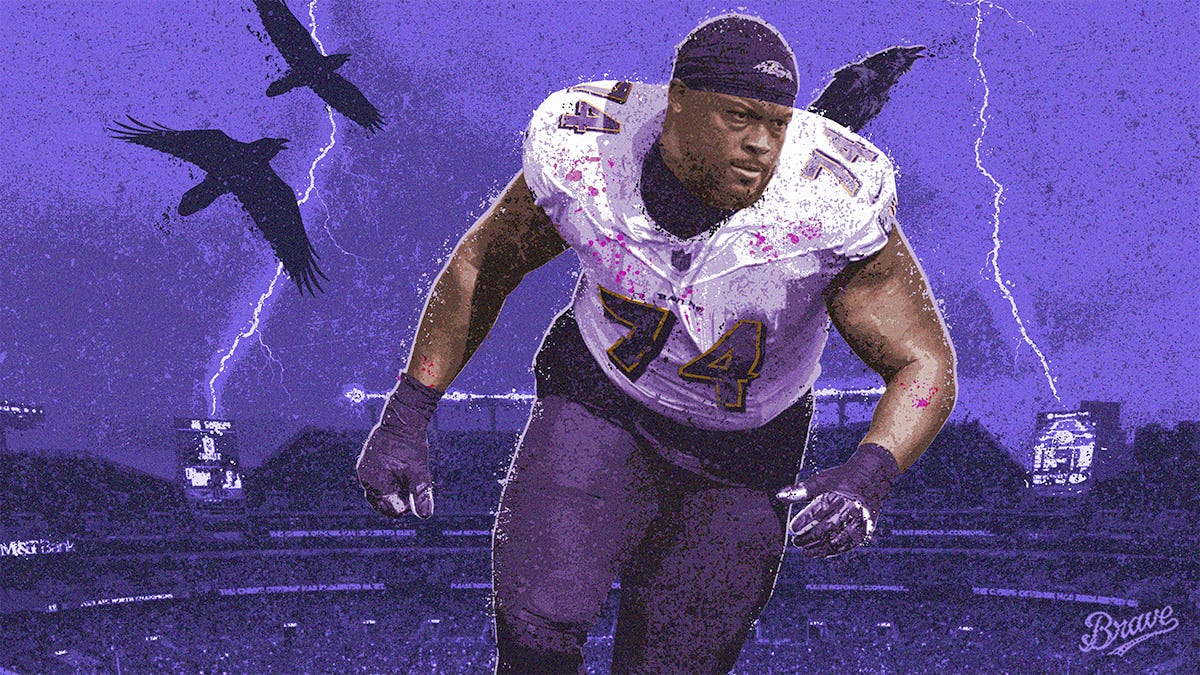
OWINGS MILLS, Md. — Long before he was the 6-foot-4, 330-pound colossus handpicked to make the Baltimore Ravens malevolent again, John Simpson was a kid from North Charleston, S.C., whose father was in prison and whose grandfather had just gotten out. The generational curse was real. Drugs were everywhere. Guns, too.
Something inside him stirred.
He cannot pinpoint the biological mutation, but one vivid image comes to mind.
Hanging out with his younger cousins, something inspired him to be “different.” They were into drugs. They knew exactly where this life led: prison or six feet under. Everyone in the Simpson family tree — for years — could clearly see the consequences of living the fast life with their own damn eyes. Nobody needed to theorize. His grandfather was a testimony.
“How can you see this and then still want to be in it?” he’d wonder. “Some people just don’t get it. It’s hard. I feel the same way about my little brother. It’s like, ‘Bro, we all grew up in the same thing. How can you just follow that shit?’ It doesn’t make any sense to me.”
We’re seated on an outdoor bench outside the Ravens’ castle of a practice field. “Big John” — seven-year vet, husband, gregarious father of two — is a gentle giant. Throughout this conversation, he laughs. And smiles. And exudes optimism. This topic, however, summons irritation. He doesn’t claim to author an elaborate “blueprint,” and that’s the problem with lemmings who line up to sell drugs like everyone before them in his old neighborhood.
Too often, people make it seem as if they’re sentenced to this grim lifestyle in perpetuity.
Stuck, with no way out.
What a horrible way to think.
“Bro, it’s not impossible,” Simpson says. “A lot of people think that it’s impossible. Life is hard and they make it hard on themselves because they choose the fast way. Everything doesn’t need to be fast. For me, I keep my head on straight and try to be the best version of me every day. Putting one foot in front of the other and take — not the easy way — but the most effective way.”
The mental calculation is strikingly basic. Every dream, to him, is attainable through hard mothereffin’ work.
All anyone must do is embrace this reality. OK, so you were dealt a terrible hand. Does that mean you outright concede defeat? Quit on life? It’s easy to bitch and moan and claim that guy had connections or this guy had the right genes. Alert: Life itself is not fair and — guess what? — life will never be fair. A word like this (“fair”) makes a hyper-driven individual like this (“Big John”) cringe and shake his head because he knows it’s a cop-out excuse people in all walks of life use to loaf.
All hours spent overanalyzing alleged “fairness” is time wasted incinerating your own prospects of success. You atrophy. Bring up sermons from Andy Frisella and David Goggins on the subject, and he nods. That’s his life personified.
Simpson had every conceivable reason to cast himself a victim — a helpless, hapless casualty of a broken world. The two most important men in his life spent time behind bars. Friends have been murdered. He didn’t have a mentor holding his hand every step of the way. Instead, he outright refused to accept preordained destitution. All pioneers in all industries cite insomnia, relentlessness, buckets of perspiration as the foundation for their success.
An alarm blares and they’re overwhelmed with the urge to kick the collective asses of anyone standing in their way.
John Simpson can hear that noise. He’s back in Baltimore.
Go Long is your home for real, raw football.
Support independent journalism today.
These Ravens have been loitering at the championship doorstep for most of the last decade. Lamar Jackson and Derrick Henry are unicorns who’ll don gold jackets one day. John Harbaugh is out, Jesse Minter is in. To go the distance, this organization knows it must re-embrace its belligerence. What’s needed is a player unafraid to speak and play in blunt terms. Originally drafted by the Las Vegas Raiders in the fourth round of the 2020 draft, Simpson spent the 2023 season in Baltimore and lived through a gutting home AFC title loss to Kansas City before spending two seasons with the terminally ill New York Jets.
He was brought back here to displace other 300-pounders in the trenches and mold minds in the locker room. Everyone should listen.
“I talk to a lot of the younger guys,” Simpson says, “and just tell them to keep going, man. Keep your head up. Shit’s hard. Shit’s going to be hard. That’s life. And it’s a part of it. Every day you wake up, you’re going to have that like… ‘Fuuuuck.’ But fuck that! How are you going to approach today? You can either approach it like that or you can come in with a great attitude every day and give your best.”
One message plays on repeat. Simpson tells everyone to embrace “every moment.”
Don’t stress over the bigger picture. Don’t obsess over the Super Bowl.
Do focus on the one specific task in front of you. Do embrace the suck because, over time, all of those moments will add up and you’ll love where it leads.
That’s exactly how he chose to grow up.
He didn’t watch peers sell drugs, get a nice car and view this as an attractive option.
To him, there’s no such thing as pushing a button and getting rich in life.
He relished the long game.
“My Dad showed me what not to do, what not to be like,” Simpson says. “Obviously selling drugs and all that stuff — where I was at? — it was easily and readily available if you wanted to go that route. But bro, I want to be great outside of the shit that’s the normal everyday life.”
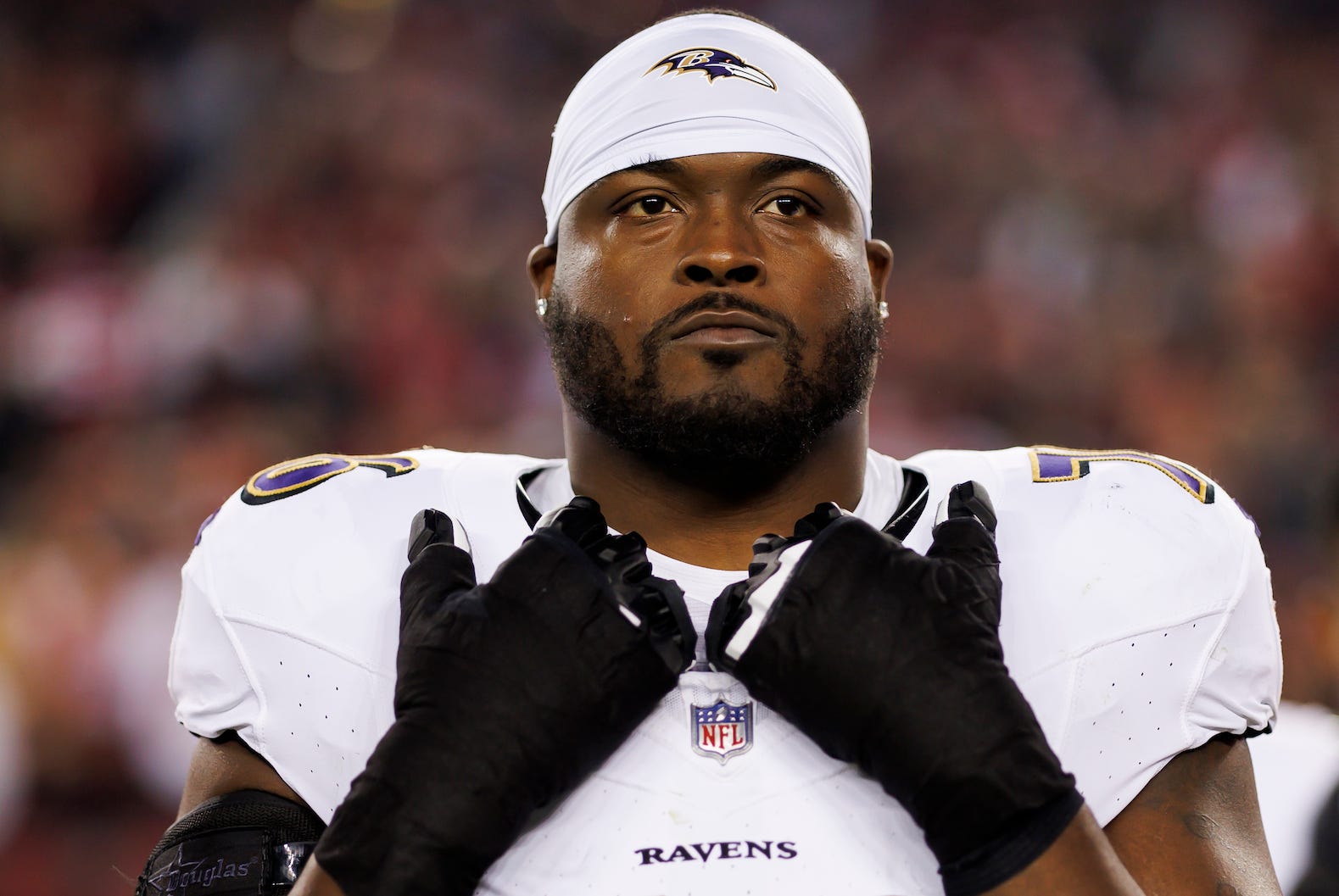
First, explore his old neighborhood — Dorchester-Waylyn — in North Charleston. Crime was rampant. The sound of gunfire blended with horns blaring and birds singing.
There was rampant poverty, theft, depressing sights everywhere.
“You’ve got junkies — crackheads — and shit like that all over,” Simpson says. “You see it all the time. It was everyday life for me. Not really knowing too much different. It was definitely shitty. Shitty. And it’s eye-opening now to be where I’m at. Like, OK, that’s not how life is supposed to be.”
Take one trip on the city bus, Simpson’s mode of transportation in high school. One day, an elementary-aged kid bounded onto the bus in glee. He was overjoyed with a new toy he had found in the woods. “Look what I found!” he yelled. It was a gun. Simpson stepped in to safely put the gun away.
He didn’t see cartel members behead people in the street — like Dolphins center Aaron Brewer — but police often needed to block off his street to examine dead bodies. Many days, Simpson was told to stay inside his home in the name of safety. “I’ve seen some shit dog,” he says, pausing. “For me, it was more hearing it than seeing it.” Top of his head, he can count five times gunfire spontaneously broke out and he dove behind a vehicle to take cover.
Simpson kept a small circle of friends growing up. Calls himself a “popular loner” those days. Everyone wanted to be around him, everyone knew he was going somewhere. But he turned down so many invitations to parties that Simpson is positive peers at Fort Dorchester High School thought he was “weird as hell.” Simply, he never wanted to jeopardize football. He heard his coach say that whoever got into a fight wouldn’t play and decided, right then, to mind his own damn business 24/7.
People could try him if they wanted. No way would he retaliate.
One party he did attend scared the bejesus out of him, too. A fight broke out inside the house, spilled outside and… you guessed it. Guns were drawn. Bullets, sprayed. Simpson bolted home.
“Shit got real,” Simpson says. “I was like, ‘Yeah, I’m not going to no more parties, dog.’”
One comprehensive 2017 series in The Post and Courier illustrated why the Waylyn and Terrace neighborhoods in North Charleston are teeming with gun violence and the problem has only exacerbated over time. In 2021, the city’s police department reported 36 homicides. Numbers alone fail to tell the tale. Simpson can point to specific childhood friends who could’ve made it with a different frame of mind. Kids like Kharee Whitley. They played little league football together, then basketball in eighth grade. “That was my dog,” Simpson adds. “My dog.” Their paths gradually diverged — Simpson toward sports, Whitley the streets — and the news rocked his world.
One Sunday afternoon in July 2019, on the 5300 block of Albert Street in North Charleston, Whitley was shot dead. This shooting marked the 15th homicide investigation for North Charleston police that year.
“Somebody robbed him,” Simpson adds, “and they killed him in the process.”
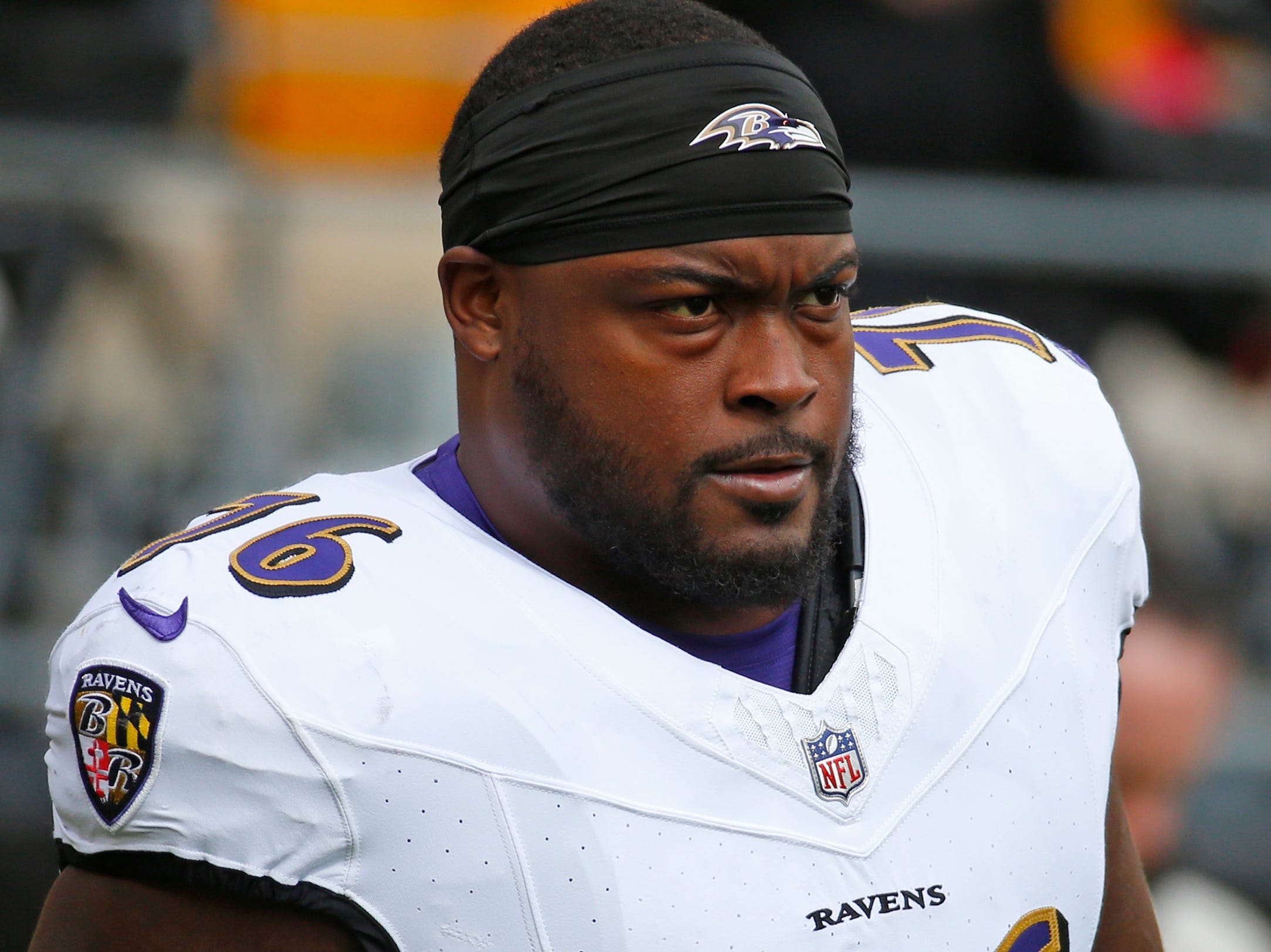
Simpson’s home life wasn’t any better than anyone else in his neighborhood.
He, too, should’ve been ensnared.
His grandfather, John Simpson Sr., got out of prison in 2000. John III was three. And when he got out, John Sr. was determined to be a better man for his 11 grandchildren. He started his own lawn care business and relayed valuable lessons, impressing on his grandson the need to work hard and excel in school. In the summer, he’d then take him to North Carolina to see his father behind bars: John Simpson Jr.
Always a sobering trip. Dad was in and out of prison for selling drugs most of his childhood.
When John Jr. finally got out for good, his son was 13 or 14 years old. A relationship between the two technically exists but Simpson admits that he keeps his Dad at “a respectful distance.” Scars remain. He wanted a father as a kid and a father was nowhere to be found. Instead, Simpson was mostly raised by his mother and his Dad’s Dad. “Weird at first,” he adds. “My Dad was a little salty about my granddad being there more than he was.”
His mother, Keyonna Snipe, worked the third shift on the assembly line at Cummins Turbo Technology. Only recently did she retire from this job, and she still cannot stop moving. Snipe cooks food, sells food. “A beast,” Simpson adds. She refused to ask for any help raising her two boys.
Seeing her sacrifice every available second to give them a decent life instilled the same instinct in him.
“She was a dog,” Simpson says. “Obviously it was hard on her. She did everything she could to give us what we had.”
Into his teen years, Simpson became the man of the house. At 15, he started working at Halls Chophouse through an outreach program, “Teach the Need,” to bring home extra dough. He’d even get in hours after his Friday night football games. Simpson bandaged up his bruised and bloodied hands, never complained, and got to work.
Football, of course, was his sanctuary. Football was where he could unleash all anger bottled up inside. But mostly? Football is where he learned life’s greatest lessons. Simpson loved zeroing in on the smallest, most nuanced details to execute a play, working with others toward a common goal and testing the limits of body and mind.
“I was never the type to give up on myself,” Simpson says. “Whatever it was going to be, I was going to be successful at it. If it was going to be the military, this football shit, whatever. If I was working at a damn car dealership, I would have been the best car seller. So it was having that mentality.”
Simpson seriously considered joining the military, too. He was all about Army ROTC. Once those Division I college offers started to pour in, he switched gears. But the structure of military life appealed to him. That’s who he is to his core, and that’s why he got married at 23 years old. Simpson knew Aliyah — a biochemistry student, a future M.D. — was the headstrong woman he needed in life. From Clemson to the NFL, Simpson was out to change everything the name on his jersey represented.
“Flip the script,” Simpson adds, “and not be anything like the people that I grew up around.”
Take a moment to revisit the infancy of these Baltimore Ravens and you realize Simpson is exactly where he should be. Five years ago, I chatted with Hall of Famer Ozzie Newsome at length for “Blood and Guts.” When Art Modell left Cleveland for Baltimore (in November 1995) and named Newsome de facto GM (in February 1996), the former tight end essentially started from scratch. Calling the franchise “bare bones,” as he did, is a remarkably kind assessment.
Baltimore didn’t have a team name, team colors or a functional team headquarters.
Twelve years had passed since the Baltimore Colts departed in Mayflower Transit moving trucks overnight.
Since then, the Colts’ old facility had been transformed into police barracks.
When the Ravens moved into town — and the building was flipped back into football shape — Newsome’s crew found old bullet casings on the field where the police academy had done pistol training. On March 29, the team finally had a name. The “Ravens” won via city vote. One week later, a small group that included Newsome, Phil Savage and Kirk Ferentz got to work inside this rectangular-shaped bunker of a facility. They told themselves “it’s not the walls, it’s the people within them.” But then they looked at those walls, and… damn. It was humbling With no shelving available, the men building the Ravens stacked up about 3,500 VHS tapes around the perimeter.
“We had a mountain to climb trying to get this franchise moved,” Newsome recalled. “It was a monumental task, but when you have a good team of people working with you — and everybody working toward the same goals — you can accomplish things, and that’s what we did. We started from scratch and we built it. And we built the way we wanted it to be built.
“Guys rolled up their sleeves and we went to work.”
With the No. 4 pick, Newsome selected UCLA tackle Jonathan Ogden over the player Modell coveted: troubled running back Lawrence Phillips. Simply, he stuck to the board. Ogden was their No. 1-rated prospect and he knew he’d lose the confidence of all scouts on staff if their first pick defied their hard work.
With the 26th pick, Newsome then selected Miami (Fla.) linebacker Ray Lewis.
The two combined for 23 Pro Bowls and were first-ballot Hall of Famers.
The Ravens took on Newsome’s personality in Year 1, Draft 1 and never looked back.
Life is different in 2026. The Under Armour Performance Center is affectionately known as “The Castle,” and Go Long can confirm the nickname is justified. There’s not a bullet casing to be found at this majestic 33-acre complex. One sight, however, has not changed. Newsome, who stepped down as GM eight years ago, remains a strong presence. He watches each practice. He consults with GM Eric DeCosta. He’s a 70-year-old sage on daily patrol. The soul of this organization endures.
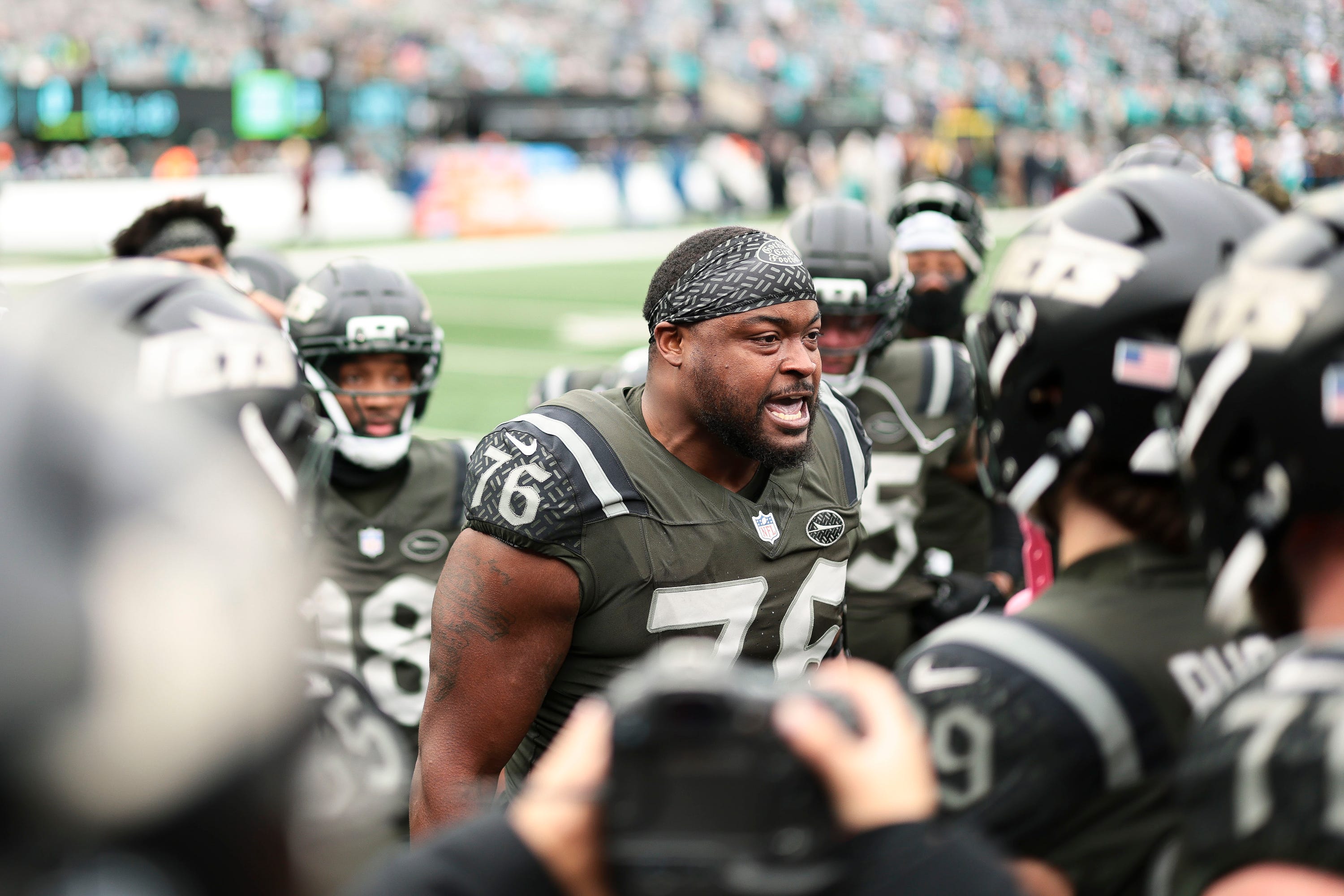
These Ravens are at their best balling up a proverbial fist and cold-cocking the opposition in the mouth. Each collision must inflict maximum damage. That’s Simpson’s game. “Nasty,” the left guard adds, “on each and every play.” He talks shit. He says things that invite literal punches to the face. Unprompted, Simpson brings up the name Trysten Hill. Back in his Raiders days — after a 36-33 win — he strutted past Hill at midfield and said something obscene enough to warrant a haymaker to the head. His silver helmet went flying. A scrum broke out. This was the culmination of the two jawing all game.
“It definitely got personal,” Simpson says. “I don’t know if I can go into details.”
These Ravens are also talented enough to vault themselves right back into high-stress playoff games.
When the margins are razor thin, when nerves can spike uncontrollably, Simpson’s perspective is needed most.
“There’s always going to be times where you’re uncomfortable,” he says. “But how are you going to operate to get yourself out of those situations? How are you going to perform on this football field in front of all these people that are watching you? Be calm. Be in the moment. Be present in the moment. It’s not focusing on the big picture and not trying to do too much at once.
“Make every moment matter.”
He’s most passionate on this topic because this is the formula to win in football, in life.
“You might not win every rep, but you come back and you try your hardest and do the same shit over and over and over again and you’re going to get great results. Nowadays, we try to rush to the Super Bowl. But that’s not how this shit works. It’s a journey. Everything’s a journey. So you’ve got to embrace everything. Today was a great day. Embrace every day you come out here and step a foot on the field. Find joy in everything you do.”
Not easy. One bad bounce tends to decide the fate of this team. The last three season-enders have been particularly disturbing. 2023. If Zay Flowers doesn’t fumble at the goal line against the Kansas City Chiefs in the AFC Championship Game, perhaps Baltimore is in the Super Bowl. 2024. If Mark Andrews doesn’t have a fourth quarter from hell in the AFC divisional round — one fumble, one drop — the Ravens get their shot at Chiefs redemption the next week. 2025. If Tyler Loop connects from 44 yards in Week 18 against Pittsburgh and the Ravens win the AFC North, is John Harbaugh fired? Baltimore might’ve won a playoff game. Or two.
All players who lived through such misery certainly wished they could slam a fast forward button back to January.
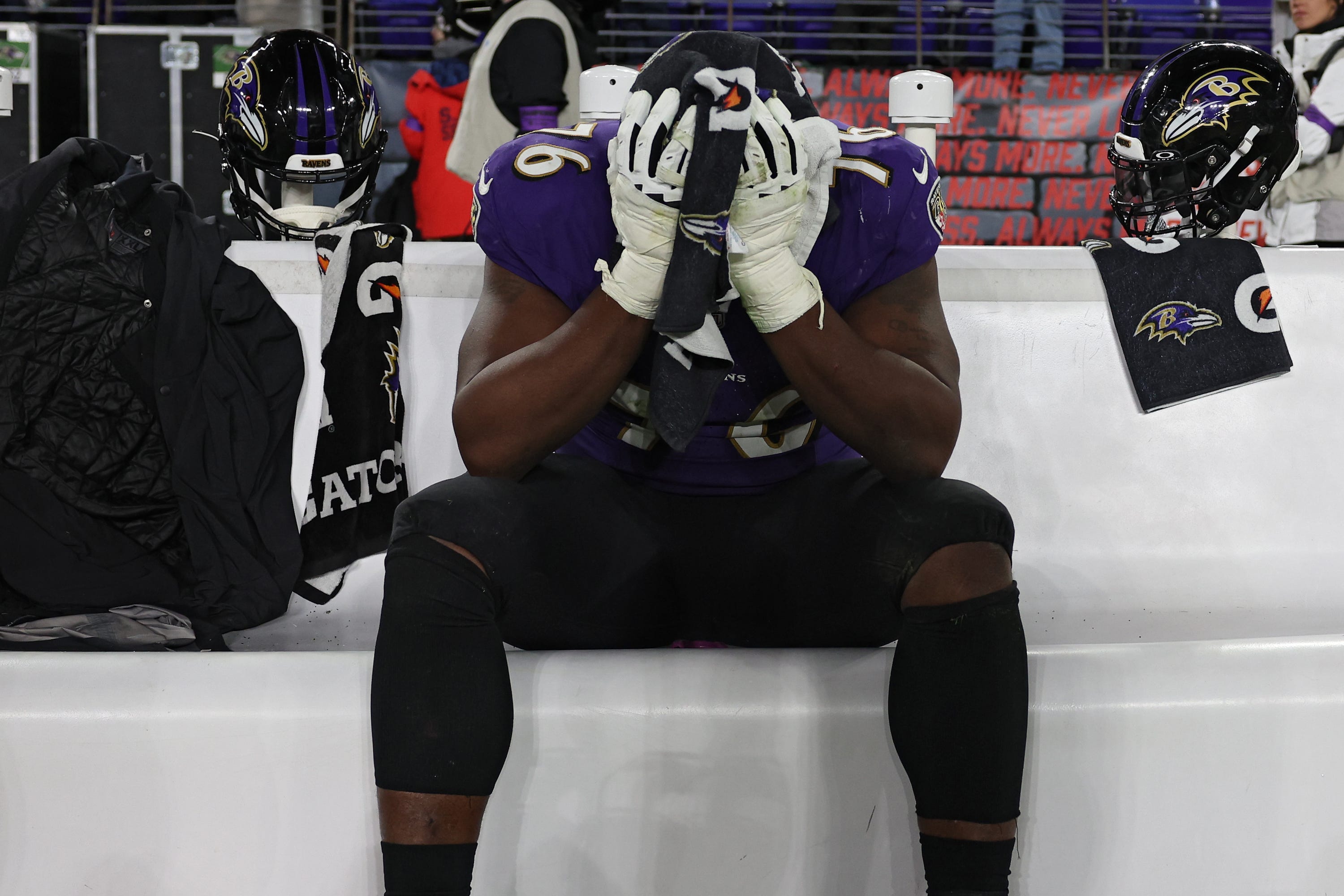
After the ‘23 loss, Simpson buried his head in his hands on the bench.
Yet, Simpson knows the worst thing any pro can do is obsess over the next do-or-die playoff moment.
“Everything,” Simpson says, “leads up to something.”
This contrasts the latest evolution of our species. Err, devolution. Homo sapiens have taken a lazy turn the last 10 to 15 years. Anyone can press a button for anything they need. Hungry? Place an order on DoorDash and keep your ass fixated on the recliner. Going somewhere? No need to drive and carefully follow directions. Call an Uber. Seeking a mate? No need to court a woman on a date and seek a meaningful relationship. Young men are hooked on porn and old billionaires can’t stop soliciting prostitutes.
Delayed gratification — patience — is becoming a lost art.
Those who grasp this concept have a striking advantage over their peers.
Simpson never envisioned an NFL pot of gold on the other side of a rainbow. He lived an honest life, made daily deposits and earned this dream life.
Off the field, Dad life is beyond rewarding. The Simpsons have 2-year-old and 10-month-old boys. Both are albino. Both parents shared the same gene, so there was a 25 percent chance of albinism during the first pregnancy and a 6 percent chance on the second. “It’s got to be something in the water,” Simpson says. “God knew what he was doing.” Simpson dubs himself an overbearing father. He’ll be the father he never had.
The way he sees it, this stage of life is fleeting. He needs to be with them every free second.
“For me growing up,” Simpson adds, “I know what a kid would want.”
So, one day, he’ll also talk to young kids who lack a father figure in their life. His major in college was sociology. If Simpson never made it to the NFL, the plan was to get into social work. Simpson doesn’t view himself as “mentor.” Rather, a voice. He’ll share his story, offer wisdom and leave the rest up to whoever chooses to listen. Kids will naturally take heed or think he’s full of it. He wants to speak to the kids that want to be spoken to.
Until then, Big John is the missing piece on a contender.
“They brought me here for a reason,” Simpson says. “And that’s to improve the trenches and bring nastiness back and instill into the younger guys behind me or beside me: ‘Yo, we’ve got one goal and that is to impose our will on the person in front of us.’ I truly believe every moment matters. Every little thing matters to get you to where you ultimately want to be.”
Which is obviously Super Bowl XLI in Inglewood, Calif.
A quarterback this talented shouldn’t go a decade without reaching the sport’s grandest stage. X’s and O’s are secondary. Lamar Jackson has won two MVPs in two different offenses. Personnel is no problem. Baltimore is loaded. Please, go ahead and doubt 32-year-old Derrick Henry. Up close, he still resembles a genetic freak.
The missing ingredient is something more difficult to quantify. Both owners in Buffalo and Baltimore hired young coaches to usher in a fresh vision.
Eleven-year vet Ronnie Stanley has only known Harbaugh. He, too, cites the “little things” as the difference between being great and elite. He believes the coaching change should help.
“For it to be like a culture-wide thing,” the left tackle says, “it takes a lot of conscious effort, conscious awareness of what is the focus, what are we trying to value here. Our mentality. The whole thing. I think trying to separate yourself amongst the best — there are very few things that can be differentiators and that is one of those things that can make a difference.”
Ultimately, it’s up to the players. These aren’t pixelated figures on a telestrator.
Simpson understands human beings are the most complex organisms on the planet. You have good days. You have bad days. He’s a prime example himself. At the start of training camp this summer, he got into his own head overanalyzing everything. Again. This has been a problem since Simpson thought he was going to be a starter for the Raiders and got benched. He acknowledges that it gets to the point of anxiety and borderline panic attacks.
“Every camp, I go to this place of trauma,” Simpson admits. “I’m like: ‘Fuck, let’s lock in, let’s lock in!’”
Then, Simpson takes a deep breath and realizes such hyper-, hyper- intensity is not his game.
He keeps it light, has fun, brings people together.
“I can get to that point of super seriousness,” he adds. “But that’s not who I am. So I’ve got to come out here and show the guys that surround me: ‘Yo, he’s got my back no matter what. We’re going to have fun with this shit and whoop some ass while we doing it!’”
That’s the objective this season. The man who refuses to think too far ahead — briefly — allows himself to dream. He can’t help it. When he’s finished with football, his family will live on a lake somewhere with 10 acres of land and five horses. John Simpson is taking the family name a bold new direction. That’s exciting.
As for this 2026 season? Yeah, he can only contain his excitement for so long.
“This year,” Simpson assures, “is going to be fun as hell.”
Go Long is your forever home for longform.
Thank you for growing our community.
2026 NFL Season Preview Features to date…
Excellent article Tyler. The man is correct on what he says. I am glad he took charge of his life.
Lombardo got nothing on you.