

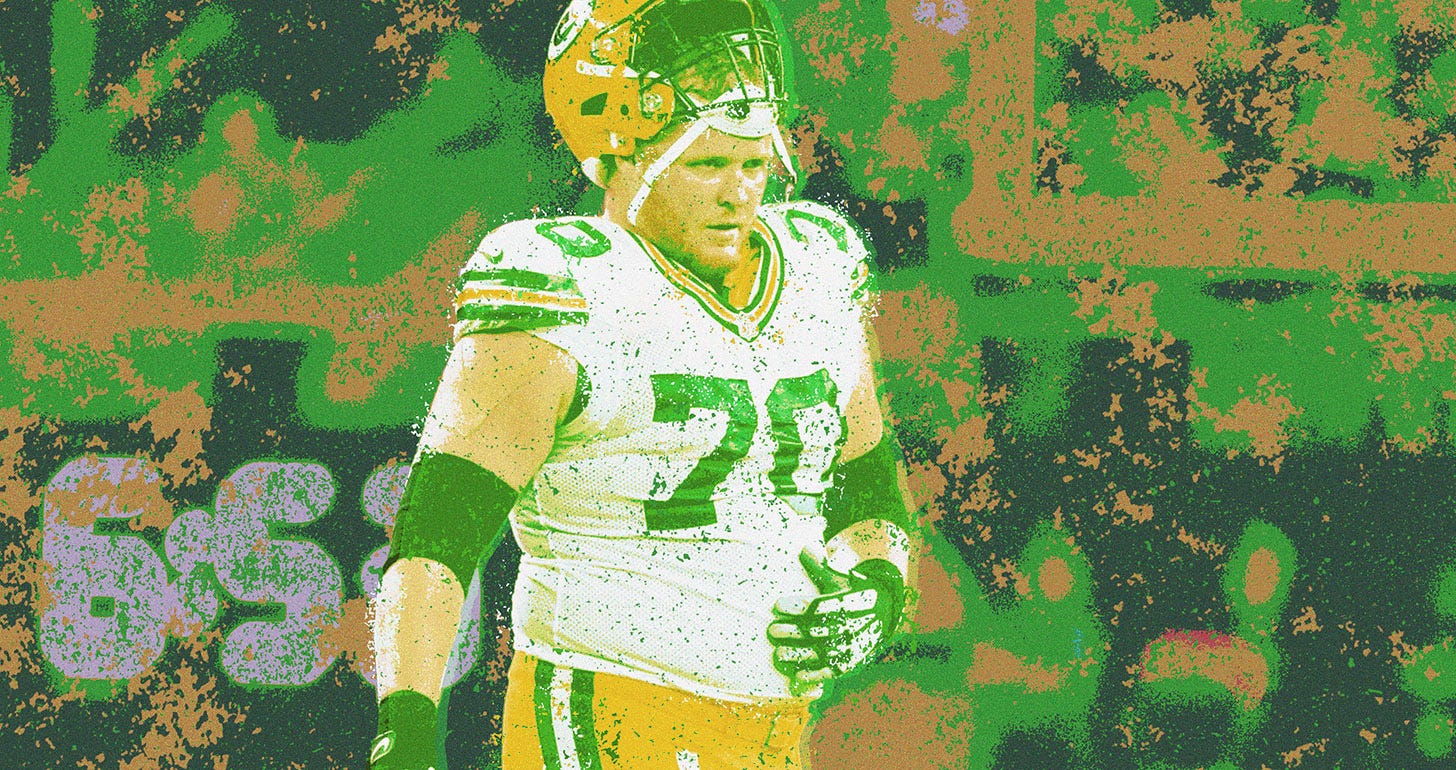
Here’s the written transcript of our conversation with 10-year NFL vet T.J. Lang.
We get into it all.
Video and audio are accessible here. Words are below. Be sure to click to expand in full if you’re reading in your email.
A pleasure to have you, man. It was 15 years ago we first met — I think both of our minds were a little blown bullshitting before dinging record that it’s been that long. Because you had your son that year and now you’re telling me he’s in high school. You’ve got three kids. I’ve got three kids. What in the hell happened to us, T.J.?
Lang: Time, brother. Time. If you had a full head of hair, I think you’d have more grays than me, but smart by you to try to cover those up by shaving. I’ve plucked out a couple myself. My claim to fame now is I’m not quite 40 yet. I’ve got about a year and a half left. But yeah, man. Time flies, dude. It’s crazy. I remember, shoot, all the years we spent in Green Bay together, my son being born in 2011. All of a sudden I’m sitting here going, “Yeah, he’s in high school now. He’s getting ready to drive.” And like, oh boy, his life does really go by fast, doesn’t it, man? And some of the memories fade obviously with that. But no, it’s awesome, dude. I’m in my football cave right now. I’ve got all my jerseys behind me and I love talking ball, dude. It’s great. I don’t need an introduction. Please don’t make me uncomfortable by doing some of the stuff that the radio guys like to do. But still working in the NFL, doing some radio stuff back here in my hometown in Detroit. It’s the perfect balance for me. I still get to be around the game a little bit without working 100 hours a week like some of these coaches are. So I’m enjoying myself, man. I’ve got a good balance going right now.
It does seem like you’ve mastered post-NFL life with doing the sideline stuff with the Detroit Lions. Which by the way, Bob McGinn has high, high praise for your work on those broadcasts. He was driving through the holidays and he made a point on our pod to say how TJ was bringing the heat. It was objective. It was sharp. It wasn’t just kissing ass. So, well done.
Lang: Coming from Bob, I’m sure he’s got high standards. And look, he’s been around for, shoot, what, seven decades now. So he’s heard a lot of football on the radio. And that means a lot to me. The reason why I love it so much and why I have a good relationship with the Lions is because they know exactly who I am. When there’s something bad that happens, my No. 1 goal is I’m never going to embarrass somebody on the radio. I’m never going to say, “Hey, this guy needs to get cut, get him out of here, he stinks.” But if there’s something bad that happens — no matter if it’s the first guy on the roster or the last guy on the roster — it’s always, “Hey, he’s going to watch that one tomorrow and not like the way that one looks.” But I appreciated that when I played, too. Guys have to be honest. These guys have a living to do. And now that I’m on the other side of the business, people are going to know if I’m BS’ing.
I’ve always been… just tell me straight up, right? Get to the point. Doing that on the other side, calling the games now, I’ve had a lot of fun doing that and made a lot of great relationships with those guys. So it’s been a lot of fun.
I’m thrilled that you’ve joined the dark side because even…
Lang: Don’t go that far.
You’re fully over.
Lang: No, don’t go that far. Don’t go that far. Because I hate when people look at me like a media member now and I’m like, “No, unfair. You cannot say that. I call the games on Sundays.” I do two hours of radio during the week and I just talk about the game — whatever happened after the game, what happens before the game. So don’t look at me like a media member. I do not write articles. I do not interview people. I do not do that. I just call it how I see it on Sundays. That’s my job.
One of the first times we talked in the Packers locker room that 2011 season was for a story on your transformation on how you went from this life of partying your ass off and drinking. You talked about surviving on two, three hours of sleep and drinking and eating like shit and just not taking your job seriously. And then they drafted Derek Sherrod. That camp, you got it together. Josh Sitton had a few words for you: You’ve got to win this job. We need you. And you turned it all around. Re-reading. I almost forgot I was calling bartenders in Green Bay asking for their best T.J. Lang stories.
Lang: Yeah, I remember that.
One of them had a crazy story. At the end of the bar close, they’d go around with a pitcher and just throw all the drinks in there. And I want to say you had it and you just downed it. They said you hit it really hard.
Lang: Yeah. That part of the story I remember I thought was exaggerated. Then I remember talking to you and you’re like, “No, that’s a legit quote.” I wouldn’t say that was every time I went out, but maybe once that probably happened. I can’t put that past myself. I was open and honest. I had a transformation there. Look, I grew up with separated parents. My Dad worked 80 hours a week. We lived in an 800 square foot house and I was young. I was 17 going into college. I was 21 going into the NFL. And all of a sudden, you’ve got a little bit of money now. I fell into the trap of thinking I was a big shot and going out and doing all the stuff that I didn’t do much in college because I didn’t have the money to do it, first of all. Then, I finally got that next step and it was like, “OK, I’m here now. We’re going to have a little bit of fun.” And certainly I pushed boundaries a little bit. I wasn’t shy about telling that kind of story. Thank God, I was in Green Bay, Wisconsin.
Especially now, I think about some of these rookies, and if I was in Vegas? I don’t think I would’ve lasted very long out there with my first two years in NFL. But that 2011 period was a perfect storm for me. We were coming off the Super Bowl win obviously in 2010. We went into that offseason and had the lockout. We had no football, no OTAs, no minicamp, nothing. And for me, it was the first time I realized I had a legit shot of earning a starting spot because we had our whole offensive line together for my first two years. Outside of Mark Tauscher getting hurt my second year and then Bryan Bulaga filling in as a rookie. But Daryn Colledge, the starting left guard, left that year in free agency. That was the first time I went in that offseason thinking, “OK, I think there might be an opening. I’ve got to lock down a little bit.” And a couple other different things happened. They drafted Derek Sherrod, an offensive lineman, and I’m like, “Ooh, is that the next left guard? I’ve got to reset my mind that this is my spot. That’s not his spot.” My girlfriend at the time, who’s now my wife, got pregnant with our first son who is going on 15 later this year. So for me, it wasn’t like a slow progression of a wake-up call. It was like a wake-up call like now. You have to make a change today. Are you going to dedicate yourself in the offseason working out, getting in shape, staying in shape and being reliable? And obviously I had a good support system.
But it was a perfect storm for me going into that 2011 year. The determination that I remember feeling that, “I don’t care if you bring in Steve Hutchinson to compete with me at that guard spot. I’m not losing that guard spot. I’m just not.” And that built the foundation for me for the next eight years of my career. Developing the good habits. And it took me a while. It took me a couple years to develop those. But that for me — that 2011 year — was the most important year of my career by far.
You easily could have put me in a headlock and been like, “What are you doing calling these bartenders in Green Bay? Get lost, man. That’s my personal life. If I want to drink til 3:00…”
Lang: You’ve got a way about your interview style that was very personable and then when you read it a couple days from now, it’s going to be like, “Oh shit, did I really say that to you?”
Conversations, not interviews, right?
Lang: As a player, you’re not going to admit to maybe some certain things if you don’t want your coaches or your teammates to know about. I lived in an apartment complex in Green Bay where I lived right next door to Tom Clements, our quarterbacks coach. I lived next door to Mark Lovat, who was our weight coach. I lived down the hall from Charles Woodson, who was at the far end. He was at the nice end of the hall. But I’d go in on Fridays and Saturdays sometimes, and I’d see Mark Lovat and Tom Clements, and they would have beet-red eyes because they were up all night because I’m blasting music next door. And I’m like, “Oh, shit.”
You can fool some coaches once in awhile. You can’t fool your teammates. Your teammates are going to know exactly who you are. So I remember at the time doing that interview. Dude, I’m an open book. I’m not going to hide stuff. I’m not going to pretend to be somebody I’m not. If I’ve got scars in my past that I’ve overcome, I’ve got no problem telling those stories. So I remember doing that interview with you and it was like, “Yeah, dude, I guess I’ll just lay it out on the table. And I know I still got a lot of work to do.” Especially at that point. That was my first year as a full-time starter back in 2011, but that was a challenge now.
Everything’s out on the table. Now, I’ve got to prove to these guys that I can continue this. Keeping up with the demands that it takes to be a successful player in this league. So I never once shied away from any question that you asked me. It was just, “Yeah, I’m an open book. What do you want to know?” And I put it all out there. And I think that more than anything, I knew that other people finally knew. So now I really have the freedom to build the image that I want to build. I think that was very, very important for that transition time in my career.

This is what you told me way back then: “I’d be out until 4 in the morning and we’d practice at 7. Looking back at it, ‘What in the hell was I doing?’ I was always tired. I was almost living a secret lifestyle. I would come in here and tell everybody I went to bed at 10 just because I didn’t want to set up a bad reputation for myself.” James Campen knew, your O-Line coach. But I asked Joe Philbin about it and he just goes, “Nope, didn’t know about that.”
Lang: Well, thank God Joe didn’t know because he was probably one of the harder coaches I played for. Loved Joe.
If you’re going to change, if you’re going to evolve and win that job and kick ass and have the decade in the NFL that you had, that was your moment of truth. Think about how many players are having their moment of truth right now and they’re not facing reality. They’re not looking in the mirror. They’re not changing because they don’t think anything’s wrong. You were honest with yourself and changed your life.
Lang: It wasn’t every single night. But you have certain nights in the NFL where it’s, hey, Sunday night after a game or you have some with the boys Monday night because Tuesday’s our off day. Hey, Friday’s a light day, let’s do something Thursday night. Friday night. It was probably still three or four nights a week. It wasn’t every night. I wasn’t drinking night before games or anything like that.
And you said that then — it was never before a game. You were maybe a little groggy for practice.
Lang: And maybe a preseason game if I was playing a series or two. Yeah, that’s the one thing. You can maybe fool your coaches — like when Joe Philbin said he had no idea. I didn’t spend that much time face-to-face with Joe Philbin. But James Campen, in these meeting rooms, you’re together four hours together. You’re on the practice field. When you’re drinking, obviously you can smell it off somebody next to you. But I think the luckiest part for me was that — especially James Campen — he had my back. Going into my third year, he was very blatant honest with me. It’s basically, “You earn a starting spot or I don’t know if you’re going to be on this team much longer.” They can’t wait forever for some of you young guys, especially if you’re a fourth-round pick. You don’t have the guaranteed money. You’re not a first-rounder that they’re going to give more leeway to. But he had my back and that was really the start of a phenomenal relationship that I’ve had with James Campen. It was a lot of tough love growing up in that time period with him. But he stood by me. And I love James.
I talk to him all the time now. I’m happy he’s back in the NFL out there in Pittsburgh and back with Mike McCarthy. Like I said, mostly my teammates ... and here was a funny thing, too. I was with Josh (Sitton) on a lot of those nights. But when he’s the one telling you, “Hey, maybe you’re going a little too far.” It’s like, “Oh shit, I thought we were doing the same thing.” Then you look in the mirror and you’re like, “Well, I guess he wasn’t with me Monday or Friday.” So yeah, that kind of hit me a little bit harder. It always means more coming from your peers.
I don’t look at it as a black eye or anything. I look at it as more as that was kind of my reality check moment: “You’re not doing this for yourself anymore. You’re not doing this just for fun. Your girlfriend who’s going to do turn in my wife is pregnant. I’ve got a boy on the way and I’ve got to start doing this for more people than just myself.” And with all those things combined, like I mentioned earlier, the perfect storm, man.
Meanwhile, you guys are going 15-1.
Lang: Coming off the Super Bowl. I think we had won 19 straight games between the regular season, playoffs, into the next year. We started 13-0. So it was like, “This shit’s easy, man. We’re never going to lose again.”
What’s it like then when your play style is then able to flourish? I remember talking to your old college coach: Chris Symington. The way he detailed your game back then — old school, throwback, I will shove your face into the dirt. You can drop T.J. Lang into any era and you would excel because you’re a brawler. When you’re out there and now you’re not hungover, you’re not hurting, you’re able to just be you, what’s that feeling like?
Lang: Yeah, it was an eye-opener for me because it was like, “Wow, if I actually put in the work in the offseason, if I actually focus on a good regimen, if I actually focus on keeping my weight steady for nine months during the season and offseason, if I get on a strict strength program, whether I’m in Green Bay, whether I’m back home in Michigan, whoa, this is getting easier.” Wow, I was having a hard time. I was scrapping with BJ Raji and Ryan Pickett and Johnny Jolly and all these guys. I couldn’t hold up with those guys. And then all of a sudden, hey, you get a little bit better, you get a little bit older, you get a little bit wiser. And it was like, “OK, maybe I can do this.”
I wouldn’t call myself a road-grader. I was never going to be a guy that’s going to just pick up a nose tackle, drive you 10 yards off the scrimmage, bury you. I wasn’t that type of dude. But I knew I had to scratch and claw for every win I was going to get. That was in the run, that was in the pass.
Both of my sons play hockey now. Especially my older son — just watching him through baseball and through hockey — I got an opportunity to coach him in baseball for the last couple years. And his teammates and/or parents are always asking me, “What does it take? What does it take to get to that next level? What was your strongest attribute?” And I always told people it was this. (Points to head) It was my mindset. It was my study. It was my knowledge of the game. It was my knowledge of what we were trying to do and it was my knowledge of what the other guys were trying to do against me. That was my biggest strength.
That “enforcer”-type role slowly developed. Chris Symington, my old college coach, he molded me into that type of player because I was at Eastern Michigan. I think we won 11 games in my four years combined. And it was never anything dirty. The only personal fouls I ever got were from mostly off-setting from chirping with a guy after the play or a couple shoves here or there. But I’m never going to hit you in the back. I’m never going to try to take your knees out when you’re not looking. I’m never going to throw a punch.
But “Symo” engraved that in me: You always protect your teammates. If you’re going to be the first one down there to pick your running back up after a 20-yard gain, that’s going to demoralize the defense. And I would notice that throughout practice. Because the defense’s big thing is pursue to the football: ‘get to the football, get to the football, get to the football.’ Well, if I’m beating five or six guys on the defense to get to my running back to help him up? That looks really bad on the other guys. And I wasn’t trying to embarrass them, but I was trying to show them how committed I was to finishing the play.
And then that slowly evolved. My upbringing, I grew up in a lucky time. I got to watch 90s hockey. I was a huge hockey fan. And especially in Detroit where you’ve got Bob Probert and Darren McCarty and Joe Kocur and some of the toughest dudes to ever play the game. I remember watching the ‘97, ‘98 Wings. I wasn’t even in high school yet, but the ‘02 Wings where they had 15 of the Top 100 players of all time on their tea, I always gravitated toward the tough guys. I always gravitated toward the dudes that stood up for the teammates. Those are the dudes that you want with you, man. Those are the guys. Those are the teammates you’re going to remember. Everybody wants to be a Steve Yzerman or a Sergei Fedorov or Brendan Shanahan or a Brett Hull or Chris Chelios. But the tough guys? That’s the dirty work, man. You don’t get a lot of recognition for doing that, but that was kind of ingrained in my mind, too.
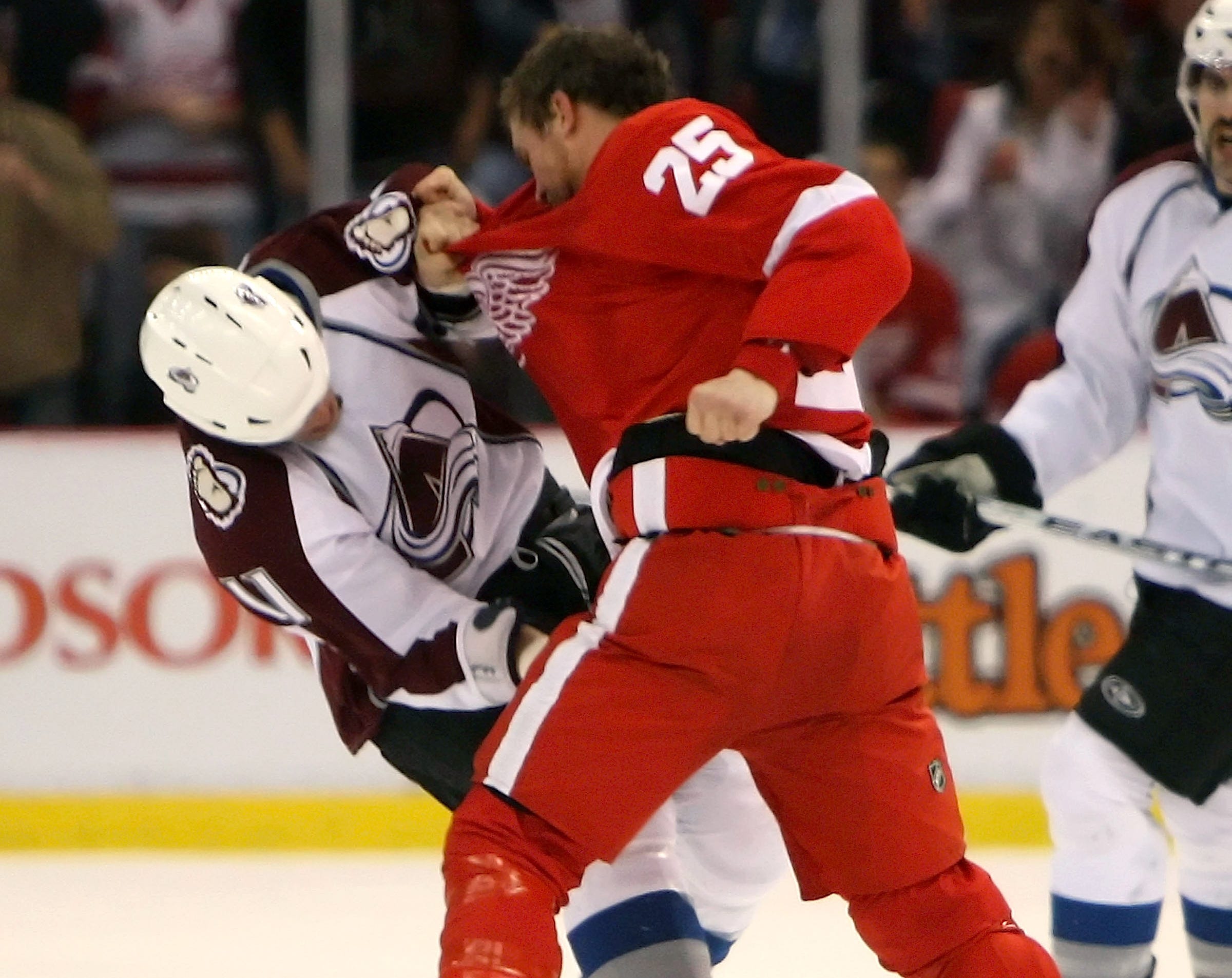
And I think what that naturally became — as you get into these football games, they’re emotional, they’re physical, they’re fast, they’re intense, there’s so much on the line. And it also comes naturally being a big guy, whether you’re playing football or whether you’re around a pack of friends, something goes wrong, you look at the big guy: “You got our back dude?” And if you don’t got their back — the first time — that’s all they’re going to remember. So the first time you get a chance to get somebody’s back and go stick up for somebody, I don’t care who it is, that’s going to make a lasting impression. And then I think that kind of just stood with me throughout my career. We’re not going to be a soft football team. Somebody takes a cheap shot, somebody wants to run their mouth, somebody wants to get up in my quarterback’s face, I got to be the guy to do it because I did it the first time? Second time, I can’t back away. Third time, I can’t back away. 50th time, I can’t back away. I’ve got to be that guy to do that. And I felt like I just had to add a little bit of extra because, in my mind, I wasn’t ever an All Pro, clear No. 1 right guard in the league.
What other value can I add to this team? What other value can I add to my name outside of just winning a run block or being a good pass blocker? What other value can you bring to this team? For me, that was the toughness factor of just, “You’re not going to back down from anybody. I don’t give a shit who it is. You’re not going to push my guys around. You’re not going to talk shit in my quarterback’s face. You’re not going to do that.” Of course, it’s not like hockey where you can take the helmets off and throw haymakers. And I knew that. Because there were some guys that, trust me, if they dropped the gloves and took the helmet off, I probably would’ve been like, “OK, you need to chill.” I think that was just ingrained with me just from my background growing up here in Metro Detroit, going through college and then obviously trying to just add that little bit of spunk to my character. Not only to show the team what I’m about, but I’ll tell you the biggest thing is showing your teammates what you’re about. Because I always felt like when I was on the field, my teammates knew nobody was going to fuck with us. If you take a bad hit, you take a late hit, the first thing I’m going to try to do is fucking get your back or go try to get some payback. And I obviously can’t speak for my teammates on that, but that’s how I kind of compartmentalized everything. My teammates appreciate that.
Perfectly said. The hockey analogy is dead-on. There’s so many plays that pop to mind. I grew up on the Buffalo Sabers, so you took Hasek. He was on that team that won the Cup. Everything you just said — I know we’ve got a lot of Packer fans watching and listening and they’re saying, “I know TJ Lang works for the Lions, but can he talk to the Packers? Can he say everything he just said to the current Packers team?” Because you came to mind and the Buffalo Sabres came to mind when I’m watching Green Bay at Denver and Jordan Love gets whacked in the head on the sideline. Nobody came to his defense. Nobody is getting into anybody’s face. Maybe they’re coached, “Don’t retaliate, don’t take the 15 yards.” I’m thinking, you know what? Take your 15 yards. Fifteen yards are worth it in that situation because you’re chipping away at the soul of your team if you get punked and don’t stand up for your quarterback in that moment.
My mind went back to Ryan Miller 15 years ago. I think it was Milan Lucic for the Bruins. He wiped him out, took him out, and nobody really came to Miller’s defense in this 2011 game. It was a very tepid, two boxers in the ring hugging, waiting for a whistle sort of thing. What happened? The Sabres haven’t made the playoffs since.
Lang: You proved my point. You remember that play. And there might be two guys involved in that — why didn’t one of them do something? Well, five games later, maybe they could have done that. But you don’t really care at that point because you only get one impression to show your teammates, “We’re not sticking up for that.” Look, I can’t speak on behalf and I see it all the time on social media from Green Bay fans on the cheap shots on Jordan Love. I will just tell you from my experience, it wasn’t coached that we go dive into piles and protect guys. But it was encouraged.
Whether it be the Seattle game in 2015 where Richard Rodgers was getting pummeled into the ground by KJ Wright. I came in there, dove in. I got a personal foul in the playoff game in 2014 against Dallas, the divisional round. I threw a block, questionable still to this day. I would tell you still to this day, I didn’t hear a whistle. Started a whole skirmish on the sideline. I ended up getting a 15-yard dead ball foul. Which hurt. Because now you’re losing a down. Got into it with Suh a couple times. But you can’t name any personal foul penalty that I’ve ever gotten where my coach yelled at me. Every single time I got a penalty, the next day I would come in and Mike McCarthy would say, “T.J. Lang, you get a chance to do that again, do the same frickin’ thing again. You stick up for your frickin’ teammates. This is what we’re about. We’re a family.” So I’m not going to say it was coached to do, but it wasn’t looked down upon.
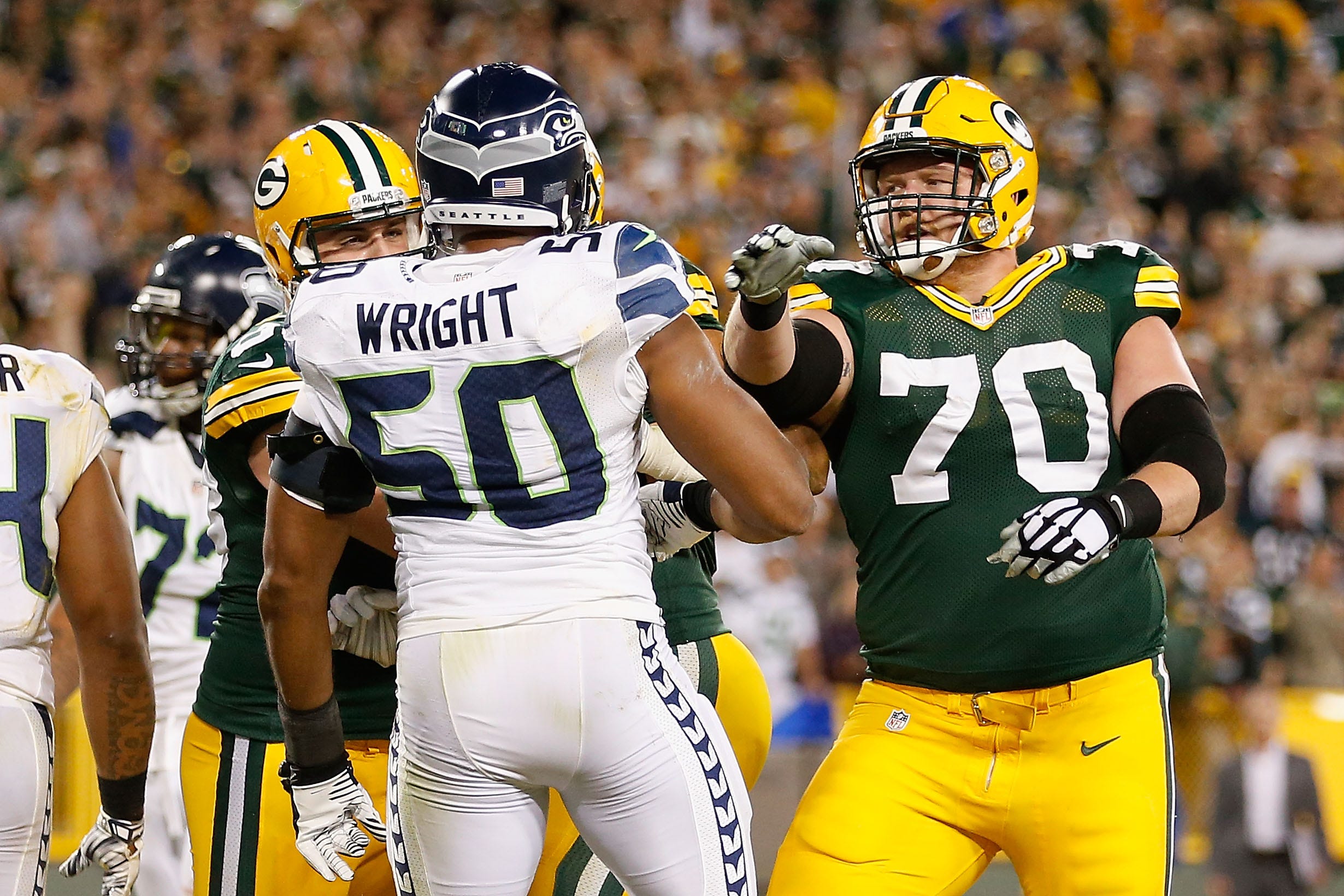
And I’m not saying that’s the case in Green Bay right now under Matt LaFleur. But you have to question sometimes when you’re looking at — especially when it’s your quarterback. Especially when it’s your quarterback. I don’t care if what I thought I saw was totally inaccurate. If I thought I saw something, I’m getting into it. And there’s ways that you can get around it without getting a penalty. You don’t have to tackle a guy to the ground or throw a punch or grab a facemask or anything. But there’s a way that you can show your guys you got their back.
Green Bay, that’s been a missing part for them. I don’t think that’s unfair to say. I’m not trying to pick on them. I see it all the time. Like I said, on social media, a lot of fans reminisce about the old days — where not only me — but Dave and Josh and Corey and Bryan, there was no shit taken. I do question a little bit if that’s more of a coaching point of, “Hey, let them make the mistake. Let them take the 15 yards.” Where like you said, you mentioned it, you only get one shot. If you don’t protect a quarterback after the first time, nobody’s going to give a shit what you do after that. They’re just not. Because you didn’t have my back the first time. You didn’t have my back when I needed you. And you never know when those plays are going to happen. And that’s the thing. You’ve got to respond like that. You can’t be tepid about it thinking like, “Oh, am I going to go do something or am I going to…” No, it’s got to be, “No, you don’t touch my fricking guy.” And we were coached that way from James Campen and Mike McCarthy. If anything happened where it was a 15-yard penalty, I got fined a bunch of times because as soon as you get a personal foul or anything like that, it’s automatic fine.
But you know what? I think my coaches appreciate it. More importantly, I know for sure that my teammates appreciated it, too.
You can’t tell me there isn’t a correlation when you look at how these games ended for the Green Bay Packers — and how their season ended. The two collapses in Chicago. You’re up 21-3. There’s some heart missing, some guts. I know we’re cherry-picking one play. How you react in that moment says so much about you as a football team. I wonder if it’s coaching or ... I’ve spent a lot of time around those Detroit Lions and Dan Campbell. And Dan Campbell would probably be the first person to say, “Look, you can’t just inject toughness into a football team. It has to innately be inside of you.” When they’re going to sign players and draft players, they’re looking for a type, a DNA. We’re only going to add players to this locker room who — when something like that happens — like you just said, it’s instinct. You’re not thinking. You’re just doing. You’re fighting. It’s who you are. These coaches are around the players all day, every day, telling them to show restraint. Don’t jump into the pile. But a lot of it is the kind of guy you’re bringing in, too.
Lang: Yeah, I think so too. I look at a guy like Penei Sewell who’s very just instinctive. His rookie year, I remember the Lions were playing the Rams and Aaron Donald is grabbing his facemask, trying to intimidate him and he just reaches right back, grabs his facemask like, “You ain’t doing that to me.” You only get certain chances during a game to galvanize a team. Everybody sees that like, “Oh, look at the big dog out there, dude. Oh man, look at him. Do you see him stick up for himself or him go protect the guy that took the cheap shot?” You might never have that chance. But I think the dudes that really have that toughness factor that can change the culture of a locker room, it just comes, as you mentioned, it’s almost just instinctual. This is a physical sport. This is a violent sport. This is a sport where guys are going to try to intimidate you. Guys are going to try to get one up on you anytime they can. The more you stick up for yourself, your teammates, the more that’s going to back off the opposition.
That was always my mindset. When you look at a Green Bay factor, I don’t know what their issues were this past year. I got to watch them up close couple games and it’s like, “Man, they got all the talent in the world.” You could look at losing Micah Parsons as being a big issue. He was a guy that brought that toughness factor, especially for that defense.
I think you’re right, though. When you look at that offense, you’re like, “Who is the tone-setter?” And the tone-setter doesn’t always have to be a skill player. It doesn’t have to be a quarterback. It doesn’t have to be a Josh Jacobs type. I’ll give you an example. We played the Lions in 2014, the last game of the season. Winner takes the division, and I think the winner got the two seed and a bye came with it. Detroit came into Lambeau Field and the first play of the game all week, the coaches were just talking: “It’s a run to the right. We’re pretty much running right at Ndamukong Suh. And we’re going to fucking set the tone the first play of the game.” And if you go back and watch that play, Eddie Lacy made a nice move. I don’t think I had a great block, but I held Suh up just enough so he couldn’t make the tackle. He went for an eight-yard gain, and then you just see a pile of offensive linemen come behind him and push him for another six, seven yards. And I’m just telling you, the noise that you hear in that stadium. The energy that that builds. The energy that that builds on the sideline. To know that you got five badass MF’ing O-Linemen out there that are just going to not back down against a vaunted defensive line. The energy that injects into your team and into the stadium? That first play that we were able to set the tone was like ... and it gave us all kind of a sigh of relief, too. Like, “Hey, we’re feeling it today, boys. We’re feeling it.”
That feeling, you don’t get very often. And it was the same feeling I got a couple weeks later playing Dallas when we got into this skirmish on the sideline. I tell people all the time, I think that’s the loudest I’ve ever heard Lambeau Field cheer. You got Green Bay and Dallas getting into a fight on the sideline.
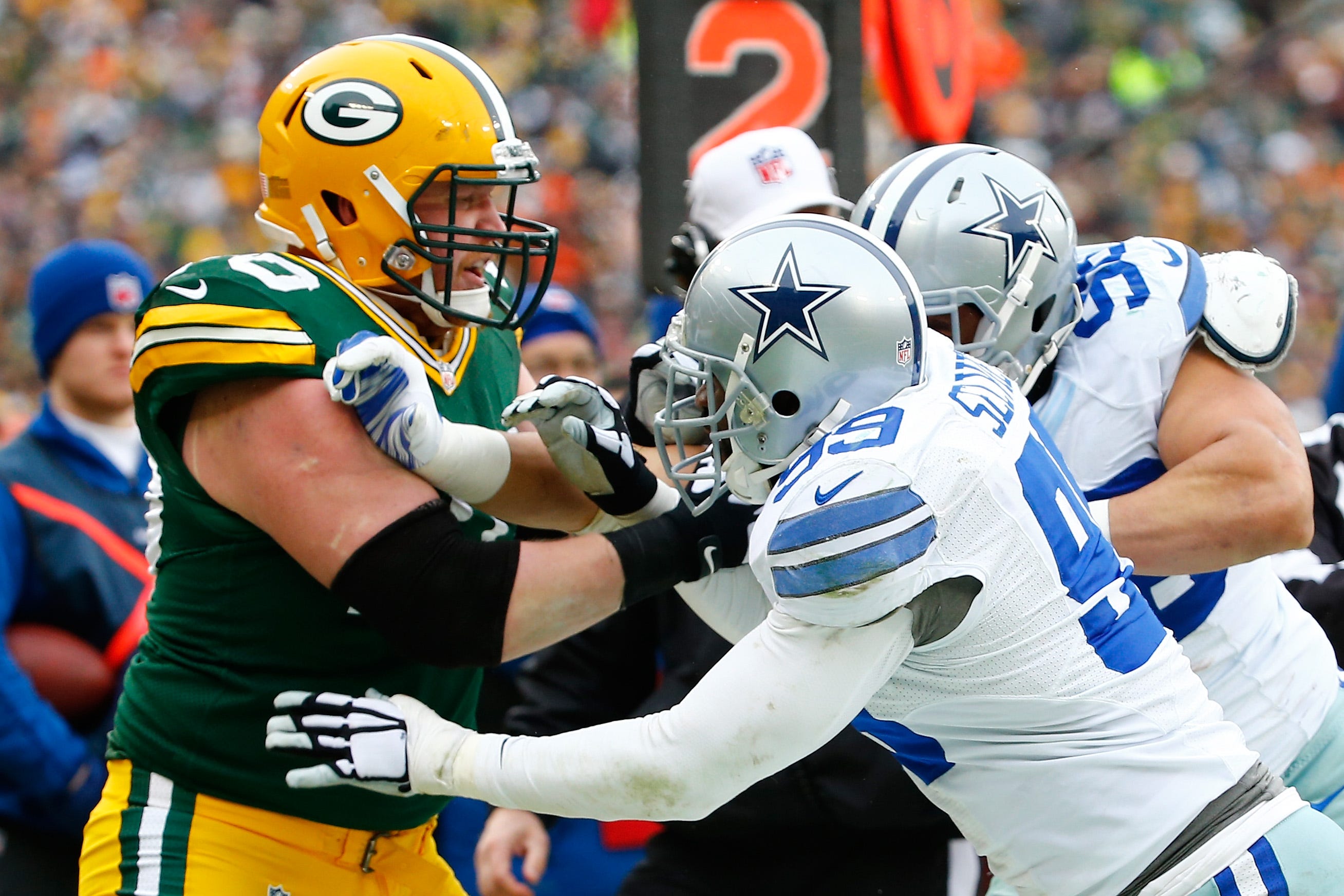
That place was rocking. It was right in front of us from the press box down below.
Lang: It was incredible. And I know I got the penalty afterwards and I felt like the goat. I’m like, “If we lose this game, people are going to look at this as one play.” But it galvanized the team. You could tell the energy on the sideline was different. I had defensive linemen coming up to me, “Hey, we got your back! We got your back! We got your back!” Julius Peppers, Mike Daniels, Clay Matthews. It’s almost like you kind of need something like that to wake you up a little bit or to break the ice. And I don’t think anything that I did was intentional, but you just hear that roar from the crowd and there’s something inside you that says, “This can be our day, this can be our day.”
And I’m not singling out the modern-day Green Bay Packers. I don’t feel that a lot with any teams anymore. I feel like a lot of coaches now, their mentality is almost just like, “Hey, let the other teams screw it up and just play clean football and they’re going to make the big mistake. And if we have to win 3-2, we’ll win 3-2.” It was a different era.
I don’t want to go down a rabbit hole here, but there’s a different style of player coming in the NFL now. These kids are getting paid. They’re coddled, man. They’re getting paid a ton of money. They’re not used to adversity. First thought of adversity, first sign of adversity, “OK, I’ll go somewhere else where they’re going to treat me like a superstar.” I didn’t see it. I retired in 2019, so I didn’t really get a good hint of that. But just the small part that I’m still around the game now, I see it a lot from the outside. So I think rewinding 10 years where a lot of us still have that old school mentality, it’s becoming rarer and rarer. Unfortunately, it is.
And I think that the results that you’re seeing on the football field? We watch football games. You’re a football junkie. A lot of the fans that are going to be watching this are football junkies. The product is not the same. It’s kind of dumbed down a little bit because it’s like, “We don’t want to confuse anybody. We don’t want to piss anybody off. We don’t want to call anybody out. We don’t want to embarrass anybody if they shut down. It’s changing. And in my opinion, not for the good.
But if you look at the teams that are winning Super Bowls: Philadelphia Eagles two years ago, the Seattle Seahawks this year. I spent a lot of time around that Texans defense. If they get competent quarterback play, maybe they’re in the Super Bowl playing Seattle and it’s 9-6 and we’re having a different conversation about football. But the teams that can find that kind of guy — that didn’t just play college football for the money, but truly love the game — you’re going to have an advantage. You’re going to have an edge.
Lang: That’s rare though, brother. That’s rare.
How difficult is it to find that type?
Lang: Listen, I’m not that dialed in with college football now. But I spent a couple days ago looking at just some mock drafts and 10 of the first 20 guys projected to go are like 23, 24 years old. And it’s like, “Huh? This guy had four redshirt years where he was injured?”
Tommy Callahan. A lot of people go to college for seven years.
Lang: Van Wilder, right? Now, it’s like he went to six different colleges and appealed for a sixth year or seventh year. This is insane. What the hell is going on? I think a lot of it’s because of the money. But a lot of it’s just the availability that these kids have. It’s like, “OK, I can go play another year. I can go to a different school and have a different experience.” Whatever it might be. I don’t think you get the players anymore that are just ... I understand the players that are coming from a Group of 5. The MAC or Sun Belt, schools like that and they’re like, “Hey, I think I can go play with the big boys. I want to get a little bit more exposure.” I can understand that. What I can’t understand is the guys transferring from Alabama to Ohio State to LSU to Ole Miss. That to me is like, “What?” I don’t get it. I think that it’s starting to bleed in those NFL locker rooms unfortunately.
That is a massive challenge — to try to dig through the motive behind all that. I don’t think there’s any problem with the kids saying, “Hey, I had a better opportunity there and my family’s really struggling and I really need to find a way to help them out.” I don’t have any problem with that because a lot of these juniors that come out to the NFL now have the same motive. So you can’t kill ‘em for doing that because, “Hey, I need to help my family.” Maxx Crosby was that type. Maxx Crosby, who I was really close to was an Eastern Michigan guy. I didn’t play at the same time with him, but he came out as a junior. And I remember guys from the Lions telling me like, “Oh, that’s bad, bad advice. He should probably go back to school for his senior year.” And I said, “He’s the type of dude that’s motivated to help his family out. Now.” And that motivation obviously worked for him.
If I was a scout, I think about this often. If I had three questions I could ask a player, what would they be? To try to dig to the bottom of exactly who that person is? I don’t know all three of them, but one of them would be: What’s your backup plan? Because there’s a lot of kids: “Oh, well, I got a degree in this. I could just go do this or I can go work for ... my dad owns this company. I can go do that.” I want the kid that’s like, “I got no fucking backup plan. I need to make this work.” My family’s counting on me. I got people that are fucking relying on me. If this doesn’t work, I got nothing. I got nothing. There’s no, “I’m going back to school to get a degree.”
Burn the ships.
Lang: I want players like that because that’s how I felt like I was. And I felt like that’s what drove me. I don’t have a rich family I can go back and just jump into a job with and be comfortable. No, I’ve got to go back to school. I’m going to have to pay out of my pocket. I’ve got to make this work. That would be one of the questions I would ask — what’s your backup plan? Obviously you’d have to decipher through the bullshit a little bit because these kids are so well-trained going into these interviews now.
But that’s a good one because their instinct might be, “Oh, they want me to have a backup plan.”
Lang: Some of them probably do. I’m the type of guy that’s like, “Yeah, I need you to make this work and I need you to dedicate yourself and make this work.” So obviously I didn’t take my own advice when I was 21. But if I could look back at 21-year-old TJ, I would’ve said that’s something similar there.
Your backup plan was, “Where’s the after party? I would’ve told you it’s at Rivers Edge. I was living in downtown Green Bay. You could’ve come over. That’s where everybody went in the media — they went back to my place. I was living that T.J. Lang life in 2011.
Lang: I lived in this condo right behind downtown, which we all know is a strip of four bars. Stir-Ups obviously used to be a popular one. I think that’s still chugging up there. But no, Green Bay, I’ll tell you what, that was the best place for me to be at that stage of my life. It was a big city. Obviously, everything is spread out. And the guys were so close together too. If you could put Lambeau Field here and then draw a 15-minute circle around it, everybody was kind of in that bubble. So it was like, “Hey, you want to ...” It felt like college. Like, “Hey, I’ll come pick you up. You want to go grab some dinner? I’ll come pick you up.” And you go to some of these other cities. Obviously, I finished my career in Detroit, which I’m from Detroit, so I understood the geographics of it. But it’s like, “Hey, where do you live at? You want to grab dinner?” Well, I’m in this town, which is 40 minutes away and it’s like, “Eh. That’s going to be a tough drive home after an O-Line dinner.”
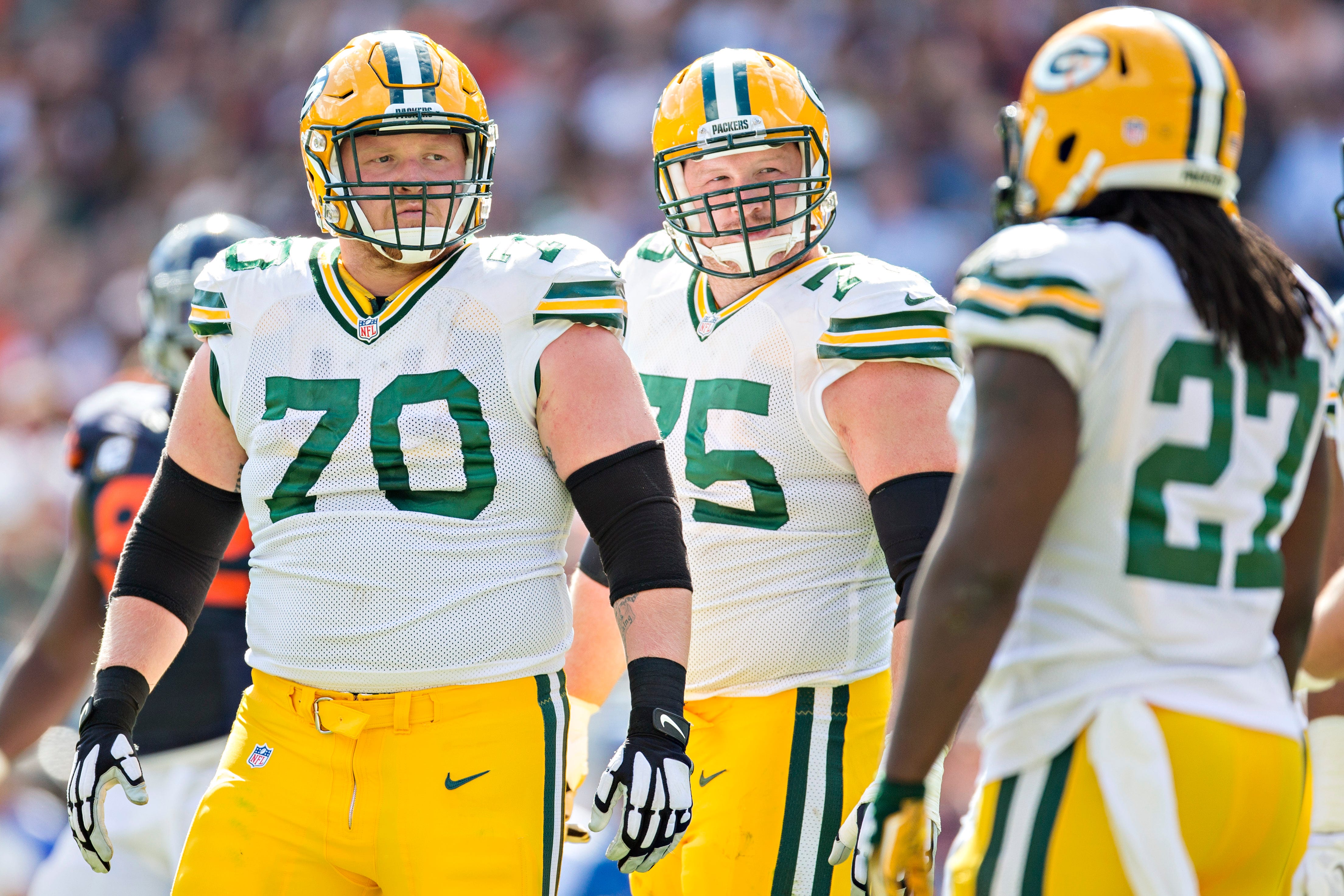
On the current Packers, I think they do have some of those players. Tucker Kraft would be one and he was hurt.
Lang: He’s a dog. I like him a lot.
There were moments last year where Tucker Kraft just said, “F it, I’m taking the game over.” Josh Jacobs, same deal. And then he’s battling injuries at the end. Javon Bullard, defensively, I love the way he plays. So maybe there are little rays of hope.
Lang: McKinney’s a good player. I think it was a mistake to move Elgton (Jenkins) to the center. I think he was such a steady force there at left guard that I’m never a big fan of weakening two positions. Meaning, if one guy goes out, we’ve got to move you here, then you here, and then you go over this side. I always hated that. Let’s just plug a hole and we’ll fill in with the guys we’ve got next to you. I thought when they moved Elgton to center it was more of a desperation move. I thought if they just kept him there (they’d be fine), and Elton ended up getting hurt and missing a bunch of time there second half of the year, too. Which was a bummer and hurt them because I really like him a lot. Elgton’s been around long enough that he played with guys that I played with. He played with Bakhtiari and he played with Bulaga maybe for a year and those guys raved about him. They’re not going to give you that praise undeservedly.
Losing him lost a little bit of identity, especially on that offensive line. It felt like a hodgepodge along that offensive line. Walker’s going into a free agent year. You got Sean Rhyan going into a free agent year. You’ve got a couple other guys — rookie guys, free agent guys that Aaron Banks is a free agent. That first year of free agency, it’s weird trying to fit into a group: “I don’t want to establish myself as a leader. I want to fit in a little bit more before I see where I can take off.” Maybe he hits a different stride here going into Year 2 in Green Bay, but it just felt like there wasn’t enough chemistry.
And maybe I’m biased because the guys that I played with, we had three, four, five. I played with Sitton for seven years. I played with Bulaga for seven years. I played with Dave for five years. Corey, same thing, four or five years. We were spoiled by just having so much stability. You don’t have to question who’s next to it. We could hear the play call and we all know what we’re doing. When you have a hodgepodge with so many moving parts or new pieces or guys going from this spot to that spot, it’s going to be more challenging. So I would say this for Green Bay, especially up front on their offensive line, I hope they can just find some stability. And look, they had some young pieces, too. And when I talked about some of that toughness coming out and that enforcer mentality coming out, sometimes that does need a little bit of time where you can earn the trust from your teammates first. You’re so bogged down with “my job, my assignment, I’m making sure I know what I’m doing,” before you start worrying about the extra stuff. So I still have high hopes for those guys.
But when it comes to some of those shots on your quarterback, man. You take a 15-year-old penalty, sometimes it’s worth it. Not in the game’s sake, but for what you’re going to gain moving forward with the trust of your teammates and the respect that you’re going to get from your teammates.
You’d speak a certain language up front with Josh Sitton and those linemen. You’d get up to the line and you don’t need to say anything because you’d see the same exact thing that the defense is doing — and just react — thanks to those thousands and thousands of snaps.
Lang: And you know what? The special thing about that group would be the football IQ that we all had together. I can’t recall a specific time where we ever saw a look from the defense that we didn’t practice or weren’t prepared for. Because we studied so hard. Because we sat in that film room and we thought of different ideas that maybe the coaches didn’t even throw at us. “Well, I know they haven’t given this look against this personnel or this formation, but what if they do? What’s our adjustment?” Ah, don’t worry about that. They’ve never done that. Then you might get into a game and be like, “I’m glad we talked about that on Wednesday because they did give us that.”
Some of the smartest defensive players I ever played against were guys that listened to what the offense was saying. A Luke Kuechly, a Bobby Wagner, just talking about the middle linebacker guys. Obviously Urlacher or Lance Briggs that played in Chicago. Chad Greenway was the same way in Minnesota. They would listen to your call and offensive line calls are very, very elementary. If it starts with an L, we’re usually going to the left. If it starts with an R, we’re usually going to the right. Or if it’s east for us, that would be to our right. So it’s pretty simple to pick up. Especially with ... at the time we started playing the advanced TV copies that you would get with all the accesses. They started putting microphones on the center so you could get more microphone access to what’s going on at the line of scrimmage. That was sometimes so valuable to teams because you would just watch that and be like, “OK, he said Liz and it was a pass and the center went to the left.” So, we would have to counter ways to be like, “Let’s get to the line. We know it’s a Rip, but let’s say Liz anyways, because now they’re going to bring the blitz from this side and we’re going to fall right into it because we’re sliding into it.” Now it’s that cat-and-mouse game of, “I know he’s listening to us and he knows we’re listening to him.”
That was such a small part of the game that I had so much fun doing. Trying to fuck with the defensive tackle in front of me and the linebacker in front of me by calling a run block out: ‘Hey, we got an A scoop,’ which is both me and the center working together up to the middle linebacker. But in reality, we kind of fake it for two steps and then we drop back into a pass protection. Now the linebackers are sucked up to the line scrimmage like, “Oh shit, now you’re watching and trying to bail out to go cover the tight end.” That was the part of the game that I always really enjoyed.
The best defensive players I played against, they listened to your calls. Obviously you have percentages based off of personnel, formation. OK, hey, 80 percent of the time, they do this. But another underrated part of it, too, is if they can read the stance of the offensive lineman? Normally, that’s going to tell you what the play’s going to be. And I was a main culprit. If my feet were kind of ... if this is my left foot and this is my right foot, my right foot was back here, it was either a pass or it was a run to the right. Because I can’t be staggered like this and somehow open my hip to go scoop the nose tackle. So if it was a run to the left, I would always start in this position. And then as Aaron was getting into his “Green 18” or a dummy count, I would pretend like I’d turn back and listen, but I would somehow even my feet up. So I could do it where the D-tackle didn’t notice it. Because some of them wouldn’t even get into their stance until they looked at my stance like, “Okay, he’s going to his right.” And then we’d do a hard count and I’d fool with it at the last minute. Those are the little parts of the game that I enjoyed so much.
We just had that tight group of guys that were together for so long that we could do that where I could give you a dummy call as Corey Linsley as a center and you wouldn’t look at me and be like, “Wait, what?! No, that’s not the play. We’re going this way!” And I’d be like, “Fucking dumbass. I’m trying to fuck with these guys!” You know what I mean? We’d get to a play where it’d be like, “Oh yeah, yeah, yeah, I got you. I got you. I got you.” And you’d be like, “Fuck, I hope you really got me.”
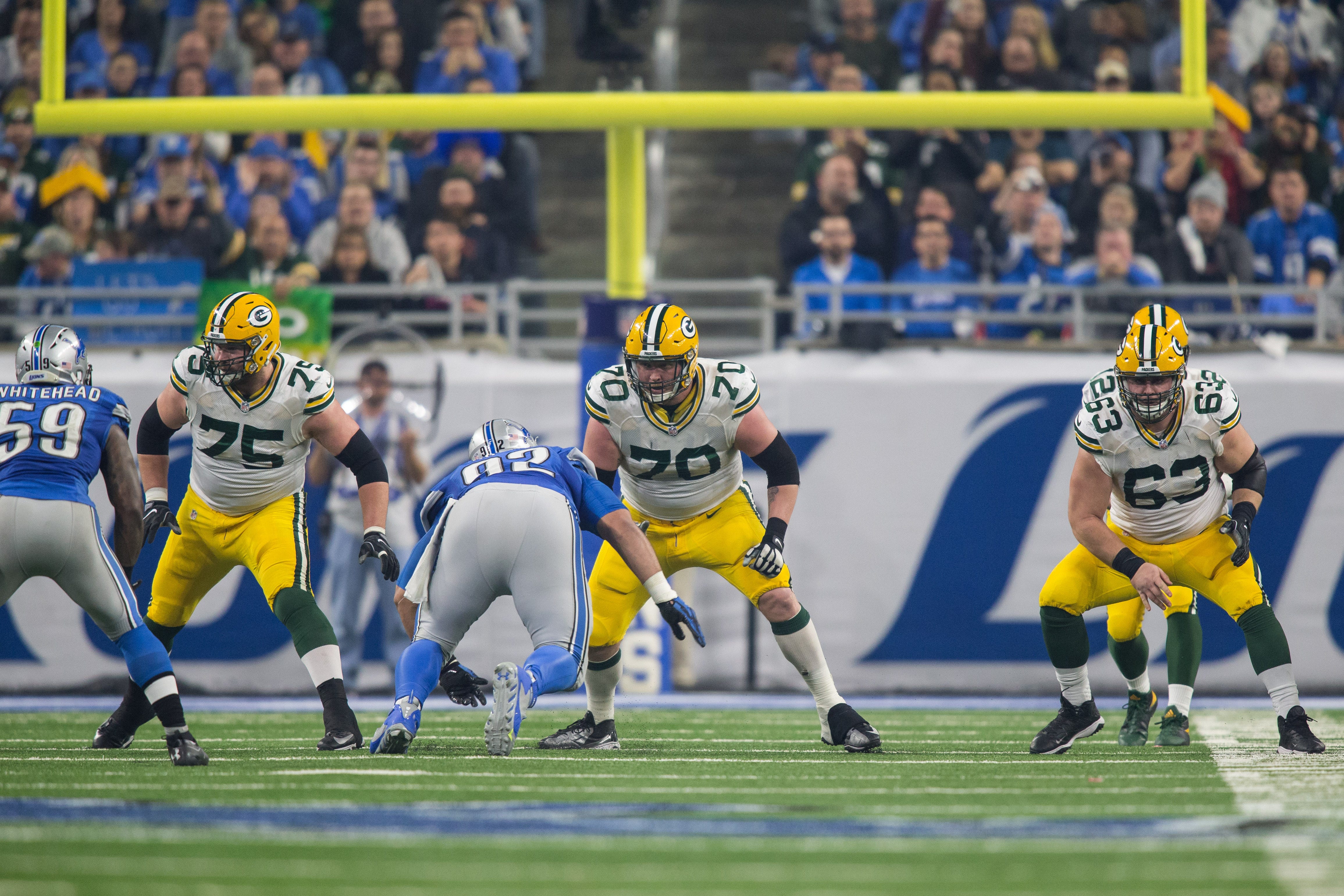
That’s why you’ve got to play together for games, for years. So you can fuck around with the D-Linemen.
Lang: You need that chemistry, you need that kind of synchronicity. That’s such a little part of the game that I miss. Messing with the dudes on defense. And then pointing to him after the play being like, “Keep listening! Keep listening to me!” We would have dummy calls for ... Brian Flores is a really good defensive coach, and he still runs that Double A mug in Minnesota. Mike Zimmer was kind of the architect of that whole thing. And once we realized that they would blitz based off of who we would point at — which guy in which A gap — they would send the opposite and then the opposite safety. So the running back was responsible for two blitzers. We would have to come up with code names. So one of the good ones we came up with wasn’t even that clever. Anthony Barr was one of their middle linebackers they used to blitz. Him and Eric Kendricks all the time. So if we were going to Anthony Barr, we would just yell, “Whiskey, whiskey, whiskey, whiskey, whiskey.” We would yell whiskey and point at Kendricks. But we all knew we were going to Barr. A bar serves whiskey. You get it.
But that was a way we would counteract some of these blitzes — a misguided point, but make sure we’re all on the same page with who we’re really going to. And I think you could only do that with a veteran group of guys that had been together for so long. And it wasn’t just our offensive line. We had John Kuhn forever. Eddie Lacy for a while there. James Starks for a while. Jordy Nelson was part of it. Quarless was there for a while. Richard Rodgers. They were all in tune with, “Hey, you’ve got to be in tune with what we’re doing here because we’re going to try to fuck the defense up. Make sure we don’t fuck you up too.” We had a smart group of players, man, but we had so many reps together that I think was the most important part of creating so much of that success we were able to have.
Meanwhile, you’re on play 52 of 75. You’re on E. You’re dead. Maybe you’re playing up-tempo. You’ve got to be able to think on the fly.
Lang: Oh yeah. No-huddle was awful, by the way. Oh my God. Mike McCarthy’s no-huddle offense? Ugh. We had a lot of success doing it. It wore you out, dude. We had one in the preseason. I can’t remember who we were playing. It might’ve been 2012, 2013, and we’re 13 plays into a no-huddle drive and Aaron calls for a power, which called for me to pull to the opposite side. And I looked at him in the huddle and I said, “No.” He said whatever the call was, power left. I was like, “Aaron, no.” He’s like, “What do you mean?” I’m like, “I can’t pull. My legs are gone, dude.” I’m like, “Call a three-step, call a three-step, call a three-step.”
Did he listen to you?
Lang: I think he called the power and then he got to the line and went, “Check, quick Jerry, quick Jerry,” which was a three-step. I was in a two-point stance on the goal line. I’m like, “I can’t even put my hand in the dirt right now, I’m so tired.” But it did have his benefits because then it limits what the defense can do with their substitution. And it forces the defense coordinator into a more vanilla call when you only have five seconds to get to play in. So it had its benefits. But, man, you’d get into that 16-play drive and it’d be like, “OK, can we huddle up please?”
When you guys made the shift, I think Alex Van Pelt was around and he played in the K-Gun here in Buffalo. Was it 2013 maybe that you guys really leaned in heavy to no huddle?
Lang: Yeah, it felt like right about that time. 2013, 2014-ish where we started ramping it up. I think 2013 might’ve been the experimental factor where Mike was calling plays. And I think 2014 got to the point where he gave Aaron pretty much free reign at the line of scrimmage. Get up the line, see the substitution, see the formation, and let’s all get on the same page here and get into the right play.
I can still remember in 2014 spending the entire week in Seattle ahead of that NFC Championship game and thinking the Seahawks are going to win by 20, 30 points. Their swagger was on a different level. You’ve got Marshawn Lynch cranking the rap music in the locker room. These defensive players are talking about their legacy. I’m thinking. “The Packers don’t know what’s about to hit them.” They kicked your ass in Week 1 that year.
Lang: Week 1, they beat the shit out of us. I think they had eight sacks in the first half against us. … I remember walking up at halftime and they put up on the big screen how many sacks they had and us walking in as an offensive line, we were like, “Whoa.” And first of all, if it was eight, I think five of them were on a play-action bootleg that Aaron should have thrown the ball. “That’s not true. It’s only four. Fuck these guys!” That was a scary place to play.”
But then you guys go in there to whatever it was called, Qwest Field, Century Link and you kicked their ass for 56 minutes.
Lang: Yeah, for 55 minutes. They threw everything at us.
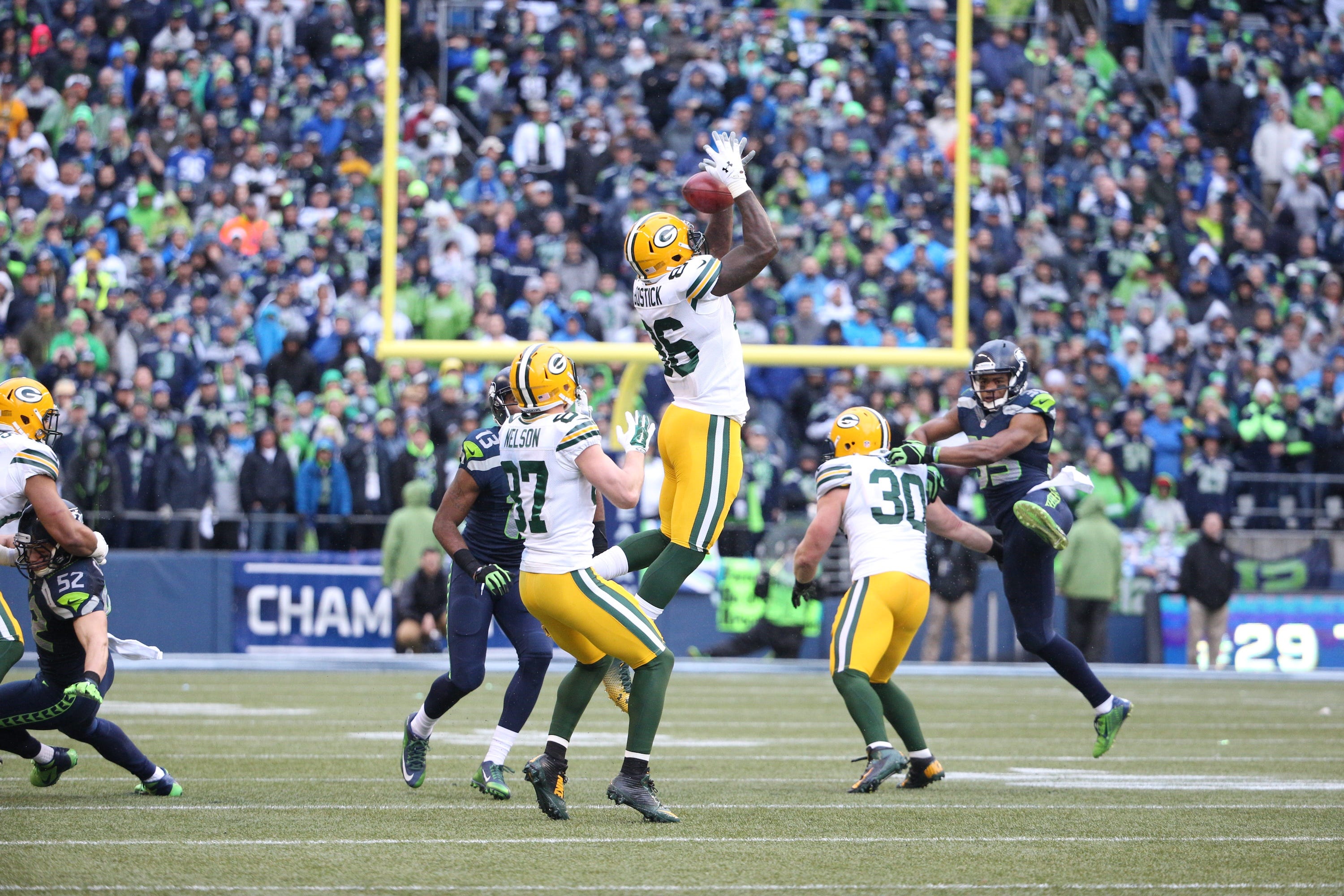
Good to dust off that fond memory, but we have to talk about that game. That’s the one that got away.
Lang: That really is the one. If you talk to any player from that era — more than any other year. I played there for eight years and we made the playoffs all eight years I was there. That 2014 year for me was the clear-cut year we should have won the Super Bowl. More than 2010. Because 2010 was a young team. We snuck into the playoffs as a six seed. We had no pressure. We had to go on the road. Let’s just go see what happens. Maybe that freedom that we played with was beneficial. Because the longer it takes to get back there, I think the pressure starts to build a little bit. 2011 hurt because we were such a good team, 15-1, smoking teams. 2012, a little bit of a weird year. 2013, Aaron broke his collarbone and missed a bunch of games. ‘14 was the year that everything has finally come back together. And we had such a vengeance going back to Seattle because we had started to build an outer-division rivalry with that team. They were our most-hated team. They overtook the Bears and the Vikings and the Lions. “We need to beat the Seahawks.” And we understood what kind of toughness it was going to take because you understood how tough the team that was.
And so when we went back there in the NFC Championship game, we were feeling good about ourselves, man. We had a great week of preparation. And obviously that showed for most of the game. Especially with our defense. Defense played phenomenal. Offense, I still look at that as probably a C-minus game because I think we had the ball twice on the goal line and had to settle for field goals. We threw a pick early in that game that they were clearly offsides on, but they did not blow the whistle. I think the only reason Aaron threw that ball was because he thought he had a free play. That took points off the board.
But obviously the big play in that game everybody remembers. “Hey, everything that could go wrong has gone wrong. Let’s just recover this onside kick and we’re going to be good.” And I remember being in the huddle for that because it was TV timeout. I remember a bunch of us offensive players going in the huddle and echoing what the coaches were saying: “Just do your job, do your job, do your job, block your guy. Jordy’s going to catch this thing. We almost blew this thing, but we’re going to go to Super Bowl. Just do your job.” And then we obviously remember how that ended up.
After that game, I remember having a bunch of hostility towards Brandon Bostick. Like “Dude, if you just would’ve blocked your guy, Jordy was literally behind him like this.” As I’ve gotten older — and hopefully a little bit wiser — I look back at probably five or six plays that I had in that game where I’m like, “If I would’ve done a better job, maybe we don’t get stuffed at the 1-yard line. Maybe it doesn’t even come down to that.” And I think that’s a common sentiment between a lot of the guys that played that game where, yeah, Brandon Bostick took the heat the most because it was the biggest play at the biggest time of that game. But I think everybody on that field felt like, “Dude, he had one bad play. I had five bad plays that I want back.”
It sucked. But it was almost a comedy of errors. We needed eight things to go against us and 10 things went against us. We just needed one out of 10 things to go right for us. And all 10 went the other way. Whether it be Ha Ha (Clinton-Dix) on the two-point conversion where it was just heaved up. And I don’t mean to single him out, but he miss-jumped the timing or Morgan Burnett who had the pick and maybe could have scored. He goes down.
Peppers did this. (Motion hands down)
Lang: Yeah, right. But we had turnover earlier in that game where we would’ve had the ball inside the 5-yard line. And I think Mike Daniels took a personal foul hitting a guy late. Backed us up. We had to settle for a field goal. And I’m not blaming any of these guys, don’t get me wrong. I’m just listing plays. Everything went wrong for us. I had a play where I pulled around on a power and I was supposed to block the linebacker, but I saw Kam Chancellor coming down and I kind of dove out on him instead and the wide receiver came to block him and I let the linebacker free. That could have been a 20-yard gain, Maybe a house call. So you have all these little plays that you think about that, “What could have made that not matter?”
Even the fake field goal. If anybody on the sideline would’ve just been like “Safe! Defense Safe! We will give them three points. We’re up 16-0.” Give them three points. Just go safe defense. Obviously, you get in those big games and you have a bunch of stuff that you second-guess. Even with all the crazy shit that happened, for us to put a little bit of a drive together at the very end of that game to go tie it back up, then we lose a coin flip. And we all know how that one ended, but that was a dagger. That’s probably the hardest game for me to rewatch out of my entire career because it was right there. It was right there.
And it was so different from the 2016 NFC Championship game because 2016 was just such a rollercoaster, man. We started 4-6, and then we run the table. We were in the NFC Championship game. But it felt like we were down 21-0 getting off the bus in Atlanta. It felt like no matter what we did, it was their day. And it sucks to say, because obviously in the moment you don’t feel that. You want to believe, “Hey, we can turn this thing around. We’ll hit that switch and, boom, we got Aaron Rodgers, we’re going to be good. But that game, for whatever reason. The day before that was a nightmare. I mean, a nightmare. We get to the airport in Green Bay at 2 o’clock and there’s fog like I’ve never seen before in my life. We sat at the airport for a couple hours. Because Green Bay is a small airport. They have to get special clearances to take off and land.
All of a sudden, we’re calling some buses. We’re going down to Milwaukee. We’ve got to fly out of Milwaukee. So long story short, not making excuses, but just to tell you how hectic that day was, I think we got to the hotel at 12:30 or 1 o’clock in the morning. The morning of the NFC Championship game. And this is also a group of guys that you’re used to routine where, “Hey, I’ve got a pregame routine. I’ve got a Saturday night routine. I’m eating this at this time. I’m going to bed at this time. I’ve got my certain snacks or vitamins that I’m going to take. When you get to the hotel and it’s like, “Hey, we got pizza and French Fries for you at 1 o’clock in the morning.” And then you basically hustle to bed and then you got to get ready for a 3:30 game the next day, it’s like, “Holy shit.”
I was in charge of the pregame speech that day, and I think that’s the first thing I said. I’m like, “Yesterday fucking sucked! But it’s over! It’s going to make today feel so much better. And I gave this great rah-rah speech and I’m like, “Dude, I’m going to be like Charles Woodson where my fucking speech is engraved on the ring.” And then we get our ass smoked and I’m like, “Oh fuck, somebody else should have done that speech. Shit, I blew it. I blew my one chance.”
You’re at fault. It’s not the fact that Ladarius Gunter is on Julio Jones or Geronimo Allison is out there. It was T.J. Lang’s speech.
Lang: And we missed the field goal early in that game. I think we fumbled inside the 10 later in that game. Julio Jones, and I’m not trying to say anything bad about our defense, but I don’t care who he was going against that day. He was a grown man. He was a grown freaking man. Matt Ryan had a rushing touchdown. It was like, “God, it’s clearly their day.” We had so many injuries. I ended up getting knocked out. I broke my foot in Week 12 and they told me my season was over. I’m like, “That’s not possible. I’m going into a free agent year. I’ve got to come back and play.” I missed three games and came back and played with a big cast over my cleat. I ended up re-breaking it in that NFC Championship game, I think in the second half. We had two defensive linemen playing guard at the end. Our right guard was Letroy Guion at the end of that game. It was kind of like, “We gave it a hell of a run boys.”
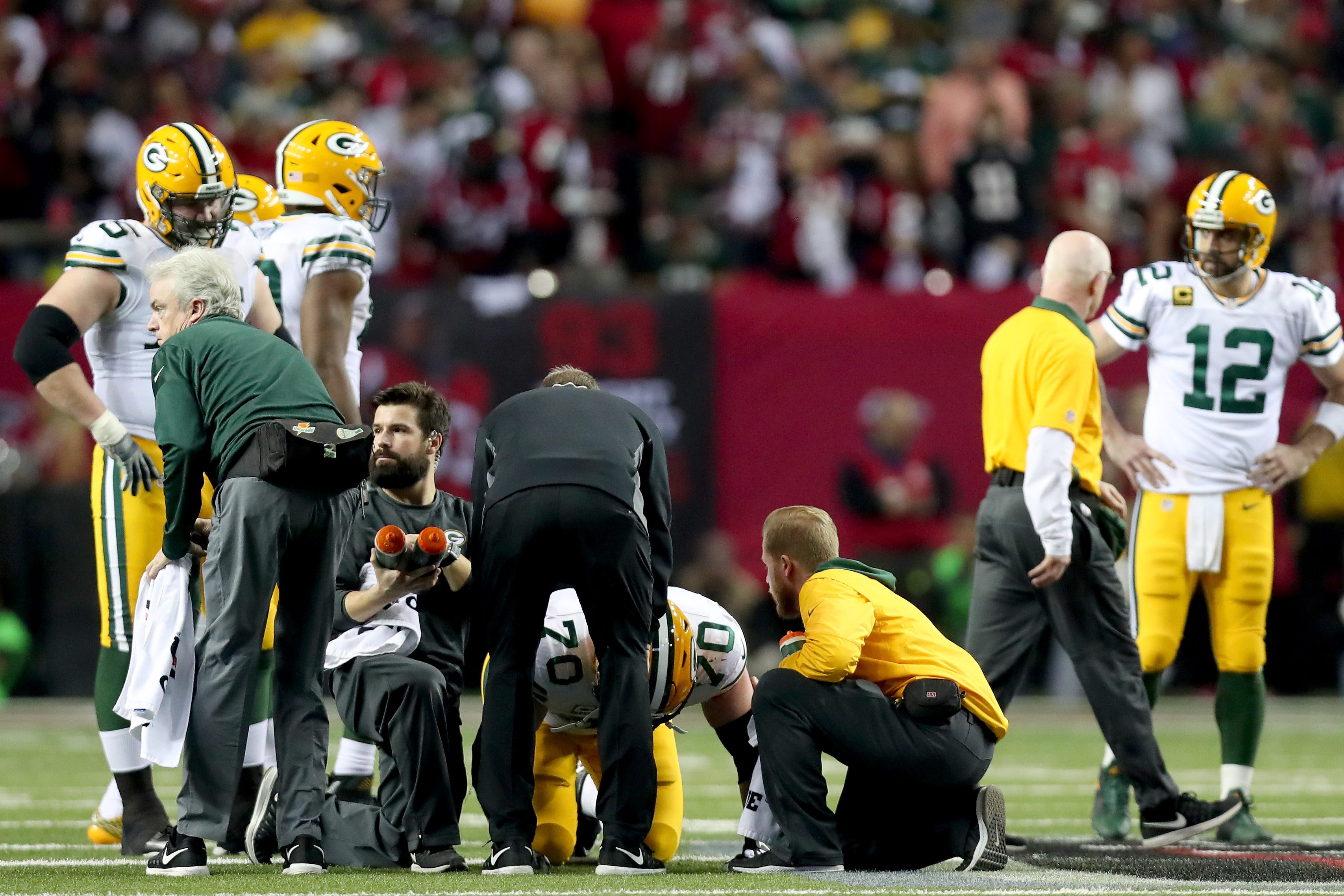
Ran out of gas.
Lang: It sucked for me because when I broke it, I knew it right away. I knew the feeling because I knew the feeling from the first time it broke. And it was just a weird play where me and Corey Linsley stepped on each other and I felt it pop. Right away, I knew it was over. I went down and I remember my phone blowing up afterwards. Because they’re taking me off the field and I was in tears. I had a towel in front of my face and they’re taking me off on the cart and I was literally sobbing. It wasn’t from breaking my foot. It was because I knew that was the last time I was going to put that helmet on. I just had a feeling. I had a feeling that was the last game I was going to play in Green Bay. All the emotions hit me so hard. I remember going back and rewatching and Troy Aikman was like, “Oh, I played with an O-Lineman. He blew his ACL and MCL and PCL and meniscus out like that. See the way his knee tweaks.” So everybody’s blowing up my phone like, “Dude, you’re about to be a free agent. Did you really just blow your knee out?” And I’m like, “What the fuck are they talking about? No, I broke my foot.”
And I think Troy ended up correcting himself saying, “Oh, I’m not saying that’s what it is.” But it’s right away after the game. All the emotions hit me, dude. That was the most emotional I’ve ever been. I don’t think I’ve ever welled up like that during a game before. But I had a feeling. This place was so special to me for more reasons than just football there in Green Bay. It was the last place I ever saw my Dad before he left and passed away in January 2012.
But it was special to me. It’s where my daughter was born, where we raised my first two kids. And it was more than just like, “Oh, I’m going to miss the guys on this team.” It was like this chapter is closed and I just knew it. And it just hit me unfortunately right there on the field as that fourth metatarsal snapped in half again.
How would that not hit you? All the above. It was lung cancer for your Dad, right?
Lang: Yeah. So I talk about 2011 being a changing point in my life. Good and bad. I lost my grandpa earlier that year in March of 2011. Obviously, we talked about the good stuff that happened with my son being born in August, winning a starting spot. And then that November, my dad got diagnosed with lung cancer and passed away not even two months later. And I don’t know how much people realized that 2011 season — where we were 15-1, making it look easy for the most part — we hit the playoffs, dude, and it was like a brick wall. It was a brick wall for a lot of people. My Dad passed away during that bye week and Joe Philbin, our offensive coordinator’s son, passed away a couple days apart from each other. It was such an emotional week getting ready for the Giants. You just had that bubble. I know I did. I can’t speak for everybody else. But I know I had that obviously for me and Joe, and I think everybody else in my room, we were so close, had that for Joe. Because we knew how devastating that was. So that was an unfortunate loss for a lot of people. But that week was honestly a blur.
I remember Aaron Rodgers putting the suit on in the locker room. The funeral was that Friday, and that was the first funeral I believe he had ever even attended in person. This was weighing heavy on the entire team. You could feel it in there.
Lang: Super, super. And Joe’s son was either late teens or early 20s. He was a young kid. For me, I know it was a blur. I had such tremendous support from the guys and everything, and I know we all tried our best to support Joe and his family. But it was a heavy fucking week.
I didn’t know that your dad was that same week.
Lang: Same week. My Dad passed away that Thursday right before we went on the bye week, and Joe’s son was maybe over that weekend. We had the bye week, so I think we had Friday, Saturday, Sunday off. And I think we come back Monday or something like that. The fucking air was out of our balloon, man. It was devastating. Because it’s real life. Real life stuff, real life pain that you’ve got to deal with. And you talk about how bad I felt for my own Dad, but how bad we felt for Joe when you talk about a child. It was heavy. So I think a lot of people kind of forget about that.
We were just such a close-knit... that’s why I tell you Green Bay was so unique. Everybody. Coaches, players’ wives, and coaches’ wives. I see other organizations where you don’t know anybody. You don’t know the GM’s wife or the strength coach’s girlfriend or anything. But Green Bay, you couldn’t avoid it almost. It was such a close-knit family feel. A big part of it was that’s all we really had in that town. And I know obviously they’ve done a heck of a lot of work the last eight to 10 years of building that city up a little bit and making it feel a little bit bigger. But back when we were there, man, that’s all we had. All the wives were hanging out. My wife last week just went on a trip with a bunch of the wives of guys that I played with 10 years ago. They still try to get together once a year for a weekend.
It had that community feel to it. Any time that anybody went through a tragedy of any sort, you felt that personally because you felt like that was truly a brother. That’s why I tell people how unique Green Bay was. There’s no place like it. Buffalo might be the next closest. But I don’t think there’s really any place like Green Bay in the rest of the league, man. And that’s what makes it such a special place. I miss the hell out of it, dude. I still consider it my second home. Even though I work for Lions doing Lions radio now that I’m back home in Detroit, I still try to keep in touch with everybody I played with. I still try to stay in tune with what they’re doing up there because I can’t forget that passion that I had for eight years of my life and how much that place means to me. You don’t just forget that overnight. It’s always going to be a part of me.
The town and the team are intertwined in a way that is incomparable to anything else. It is special here in Western New York but Green Bay is much, much, much smaller. You go out on Washington Street for a beer and you’re probably going to run into three, four players. You’ve got a few options when you’re thinking about dinner, a beer, pumping your gas, anything. But it does make everybody tight in this community way that you don’t get anywhere else in any sport.
Lang: No. And I’ll tell you the funny thing, too. If you’re in Detroit where I’m at now, or a big city, and you see an athlete or a celebrity out at dinner, people are starstruck like, “Oh my God! I can’t believe you’re sitting over there!” I feel like in Green Bay — especially the locals that live there — were so nice and respectful and made you feel like almost like a college, like a high school town. “We’re coming to your game on Friday night and we’re all going to be rooting for you.” They’re used to seeing people out because it is such a small town. Running into somebody at the grocery store isn’t a big deal. I saw them two days ago or going to a restaurant and be like, “Oh, he’s here all the time.”
They probably give you hell, too.
Lang: Yeah, some of them would. But it makes you feel more like a community type feel that they also respect your space and your time and your privacy. At the same time, instead of coming up and asking for pictures or asking a thousand questions — and listen, I’m not putting myself in this boat, but Aaron used to come with us to O-Line dinner most Thursday nights where people would just kind of gently stop by and, “Hey, just want to wish you guys good luck this weekend. Go Pack. Big fan.” And you appreciate stuff like that. The stuff you don’t appreciate is, “Hey, can I take 10 pictures or ask you 50 questions?” You didn’t get that in Green Bay. I’ll tell you that much. You didn’t get that because I think it was just such a norm that you’re going to see these guys out all the time because it is such a small town. That’s one thing that I always appreciated. It reminds me of a Northern Michigan small town where everybody’s just community. Everybody’s nice. Everybody’s family. Everybody cares for each other. And that’s what made Green Bay such a special place for me. And it still is a special place.
I can see where it would hit you a ton of bricks as you’re getting carted off in Atlanta.
Lang: Hard, dude. Hard, man.
All this is running through your mind? Friends, the teammates, the playoff losses, how close you were, and just knowing that this is the end.
Lang: Never getting back was the hardest part. To that Super Bowl. Because I tell you, even to this day, of course I appreciate my Super Bowl ring. But for me personally, I never felt like I did much to earn that. I started four or five games my rookie year. My second year, the offensive line pretty much stayed healthy for the whole year. Taush went out, but then Bulaga filled in. Those guys pretty much played. I filled in spot duty here and there. And then the NFC Championship game, I think I had to play maybe a quarter, a quarter and a half when “Cliffy” got his little stinger, and I got Aaron smoked by Julius Peppers. One of Mike’s first calls was a play-action pass. It was 1 on 1, me and Julius Peppers, on the backside. Smoked. And I looked down and Aaron was wincing. I think he busted his lip and I reached down, grabbed his shoulder pads as hard as I could and yanked him up as fast as I could. I’m like, the longer I let him sit on this field, the more cameras they’re going to show, the more replays are going to show about me getting beat. And I’m like, “That ain’t going to happen. Get your ass up. No huddle. Get to the line. Let’s go.”
I’m not kidding. Probably four or five years, I didn’t even want to look at my Super Bowl ring. It motivated me to help my team to get back there when I was a starter, when I was a meaningful player on that team, when I was a leader. And obviously the older I get, the more I appreciate that. But that was the hardest part — never getting back. Because I never had that feel of “I was on the field when we took that knee in the Super Bowl.” And I know that might be a selfish thought to some people listening, but that was just the kind of way that I had to motivate myself to get back there.
Dude, I’m telling you. I texted Mike McCarthy that maybe last year. It was like a Sunday morning. I was sitting around watching NFL Network and they were showing the Top 10 most heartbreaking playoff losses. I think we had four of them. It was Seattle, both Arizona games — ‘09 and ’15. We lost both of them in overtime. Maybe it was just the three of them. Maybe the 2011 one was honorable mention just because we were a 15-1 team and lost to a six-seed Giants. At least they went on to win the Super Bowl. That’s what we tried to tell ourselves. But I’m like, “Three of the top 10 all time are heartbreaking playoff losses?”
How often do you think about 2014? Seattle?
Lang: I try not to, to be honest with you. I try not to. During the Super Bowl, I always have NFL Network or something on in the background, and they always kind of do that 30-minute Super Bowl highlight of each Super Bowl. And I think it was in the background when I was in the kitchen — the 2014. And I immediately yelled at my son to turn it off because I didn’t want to watch ... Although Seattle ended up losing to New England. Gave me a little satisfaction, but no, it was like, “Turn it off, can’t watch it.”
You guys did beat New England in the regular season.
Lang: We did. We beat them at Lambeau. … I try not to think about it. Josh Sitton and I did an interview. We were back in Green Bay this past season. Somebody was doing a documentary type deal on the Green Bay Packers and we were a part of it. A lot of their questions were kind of around that 2014 year. So that brought up some bad memories for both of us. We probably both said some things that we’re going to regret. We’re going to regret it whenever it comes out in a year from now. Some of the stuff that we said. You’re so attached to this. You’re so emotional about it. It’s like that line from “Moneyball” where Brad Pitt’s like, “How can you not be emotional about baseball?” That’s how you feel about football game. It’s impossible not to. It’s impossible to think about it as just a profession and “I’m just going to go to the next team. Whoever wants to pay me more.” It’s impossible not to develop relationships or a passion for the town that you’re playing in. Especially as offensive lineman, which I think you would agree, we consider ourselves probably the most down to earth athletes in all major sports, I would argue. So it’s impossible not to feel a different array of emotions. Josh was there for eight years. I was there for eight years. Bulaga was there for a ton of time. Same with Dave and Corey. The guys that were my best buddies. Aaron, obviously. It’s hard not to be emotional about a lot of the stuff that you do. So I try not to think about 2014 very often, but it’s that one lesson that you learn. Unfortunately, you carry it with you forever.
Use it with the kids. Somehow?
Lang: Yeah. I mean, you might have to. But at the same time, there was a ton of great memories from that year as well. It is what it is.
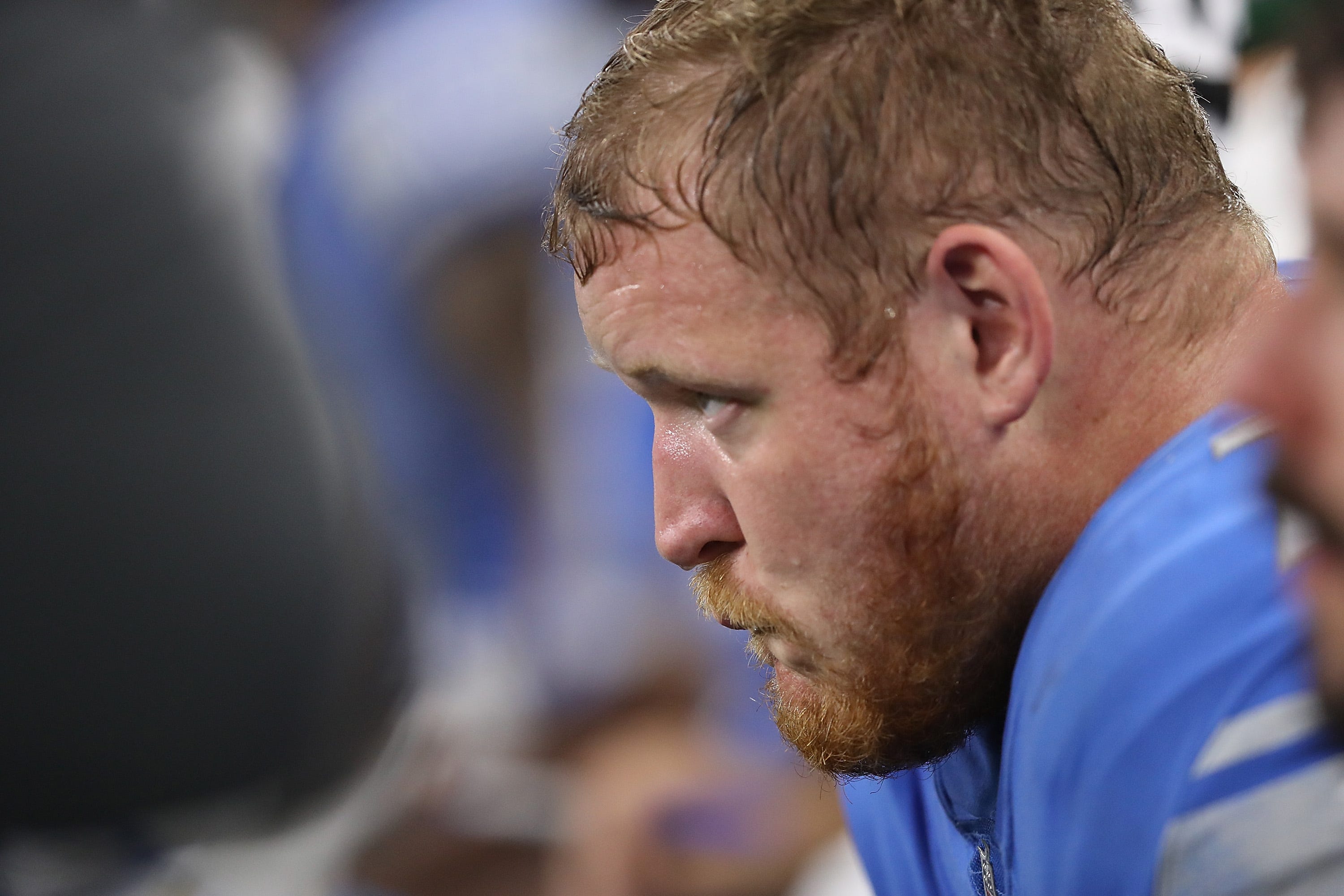
You hit on those lessons at the top, too, that the Packers of today can take. If somebody goes after your quarterback, bum-rush him.
Lang: There’s no negotiation. Because I see a lot of the comments like, “Oh, LaFleur coaches them this way.” Or Stenavich — the coordinator who used to be the offensive line coach — “oh, they’re coached that way.” I don’t give a damn. Honestly, I swear to God, I’d rather go into the locker room with my coaches screaming at me in a team meeting room and then walk in the locker room and have 50-fucking-5 guys fist bump me and be like, “We got your back.” Then, to sit there and not do anything? And the coaches say, “Hey, great job. Way to restrain yourself after watching your quarterback get cheap-shotted.” And then wondering what the guys in the locker room are thinking about you. I’d rather have it the first way every day. Every fucking day. I’d rather have it that way. Because like I said at the beginning, you can fool your coaches. You ain’t going to fool your teammates. Your teammates are going to know exactly who the fuck you are.
And in the age of NIL and these college players getting paid — with a different type of 23-, 24-year-old entering the pros — the teams that can find that type of player in high volume are the teams that will win games in January. It’s harder to find those players, those TJ Langs. They’ve got to be out there somewhere.
Lang: They’re definitely out there. Going off recency bias, look at what John Schneider has done in Seattle. And it’s a combination of not just all just finding those guys for the draft, but also finding those guys from other teams that might be castaways, that might have chips on your shoulder. He has put on a masterclass of roster-building and obviously it paid off for them by winning the Super Bowl. Every year is so different.
It seems like whoever wins it, other people try to, “OK, what was their method behind it?” Every year is different. So you have to be convicted on how you build a team. And I think Gutey does it the right way. I’ve talked to him a ton of times. I know what he’s looking for in players. I think it’s just getting harder to be right about those players and to identify those players. And that’s not a one-person problem. That’s with everybody around the league. Moving forward, you’re going to see a little bit more of what John did out in Seattle where it’s “Hey, we might have to make some hard decisions and let go of a very popular player like a Bobby Wagner or a very popular player like a DK Metcalf and bring in a conglomerate of dudes that can mold back into picking up those pieces.” And obviously when you have success, there’s going to be a lot of people that are studying what you’ve done. And I think that’s probably going to be the new norm that I think is going to be maybe the most sustainable for the NFL moving forward. Certainly you need pieces in the draft that are going to help you and be cheaper and can have that right attitude, but you’re going to need the right mixture of veterans that can come in and are hungry as hell.
Like Seattle, led by their quarterback. Sam Darnold, the guy won 14 games last year in the regular season and he was basically kicked out of Minnesota. I know he had a bad game against LA in the playoff game, but players like that mold — that have the chip on their shoulder and you know can play winning football. Whether it’s quarterback, defensive line, DeMarcus Lawrence-type of guy. Some of the guys they picked up, Rashid Shaheed, who was nobody in New Orleans. A gadget player. I think that’s going to be studied what they did out there. And John, obviously with his Green Bay roots, maybe that’s something that Gutey looks at and says, “OK, maybe we have to change the approach a little bit to get back to the top of the mountain.”
Eastern Michigan connection. I imagine the Lions have deployed you to convince Maxx Crosby to want to be a Detroit Lion. When’s that trade going down?
Lang: I don’t know why everybody thinks that. I talk to Maxx once in a while. As early as Tuesday, the Bears were a minus-150. And they just freed up some cap space with their center retiring, too. Maybe them. But I would be shocked if it’s Detroit. That’s just not the way they really operate. But I would say when you have a season, when you go 15-2, and then you miss the playoffs the next year, usually some big changes happen. I just think it won’t happen with Detroit because they just have so many young players that are going to eat up a lot of the cap that they want to be saving, especially for the next probably three, four years. So I’d be surprised, but I wouldn’t be surprised to see Chicago make the move because I think they got the taste of success last year. Obviously winning the division and Ben Johnson reinvigorating that team. Plus, you still have a young quarterback on that rookie deal. It’s the time to make some big moves. Especially their defense was kind of faded out by the amount of the plethora of turnovers that they created. Outside of that, they were probably a bottom 10 defense. So I wouldn’t be surprised to see them make a move, but I don’t think it’s going to be Detroit. I think that they’re going to find other ways to fill some gaps across their team, whether it be draft or free agency. But I’d have a hard time picturing them make a big trade for Maxx.
You can always move money around. Just talk to Jared, Amon-Ra, Penei and say, “All right, all this money, we’ll convert to bonuses.”
Lang: People like to say the salary cap is fake. I’m just waiting for the NFL to take up the Dodgers model of like, “Hey, we’re going to pay you 30 years from now.”
Bobby Bonilla contracts across the board.
Lang: We’re going to defer it for 20 years. How about that? I’m just waiting for the NFL to start taking up that model a little bit. But no, you’re right. There’s always ways to make moves. I just think if you’re a team that has holes, multiple holes and multiple question marks, it’s probably harder to make a big move like that where you’re giving up that much draft capital. And I’d put the Lions in that boat. I don’t think they’re far off. But both of their starting safeties who are All Pro-caliber, Kerby Joseph has a lingering knee injury. Brian Branch is going to be coming off an Achilles. Sam LaPorta’s coming off a back surgery. Their offensive line was pretty much in shambles last year with some of the injuries that they had. So if you feel like you’re one or two pieces away, then that’s the move you make. And I think Chicago might be closer to feeling that way than Detroit does.
What about Aaron Rodgers? Is he going to be a playing quarterback for the Pittsburgh Steelers this season?
Lang: I feel like we’re going to find out in the next week. You can’t wait until May anymore. Although I would say, I don’t know what free agent quarterbacks are out there. Obviously a Kyler Murray’s going to get moved. We know that. I would say I think Aaron’s going to try one more year. I would say that. Because I think he had a couple really tough years in New York. Obviously the first year with the Achilles, the second year just being in an overall dysfunctional organization, I think wears on you. I would say maybe he got that little bit of a taste last year by making it to the playoffs and feeling like, “Hey, we’re not far off.” And maybe him and Mike have amended some things. Obviously, I love Mike going back to Pittsburgh.
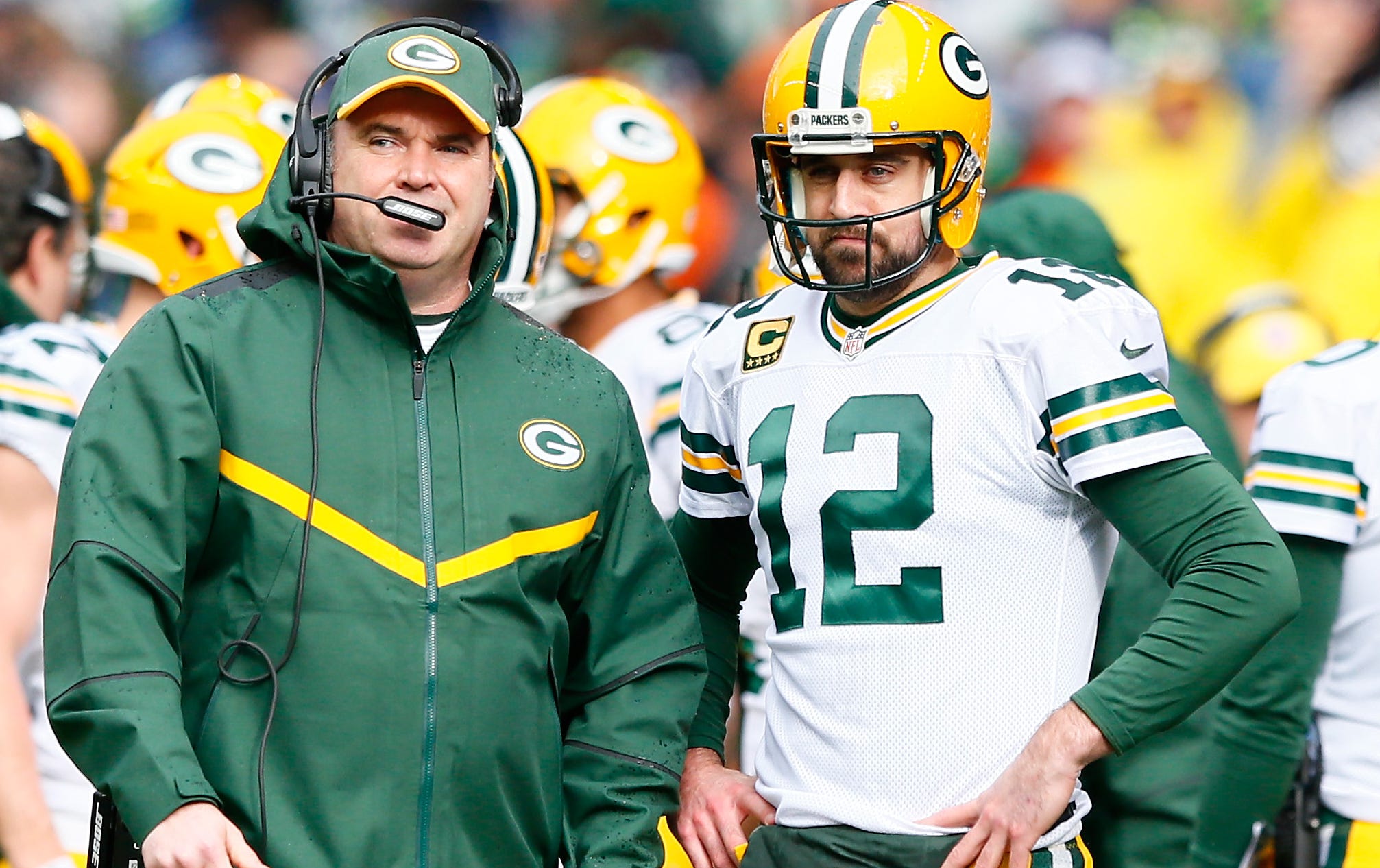
That’s possible, though? You really think that they could mend that relationship?
Lang: I think it is. I don’t want to sound corny, but I think time maybe can make the heart grow fonder. And I think that maybe in a football sense — I’m not saying this because I don’t want my wife to hear it — but maybe some time apart can make you realize what you missed. I would say that. And we had it. I only played for three head coaches, but he is — by far — the best head coach I ever had. And I know a ton of people feel the same way. And his passion for Pittsburgh was never a secret. I mean, he always used to talk about it. He was proud to be from Pittsburgh, kind of same way I always talked about being from Detroit. You understand it. I think he’s going to have all the motivation in the world to go back there and have success.
I do. I really feel in my heart that I think maybe on both their parts, Mike and Aaron spending so much time together and then spending a good amount of time away from each other, maybe that makes you appreciate each other a little bit more. So I would throw that out there. I could definitely see Aaron coming back for one more year playing for Mike, and it’d be good to watch those two get back on the same page and maybe have a good amount of success out there. I’d be rooting for both of them.
If I’m Mike McCarthy, I’d be very interested in a Malik Willis or a young quarterback to mold. Work your quarterback-guru magic, whatever he’s talking about in these head coach interviews. That’s his thing.
Lang: Pittsburgh’s a very proud team. They’re a very proud city. Mike Tomlin never had a losing season in 18 years. I don’t think that’s a town that’s going to accept, “Hey, let’s take a young quarterback for a year or two.”
I think the town would. I think the fans would. Ownership doesn’t want any of that.
Lang: Yeah, but you talk guys like Malik Willis. From the small sample size in Green Bay, he certainly seemed capable of not making the big mistake, I would say that. But I think if Mike wants to come in Year 1 with a bang — especially Aaron coming off that playoff appearance — I could see that.
The Texans ate him up, T.J. It was ugly.
Lang: Oh yeah. That Texans defense is nasty. We’re going to see. Obviously Pittsburgh has holes to fill, but I think that’s a team that just wants to continue the success and always know they got a shot. Just believe that you got a shot. Believe that you got a shot. Aaron Rodgers, even at this age, he can’t move like he used to. Anytime you got a quarterback like that, you’re going to believe that you got a shot. I wouldn’t be surprised. I don’t know anything. I talk to Mike all the time. I haven’t talked to Aaron in a while. But I could see both of them maybe getting on board and saying, “Hey, let’s rekindle this one more time. I wouldn’t be surprised.”
It would be fascinating. That is telling that McCarthy is open to it, to his credit with how things ended. It did not end well. But it has been six years.
Lang: And I would root for both of them, man. At this point in both their careers, I would root for both of them. I really would.
T.J., we could talk for hours and hours and hours.
Lang: It’s only been, what, 10 minutes?
Anything else you want the people to know that you’ve got going on in your life, football or otherwise?
Lang: No, not really, man. I think I’ve found that — I’m not going to say perfect — but it’s a good balance of being around the game, calling games on Sundays, working during the fall, and then getting to spend the spring and the summer with my family and with my kids and taking them to school and all their hockey and baseball and figure skating and events. I’ve got a good balance right now. It’s been funny. The older I get, the little bit of an itch I get to be like, “Do I think I could coach?” Maybe. Do I want to work 100 hours a week?” I’m not there yet.
But the one thing I would say, is I think the last maybe five years, and understandably so, I’ve been kind of more portrayed as the “Detroit Lions guy,” and I know we’re going to get a lot of Green Bay people that listen to this. I always consider myself a Green Bay Packer. I’m never going to be a Hall of Famer, but the argument is, “What’s he going to go in the Hall of Fame as? This player or this player?” For me, I always consider myself a Green Bay Packer, and I’m always proud of that. I miss being in Green Bay. I love Green Bay. I love going back there when I get to go on the road with the Lions. Honestly, it sounds corny. I’m a fan of both of them. If one of them gets knocked out in the playoffs, I throw on all my gear for the other team. I’m ready to go.
I was blessed to have a 10-year career playing for both teams, hometown team, and obviously in Green Bay for eight years. And I cherish it every single day. I love it. I still have all my captain pictures and jerseys on my wall. I’m proud of it. I miss that place like hell. I always consider it my second home. And I love Detroit. I also love Green Bay just as much. So any time I get to talk about the old time, especially with you, buddy, it’s always good time.
The pleasure is all here. Covered this league for 15 years. You are right at the top of the list. There’s that gravitational pull toward T.J. Lang’s locker because it might just be BS’ing with the recorder off for 10, 15, 20 minutes, or we’re talking about a game and you know that T.J.’s going to keep it real.
Lang: Honesty got me pulled into the coach’s office, I would say more than five or six times. But at the end of the day, what do you want me to do? I can’t lie to the people. We sucked today. The playcalling sucked. I don’t know what you want me to tell you, Mike. Maybe I won’t say “suck” next time.
So you’d get called into the principal’s office? C’mon Mike.
Lang: Oh yeah. Usually me and Josh at the same time. Hey, somebody would come down and, “Hey, the big guy wants to see you upstairs.” Any time you’ve got to go to the fourth floor, it’s like, “Ah, shit.” And then you’re Googling your quotes. Did it really seem that bad? “Fuck. Yeah, we shouldn’t have said that. We probably shouldn’t have said that.” That’s another big part that we appreciated was we didn’t feel like we were answering to a boss. We felt like playing with Mike and playing under Mike, playing under James Campen, maybe we say something that you might regret, but you could have those conversations, hash it out by lunchtime. Hey, we’re onto the next task.
You know me. I’m never going to mince words. I’m never going to bite my tongue. It’s just unfortunately who I am. It’s got me in trouble at some points, but I think a big part of the reputation that I’ve built is based off of the fact that I’ve always prided myself in just being honest and giving it to you the way that it is. It’s still who I am to this day.
Great read. We need more old school guys like T.J. Lang in today's NFL.
Love this. Very interesting stories and a refreshing change from the vanilla quotes players are coached to spout.
Oh, and GO PACK GO!