


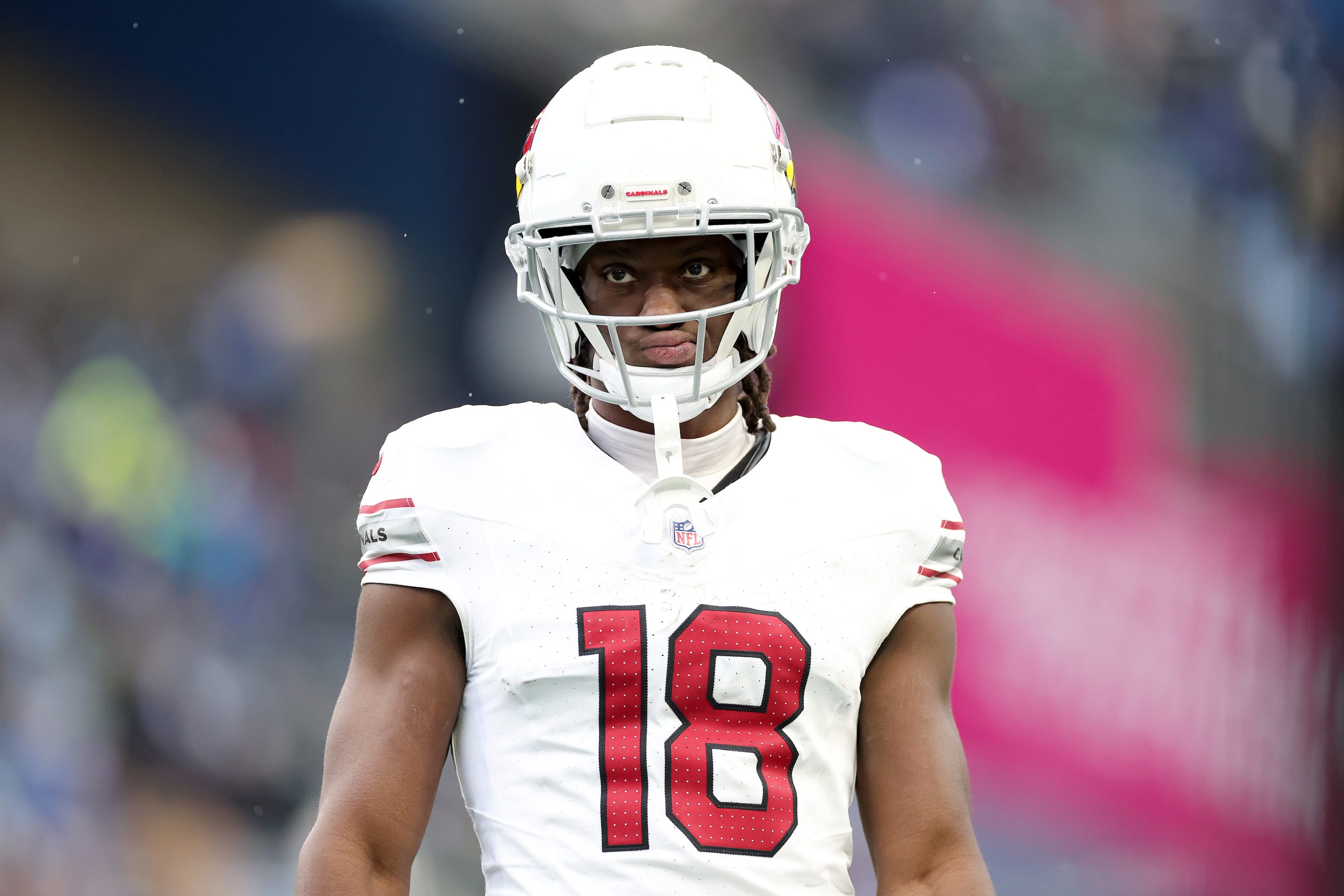
The Marvin Harrison Jr. era is over in Arizona.
Starting this weekend, he’ll try to revive his career in Houston.
After some funky real-time reporting, he was shipped off to the Texans for a second-round pick — a steep price for a player who’s struggled to catch on in the pros.
In our two-parter over the summer, “The Kyler Murray Project,” we reported on the real concern scouts had in the Ohio State prospect. Subscribers can read Part I in full here.
Figured it was worth extracting the Harrison stuff here in a separate post for those wondering what went wrong. It is pasted below.
From our August series…
Ascending homegrown players that Arizona Cardinals GM Monte Ossenfort inherited slipped away — Zach Allen to Denver, Byron Murphy to Minnesota — and his drafts have been hideous. In 2023, Ossenfort traded out of the No. 3 overall slot that netted the Houston Texans defensive end Will Anderson Jr., a move praised to the high heavens by talking heads at the time. This offseason, Anderson, the “Terminator,” signed the richest non-QB contract in NFL history. Suggest to one Cardinals coach on staff that his front office passed on one of the best defensive players in the sport and he chuckles. (“We heard otherwise before the draft. This could go on and on and on.”)
As Anderson makes opposing offensive tackles piss themselves, the collection of players Arizona acquired in the deal haven’t done anything of note.
Somehow, it got worse in 2024 when Ossenfort chose Ohio State’s Marvin Harrison Jr. at No. 4 overall over LSU’s Malik Nabers.
The move was supposed to unlock greatness in Kyler Murray. Instead, it drove one final nail in his Cardinals coffin.
Even worse? It was all predictable, all avoidable. In NFL circles — one wide receivers coach explains — Nabers was widely deemed the superior prospect. “You talk to 99 percent of the league,” says this coach, “everyone knew that Nabers was a Hall of Fame player.” The variable was his supposed baggage. Nabers was obviously the more volatile personality. Harrison was the safer choice and Arizona opted for safe. (Our Wide Receiver Matrix debate most certainly applies here.)
“We knew coming out that Harrison doesn’t have that dog,” this coach explains. “He doesn’t have that fire.”
One Midwest scout whose livelihood is making sense of all prospects in Columbus, Ohio, told the team that Harrison struggled with the stress of being the son of Hall of Fame wideout Marvin Harrison Sr. — a major presence in his life.
Even after big games, Dad ripped him. Told him it wasn’t enough.
“His father is a very big influence on him,” the coach continued. “His father would text him and call him like, ‘Hey man, you need to do this, you need to do that,’ while he was at Ohio State. So he feels the pressure. Any time he comes off the field — practice, games — his Dad is always there. So, he’s not a very confident guy.”
Coaches and scouts alike in the other three NFC West draft rooms were thrilled to see Arizona pass on Nabers. San Francisco’s Kyle Shanahan watched 10 or so clips of Harrison and said aloud that he thought the Buckeye would be better. Hard to blame him. At that point, the prospect was being compared to Julio Jones and AJ Green as the world’s next can’t-miss wideout. The closer NFL people looked, the more they didn’t understand the hype.
Especially when it was time to turn on the Nabers film.
Goodness.
This wideout was a dog in every sense of the term.
He caught slants in stride and toasted defenders. He dunked on cornerbacks in the end zone.
“It was clearly night and day,” one NFC coach recalls.
Perhaps Arizona didn’t believe it had the veteran infrastructure to take on a big personality. Gambles can backfire. But even this excuse is an indictment of Bidwill because, remember, vets should be dying to play in this market. However you slice it, the Cardinals missed on elite talents in back-to-back drafts.
Any GM petrified of selecting receivers with attitude should probably post their home on Zillow. There’s no guarantee the “safe” pick won’t give you a headache, either. One source labels Harrison one of the hardest players to coach on the entire roster and one of the hardest he’s experienced in his career. “And usually when somebody says that,” an ex-Cardinals coach adds, “it’s like, ‘Oh, that guy’s an asshole. You’ve got to get him going.’ That type of shit.” In Arizona, Harrison was difficult “for all the opposite reasons.” He lacked fire.
Production equals tolerance.
Nabers has already flashed that Canton potential.
One NFC wide receivers coach says he always prefers the WR1s with “some shit to them” like Nabers. He’ll handle baggage. He’ll tell guys to simply make sure they roast Patrick Surtain and Jalen Ramsey when the game’s on the line. “That’s why those guys get 30, 40 million dollars,” he adds. The goal is to land on the Ja’Marr Chase end of this spectrum and avoid Brandon Aiyuk-level disasters. To him, it’s obvious Harrison Jr. lacks the confidence required at this position. The 6-foot-3 wide receiver who refused to run a 40-yard dash at his pro day runs slow and plays small. In 42 percent of his games, he caught two or fewer passes.
This coach points out that the soft-spoken Harrison Jr. doesn’t seem very confident when he speaks. But it’s bigger than that. Some receivers bring a palpable presence to the field. They plant a feeling of play-to-play dread inside a cornerback across the line of scrimmage. Like Nabers. Like Chase.
Others, like Harrison, do not.
“His game’s not very powerful,” this coach says. “He’s a big guy, but he’s not. If you’re ever on the sideline while he’s playing, you don’t feel him out there. You can feel Malik Nabers. You can feel Justin Jefferson. The best players, you can feel the presence. You don’t feel him out there. He’s just kind of out there. You can easily take him out of the gameplan.”
Murray tried to fuel his young receiver with confidence. Pull up Arizona’s gut-wrenching 23-20 loss to the eventual Super Bowl champs in Week 3. Harrison quits on one route that leads to an interception. Later in the game, on a slant, he bobbles the ball right to linebacker Ernest Jones IV for another interception. Murray refuses to ice him out, as if knowing that would be the worst thing for a young player’s mental state. The QB gives Harrison a chance to high-point a touchdown and the two later connect on a crucial third and 5 that helped knot this game up at 20-20.
It took Seattle all of 28 seconds to move into field goal range. Seattle won.
Murray played all of one more game for Arizona.


Will the Bears give up on Odunze as the Jaguars have appeared to with Brian Thomas, Jr? 3 first round WRs from the class being traded in first 3 seasons would be wild.
It seemed to me that all you had to do in 2023 was watch Harrison Jr. in various venues. The dog seemed to be missing. No surprise at this outcome.