

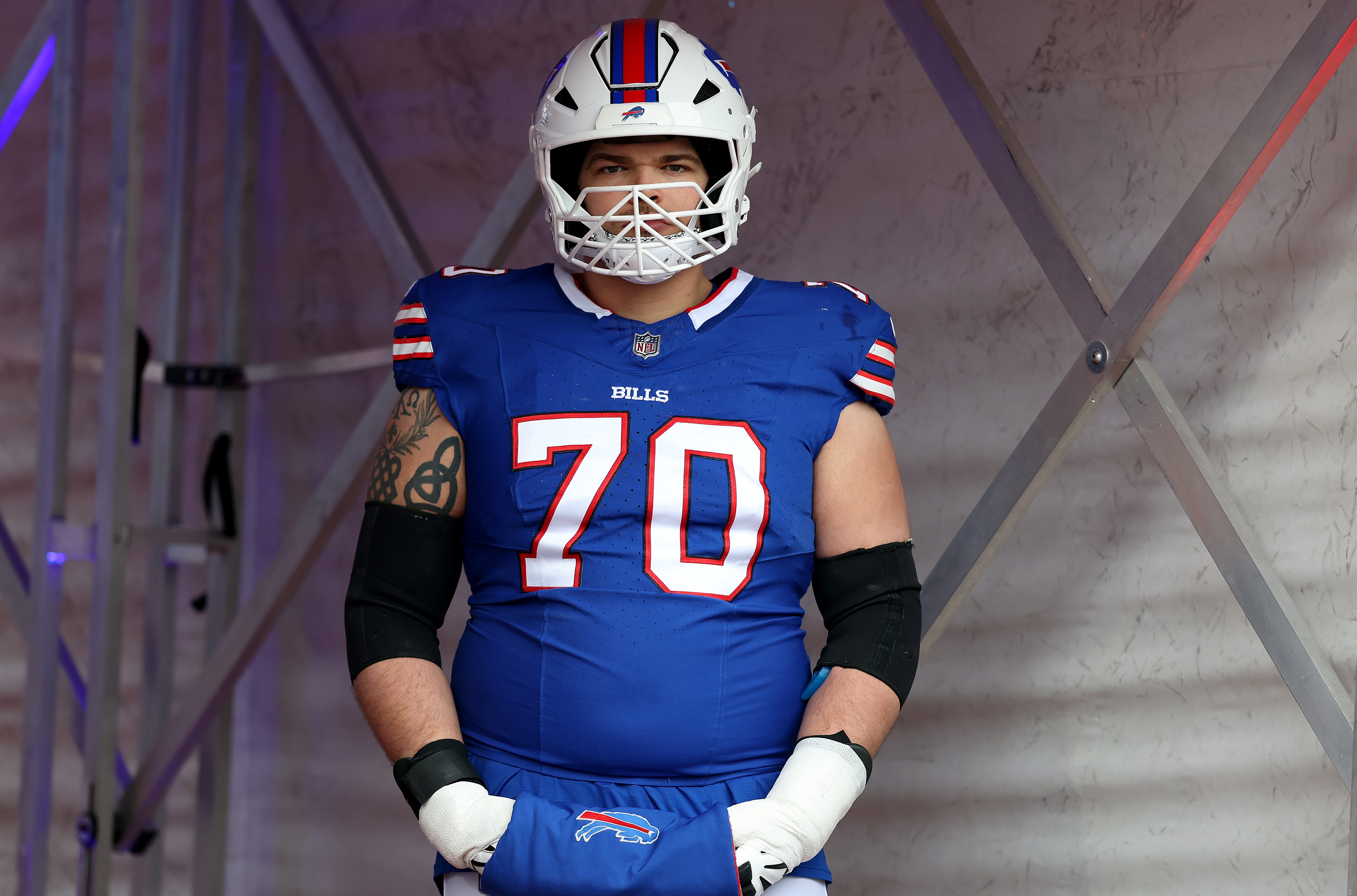
PITTSFORD, NY — Shaking the hand of Alec Anderson feels more like grabbing ahold of a deadly weapon. There’s so much tape wrapped around his palms, that they’re more like a pair of clubs… if those clubs were composed of concrete.
Yes, this is legal in the actual games.
“That shit will hurt,” he assures all future combatants.
The man looking to lock down the left guard spot on this Buffalo Bills offensive line has zero filter. It’s all he knows. Ask him any question and he’s ruthlessly honest — always.
When Joe Brady was officially announced as the new head coach of this team, Anderson assured all assholes wouldn’t be so tight inside the building. Back when we chatted into the ‘24 playoffs, Anderson didn’t care that nobody was talking about this O-Line. “We just do our fucking job,” he said then. “That’s what’s wrong with today’s society. Everybody wants a fucking pat on the back for doing their job. It’s bullshit. Man up and just do your job.”
Here the Bills are again, knocking on that championship door.
Undrafted out of UCLA in 2022, the 6-foot-5, 305-pounder has patiently waited for this opportunity in 2026. With David Edwards off to New Orleans, he’s been competing with Austin Corbett for the spot and appears close to locking it down and earning a coveted starting spot.
He fully expects the Bills to boast the best O-Line in the league, too.
On our trip to Bills camp, Go Long chatted with Anderson about his total mental transformation. He’s always been transparent on his battle with anxiety and depression.
He’s loud. He’s confident. He vows to kick copious amounts of ass this season for a Bills team trying to find any new edge it can. Maybe it’s him.
Go Long is your home for longform.
We are fueled by you.
This is a huge opportunity for you. What’s your mindset this summer?
Anderson: It’s great. It’s honestly full of excitement and anticipation. Today we got to throw on the pads for indy and some 1 on 1’s, so that was really fun to do. Kind of get back out there, get the hands shooting again, feel my hands on some pads and be able to hit something. So it’s nice. I think for this year I’m honestly excited more than anything to finally be able to have a shot and find myself in that left guard role as I’ve always seen. And so I’m excited for it more than anything.
Where does your story begin? Your roots, where you come from?
Anderson: So my wife and I, we both come from Southern California — San Bernardino County. Both grew up in Fontana, California and went to Etiwanda High School. And then I went to UCLA and she went to UCSD. And then I played there for four years. Left after my redshirt junior year and I was an undrafted free agent in 2022. I was on practice squad my first year and then got elevated for two games in a playoff game. And then my second year I was elevated the entire time I was active/inactive. And then my third year is when I was able to dip my toes in the water as a jumbo tight end. Most jumbo tight-end plays ever in an NFL year that year. And then my fourth year was the same thing. Still learning from the guys in front of me. Going from my rookie year — having Roger Saffold and Mitch Morse. And then my last three years having David Edwards and Connor (McGovern) there was very much of a treat because David being David, he sees the offense through a quarterback lens because that’s where he started. And so, it was fun to learn his point of view of football and then also take the stuff that I learned from Mitch and Roger as well. It’s helped me develop into the player that I am right now.
It’s got to feel like you’ve been building to this opportunity, right? You’re not just getting thrown into the fire. You’ve done it. You’ve been out there. Thinking back to that Pittsburgh game. What do you bring this offensive line? Every time we’ve talked, there’s a violence to your tone.
Anderson: You just said it with that. I think with offensive line, you need some people that are going to be violent and not give a fuck. I’m one of those people every now and then. It’s where if we need a tone-set or somebody to go out there and be the enforcer, I’ll do that job. I’ll get my hands dirty for the boys. I’m ready to do all that.
I’m thinking back to the way you put it — on the offensive line, nobody gives a fuck. Nobody cares what you’ve been through. Good day. Bad day.
Anderson: No one cares. We’re all suffering together and it’s the best part because you’ve got five guys that are willing to suffer with each other and then you add six other people onto that and you’ve got the No. 1 offense going. And so I’m excited to add myself into that equation and fire up the boys and get it going.
You’ve gotten through some hard times to get to this point — mentally. How has that made you tough for this opportunity?
Anderson: I think that it makes you realize what is important and what’s not. And I think when you’re in-between the lines, your mental health is important. When you have a job to do, you’ve got to silence that button and go out there and just know, “Yeah, I may not be in the most mentally right space. I may not want to be doing a certain thing right now or feeling a certain way.” But you’ve got to put that on hold and push through that adversity because you’ve got 10 other brothers on the offense that need you to do your job. And if you don’t do it, it’s not like defense where you could loaf on the backside and somebody’s going to be like, “All right, I made the tackle.” If you’re fucking around with the offense, man, and you’re not doing your 1/11th, it’s going to show on tape. And I think going through years of therapy, you learn different tools to fight and combat the anxiety and the different type of feelings that you get throughout season entirely, but also during the games. Because it’s up, it’s down. We just scored a touchdown, and then now we’ve got to punt. You go three and out. And so it’s in a microcosm of itself. You learn how to deal with the ups and downs of football just like you do with the ups and downs of life.
You could play 60 snaps and be perfect on 59 of them.
Anderson: That 60th one might bite you in the ass, man, and you’re no good.
How do you process that mentally? It can’t be easy.
Anderson: No, it’s not. But it’s part of the game and you’ve got to play the game within the game. And part of that game within the game is your mental. And if you let that beat you, then you might as well not even go out there and play because you’ve got to be coming in mentally sharp on every single play. We have 60 to 75 snaps a game and you could be perfect on 74 of them. And then that 75th one, you think you’re better than you are. You think, “Oh, I just got almost beat this next play.” And you let one turn into two. That’s what I learned a lot in college. Don’t let one play turn into two, and turn into three, because then you just start letting shit slide downhill and that’s not good.
I remember George Kittle told me once that back in college, he went through all that and he put a big red dot on his wrist tape so he would hit it for a mental reset.
Anderson: A mental reset button. A lot of guys in college, we’d “wipe it off.” We’d wipe it off — the top of our helmet. Now, I just start box-breathing. I go six seconds in, four seconds out and let that do its thing. Relax that way. All right, it was one play. You’re fine. Reset because every play is its own. No matter what happened the last play, this is a new play and the last play can’t affect too much. You don’t want it to.
They say that’s the best way for everyone to breathe, too.
Anderson: Count to four or five and let it out. Exhale. It takes a minute because you don’t want to be breathing into your chest when you’re breathing into your stomach. So it’s an exercise of itself, but it works. I’ll say it works a lot.
You’ve had some battles with Ed Oliver out here. It was close to a fight. I could see it simmering.
Anderson: They were getting up there, man. But it’s always fun going against Ed. He’s quick, he’s strong, he’s fast off the ball. So you’ve got to be really be quick with your hands and precise with how you’re striking him. I like going against Ed.
You strike me as the most interesting man in Buffalo. How would Alec Anderson describe Alec Anderson?
Anderson: Funny, hardworking, sarcastic, and don’t fuck around.
Take it way back. You got into football as a way to deal with some processing stuff going on? And ADHD? Is that where it really began with the sport?
Anderson: Playing sports was an outlet for us. My parents, they played sports. So therefore we all played sports and you grow up doing that. But it really helped me out in school, especially having to focus on one thing while do multiple things at the same time. It was really beneficial for me to be able to go out there and let my energy out and be able to understand, “OK, I can look at some stuff, but hear other things and diagnose both things simultaneously. And so I liked doing that, which that’s why I stuck with the sport. But at the same time, learning how to have a learning disorder, but also apply that in school and not just in sports. That was the battle for me. Trying to stay active in the classroom, but sitting still was a hard part. So my Dad would get green elastic bands and different types of rubber bands and put them underneath my chair and I’d be kicking on them all fucking day. Whatever class I was in, I had a vibrating watch to get me back on track. And so there were a lot of different things. But very, very fun.
What was the condition that you had with the processing?
Anderson: Man, I couldn’t even tell you. All I know is I had major ADHD and ADD and they wanted to put me on pharmaceutical-grade meth and I wasn’t about that. And so yeah, I said no. Screw big pharma. They just want to make millions and billions off of us as they use us as experimental rats.
So when did you turn that corner then playing football as a young kid? When did you realize, “I can unleash all of this energy onto other human beings?”
Anderson: Probably in middle school is when I really started having fun hitting people and wanting to do it. And I got into wrestling as well. Started out as like a punishment. I got in trouble in school. My dad was like, “All right, you want to fight? I’m going to take you to wrestling practice.” So he took me to wrestling practice and we had to do a bunch of shit and it was very hard. But at the same time, it was a lot of fun. And so I was like, “You know what? I might want to do this for a long period of time.”
You’ve been open about your anxiety in football. When was that? High school, college?
Anderson: Yeah, it started for me in high school, probably my sophomore year, having to gain a lot of weight in a short amount of time. It’s always been hard for me to maintain and keep the heavy weight on. And so you gain 10, 15 pounds and then you go to practice for two days and you lose 30 pounds. It was very hard. And wanting to get better, but you’re like, “Man, I’m lifting weights. I’m doing what I’m supposed to. I’m just not getting bigger. Am I staying stronger?” That started to weigh on me. And then also the internal pressure. Sometimes you think you have a lot of pressure on your shoulders, but majority of it can be coming from yourself. Not knowing. And that was part of my issue — not knowing how to process what I’m feeling at the time. Is it nerves? Is it excitement? Or is it me not being ready for the game because I’m underweight or is it because of another thing? And so that’s when it started. Self-processing was always a main thing for me. Having to self-diagnose and self-soothe.
Once I got in the league, I had a big panic attack, an anxiety attack that didn’t end up so good. And that’s when I knew I had to start actually getting some mental help and figure out what’s actually wrong and how to diagnose different issues and separate the two.
When was that panic attack?
Anderson: Can’t tell you about that.
Hey, it’s just my job.
Anderson: It’s part of your job to ask. It’s all right.
But it was something you really had to work through.
Anderson: Yeah, I’m still working through it. My wife helps me out a lot with that. Being able to talk exactly how I want. Some people take me that… I get hyped up or I get amped up when I start talking and my voice will go up and I’ll start cussing a lot. And some people take it as me getting angry or kind of aggressive, but that’s just me trying to process what the fuck’s going on. And my wife allows me to do that and she’s like, “All right, are you done?” I’m like, “Yeah.” Now I actually start diagnosing the main issues and how she can help me or if I do need to go to therapy for something, she will encourage me to go and talk about it. So it’s a lot of things.
When did it happen?
Anderson: 2022. My rookie year.
So it’s been a while. You’ve figured out coping mechanisms.
Anderson: I’ve figured out ways. You always have some type of coping mechanism to get you back on track, whether it’s something small and quick or a whole routine some dudes have to do. So it’s kind of based by person, I’d say.
Meditation?
Anderson: Meditation. Breathwork. Even visualization training — that’s a big one for me as well the nights before games. So I have my little processes.
When you visualize, are you sitting, closing your eyes, imagining?
Anderson: Yeah, it’s sitting there. I’ve got a mask on my eyes. I have noise-canceling headphones and I just let it all go through. And if I’m not doing that, then our sports psychologist, “Dr. Dez” (Dr. Desaree Festa), she’ll be walking us through a guided meditation and telling us exactly like, “Okay, it’s third down. There’s two minutes left on the clock. It’s third and 8 and you guys have an under front. This is what’s going on. This is the play.” And then she goes, “I want to hear you guys’ communication.” She gets us to the line and we talk through communication. And then she goes “set hut,” and then we talk about what we’re going to do post-snap. And it helps out a lot.
And I’ve gotten to know Jordan Poyer well. We talked a lot about breathwork. Have you done his breathwork?
Anderson: Oh yeah. “Po” and I, we’re close on the breathwork. He and I, we bounced ideas off each other when he was here. And I would take a lot of his ideas, especially with the guided meditations and things like that.
Beats and Breath. It works.
Anderson: I was big on that. And WimHof breathing.
What’s that?
Anderson: So it’s all breathwork through your mouth and through your mouth, out your mouth.
Whoa now. Isn’t breathing in through your mouth terrible for you?
Anderson: It’s bad, but it’s rapid breathing and it’s meant to be like a stress meditation. And so you do about 30 exhales, 30 inhales, and it’s quick. You fully exhale and inhale completely. And then you hold your breath for about two and a half, three minutes or as long as you can go. And you hold it and then you let it out. And then your body kind of goes into this shock’ish state — like “What the fuck’s going on?” Because you think you’re about to suffocate. But no, it’s different. It’s fun. I like it.
Is that different than the holotropic breathwork?
Anderson: Yes. A little bit different, but not drastically.
Because that kind of gets you into other dimensions.
Anderson: Yeah, it’s meant for some people who go on little micro doses of some shrooms. But me and Tommy Doyle, actually, he and I would do it in my apartment and his apartment in our living rooms and we’d go back and forth going through that. Doing two of them a night and it’s about 10 minutes each and then we just go to sleep.
The breathwork or the shrooms?
Anderson: (laughs) The breathwork. C’mon now. Yeah, that’s kind of it.
All of this helps you get to a place where you can kick ass. When that switch happens, how violent are you out there? What takes over?
Anderson: It goes back to what drove me to want to play, man. It’s the excitement, the wanting to get better and the slight anxiety feel of wanting to not lose. I like that feeling. Right before the snap, you get that weird kind of heartbeat in your chest and you get that weird feeling in your stomach of like, “All right, what the fuck’s this guy going to do? I know what I’m going to do. Let’s see what happens.” And then the ball’s snapped and you do it.
How confident are you that you can win this job and be a part of one of the best lines in football and dominate?
Anderson: I’m very confident. I’m confident in my abilities to push through adversity and really strive to get better. And I think I’m doing that every day.
Can this be one of the best lines in football?
Anderson: I think this will. I think we will be the best offensive line in football this year. I think the proof’s in the pudding and we’re out here working every day and showing it.
It helps when the assholes aren’t tight, too.
Anderson: Exactly right. It’s nice.
How is it different?
Anderson: It’s not too much different. Joe wants us to go at it every day and get better and that’s what McDermott wanted, but I think it’s just a different viewpoint from the same family member.
More from Bills Camp…
‘I’m still a top receiver in this league:’ Is DJ Moore the missing piece in Buffalo?
Bills T-Camp: How new HC Joe Brady is challenging Josh Allen
It’s a Joe Brady World
2026 Season Preview Features to date:
How great for fans to be able to get this close to the real player inside the helmet. Thanks for taking us deep into the depths of the O-line.
Love this guy! Another banger Ty