


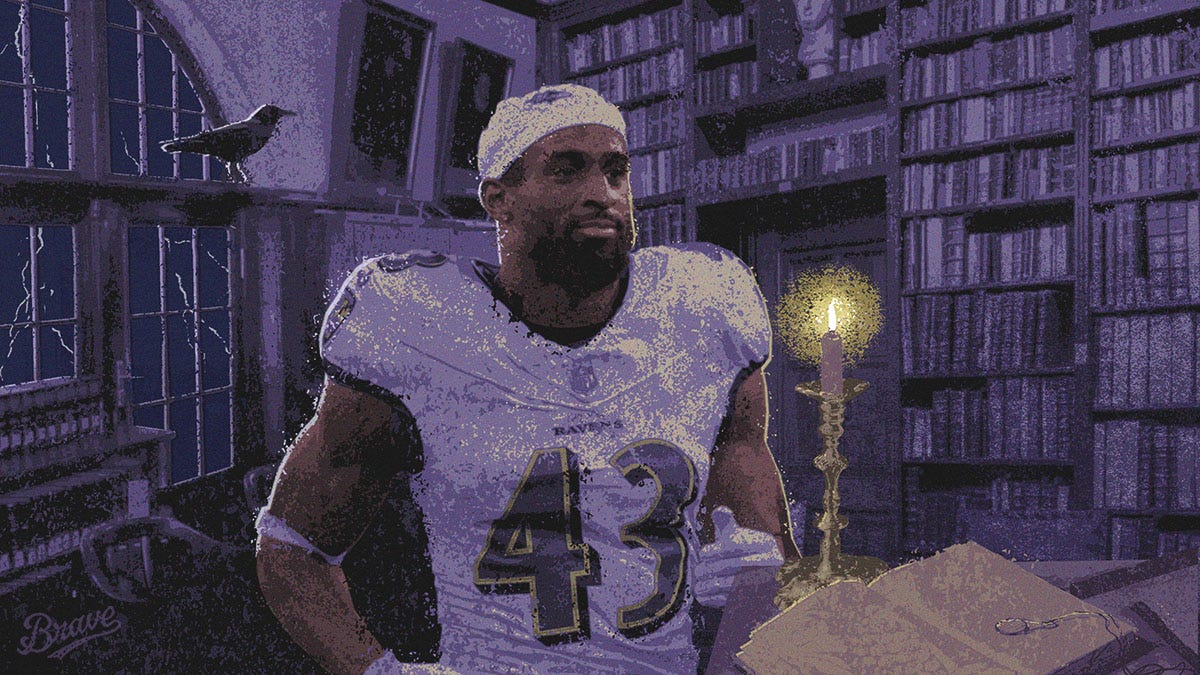
OWINGS MILLS, Md. — Arms crossed, he stares off toward the sprawling practice fields in the distance. Justice Hill is a seasoned vet now. This is Year 8, and he has spent the entirety of his NFL career with these Baltimore Ravens. Despite all excruciating playoff defeats, his full beard consists of exactly zero white strands.
Those fields are empty.
Only the gentle hum of a utility vehicle fills the air as he thinks back to Sept. 2, 2021, to the moment he tore his Achilles on those fields. The best way to understand Justice Hill is to understand there are two completely different versions: “Pre-Achilles Justice Hill” and “Post-Achilles Justice Hill.” One cannot recognize the other.
“Sometimes,” Hill says, “you’ve got to go through adversity to build yourself, build your character, build your mental. At the time, it sucks. But when I look back? I needed that.”
Five days before the injury, his Ravens played Washington in the final exhibition game. It had been a rough summer. Hobbled by a high ankle sprain, Hill knew he’d be watching this one from the sidelines in street clothes. But when Ravens players filtered into the visiting locker room, the third-year running back was treated to an unpleasant surprise. His nameplate was grouped with all the players clearly on the roster bubble. During pregame, John Harbaugh made the rounds in this area. Locker to locker, he offered some players a farewell and told others he wanted ‘em back on the practice squad.
Finally, it was Hill’s turn. The Ravens head coach said he didn’t have any space for him on the roster. He’d be cut.
The game began and — nine plays in — starter JK Dobbins corralled a screen pass, turned upfield, tore his left ACL… which triggered a new conversation with Hill.
Soon after, Harbaugh approached Hill and did a 180. Told him, “This is going to be your year.” His roster spot was now safe.
Huh?
Hill was torn.
He couldn’t forget what Harbaugh told him first.
“It was so much to battle through because it’s like, ‘OK, everybody in the building does not want you here,’” Hill says. “You don’t know how to feel. I hear you, but I don’t hear you because you said something different five minutes ago.”
This fed distrust — “a lot of distrust.” Nor did Hill have a good relationship with Greg Roman. The Ravens’ ex-offensive coordinator once told him straight-up that he wanted the team to sign a running back to take his place. Hill felt like a Raven in paperwork only because he knew how his coaches truly felt. Strapping on purple that ensuing week of practice was bizarre. Hill, livid, hurried back from that ankle sprain and, yes, popped his Achilles on those distant fields.
Crouching low to catch a pass, he felt the tendon recoil up his leg.
Part of him thinks he overcompensated on this leg because of his sprained ankle to the other.
All of him knows for certain those negative thoughts flooding his mind manifested onto the field.
“You’re internally pissed,” Hill recalls. “You have an opportunity, but you’re so caught up in all the other stuff that you can’t even focus on it. So that led to the injury because my mental wasn’t in the right space.”
With that, a new Justice Hill was born. He rehabbed, returned, repeated to himself, I don’t care who wants me here or not and morphed himself from disposable to indispensable. This day, rocking a backward hat, the man who turns 29 in two weeks believes he can overcome anything. Good thing, too. These 2026 Baltimore Ravens — a group with Super Bowl aspirations — need an injection of belief. There’s everything we see on the field. Baltimore’s jack of all trades pops free on draws, pretzels defenses on screens and is liable to put defenders on their keister.
But it’s the brain that differentiates Hill.
He’s equal parts football player and sage. Because he treated that 2021 season as a total life reset, deleting all social media. All gloom, all doom took up too much residency in his mind — so goodbye. For two full years, Hill never checked anything. Instead, he prioritized family, staying present, creating new habits. Such as embracing boredom. Nowadays, it blows his mind to see people filling up every free second of their lives with their face in a phone.
“How engulfed people are into it,” Hill says. “Constant overstimulation. You don’t know how to just sit and be bored. Let thoughts come to you. Be able to think on those thoughts and expand on it. That only comes from focus.”
Boredom fed creativity. Creativity fed happiness.
Whenever he feels the urge to reach for his phone, Hill picks up a book.
Now? He reads two to three hours every day. Hill wakes up at 5 a.m., heads to Ravens HQ by 5:45, and flips through pages while alternating between the hot and cold tubs.
The quiet. The serenity. This is his favorite part of every day. Hill makes a conscious effort to train his mind more than most NFL players train their bodies. He’s into “mental sharpness” books. Particularly the classics. “Think and Grow Rich” by Napoleon Hill, published in 1937. “The Richest Man of Babylon” by George S. Clason, published in 1926. All of John C. Maxwell’s books on leadership.
“A lot of people neglect that part of life,” Hill says. “We’re so focused on the physical. The most important part is figuring out yourself and learning what you want out of life and how to go get those things. I pour into myself that.”
And along the way, he highlights passages, journals and curates pearls of wisdom on the “Seeds” collection of his (now-active) Instagram account.
Sometimes, he puts a subtle twist on a quote he read.
Other times, it’s a Hill original.
These “seeds” lit a flame inside of Hill that’s now an inferno.
So, he’s paying it forward.
To the Ravens. To anyone listening.
“Everything worth doing is hard… and the more worth doing it is, the harder it is, the greater the payoff”
This seed, derived from businessman Alex Hormozi, perfectly encapsulates Hill’s baptism to pro football.
At Oklahoma State, he once led the entire Big 12 conference in carries (268), rushing yards (1,467) and rushing touchdowns (15). Of course, Stillwater, Okla., also served as the breeding ground for two of the best running backs in NFL history: Barry Sanders and Thurman Thomas. The Ravens selected him in the fourth round of the 2019 draft and the 5-foot-9 (and 5/8’s!), 198-pound torpedo fully expected to be unleashed in this new Lamar Jackson-powered, No. 1-ranked rushing attack.
He was not. He received 58 carries.
The next season? Twelve.
It was all spectacularly unpleasant. His entire football life, Hill was the center of the universe. Every offense revolved around him. Now — for the first time ever — he was asked to play special teams. Hill hadn’t even tackled anybody, period, since elementary school. The first time he tried to do so? Yeah, he’d like to forget. “Embarrassing,” he recalls. On Thursday Night Football, in front of 12 million viewers, he resembled more of a hyperactive toddler diving onto a Slip ‘n Slide than a gunner fielding a punt. Hill completely whiffed on Braxton Berrios.
“I’m just like, ‘What do I do?!’”

Shame’s quite a motivator. Right then, Hill realized that if this is where the Ravens wanted him to play, he better learn how to tackle — and fast — or the NFL would effectively place its steel-toe boot on his rear-end for good. “You’re a football player first,” Hill told himself. Not only a running back.
First, he managed to effectively wrap up and tackle a returner. Confidence ticked up.
Then, into 2020, at full freakin’ speed, Hill impaled Tennessee Titans kick returner Cameron Baston with a piercing right shoulder. Jim Nantz sounds horrified on the broadcast. As Hill primitively thumbs his chest, Tony Romo calls it “wicked.” Zero fans are in the stands this COVID game — only ridiculous fake cardboard cutouts — which made the sound of the collision audible to all watching at home.
Suddenly, he couldn’t get enough. He harbored a visceral craving for contact.
“Once you get a little taste of it,” Hill adds, “it’s like, ‘I like the feeling of this.’”
Life on special teams can feel like working in a coal mine. There aren’t fantasy football leagues for gunners and long-snappers. Hill needed to consciously swallow his ego and come to grips with his new reality. A simple willingness to genuinely embrace any assignment the Ravens could hand him each Wednesday became an NFL survival skill in itself.
Too many people start a career without taking a moment to sign this virtual contract.
“They get on the journey,” Hill explains. “and they’re like, ‘Oh, this shit’s hard. I’m going to quit.’ You’ve got to accept that first: the greater payoff, the harder it’s going to be. And when you already know that? It’s easy to go through the process. There’s going to be hard days. If I want to get to the end goal of where I want to get to, I have to go through that because that’s what’s shaping you.”
That’s why he treasures this seed — for everyone.
So many people in Hill’s own life procrastinate all the time. It’s easy to get distracted.
“Sometimes it just takes reading a couple of words to be like, ‘OK, you know what? Let me actually do that.’”
He’d know. His headspace wasn’t clear those early years.

“You may think the plan you have for yourself is the ideal plan. Trust God’s plan and God’s timing. He has some beautiful things in store for you. Trust.”
He rattled the bones of returners, earned a honest NFL paycheck, carved out some indisputable value to the Baltimore Ravens. But, uh, no. He wasn’t at peace. The more time passed, the more Justice Hill lost confidence at running back 2019 to 2020 to 2021.
Here, he details the “snowball” effect — how confidence drains.
“You know you’re talented. But you never get the opportunity to show it,” Hill says. “So as more time goes on, you forget that you can make these plays. And then when nobody’s feeding into you — and then you’re not feeding into yourself? — it spirals. A lot of negative self-talk and then feeling like you don’t have much support on the outside.
“I felt purposeless.”
He’d show up to practice, realize Roman had zero plays designed for him, and ask himself: “What am I here for?”
He yearned for a new team, a new offense.
Negativity mounted, and mounted, and he tore that Achilles into Year 3.
Which is exactly when Hill quit caring what was on the mind of his Ravens coaches. He told himself: I don’t care what they feel. I don’t care if anybody wants me here, I’m going to do my thing. During rehab, it’s easy to drift into oblivion. Hill would make progress, hit a plateau, make progress, hit a plateau. The key? Not obsessing over the finish line. Letting go. “Surrendering,” Hill says, “the results.”
Naturally, he started applying this thinking to everyday life. He stopped letting any obstacle in life dictate his emotions.
Mainly, he desperately needed this year off to recalibrate his mind. The injury proved to be a blessing in disguise. Hill could spend endless hours with his firstborn.
Now, his daughter is almost 5 years old. His son turns 2 in December.
“It definitely grounds you,” Hill says. “It gives you another sense of purpose. You’re doing it for others outside of just yourself. It’s easy to just do things for yourself. That only goes so far. But when you do things for other people — for your family — that gives you another spark, another motivation.”
A new man meant a new player. In ’22, ’23 and ’24, Hill emerged as the do-it-all glue to this Ravens offense with 1,730 total scrimmage yards and nine touchdowns.
His play style is a reflection of a liberated mind.
Take a third and 16 in Baltimore’s 56-19 dismantlement of the Miami Dolphins late in 2023. He catches a screen pass behind the line of scrimmage, cuts back against the grain and embarrasses Jalen Ramsey with a head fake for 18 yards. The cornerback’s jockstrap remains buried somewhere deep within the Bermuda grass at M&T Bank Stadium. Or Jackson’s lob to Hill deep vs. Buffalo on Sunday Night Football in 2024 for a TD. He juked and spun and ripped through Bills arms tackles all night. Or this third-and-2 vs. the L.A. Chargers. He brushes away safety Alohi Gilman with his right hand to gain the corner, knifes upfield behind a Zay Flowers block and accelerates past a pack of bodies for the decisive 51-yard TD in a 30-23 win.
Good things happen when the ball is in his hands.
No. 43 is a joystick fully capable of bobbing any direction any moment.
Granted, each of these seasons concluded with an excruciating playoff defeat.
“Everyone won’t understand your vision. That’s fine. No need to explain. Win in the dark. Chop wood. Carry water. Keep walking. They’ll understand at the light.”
He’s from the Greenwood District of Tulsa, Okla., better known as “Black Wall Street” for blossoming into one of the most affluent African American communities in the early 1900s.
Then, in 1921, destruction. When Dick Rowland, a 19-year-old African American shoe-shiner, was falsely accused of assaulting a young white woman in the Tulsa Tribune, a white mob aided by law enforcement obliterated Black Wall Street. In all, 35 blocks went up in flames, 300 people died, 800 were injured.
These were Hill’s ancestors.
Their businesses burnt to ash.
To this day — 100+ years later — the north side of Tulsa isn’t developed, Hill explains.
“It’s sad. You’re working against the grain. They redlined everything after that, so investment doesn’t go there. When I first got into real estate, I tried to do stuff out there. But when you have such a long time of oppression? The people are already tainted in their minds. They can’t get past that.”
Out of nowhere, one of the Ravens assistant coaches joins our conversation. Senior special teams coach Randy Brown sees Hill doing this 1 on 1 and chimes in. “It’s about time somebody’s interviewing this guy,” Brown says. “Unsung hero on the football team. Only thing I don’t think he can play is quarterback.”
Hill corrects him. “You know,” he says, “I was the emergency quarterback last week.”
Brown smiles, and heads out to those vacant fields for a walk.
Somehow, Hill’s own mind was not tainted by Greenwood’s traumatic roots.
Same for his brother, Daxton, a safety for the Cincinnati Bengals.
This go-to quote above is drawn from the Joshua Medcalf’s bestseller, “Chop Wood Carry Water: How to Fall in Love with the Process of Becoming Great.” (Ironically enough, the same book Packers guard Travis Glover cites last week in our pages.) Post-Achilles Justice Hill welcomes all tedious day-to-day, minute-to-minute, downright boring tasks. He brings up the classic “wax on wax off” scene from The Karate Kid. Initially, Daniel LaRusso thinks he’s being used for free labor when, in fact, Mr. Miyagi is instilling discipline and circular muscle memory to block punches.
Staying consistent — to ridiculous extremes — is vital.
Zero pats on the back are required.
“A lot of people look for approval for things,” Hill says. “They want to look for validation of just: ‘Oh, is this right?’ For me, I’m like, ‘Forget what everybody else says. If you have a vision for yourself, go make it happen.’ You don’t need validation. The only person that should be validating is yourself. And if you believe it, you can achieve it.”

Speaking to Hill on this crisp autumn day in Maryland is meditative. As if all we need to do is throw our phones in the trash and smell the fresh air to retake ownership of our lives. To put this zen into motion, Hill also creates “systems” to manage his household, to make sure everything runs smoothly for his wife and kids whenever he’s on the road. Systems to learn his plays, sculpt his body, be reliable in every conceivable situation on the field.
All fine and dandy.
Inevitably, pro football cold-cocks your carefully crafted “system.” Heartbreak is always one fumble, one dropped pass away. All these Ravens know are gutting January playoff losses. As Hill turned that proverbial corner — and got the ball! — the same finale played on repeat.
2022. Ravens, Lamar-less, lose by a touchdown at Cincinnati in the wild card.
2023. Lamar’s back. Lamar is the MVP. Baltimore also boasts the No. 1 scoring defense in the NFL. Hosting the AFC Championship, they lose 17-10 to Kansas City. The crucial mistake? Flowers’ goal-line fumble.
2024. In arctic Orchard Park, NY, the Ravens trail the Bills 27-19 with three minutes left and Hill’s the running back on the field. He catches a third-and-2 checkdown to keep the chains moving, picks up blitzers in pass pro, catches another short pass and Baltimore pulls within 27-25 on Jackson’s TD strike to Isaiah Likely. Moments later, Mark Andrews drops the two-pointer. Season over. Ravens players throw on their parkas, knit hats and file into the cramped visitor’s locker room.
2025. In Game No. 272, a de facto AFC North title game, one Calvin Austin III touchdown and one Tyler Loop missed kick kill off another season. Harbaugh is fired.
Scars could accumulate.
Vets, like Hill, could become fatalists who fully expect catastrophe in the fourth quarter.
“It’s crazy,” Hill says, “because now post-Achilles, I don’t really view bad things or losses as ‘losses.’ My mindset really has changed to where I’ve surrendered the results of things. If I know that I’ve done everything I can during the process of practice — I practiced my ass off, I worked out, took care of my body — whether it’s a win or loss, I’m like, ‘Well, that’s fine. I can still learn from these.’ After a loss, you can think on it, dwell on it forever. You overanalyze. You nitpick. But now? I’m just like, ‘I did everything I’m supposed to.’ You’re never going to see me rattled. I’m always going to always be even-keeled.”
Most pros cannot. Pressure’s suffocating.
One reason the Ravens replaced Harbaugh with Jesse Minter was to reset the psychology of the entire building. Similar to Hill’s ‘21 awakening.
The running back takes comfort in knowing literal “perfection” is impossible. He lives with the results.
“Everybody talks about ‘watching film,’” Hill says. “You watch film of your life. You watch film of a game. You watch film to learn. If everything was perfect, what are you going to watch film and learn from?”
The week prior to our chat, the Ravens stormed back to beat the Atlanta Falcons in overtime, 30-23. On two runs, he could’ve busted loose for more yardage if he didn’t trip up. It would’ve been easy to dwell on those what-if’s. Instead, he stayed positive and supplied the big play that shifted momentum. Lined up at fullback, Hill gained 37 yards on a trap play, high-stepping over the diving fingertips of safety Jessie Bates. “If I was dwelling on all the bad stuff the whole time,” Hill says. “I wouldn’t have been able to make that play.”
No different than his other passion: real estate. Hill develops properties as far as Belize. When he’s over budget by 30 percent, he doesn’t throw all blueprints into the trash. He analyzes, adjusts and — many times — the final product is better than anything he anticipated.
He works with teams. He’s responsible for their income. As he travels the world, Hill will see a beautiful landscape, wonder What can I build here? and launch into the process of obtaining the land, finding an architect, bringing a “vision” to life.
“And I know,” Hill adds, “it’s not just going to be sunshine and rainbows the whole time. So I take everything from football and apply it to everything.”
Baltimore will find itself in another playoff game again, too. He won’t let his mind race too far ahead. He’ll swing that axe.
“A self-lit flame will always burn. Find your why that doesn’t need anyone else’s permission to exist.”
Central to everything Justice Hill believes — everything that’s led him to this serene state — is not giving a damn what anybody thinks. Remove from social media from your life and you quickly realize how worthless all likes, all retweets, all comments are to your joy. Your purpose.
No words of encouragement are required in-person. Validation is irrelevant.
Hill compels everyone listening to relentlessly chase your dream. No matter how lofty.
“Yeah, we’re human, but we have superpowers,” Hill says. “Visualization is one of the superpowers that people don’t understand they have. And so when you have a self-lit flame? That fire is like a rocket, man. When you set that rocket off, it can go where it’s supposed to go. And when you have a self-lit flame? You don’t need ammunition. You don’t need outside things to get you going. You’re your own catalyst.”

The power of desire can overpower more obstacles than 99.9 percent of humans realize.
This brings him back to “Think and Grow Rich,” the Napoleon Hill masterpiece.
Most famously, the author shares the surreal story of his son, Blair, who was born without ears. Doctors told Napoleon his son would be deaf and mute the entirety of his life — and there was nothing he could do. Dad refused to believe them. Dad was convinced raw desire could defeat biology. From birth, he tried to program his son’s mind that this was no handicap. Rather, an asset. He’d speak directly to him every day. And over time, the author discovered a new auditory pathway — his son could register sound waves via bone conduction. He could speak. He could hear. He attended school. And by adulthood, technology developed that utilized a bone-conduction transmitter. Blair put it on and heard perfectly.
The author’s point: “Our only limitations are those we set up in our own minds.”
Napoleon Hill is a pioneer in the field of manifestation.
Justice Hill (no relation) applies this thinking to his own life.
Too many people, he explains, let those limitations stack up. They never pursue their dreams and die with regrets.
“That’s one thing I would never want to be at the end of my life — regretful.”
He knew nobody in this building wanted him after tearing his Achilles. So the F what? He forced their hand. Made himself invaluable. And when a new Ravens OC (Todd Monken) arrived in ‘23, his career took off. The two still text regularly.
This story isn’t an epilogue. He fully expects to play a ninth season, 10th, an 11th, keep his fire burning as long as he possibly can. But Justice Hill knows how he’d like people to remember Justice Hill, and that’s a team-first player who did everything imaginable to get Baltimore to a Super Bowl. He thinks they’ll get there. He believes all those playoff defeats have only strengthened bonds inside the locker room.
“I feel like we’ve let that mental image of failure escape,” Hill says, “and now we can replace that image in our head with success. Even if the game isn’t going right, if we have more time on the clock, there’s an opportunity.”
Of course, his team then lost to both Cleveland (13-10) and Cincinnati (35-13) after our sitdown.
The 2026 Ravens face a critical juncture with the Buffalo Bills and Jacksonville Jaguars next.
With Jackson back, they’ll either assert themselves as an AFC power, or fade.
Seven games in, he’s got 224 total yards. More Hill might do the trick on offense.
One play last season embodies these “seeds.” The Ravens are losing, 38-24, to the Detroit Lions with less than a minute left. The game’s over. There’s no reason for anyone to overexert themselves. Hill catches a short pass, redirects upfield and is sandwiched simultaneously by three Lions defenders. Miraculously, he pops free from this vice. Escapes ‘em all to gain 37 yards. Something small that reveals something much bigger.
Get others to tap into their own superpowers and maybe the Ravens finally do claw back to a Super Bowl.
Inside the locker room, Hill will offer book recommendations, remind teammates that a little boredom goes a long way and — most of all — try to lead with his actions.
Without being overbearing, his belief can become contagious.
“Some things stick, some things don’t,” he says, pausing with a smile.
“You plant the seeds either way.”
Related:
The “Big John” Simpson Creed

OWINGS MILLS, Md. — Long before he was the 6-foot-4, 330-pound colossus handpicked to make the Baltimore Ravens malevolent again, John Simpson was a kid from North Charleston, S.C., whose father was in prison and whose grandfather had just gotten out. The generational curse was real. Drugs were everywhere. Guns, too.
Thought you were a Bills fan. Lol. Good piece Ty.