


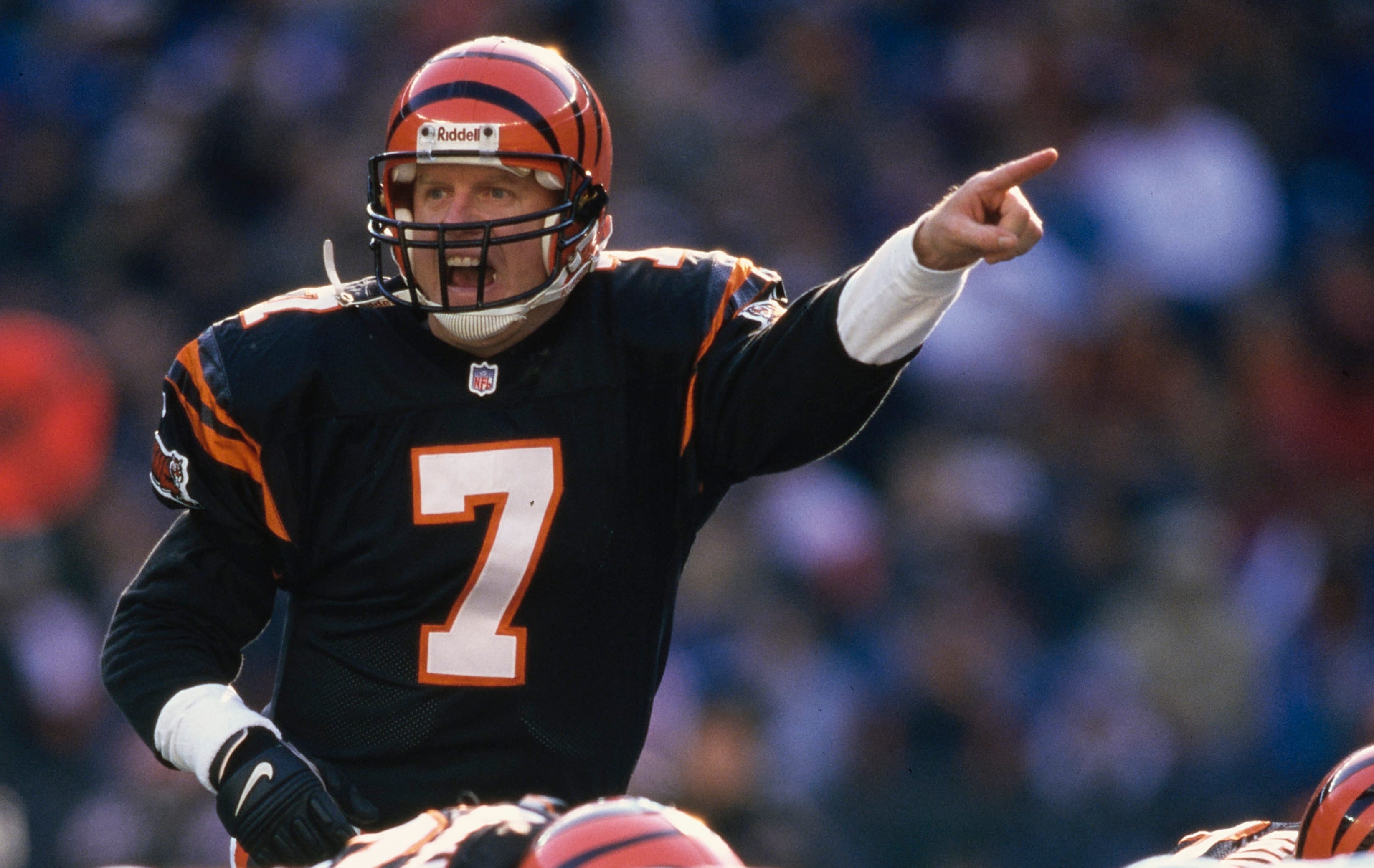
Midway through his NFL career, Boomer Esiason was shook with news that changed his life.
His son — Gunnar — had cystic fibrosis.
What came next is changing lives to this day.
For our annual Old School Week, I caught up with the 1988 NFL MVP to discuss football and life. Esiason opens up on his wild rise in the sport. One high school basketball game got him his shot at Maryland… albeit as an 11th stringer. Gunnar’s battle became his life’s work in more ways than anyone realizes. And, of course, Esiason takes us down memory lane as an NFL quarterback. The Bruce Smith hit that supplied a blackout concussion. No-huddle innovation with Sam Wyche. Coming so, so close to a Super Bowl victory over Joe Montana’s 49ers. And much more. These days, of course, you can hear Esiason on WFAN each morning.
Video & Audio of our chat is here, icymi:

Prefer to read? Words are below.
Thanks, all.
Go Long is your home for independent NFL journalism.
Christmas is a month away.
A fine time to share the love:
Hey, it’s Old School Week at Go Long, so it made sense to bring on one of the absolute best. Boomer Esiason: 14 seasons, four Pro Bowls, MVP, this close to a Super Bowl. And of course, we all know you today for bringing the freshest takes that there is out there in NYC and beyond, really You cut through the noise, which is so appreciated. We’ve talked a few times over the years. How in the hell you been, man?
Esiason: I’m doing good. I’m actually doing great now that I don’t have to work on weekends. I don’t miss my CBS NFL Today job. I got my weekends back for the first time in 37 years in the fall. So once I’m done on Fridays, I’m not back until Monday morning. It’s great to have a full weekend.
So what do you do with your weekends? That’s got to be glorious. Catch up on life and see family. What’s it been like this season?
Esiason: Well, it’s a little bit of that. It’s a lot of golf. It’s a lot of travel. It’s a lot of out east on the eastern end of Long Island. And now is the best time of year because it’s not quite nearly as packed as it normally is. Last weekend, I think I fell asleep 9 o’clock on a Friday night, woke up at 9 o’clock on Saturday morning and went and played golf. And then did the same thing on Sunday and got back to my home to be able to watch the football games and then get up at 3 o’clock in the morning to talk about it on Monday morning. So people don’t realize when you work like what we do early in the morning, Sunday nights are not a lot of fun. And especially if the game is supposedly a big game like Minnesota and San Francisco, those things, having to stay up and watch those and get up Monday morning to talk about it are not the easiest things in the world to do.
Oh man, you’re telling me. We’ve got three kids and it’s better now. It’s like 5:30, 6:00 a.m., but our body clocks are 4 to 4:30 a.m. AM. That’s a quick turnaround if it’s a good game and the adrenaline’s pumping because it’s not only the game. I mean, you get those juices flowing. You can’t just fall right asleep after some of these games. So it’s good to take back your circadian rhythms.
Esiason: Certainly I can. I don’t know how everybody else does it, but one thing I will say that is great about the job that we have here at WFAN, especially when we go on the air at 6 o’clock on a Monday morning, is we really get to talk about things first. There’s reaction to all the games, of course, on Sunday and there are people overnight. But there are not a lot of people listening. So people tune in on Monday morning to hear your thoughts about whatever thing is going on in the world of sports. And right now, it happens to be football. And football is all-consuming. It’s everything. It’s pretty much 75% of our show. And especially with one good football team here at the Giants, it’s great. The Jets, you’re always kind of talking to people that are Jet fans off the ledge. You’re like a psychiatrist every Monday morning, but I think they enjoy the pain. They enjoy to complain. But hopefully Aaron Glenn will figure this thing out and somehow save his job this year.
The Jets. Is there ever hope? I was looking at your career. I mean, you went 8-8 when you were with the Jets when you got traded there. And it might as well be 13-3. They should build statues for you with the accomplishments because they’re in this vicious cycle where it doesn’t matter who the coach is, who the GM is, who the quarterback is. They’re bad every year. I guess it starts with Woody Johnson. So maybe it’s not fixable, but you tell me.
Esiason: I didn’t have Woody as an owner. I had Leon Hess as an owner and he was in his (80s). And really there were a lot of similarities, however, to back then — which was ‘93, ‘94, and ’95 — to now. And the reason I say that is because when I got traded to the Jets, Bruce Coslet was the head coach and he was my offensive coordinator in Cincinnati. And I was looking to revitalize my career. He was looking for somebody who knew his offense. So it was a match made in heaven. I did go to the Pro Bowl that year. We ended up missing the playoffs by basically one game. We lost our last two games. And I thought we had things going in the right direction. We had a very popular defensive coordinator at the time. His name was Pete Carroll. So they decided to fire Bruce and then hire Pete. And then a year after that, they fired Pete to hire Rich Kotite. So stability has not been the strong point for the New York Jets even way back when, when I was here. So things have not gotten much better over the years. I think that Woody Johnson is tired of resetting. And that’s why I was saying when I first started that I do think he wants to keep Aaron Glenn as the coach. They just have to show more improvement. Last week was a good start for that.
Let’s get into your life, Boomer, because we hear your name today. We see you on TV. We know Boomer Esiason, the analyst. But Boomer Esiason, the player, was one of the best of your generation. But start at the start, your childhood — growing up in Long Island, what was that really like? You went through a lot at a young age, losing your mother to cancer. You and your father had a really close relationship. He made a lot of sacrifices for you. Give us the origin story here.
Esiason: It starts with my Dad. He was a World War II veteran. He spent either 16 or 18 months in theater in Europe. So he went in after D-Day initially and ended up staying there until January of 1946. So he was through the end of the war. He saw some of the worst things that any human being can see. And this interrupted his college football career. He came back, he went on the GI Bill, back to school, got an engineering degree, worked in the insurance industry. And then lo and behold, he has three children: me and my two older sisters who were teenagers when I was seven when my mother passed away of ovarian cancer. And I never saw my father marry another... well, he certainly didn’t marry anybody else. I never saw him with another woman the rest of his life.
I think my mother was his hero. And I understood as I got older, just the difficulties that he had to deal with raising three children. There wasn’t a lot of help. And then later on, as I was a teenager, he took in his own father because he refused to put his father in a senior home. He wanted to make sure that he had everything that he needed. So he had a sacrifice for him. So there were four of us in the home and it was a very small home. We had one bathroom and, like most kids back in the ‘60s and ‘70s, other than losing my Mom, I had a great childhood. I had a lot of great friends that lived on the street. We were all playing ball out in the street and that’s really where my love of sports came from. I was a Ranger fan, a Knick fan, a Met fan.
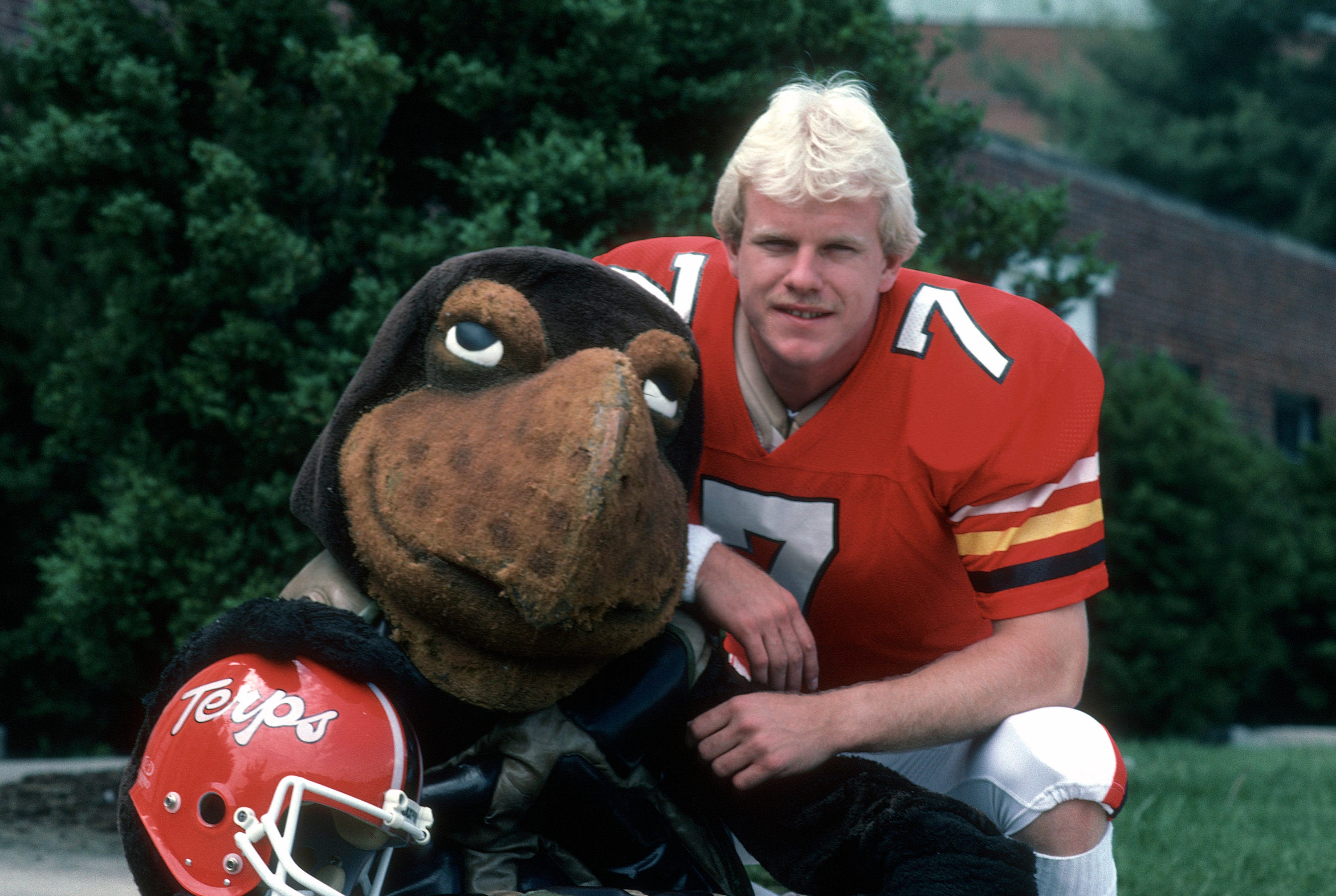
And of course, when it came to football, I was more a Bert Jones fan. I loved Bert Jones when he was with the Baltimore Colts. So I didn’t really have the Jet or the Giant thing going on at the time. But it was a great childhood. I had a great high school football coach who was like a second father to me and kept me in line, made sure I went to class, made sure I got good grades, and then really advocated for me to get a scholarship to the University of Maryland, which was really the only school that offered me a football scholarship at the time. I probably could have played baseball in a lot of different places. But I had already decided to take that college football scholarship to Maryland. Then when I got there, I found out that I was like the 11th string quarterback in 1980. It was a wake-up call to say the least.
They have those? They have 11th string quarterbacks? How do you find that out and what’s going through your mind?
Esiason: There were 110 guys on the team. It was crazy. I remember I got a scholarship and I looked at the depth chart because every practice they would put the depth chart up and my name would be penciled in at the bottom. For the first year that I was there, all I did was play JV. They actually had a JV football team. They couldn’t redshirt freshmen back in 1980. So I had to play JV and I played quarterback. I was the punter. I was the kicker. I was the safety. They had me playing all over the place. Then the next year I was redshirted and then the next year I was third-string starting the season and both quarterbacks got hurt in the first game. Then I started the next game and never looked back.
Holy cow. What do you think these programs were missing? They were your only offer. You were a three-sport star in high school, so you had the numbers. It’s high-level competition. It’s not like you’re in Middle of Nowhere Dakota. Is it the fact that you threw left-handed? How did you slip through the cracks?
Esiason: You know what? It’s not what it was in the 70s when I was coming out of high school. The recruiting process wasn’t anything like it is today. It didn’t come until, I would say at least 20 years after I had graduated high school in ’79, maybe mid-90s, when all of a sudden MaxPreps and all of these services were born and they were following high school kids and they were rating kids. That stuff wasn’t going on when I was coming out of high school.
So I was lucky enough to actually be playing in a high school basketball game against a highly recruited football player who was playing basketball for his high school. And I matched up on him 1 on 1 and he was a great running back and a great safety in high school. I was just a quarterback in high school. When we were on the basketball court that night, I outplayed him. I scored like 30 points. We beat their team in their building. Lo and behold, the running back coach for the University of Maryland, his name was Tom Groom. Tom Groom was at that game recruiting that player. After the game, my basketball coach came up to me and said, “The Maryland coaches are here. They want to talk to you.” I’m thinking Lefty Driesell, I’m thinking the coach of the Maryland basketball team. That’s how out of it I was. I didn’t even think about football recruiting at that point.
And he said, “I didn’t realize you were the athlete that you are. What I just saw on this basketball court tonight, I’d love for you to visit Maryland and I think maybe we would have a scholarship for you.” So sure enough, about three weeks, four weeks later, I took a trip down there by myself on Eastern Airlines out of LaGuardia. I’d never been on a plane before. I signed a letter of intent on the Sunday that I’m coming back. My father picks me up at the airport and he says, “What happened?” I said, “I don’t know. I think I signed a letter of intent or something.” My Dad wasn’t even with me. I was by myself. Sure enough, we got home. There were no cell phones, obviously. My high school coach calls my dad and he says, “Your son just got a scholarship to the University of Maryland to play football.” That was a great day, but the ensuing next two years was hell on earth for me because it was not easy to crack that starting lineup for sure.
That basketball game, do you have memories of that game? Were there specific plays that you think jumped out to them?
Esiason: I do. They were the No. 1 school in our county on Long Island, so they were West Islip High School. It was Suffolk County and we were East Islip and we were not even ranked. We were like a .500 team. They were undefeated at the time and we were playing in their gym and the gym was sold out. It was packed. It was a big rivalry game between the two high schools. I knew who the player was because I played football against him as well. I knew that he was highly recruited by Penn State, Pittsburgh, North Carolina, Virginia, Maryland, Syracuse, Boston College. Everybody was after him. And he was a great player. So we played, and I knew I had to play well to stop him if we had a chance to win. The fact that we did win, the fact that it was probably the greatest basketball game I had ever played, and the fact that I played against him on defense and held him to a relatively low-scoring game came at the right time.
It was the right time at the right moment. This coach happened to be there. Like I said, I walked out and I thought it was the basketball coaches. And then I saw that it was the running back coach for Maryland, and he was like, “We really want you to come and visit Maryland.” I said, “All right, I’ll do that.” So long story short, it turns out that that player that they were recruiting from West Islip ends up committing to Maryland as I do, and we become roommates that first year at the University of Maryland. All because of that one basketball game.
What was his name?
Esiason: Bill McFadden. He actually started as a freshman. That’s how good he was. He was a starting freshman safety for our defense back then. Meanwhile, I was wallowing on the JV squad and then the next year I got redshirted.
Isn’t it unreal, Boomer? When you think about youth sports today, it’s such a racket. It’s year ‘round, 7 on 7 camps and AAU. Sport specific. And here you are playing all these different sports, you’re in a basketball game, and they just see the competitiveness. They see your heart, your desire, your athleticism. Whether it’s Josh Allen, Patrick Mahomes, they all say the same thing: Play multiple sports. It’s good for you. And that’s how you were discovered. I mean, if you’re not in that basketball game, does the world know who Boomer Esiason is?
Esiason: I know my coach was fighting for me. He probably could have got me a Division II (scholarship), some money to go somewhere and play football or baseball. I could have played baseball anywhere. But to get a full ride to a major school like Maryland back in the day was a big deal. It was a really big deal. But along the journey, there’s always going to be potholes, there are going to be speed bumps, there are going to be people that get in your way. There’s going to be a lot of people that say that you can’t do something. I still to this day feel that if somebody says you can’t do something, that gives me even more motivation to go out and do it. So that’s one of the reasons why I think I ended up lasting as long as I did at Maryland and why I lasted 14 years in the NFL. I did play for the Bengals, Cardinals, and Jets. I think Steve Young called that the Bermuda Triangle of the NFL. So somehow if you can get through 14 years of that, there’s got to be some perseverance within your character that makes you want to go through that and make you love it.
You ain’t kidding. And those two years, you described them as “hell.” You’re buried on the depth chart. You don’t know if you’re going to get your opportunity. Are those characteristics that were in your Dad — the sacrifices he made, World War II, everything that you detailed — I’ve got to think a lot of that DNA was inside of you and helped you kind of persevere through that stage.
Esiason: I would think so. He would never let me complain about anything. His ultimate sacrifice was being in a group of men that were fighting over in a foreign land, in the middle of the Ardennes Forest. Mortars flying over your heads. You’re sitting in a foxhole, things of that nature. When I juxtaposed that up to the way that I was growing up and what has happened to me since then, it’s not even remotely close. So I always use that as the backdrop of understanding what true sacrifice is all about and how he raised three children without any subsidies, without any help. There was no live-in nanny or any of that crap. Like I told you, we had one full bathroom in our house, two sisters and a brother who don’t get along when they want to use the bathroom. Obviously, you learn a lot about competition in those certain situations, too.
I always say this. He was the best mentor that I could have ever had and somebody that when I think of being a Dad, I always try to emulate. And my son will tell me today, he’ll say, “Dad, you were the greatest Dad.” I’ll say, ‘Well, because I had the greatest Dad and hopefully someday you’ll turn into the greatest Dad for your children,” which as I’m watching unfold in front of my eyes these days, I would say he’s well in the way of becoming that.
And that’s been so well-documented — your relationship with Gunnar. Age 2, you find out about the cystic fibrosis diagnosis. I don’t know how much people even really know about the disease before you guys bring it to the forefront and fight like hell to find a cure and help families in need. I can’t imagine how much money you’ve raised, how many lives you’ve helped, lives you’ve saved. You’ve been vocal on: I want my son to outlive me. And he’s still going strong. I can’t imagine how near and dear this is to your heart and it’s been a lifelong just passion of yours, hasn’t it? I don’t even know how you would describe it.
Esiason: Well, it’s been about 35 years now we’ve been fighting this. Interestingly enough, in 1989, I did not have kids and I was at the awards dinner to receive my NFL MVP. And that night there was a featured speaker and his name was Frank Deford, and Frank Deford was a well-known writer. He was on TV. He was on HBO Sports and did a lot of speaking. So that night, he happened to be up there speaking and he spoke how he lost his daughter Alex at the age of 8 to a disease called cystic fibrosis, which I had never heard of that night. There wasn’t a dry eye in the place, including me. I went up to him afterwards and I said, “Frank, I had no idea. I apologize. I have no idea that you went through this and if there’s something that I could do to help.” He goes, “Yeah, if you go back to Cincinnati and help raise money for CF and put a face on the Cincinnati Children’s Hospital, that would be great.” So I did that. And so from ‘89 to ‘91, I was the figurehead in Cincinnati to raise money for cystic fibrosis. My son is born in 1991 in Christ Hospital in Cincinnati. He doesn’t show any signs of CF. It’s a genetic disease, so they’re born with it. There are certain signs that do happen at birth that would give you the idea — or if you did any pre-genetic testing or any of that stuff, which was not in vogue back then like it is now, you would find out that this was going to be the case. So for about a year and a half, Gunnar had been suffering. We did have him tested for CF in 1992. That came back a false negative. And then, I didn’t play well in ‘91. I didn’t play well in ‘92. I actually got replaced in ‘92 by David Klingler who was drafted in the first round by the Bengals.
All this time, Gunnar’s going through all of these things. Luckily, we also had my daughter, Sydney, born late in ‘92. We probably wouldn’t have had her had we known about Gunnar’s diagnosis prior to her birth. So there was a silver lining of a misdiagnosis and that turned out to be Sydney, my daughter.
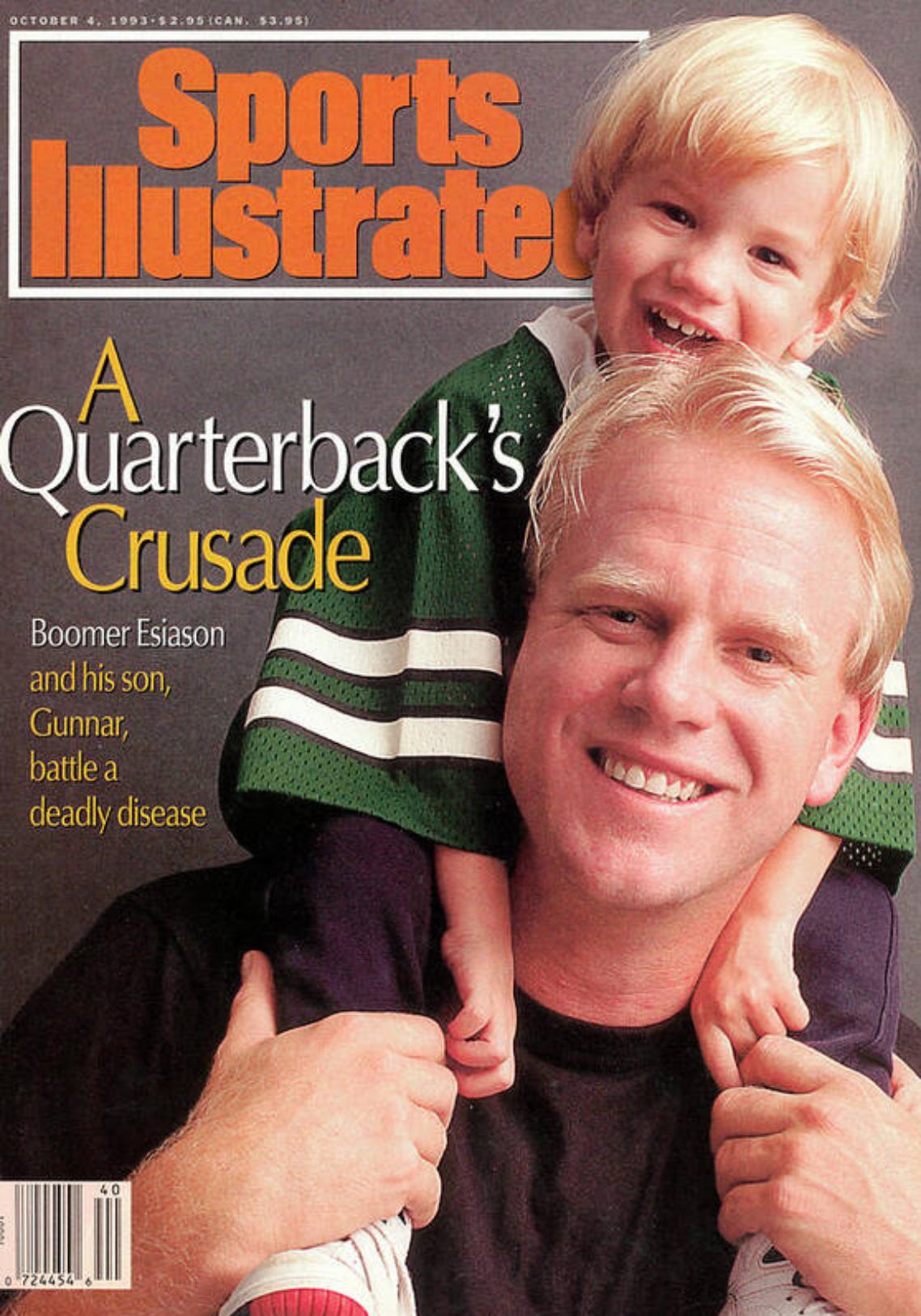
When Gunnar was diagnosed with CF, my first call immediately went to my Dad and my Dad being the way that he was back then said: “This is you, you can handle it. You’ve got big shoulders. You never blame anybody. You’ve got to look within yourself. You’ve got to lead. You’ve got to lead by example,” that kind of thing. Then the second call was to Frank Deford. There was a 30-second pregnant pause on the other end of the phone, and I could hear him crying. He’s going, “I can’t believe this, Boomer. I can’t believe your son — of all people that’ve been diagnosed with this disease. You have to take this public. We need somebody like you to put a face on this disease.” Then that October of ’93. Now, I’m the Jet quarterback. I find out in May ‘93 that Gunnar’s diagnosed. Sports Illustrated, when Sports Illustrated was still a thing, put me and Gunnar on the cover and they called it a “Quarterback’s Crusade” back in October of ‘93.
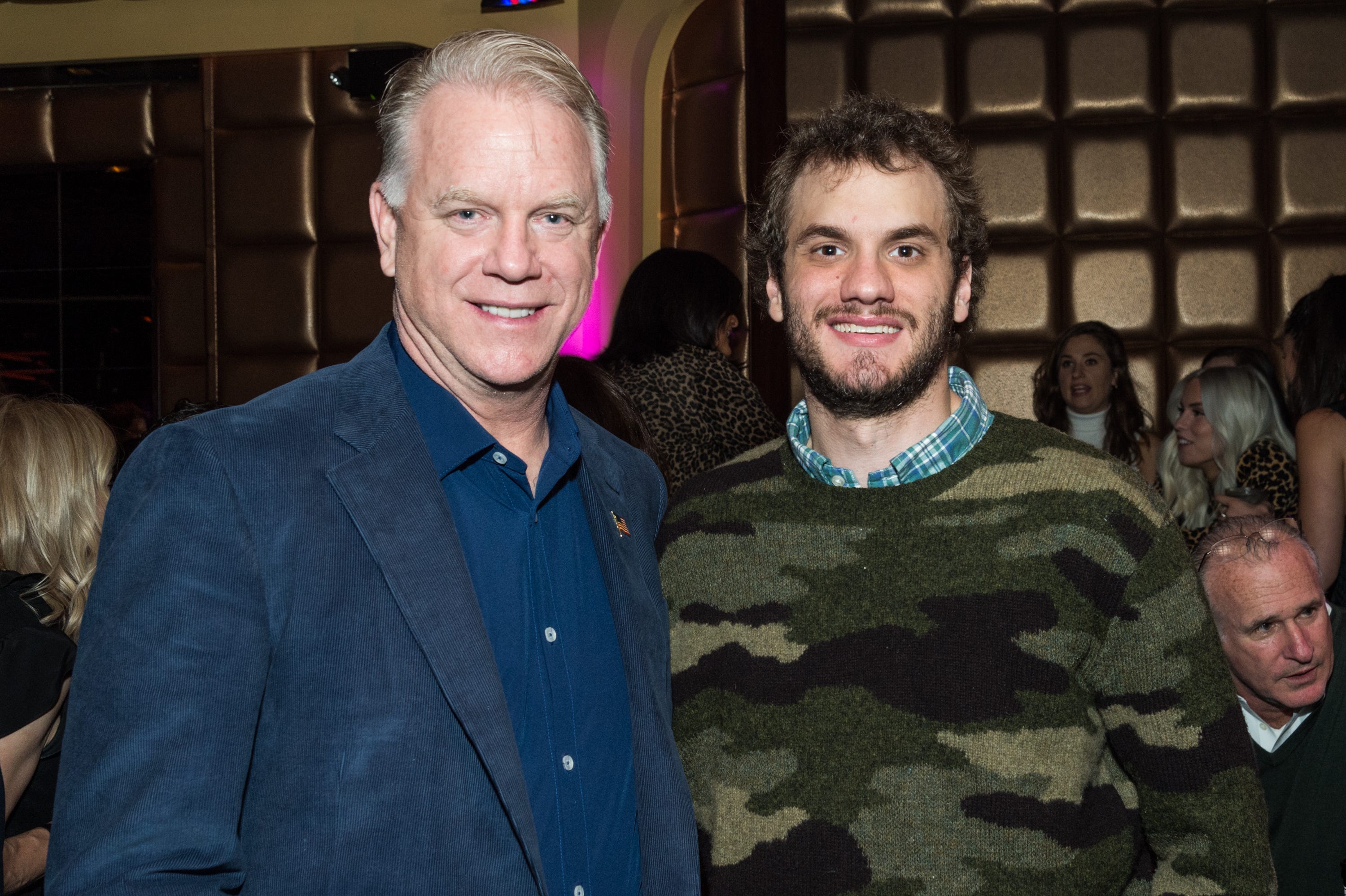
Here we are in November of 2026, and all I can tell you is we’ve been through so many ups and so many downs, so many hospital visits, so many doctors, so many needles, so many bacterial infections. Then in 2017 comes a major breakthrough and that unlocks Gunnar’s adult life because when he graduated from Boston College, he was in the midst of a very depressed state because he thought he was going to need a double lung transplant because of all the infections that he had been dealing with. And this new drug comes out. He’s on the test and it changes his life forever. He meets a girl. He gets married. He goes to Dartmouth to get his business degree at the Tuck School of Business. They get married and then they have two children via IVF and here we are.
He’s 35, I’m 65, and it’s nothing short of a miracle that we’re sitting here today talking about this.
I mean, shit, Boomer, we could talk about the fourth and 23 pass against the Bears and beating the Bills here in Western New York in the AFC Championship Game, winning MVP. That’s got to be what makes you feel good inside more than anything combined. That relationship with your son and having him to this day and seeing what he’s been through to get to that other side — how fulfilling is that for you both?
Esiason: Wow, it was amazing because they got married in June of 2021 on Father’s Day Weekend, of course. And the Thursday before that wedding, we’re up in the Berkshires where they got married and we were at my daughter-in-law’s family’s house for a small family dinner to get together in celebration, and they handed me my Father’s Day gift before the wedding, and it was a little Lucite frame and had a picture in it, and inside the picture was the sonogram of my grandson. That is the moment where I just lifted off the ground and couldn’t speak, and that’s when I felt like whatever I was setting out to accomplish now finally has been answered by the grace of God and by all the hard work and commitment and sacrifice by everybody that has supported the Cystic Fibrosis Foundation, my foundation, all the money we have invested in biotechnology.
So I felt really... I can’t explain it to you. I lost the ability to talk, to speak. I was crying. My daughter was crying. And then Gunnar says to me, he goes, “Dad, I just want you to know that I am the biological father.” I was like, “What?” Because one of the side effects of cystic fibrosis in men is most men are born infertile. They’re born without vas deferens, so they have a natural vasectomy. And in order to be the biological father, they have to go into his testicles and take the sperm out with a needle, and then they have to fertilize an egg that does not carry the CF gene, and then they have to implant the egg via IVF. That’s what he and my daughter-in-law were doing during COVID. And none of us knew. They didn’t tell us.
Wow, wow.
Esiason: I just lost it. That whole weekend. And then when they announced it at the wedding, it was just remarkable. The reaction of all the people at the wedding, there were about 250 people at this wedding, and it was under a tent, and you would’ve thought that tent was going to blow off. The genuine feeling of love and accomplishment that we all felt that night was nothing short of remarkable. It really was the greatest evening of my life. Actually the greatest day of my life is when they handed me that sonogram, but the greatest evening of my life is when I watched my son announce to the wedding and the wedding party that he and his wife were pregnant with their first child.
Could you have ever imagined that future when you’re on the cover of Sports Illustrated holding your son? It’s an iconic cover, and you have no clue what the next few years, few decades are going to look like.
Esiason: No clue, no clue. I often think — and Gunnar does this too — we both think about all the families that went before us, and I always think about Frank Deford. I always think about meeting him and the irony of that, the destiny of Gunnar’s diagnosis, and then ultimately the birth of two grandchildren. And what has come out of all of that, and this also makes me very proud, is that my daughter-in-law, Darcy and Gunnar come to me in late 2022, and they say, “Boomer, we think that we should have another foundation program and we should have it for IVF for other CF families because it’s a very, very expensive deal and we should, just like we would do scholarships or hardship grants, let’s do an IVF grant program.” I happen to be on a golf trip with a guy. I start talking to this guy, first time I meet him say, “What do you do?” He goes, “Well, I own a number of companies in private equity.” I said, “Well, what are some of the companies?” He said, “So I’m really more in biotech and family building.”
And I’m like, “OK, what is that?” He goes, “Well, I have an IVF company called Kindbody.” I’m like, “Really?” I said, “Well, my foundation’s trying to start an IVF program and we’re looking for a partner, not looking for you to sponsor anything, but somebody that we could run something through and see if we could set up the protocols.” He goes, “No problem. I’ll put you in touch with the CEO.” So I put my daughter-in-law in touch with the CEO, and we created this IVF program in 2023. It came online.
Here we are in the middle of 2026. We’ve already had 26 babies born to other CF families, including a set of twins, which is even more remarkable. So now we’ve gone from saving lives to help build families. And like I always say, Gunnar’s my hero. Casper is ultimately our miracle as Mieke is to my granddaughter, but look what they have created and look what we’re a part of, which is really ultimately the ultimate Super Bowl win, if you will.
Man, I think I speak for everybody watching, listening. Thank you to you Boomer, and Gunnar and Darcy and your entire family for this. I have a good amount of friends who have gone the IVF route, and it’s financially draining. It’s emotionally draining. I can’t imagine what those families, those couples go through. Twenty-six lives, unbelievable.
Esiason: Yeah, we’ve got seven more on the way. The thing is, when Gunnar and Darcy get the couples on a Zoom like we’re doing now through Riverside and tell them that they are the winner of a grant, that’s just the first part. That’s, “Okay, now we’re going to get you going, and now you got to follow all the protocols whether it be Boston IVF or Kindbody or whatever company that we’re going through.” And these couples are so committed. That’s why it’s been such a successful program. They know that they don’t have the ability to pay for these things, so we fully fund the IVF grant from start to finish. And like I said, the success rate now has been remarkable. Seven more babies on the way. So we’ll be up to 33 probably I would think by March or April of 2027.
Love it. I mean, it feels almost trivial to talk about football, but I told you we would talk about football a little bit. Your career, Boomer. Fourteen years, what are you most proud of? Like you said, these three franchises that have been meandering, lost in the wilderness in perpetuity, and you managed to have this remarkable career. What are you most proud of yourself as the quarterback of those teams?
Esiason: On the field would obviously be Super Bowl XXIII. Unfortunately, we lost a game at the end, but that whole year in 1988. I should start from the beginning. I was drafted in the second round. There was no first round quarterback in 1984. Those other guys all went in 1983: Marino, Elway, Kenny O’Brien and Todd Blackledge and Tony Eason, they all went the year before. Jim Kelly. Some of the guys went to the USFL. The USFL was a legitimate alternative for some. I did not want to go to the USFL and I made sure that the USFL knew this. I didn’t grow up rooting for the Memphis Showboats. You know what I mean? I grew up wanting to be Bert Jones in the NFL. And I would’ve played for the Baltimore Colts had they not moved.
The year before I got drafted, John Elway was taken No. 1 by the Baltimore Colts. He told them, “I’m not playing for you.” He told Mr. Irsay, “I’m not playing for you.” And I think he must have known that the Colts were going to move because they moved the year that I was drafted. And had they not moved and traded Elway the way that they did? Ernie Accorsi was their GM. He told me that he would’ve taken me in the first round to be the Baltimore Colts quarterback, which would’ve been a really cool thing for me going from Maryland to Baltimore. But once they moved to Indianapolis, I basically shut them down with a press conference said, “I’ll never play for the Colts,” because all my family and friends were big Colts fans back when I was playing in Maryland.
So I was like, “They just screwed over the city of Baltimore, so I don’t want to play for them.” So I got drafted in the second round by Sam Wyche of all people in Cincinnati. And so I go there, I got a chip on my shoulder. Luckily enough, I had the great Ken Anderson as the starting quarterback. I had Turk Schonert as the backup quarterback. Two great veterans that took me under their wings. Cris Collinsworth was there, Anthony Munoz was there, Max Montoya. We had a lot of great players. Isaac Curtis was there, Louis Breeden. So many good players in Cincinnati. So I was very fortunate ultimately to be drafted by them. And then when Sam finally handed the reins over to me, he let me run a no-huddle offense that nobody had ever done before. And the fact that we were able to do that and do that effectively for a good three years was amazing.
And it led us all the way up to the Super Bowl in ‘88. But before that, in 1987, I was the NFL player rep for the Bengals. I had just signed the biggest contract in NFL history, $1.2 million for a quarterback that August of ’87. Thinking that they could buy me from being the player rep for the team because they wouldn’t want me to go on strike. But it emboldened me and it made me want to fight for the players. So, we went on strike in ‘87. We had a great football team. I think we ended up 4-11 that year. Me and Sam were at each other’s throat. And then next year we came back, we all buried the hatchet and went from basically also-rans that nobody gave a shit about to going all the way to the Super Bowl. And I was fortunate enough to win that MVP you were talking about.
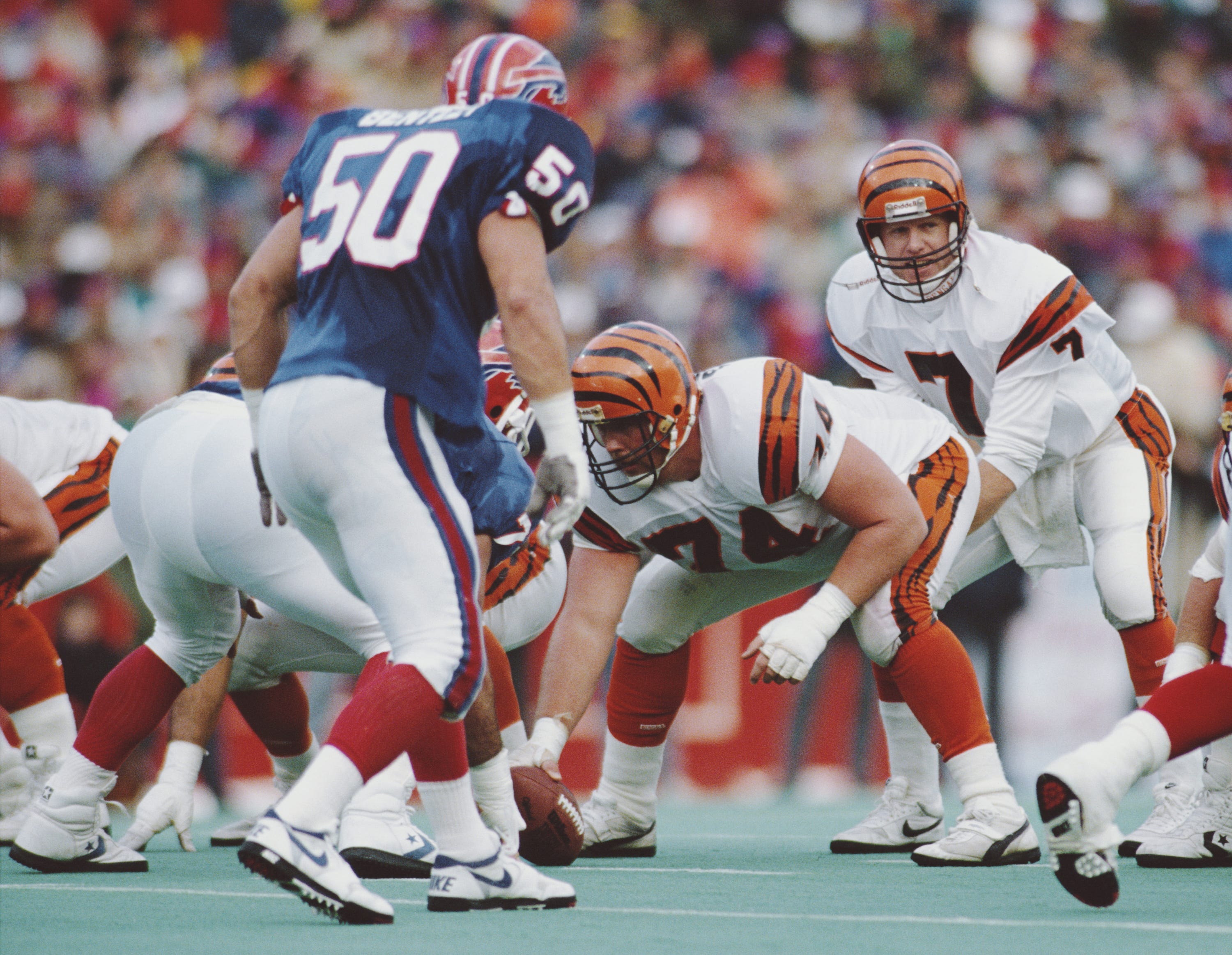
We just talked about it on one of our other shows. Bob McGinn, we have a podcast. He has covered the NFL forever, all these Super Bowls. Lewis Billups, if he catches that interception, it’s a different game. There are probably a few plays from that game that stick with you because you guys were so close. That was The Drive.
Esiason: We had a number of things that happened in that game. No. 1, the night before the game, we lost our best short-yardage runner, Stanley Wilson. He had a drug overdose that night and he had been suspended three times from the NFL for cocaine use. And the night before the Super Bowl, he misses a meeting. They find him in, I think, a bathtub in a hotel room and Sam Wyche made the decision that he’s not playing. And he was one of our most important ingredients — both on special teams and in short-yardage offense. He was virtually unstoppable as a short-yardage running back. And lo and behold, we have three or four fourth and 1’s or third and 2’s that we didn’t convert and we end up kicking field goals.
So we lost that player the night before. Then on, I think it was our first defensive series, we lose the heart and soul of our defense. One of our best defensive players, Tim Crumrie, snaps his leg trying to make a tackle because the field was horrendous. Because it had rained the night before and somebody left the drainage on and so it was coming up in clumps and Timmy Crumrie breaks his leg. And our defense played unbelievably that game against one of the best offenses the NFL had ever seen. And their opposing defense played great against us. So it was a very tight game all the way until the end. And there was a situation where we could have went for it on fourth down where we didn’t and we elected to kick a field goal and we left three minutes and 10 seconds on the clock or 3:30, something like that. And of course Joe Montana is going to take it 98 yards and he’s going to take his team in for a touchdown. They’re going to beat us with 30 seconds left to go in the game. But it’s one of those things. You lose the game, but you’re there and you’re a part of it. And up until that point, Super Bowls weren’t very competitive. And this was probably the first and most competitive game in the previous 10 years. So we gave everybody a great show. It was a very frustrating game for us offensively. But that to me is probably the best memory that I could take away from my career.
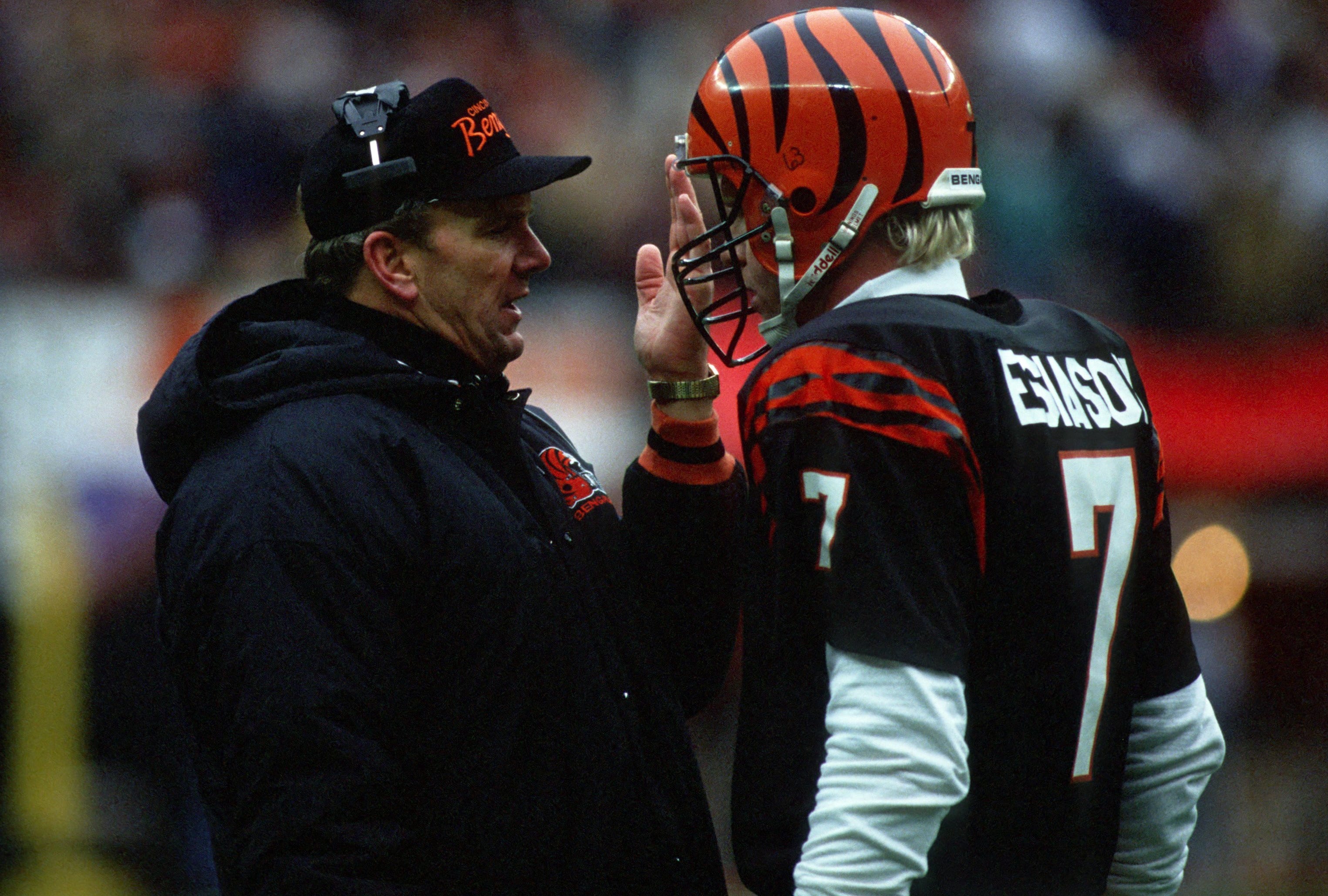
Here in Buffalo, obviously you hear all the legendary tales of the K-Gun and Jim Kelly and the up-tempo, but it started there with you guys, with Sam Wyche and Boomers Esiason. How did that come to be?
Esiason: Your guy, Marv Levy, before the AFC Championship game in ‘88 is basically complaining to Paul Tagliabue that we shouldn’t be allowed to run it. And Paul Tagliabue, I don’t know what he’s thinking about, calls Sam Wyche on a Monday of the week we’re getting ready to prepare to play the Bills: “You can’t run the no-huddle offense.” Wait a minute, we just went through an entire season, a playoff run going to the AFC Championship Game and Marv Levy is trying to convince you that we can’t run the no-huddle offense? And this became a whole thing. And Marv won just by it becoming a thing. We ended up being able to run the offense the way that we ran it, but we had to deal with all this nonsense like on Tuesday, Wednesday and Thursday and all the media hype around it and everything else.
And then lo and behold, of course my college roommate is Frank Reich. He’s the back-up to Jim Kelly. They’re all laughing at us. And so we got the last laugh. We beat them in that game. It was a tight game and it was a different game than when we played them earlier in the season when we beat ‘em pretty good. But I could tell that that team was building. You could tell that they had special players there. And I knew a lot of those players because of my relationship with Frank. And that’s one of the great teams that Marv Levy assembled there, going to four Super Bowls the way that they did and unfortunately not winning one. I just remember the battles with the Bills and every year it seemed like Bruce Smith would miss the game before the game that I would end up playing him next week.
He was out with a hamstring injury or a pulled groin or something. And then the next week, of course, we’re playing them, whether I was with the Bengals or the Jets, and that guy was always healthy when he would play against us for some reason. I don’t think he liked me very much, but yeah, he was the pain in the neck to say the least.
Well, shit, was it later in your career? I think it was a false start, but they blew the whistle late and that was when you had the concussion when Bruce Smith hit you? Sorry to bring that memory up, Boomer.
Esiason: That was ‘95. And our head coach at the time, my third head coach as the Jet quarterback was Rich Kotite. This was a remedial reading class offense. I’ve come from a PhD offense and now I’m running this dyslexic, backward, nobody really knows what’s going on. And I’m the oldest guy on the team and I’m having trouble with it. And I remember walking into his room one day and I’m like, “Hey, if I’m having trouble, the rest of the men around here have no idea what they’re doing.” So of course, going into that game in Buffalo, Richie Kotite decides to bench our starting left tackle. His name was Matt Willig. And Matt was a young kid out of USC, big. And he was good, but he was a little bit slow, but he was a left tackle. That was his position. So he could play and we could help him with different chipping and sliding the line to him so he could overplay a little bit and we could do all that.
So going into this Buffalo game, they decide to make a change. They’re going to bench our left tackle and they’re going to take a converted defensive tackle by the name of Everett McIver and start him at left tackle on the road in Buffalo in front of 80,000 fans with Bruce Smith standing out there. And I go in on Wednesday, I go, “Are you guys kidding me? Are you out of your minds?” And the funniest thing is I don’t really remember the play. I’ve seen it a thousand times. The business manager, Mike Kensil for the Jets, I had a pregame meal with him. He was sitting at the table with me and a couple of other guys. And he says that I had said to him that morning, “Tell my wife and kids that I love them because I don’t think I’m getting out of this game.” And sure enough, yes, a minute false start by Everett McIver. And obviously Bruce is a seasoned veteran. He knows when to go. The whistle supposedly blew, but nobody heard it because it was so loud and he wasn’t going to let up. He just ran right through me and caught me right under the chin as I was looking down the field. He got back there so fast, there was no way that I could even react. I didn’t even think that he was even back there. I didn’t see him! Sure enough, he knocks me out. I missed the next four games. And oddly enough, the game I come back to play and it’s against the freaking Bills. And Bruce Smith is out there again, but now we got a legitimate offensive tackle that at least can get in his way.
Did you black out? What was that concussion like for you?
Esiason: I was out. I was out for about 2 1/2, three minutes. I think I was the first NFL player that was actually placed in what we now know as concussion protocol. And that was back in 1995. And I can remember missing the next four games. And I think that fifth game that I was scheduled to come back against was at the Meadowlands against the Bills. And in that game, I think I hit a Hail Mary, but we failed on the two-point play to tie the game.
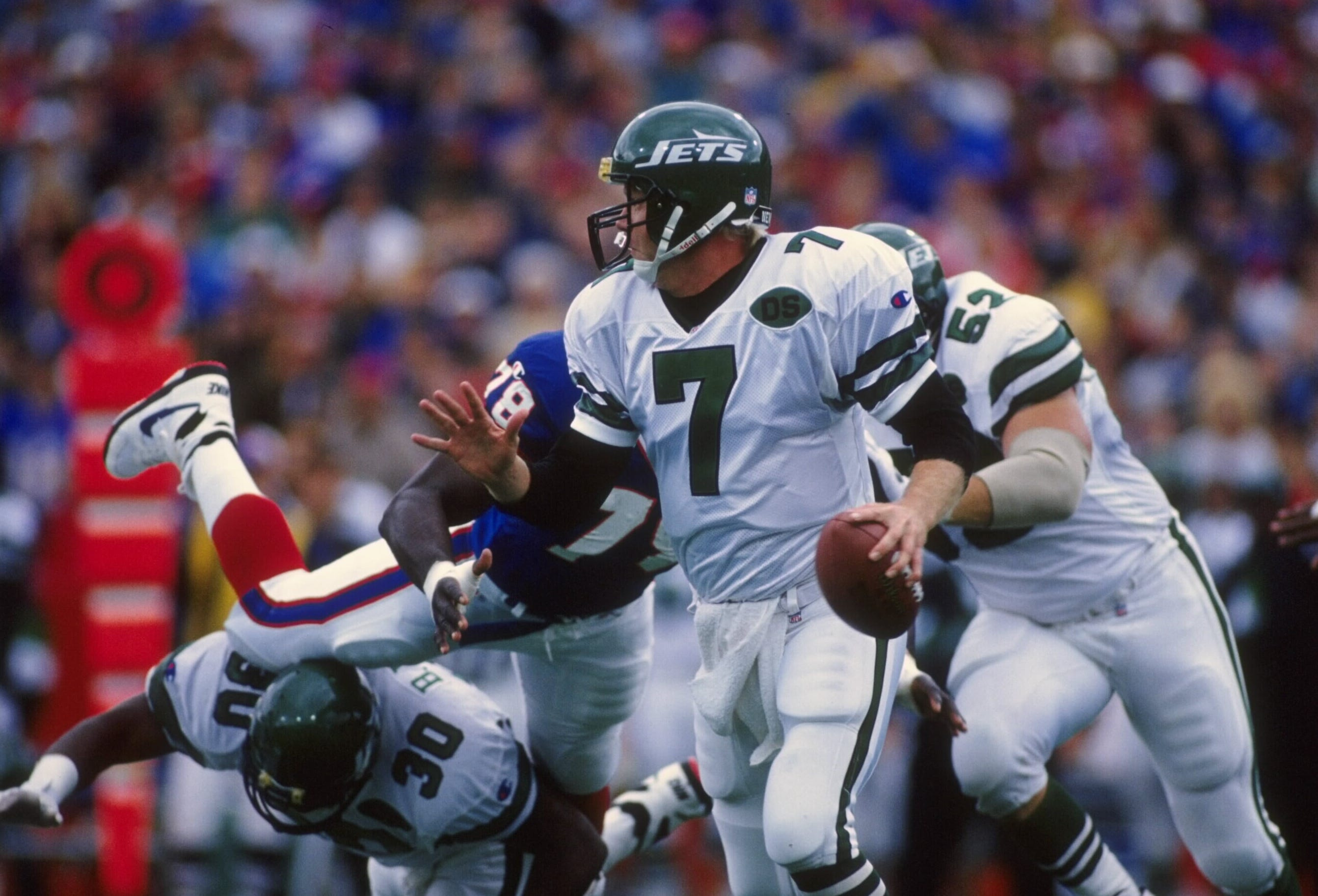
You were balling out to the very end of your career though. At age 35, in ‘96, you’re with the Cardinals and you threw for 522 yards in a game. And then at age 36 the next year, you go back to Cincinnati, you replace Jeff Blake, you’re 4-1 throwing 13 touchdowns with only two picks. Right to the very end, you were playing really, really well. It couldn’t have been easy to retire.
Esiason: They offered me a two-year contract to stay after that finish because it was really... and they were building a team. Cincinnati had a really good team. Jeff didn’t play well that year. I just brought a spark to it. We had a young running back by the name of Corey Dillon and he was a rookie and he finally started and we had Ki-Jana Carter was on that team. We had Darnay Scott at wide receiver. Carl Pickens as a wide receiver. We had a great offensive line. They just needed some cohesion. They needed somebody that really understood the offense and was going to spread the ball around so everybody had a little bit of the wealth and skin in the game. And that’s what I was able to do at the end with Cincinnati. So they did offer me a two-year contract to continue.
But ABC came knocking with a 4-year deal to do Monday Night Football. And you’ve got to remember, I’m still in the middle of trying to raise money for cystic fibrosis at this time. Gunnar’s still very much, everybody’s aware of who he is. He’s coming to the games. He knows what I’m doing. He’s about 5 or 6 years old at this point. He was 2 when he was diagnosed in ‘93 when I was with the Jets. So the story had really started to grow over the years and I needed a platform to continue to be able to raise as much money as we could. And I really felt like Monday Night Football was going to give me that more so than the NFL at that point in my career. If I were 34, I would’ve accepted it, but at 36, 37, I decided that’s enough. I’ll take the four years and I’ll go in to broadcasting. And I don’t regret that decision at all because I felt like at the end it might’ve been a little bit of hocus pocus. Simply because I was so far ahead of everybody mentally on the field that I could get away with a lot of things. I didn’t know if I could do that for another 34 games against some great defenses.
Matter of fact, the last defense we played against was the Ravens and they had a middle linebacker who was like a heat-seeking missile. His name was Ray Lewis. And I swear to you right now, Tyler, God strike me dead. I have never seen a football player on the field of play with the amount of anger, suddenness and violence that that kid played with at that time: Ray Lewis. And that’s when I said, “You know what? I don’t think I want to be out here anymore. This guy’s really dangerous. The rest of the guys that are following him now in this new era of football are coming along? I’m not going to last very long.” So I think I made the right decision.
I’m thinking of the Game Boy game, “NFL Quarterback Club” and the quarterbacks that were used to promote that, you’re there, Troy Aikman, Steve Young, Jim Kelly, these quarterbacks, their careers ended with one of those singular hits that you’re talking about. We could picture Aeneas Williams/Steve Young, LaVar Arrington/Troy Aikman, Jim Kelly in that Jacksonville wild card game. It looked like he didn’t know where he was. So that’s the sunny side up. Yeah, maybe you could have extended the career and squeezed out some more seasons, but you avoided one of those kill shots, which I’m sure you’re well aware of.
Esiason: Well, I did have one in ’95, but I rebounded from that. And I had a few others during my career and I don’t blame anybody. I’ve always thought that playing in the NFL was my choice. I knew what the risks were. I knew what the benefits were. And the benefits far outweighed the risks as far as I was concerned, even at the age of 65 that I am now. And I feel it here and there, but I never had any major surgeries. I had probably about five concussions playing, but I don’t regret any of it. I don’t blame anybody for anything that I may be dealing with. As a matter of fact, I’m pretty proud of accomplishing 14 years in the NFL and going through as many different scenarios as I did and making it out what I consider alive and well and a flourishing broadcasting career. I think I did the right thing.
Legacy-wise, you watched the game last night, Washington-Cincinnati and how Jayden Daniels just goes right down the field. Every time you see a no-huddle offense, you probably think, “Hey, we started this thing once upon...” It had to have been weird when you guys are doing the hurry-up for the first time because nobody else was.
Esiason: Well, these are 2-minute offenses, so everybody had those. Warren Moon was very good at it. Marino was good at it. Elway was great at it. Jim Kelly was great at it. Bernie Kosar was good at it. All the guys that were in the quarterback club back then that started the quarterback club that came out of that strike of ‘87, all were really good at the 2-minute end of half, end of game situation. We were taking it and doing it in the body of the game. And it really wasn’t a 2-minute offense. We were running our full offense. I had every call, every code word. Nowadays, the play calls are like 30 words long. Our play calls back in the day were formation, personnel group, call a play and maybe check in or out of the play. And we were able to run our entire offense based on code words.
I could run a play 15 different ways with 15 different code words and everybody on our team would know what those were, including snap count, including formations, including personnel groups. So we took it to the nth degree and Sam always loved having our, what we called “regular” personnel on the field, which would be two wide receivers, two backs and a tight end. We felt like we could beat anybody against their base defense and we didn’t want to get into all the spread stuff and all this other crap. So that’s one of the reasons why we did it. And when people tried to adjust to it? One of the funnier situations was a playoff game against Seattle when the nose tackle Joe Nash, after every second down, if we didn’t convert a first down and was going to be third and medium or longer, he would end up on his back and act like he was hurt.
So he would stop the game. And I think he did that about five or six times in our playoff game. It was crazy. So other teams tried to defend it and then Marv Levy brought it to the forefront of the commissioner before the championship game and made a whole big deal out of it.
I never knew that. He’s calling the commish and the commish is listening and then pressing the issue with you guys.
Esiason: And then like I always say, what is the purest form of flattery is invitation, right? So of course the Bills go to the K-Gun and they start doing their no-huddle stuff and they love their three wide receiver, Thurman Thomas and I forget who their tight end was. So it was a three wide receiver personnel group with one back and one tight end and they would just run... I don’t know how many plays they had, but it seems like they only had about 10 plays. And I used to make fun of Jim all the time saying, “You guys only ran 10 plays. I ran like 100 plays out of our playbook from our no-huddle offense.”
In what ways has football has changed for better? In what ways has it changed for the worst these last 20, 30 years?
Esiason: It has dramatically changed and it’s really helped the offense. I think the defensive players really have a hard time playing defense in this league nowadays. Even the great defenses still have a hard time because of the penalties and the illegal contact, the defensive holding, the PI, the roughing the passer. Those things were called, but they weren’t called with the regularity that they’re called in today’s game. So I would say that all of us from my era would love to have five or six extra first downs a game because that’s what it feels like. A lot of these first downs come with penalties in the end zone and the ball’s placed on the 1-yard line. How could you not score? I’m glad we didn’t have the tush push when I played. I would not want to be in the middle of that thing.
But the game is more open. It’s more offensive-minded. The wide receivers are incredible athletes. It’s fun watching them play. The tight ends are incredible athletes. When you see the top offenses like San Francisco or the Rams or when the Packers are flying higher, the Bengals are flying high. There’s nothing more enjoyable from a fan’s perspective. So I think what you’re seeing now over the last 25 years is more offensive-related and I think it’s more quarterback-driven than ever before. And it’s one of the reasons why I think we all love it so much because it’s so entertaining each and every week. And every team has their drama and now because of social media, it’s all amplified. Back in my day, there was no amplification other than the local newspaper or maybe the sports talk radio show, but now everybody’s got an opinion. Everybody’s got a fanbase with five or six different podcasts that people can check in on and listen to the fans talk about their teams. We didn’t have that kind of stuff. So I think the NFL is in a great place. I think it’s in a really financially healthy place and hopefully it’s only going to get better and more enjoyable as we move on.
Which quarterback do you really enjoy watching? If you have the chance to watch anybody on an NFL Sunday, who are you isolating on?
Esiason: Well, there’s probably about five or six, honestly. When you talk about Josh Allen and Patrick Mahomes and Joe Burrow, those guys are incredible. The younger group of guys, I love Brock Purdy. I love the way he plays. I love the way that Kyle Shanahan draws up plays for him. Caleb Williams is on that track. He’s such an exciting player now. But then there are guys like Jared Goff who’s had a tremendous career. People don’t realize how good his career has been, and he’s been lucky. He’s had some really good coaches. Sean McVay, his coach that got him to the Super Bowl, and now he’s got Dan Campbell. He had Ben Johnson as an offensive coordinator. So those are the quarterbacks that I really look forward to seeing.
The other guy too that when he is playing well, he looks like he’s unstoppable. Jordan Love from the Green Bay Packers. If they only had a running game, if they only had a run game. But yeah, a lot of great quarterbacks to watch now and there’s more in the pipeline coming every single year out of college, and I think the game is in a really healthy place.
Links from OLD SCHOOL WEEK at Go Long, icymi: